

Arthritis Aids Around the Home: What Actually Helps
By Mobile Occupational Therapist • 22 September 2026 • 13 min read
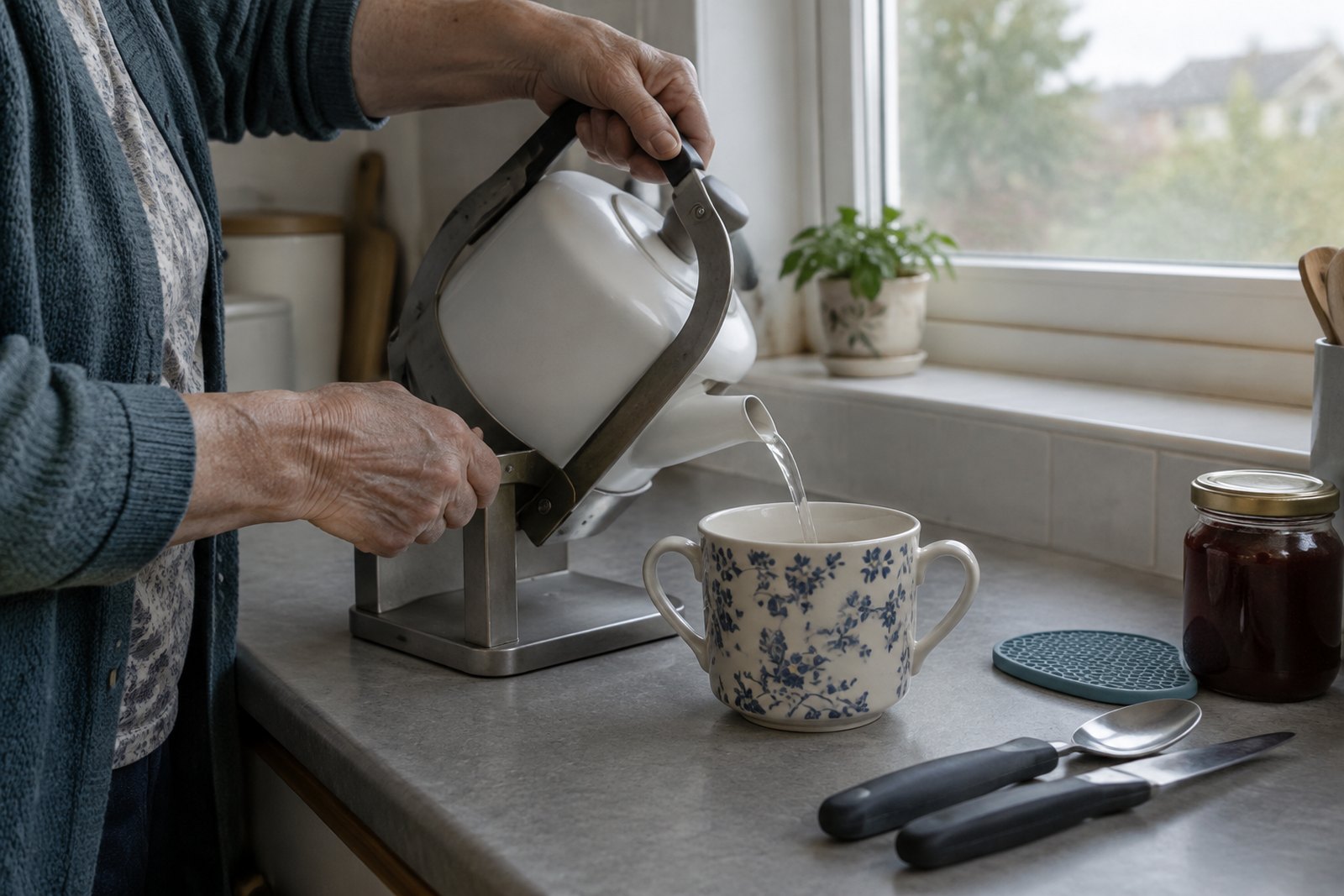
If arthritis is making everyday jobs hard, the aids that genuinely help are usually small, cheap and a bit boring: a kettle tipper, a decent jar opener, cutlery with fatter handles, a long-handled sponge, a raised toilet seat, elastic laces. They work because they cut down the gripping, twisting, bending and lifting that sore joints hate. The aids that cause trouble tend to be the bigger, more expensive ones, bought in a hurry without anyone checking they fit the person or the house.
This guide goes room by room through the kitchen, bathroom, dressing, getting about and hobbies, with links to more detailed guides on each. It also covers the joint protection ideas behind the equipment, what not to buy without advice, how to get some equipment free or without paying VAT, and when an occupational therapist is worth involving. Most people do not need a house full of gadgets. They need the right three or four.
Start with the idea, not the gadget
Every useful arthritis aid does one of a handful of things. Once you know what they are, you can spot the good ones in a catalogue and ignore the rest.
- A bigger grip. Thicker handles spread the pressure across your whole hand instead of pinching with your fingertips. Foam tubing slipped over cutlery, pens and toothbrushes does the same job for very little money.
- A longer lever. A longer handle means less force. Tap turners, key turners and lever-style openers all work this way.
- Bigger, stronger joints doing the work. Carry a bag over your forearm or shoulder rather than hooked on your fingers. Push a door with your palm or hip. Slide a pan along the worktop rather than lifting it.
- Less reaching and bending. Long handles, raised seats and keeping everyday things between waist and shoulder height save knees, hips, back and shoulders.
- Less effort overall. Sitting down for jobs, spreading heavy tasks across the day and stopping before you are wiped out.
These are the basics of joint protection, and they matter more than any single product. Our guide to arthritis and your hands: joint protection every day goes through them properly, including how to notice which movements set your hands off. If a piece of equipment does not do one of the things above, it is fair to ask what it is actually for.
In the kitchen
The kitchen is where hands take the most punishment: lids, taps, heavy pans, full kettles, tins, chopping. It is also where small aids pay back fastest.
Kettles, jars and tins
A full kettle is one of the heaviest things most people lift one-handed at an awkward angle, several times a day. A kettle tipper is a frame that holds the kettle so you tilt it forward to pour instead of lifting it. Filling the kettle with a small jug, or only boiling what you need, helps too. Jar openers range from simple rubber grip pads to wedge-shaped openers fixed under a shelf, which hold the lid still while you turn the jar with both hands. Ring-pull openers and easy-action tin openers save a lot of pinching. See kettle tippers and jar openers: who they help and how to choose.
Eating and drinking
Cutlery with thick, light handles is often the first thing people with hand arthritis notice making a real difference. Some have angled or bendable handles for wrists that do not turn well. Mugs with two handles or a large loop handle let you hold with your whole hand rather than one finger. A non-slip mat under the plate stops it skating away while you cut. Our guide to adapted cutlery, plate guards and drinking aids explains which type suits which problem.
Preparing food
A chopping board with spikes and a raised corner holds food still so you do not have to grip it. Knives with the handle set at right angles to the blade keep your wrist straighter while you cut. A perching stool lets you sit at the worktop. A kitchen trolley carries things from fridge to worktop to table without you carrying anything. Lighter pans with a second helper handle, and a basket inside the pan so you lift the food out rather than tipping boiling water, take a lot of strain off wrists. Plenty more ideas are in kitchen aids and meal-time independence.
Free changes count as much as equipment. Move the things you use every day to the front of the cupboards at waist height. Buy smaller bags and cartons. Use a food processor for grating and slicing. Batch cook on good days so bad days are covered.
In the bathroom
Bathrooms combine hard, wet surfaces with the movements arthritis makes hardest: lowering yourself down, standing back up, stepping over things and reaching your feet. This is the room where getting it wrong carries the most risk, so it is worth a little more thought.
Bath and shower
Options run from a non-slip mat and a well-placed grab rail, through bath boards and shower stools, to bath lifts and level-access showers. Which suits you depends on whether you can lift your legs over the side of the bath, how good your balance is, and how long you can stand. Our guide to bath and shower aids for older adults covers each option honestly. One firm rule: do not push up on towel rails, soap dishes, shower doors or the edge of the basin. They are not built to take your weight.
The toilet
Standard toilets are low, which is hard on stiff hips and knees. A raised toilet seat, a toilet frame or a rail fixed to the wall can make sitting and standing much easier. Height matters more than people expect. Too high and your feet do not sit flat on the floor; too low and it barely helps. See toilet aids: raised seats, frames and rails.
Washing and grooming
Long-handled sponges and toe washers save bending down to your feet. Lever tap turners help with stiff old cross-head taps. Pump dispensers instead of squeeze bottles, a toothbrush and hairbrush with thicker handles, and an electric toothbrush all reduce the work your fingers do. See washing aids: long-handled sponges, toe washers and tap turners.
Getting dressed
Dressing often collides with morning stiffness, which is unfortunate timing. A few things help before you buy anything. Dress sitting down on a firm chair or the edge of the bed. If you can, have a warm shower or move about first and dress a little later. Lay the next day's clothes out the night before at a height you can reach.
The aids that tend to earn their place are a sock aid (a flexible gutter you load the sock onto and pull up with cords), a long-handled shoehorn, elastic or curly laces that turn lace-ups into slip-ons, and a dressing stick for pushing clothes off or hooking them back. Our guide to dressing aids and easier ways to get dressed covers the full range.
Small fastenings are often the real problem for hands. A button hook pulls buttons through without fiddling, and a zip puller or a loop of ribbon on the zip tag gives you something to hook a finger through. See button hooks, zip pullers and easier fastenings. Swapping to front-fastening bras, looser necklines, stretchy fabrics and supportive shoes with touch-fastening straps can remove the problem altogether.
Getting about the house
When hips, knees or feet are affected, a walking aid can take some weight off and make you steadier. The catch with arthritis is that your hands then take that weight instead. A stick with a shaped palm-grip handle spreads the load better than a thin crook handle. A wheeled walker or rollator may suit you better than a stick if your wrists hurt. Height and type need checking, and a physiotherapist or occupational therapist can do that. Our guide to mobility aids for older people explains the options and how to get one.
Around the house, a reaching aid saves bending for dropped post, a second stair rail gives you something to hold on both sides, and raising a low chair to the right height can turn getting up from a struggle into one movement. Lever door handles, key turners and large light switches help hands that cannot grip and twist.
Hobbies and the things you enjoy
Arthritis often takes hobbies first. When hands are sore, people sensibly save their energy for washing, cooking and dressing, and the things that made the day worth having quietly drop away. They do not have to.
Playing card holders, book stands, embroidery frames that clamp to a table, thicker knitting needles and crochet hooks, and garden tools with long or padded handles all exist precisely so you can keep doing what you enjoy. See playing card holders and aids for hobbies you thought you had lost. Pacing matters here too: twenty minutes of something you love, then a change of position, is better than an afternoon you pay for all week.
What not to buy without advice
Small hand aids are low risk. If a jar opener does not suit you, you have lost a few pounds. The items below are different, because the wrong one can be unsafe, expensive, or simply never used.
- Bath lifts, walk-in baths and level-access showers. These depend on your bathroom, your movement and how your arthritis is likely to change. A council assessment may also open the door to help with costs.
- Stairlifts and other big adaptations. There may be simpler options, and grants usually depend on an assessment before work starts.
- Riser recliner chairs. Seat height, depth and width need to match your body. A badly sized one can make getting up harder, not easier.
- Raised toilet seats and furniture raisers. Height has to be right and the fitting has to be secure.
- Walking aids. The wrong height or type can push pain into your hands, shoulders or back, or make you less steady.
- Wrist and hand splints. Some help, but an ill-fitting one can rub, press on nerves or stiffen joints. Ask your GP, rheumatology team, physiotherapist or a hand therapist which type, if any, suits you and when to wear it.
- Anything sold on the doorstep or under time pressure. Good equipment does not need a deadline.
Getting equipment free or without VAT
Before you buy, it is worth knowing that a lot of everyday equipment can be borrowed. Councils run community equipment services, and you can ask your council's adult social care team for a needs assessment. In England, equipment the council arranges after an assessment is generally provided free, often on loan, though how quickly and what is offered varies by area. Our guide to community equipment services explains how it works, and GOV.UK has a tool to find your council.
If you do buy, you may not have to pay VAT. People with a long-term illness or disability, which can include arthritis that affects daily life, can often buy equipment designed for disabled people without VAT. You usually sign a simple declaration with the seller. Not everything qualifies, so check the current rules on GOV.UK or read our guide to VAT relief on disability equipment. For larger adaptations such as a level-access shower, ask your council about a Disabled Facilities Grant (in Scotland, ask your council about help with adaptations, as the system is different).
Where an occupational therapist fits
An occupational therapist looks at the things you need and want to do, watches how arthritis gets in the way, and works out what would make them easier. That might be a change in how you do a task, a piece of equipment, a rearranged kitchen, pacing your week, or an adaptation to the house. They check heights and fit in your own home, and they can write reports that support grant or benefit applications. You can read more on our arthritis page.
You can reach NHS or council occupational therapy through your GP, your rheumatology team or a council needs assessment. Waits vary. A private occupational therapist visiting at home is another route if you would rather not wait or want a fuller look at the whole house.
Other professionals lead on other parts of arthritis care:
- Your GP for diagnosis, flare-ups, pain relief and medicines, and referral to rheumatology.
- A rheumatology team for inflammatory arthritis such as rheumatoid or psoriatic arthritis, where early treatment matters.
- A physiotherapist for exercise, strength, joint movement and walking aids.
- A podiatrist for foot pain, footwear and insoles.
- A hand therapist (an occupational therapist or physiotherapist with specialist training) for splinting and rehabilitation after hand surgery.
See your GP if you have new joint swelling, stiffness that lasts a long time each morning, or symptoms that are getting worse. If a single joint suddenly becomes hot, red, swollen and very painful, especially if you feel feverish or unwell, call NHS 111 or get urgent medical help the same day.
Frequently asked questions
What are the best aids for arthritis in the hands?
The ones that reduce tight gripping and twisting: thick-handled cutlery and pens, a good jar opener, a kettle tipper, lever tap turners, key turners, button hooks and elastic laces. Which matter most depends on which jobs hurt you, so start with the two or three tasks you struggle with most.
Can I get arthritis aids free on the NHS?
Equipment for daily living is usually arranged through your council's adult social care team rather than the NHS, after a needs assessment, and is generally free in England. Some NHS teams, such as rheumatology or occupational therapy, may supply or recommend items. Small, cheap gadgets you may be expected to buy yourself.
Do I have to pay VAT on arthritis aids?
Often not. If you have a long-term condition that affects daily life, equipment designed for disabled people may be VAT-free when you sign an eligibility declaration. Rules on which items qualify are on GOV.UK.
Should I wear a wrist or hand splint?
Sometimes a splint helps, for example to rest a painful joint or support the wrist during certain tasks. The wrong one can cause problems, so ask your GP, rheumatology team, physiotherapist or a hand therapist before buying one off the shelf.
Will using aids make my joints weaker?
Not if you stay active in other ways. Aids take the strain off tasks that hurt so you can keep doing them, and keeping moving and following any exercises from your physiotherapist keeps joints working. The aim is less pain and more energy, not doing nothing.
Do I need an occupational therapist before buying equipment?
For small hand gadgets, no. For anything you sit on, stand on, lift yourself with or have fitted to the house, an assessment is wise and can save money, especially if you might qualify for free equipment or a grant.
Next steps
If you would like someone to look at how you manage at home and which aids would genuinely help, see our equipment and aids page or home assessment page, check current guide prices, and choose your area below.

Talk to an occupational therapist near you
This guide is general information. For advice about your own situation - or someone you look after - a local occupational therapist can visit you at home and see it for themselves.
Choose your area: