

Playing Card Holders and Hobby Aids: Keep Doing What You Love
By Mobile Occupational Therapist • 30 October 2026 • 13 min read
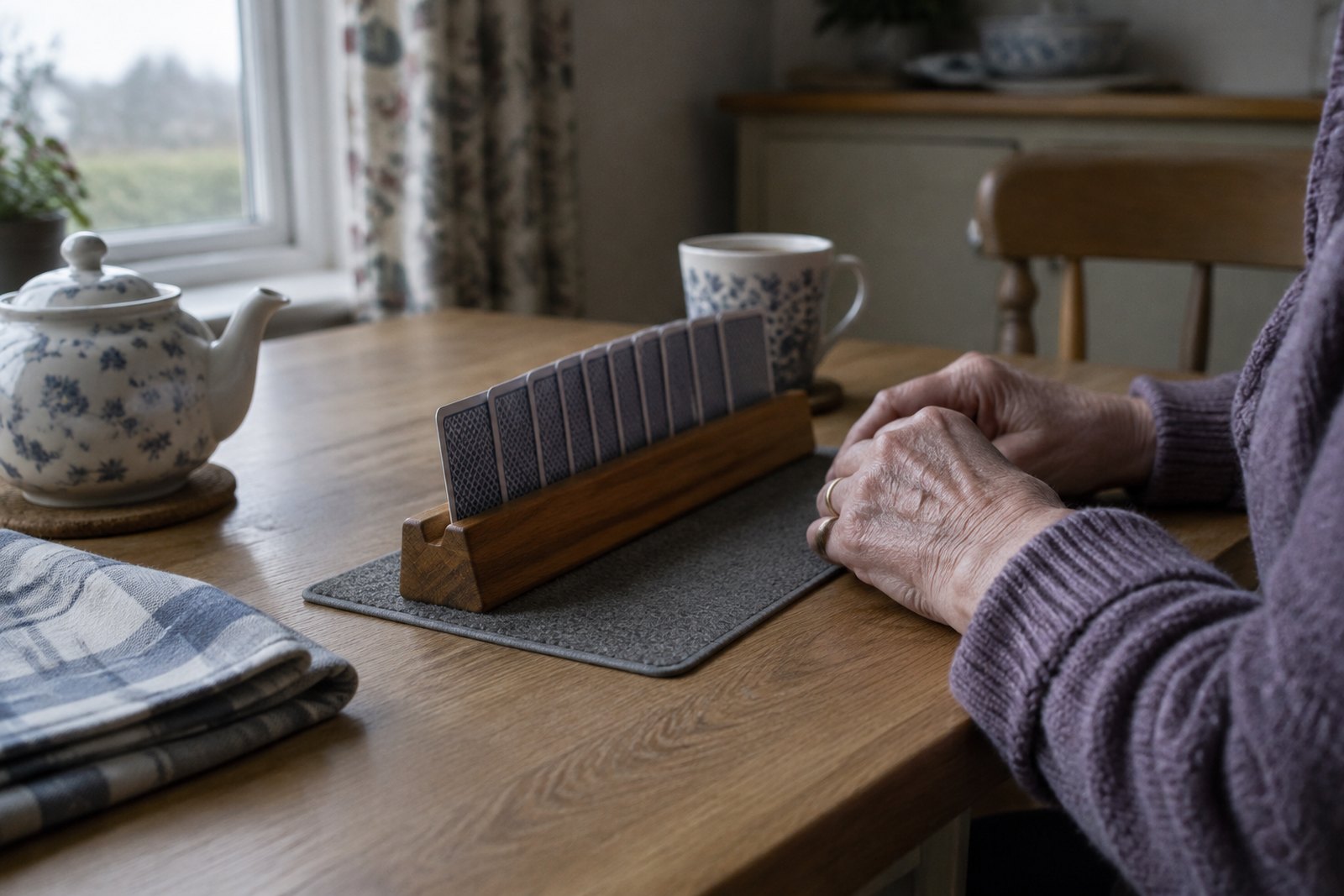
A playing card holder is a small stand or tray that holds your hand of cards upright on the table, so you can see and play them without gripping them. They suit people with arthritis, weak or painful hands, a tremor, or the use of only one hand. They are cheap, simple, and for many people they are the difference between still going to the card club and quietly making excuses.
The same idea works for most hobbies. If knitting, sewing, jigsaws, painting, gardening or music have become hard, there is usually a way to take the strain off the bit that hurts or fails, rather than stopping altogether. This guide goes hobby by hobby, explains what helps and what you can make at home, and says honestly when an occupational therapist is worth involving and when someone else should look first.
Why hobbies matter more than people admit
When hands or eyesight start to go, hobbies are usually the first thing dropped. They feel optional. Washing, cooking and getting dressed get the attention, and the crossword, the allotment and the Thursday whist drive slip away without anyone deciding they should.
That is a bigger loss than it looks. Hobbies are often where people feel most like themselves. They carry friendships, routines, a reason to get up, and the plain satisfaction of being good at something. Losing them can bring low mood, isolation and a sense that life is shrinking. Occupational therapy is built on the idea that what you do every day, including what you do for pleasure, is central to health and identity. So keeping a hobby going is not a frivolous goal. It is a perfectly good reason to get help.
Card games: holders, shufflers and larger cards
Playing card holders
There are several types, and the right one depends on what is hard for you.
- Slotted wooden or plastic blocks. A long, heavy-ish base with one or two angled grooves. You slide the cards in and they stand in a fan. Good for most people and stable on the table.
- Brush-style round holders. A disc of firm bristles. You push each card into the bristles and it stays put. Useful if your fingers cannot slide cards into a narrow slot, and easy to pull cards out of.
- Tiered trays. Two or three stepped rows, handy for games with large hands such as canasta or rummy.
- Hand-held holders. A disc or clip you hold, where the cards are pinched between two plates. Better for people who can grip something chunky but not thin cards.
Before buying, check the holder is wide enough for the number of cards in your usual game and that it will not slide about. A piece of non-slip matting underneath fixes most sliding.
You can make a perfectly good holder at home. Cut a slit along a length of foam pool noodle, turn a shoebox lid upside down and cut a long slot in it, or stand cards in the groove of a cookbook stand. A small, firm hairbrush with dense bristles also works in a pinch.
Shuffling and dealing
Shuffling is often the hardest part. Card shufflers, either battery-powered or turned by a small handle, mix the deck for you. Choose one with a lid or button you can manage. If you would rather not, spread the cards face down on the table and swirl them about with flat hands, then gather them up. Ask another player to deal, or deal one card at a time by pushing it off the top of the deck with your thumb while the deck sits on the table.
Large-print and easy-see cards
Large-print cards have much bigger numbers and suit symbols in the corners. Some use four colours, one for each suit, which makes hearts and diamonds much easier to tell apart in poor light. Jumbo-sized cards are easier to pick up but take up more room, so pair them with a holder. Braille playing cards exist for people with significant sight loss. If your eyesight is changing, our guide to low vision aids and living with sight loss at home covers lighting and magnification in more detail.
Knitting, crochet and embroidery
Needlework asks a lot of small joints: fine pinch, repeated movements, and holding things still for a long time. The aim is to reduce how tightly and how long you grip.
- Embroidery and tapestry frames on a stand. A floor or lap stand holds the hoop or frame for you, so one hand is not clenched around it. This also frees a hand if you only have one that works well.
- Ergonomic crochet hooks and needles. Hooks with thick, soft or shaped handles need less pinch. You can also build up an ordinary hook by pushing it into foam tubing or wrapping the handle.
- Circular needles. The weight of the work rests in your lap rather than hanging off the ends of straight needles, which eases wrists and shoulders.
- Lighter, warmer needle materials. Many people with arthritis find wood or bamboo needles kinder than cold metal, and stitches slide less, so there is less need to grip.
- Thicker yarn and bigger needles. Fewer stitches, quicker results, less fiddly work.
- Needle threaders and self-threading needles. These save a lot of frustration if fingertip feeling or eyesight is poor.
- A good light and a magnifier. A daylight-type lamp, ideally with a magnifier on a flexible arm, helps with fine stitching.
Pace it. Work for a set time, then stop and move your hands before they ache, not after. Our guide to arthritis and your hands explains joint protection, which applies just as much to knitting as to opening jars.
Jigsaws and table puzzles
Jigsaws are easier to keep going than most hobbies, with a few changes.
- Jigsaw boards. A flat board, often with a lid or cover and sorting trays, lets you work in short sessions and put it away without losing progress. Some tilt slightly, which helps if bending over the table hurts your neck or back.
- Sorting trays. Separate shallow trays for edges, colours and sky save repeated reaching.
- Larger pieces, fewer of them. There are puzzles for adults with larger pieces and lower piece counts that still have grown-up pictures. They suit people with a tremor, reduced feeling in their fingers, sight loss or memory problems.
- Contrast and light. A plain dark board under a light-coloured puzzle, or the other way round, makes pieces easier to see. Light from the side rather than overhead reduces glare.
To pick up pieces with stiff fingers, slide them to the edge of the board first. Some people use a small piece of non-slip matting on a fingertip-sized handle as a lifter.
Painting, drawing and writing for pleasure
- Built-up brushes and pens. Foam tubing slid over a brush or pencil makes it thicker and easier to hold. Chunky-handled brushes are also sold for this.
- A table easel. Raising the paper to an angle reduces wrist bend and neck strain.
- Tape it down. Masking tape or a clipboard stops the paper moving, so your second hand is free or does not have to press.
- Weighted pens and wrist weights. Some people with a tremor find extra weight steadies the hand. It does not work for everyone, so try before you buy.
- Change the medium. Bold strokes in acrylic, pastels or broad markers are more forgiving than fine watercolour detail if control has changed.
- Rest your forearm. Supporting the forearm on the table or a cushion often steadies the hand more than gripping tighter.
Gardening
Gardening is hard on knees, backs and hands, but it is very adaptable.
- Bring the garden up. Raised beds, troughs and containers on stands at waist height cut out kneeling and bending.
- Long-handled, lightweight tools. Long-reach trowels, forks and weeders let you work from standing or a seat.
- Ratchet pruners and secateurs. These cut in stages, so you need much less grip strength.
- Kneeler seats. A padded frame with handles that you can kneel on, using the handles to get up, then turn over to sit on. Only use the handles to push up if you can do so steadily.
- Add-on handles. Clip-on second handles turn a spade or hoe into a tool you can use with a more upright back and a straighter wrist.
- Lighter watering. Smaller cans filled more often, a hose on a reel near the beds, or self-watering pots.
Garden in short bursts, swap tasks often, and keep a seat nearby. Paths that are uneven or slippery need looking at before anything else.
Music
Many musicians keep playing for years with small changes. Adjust the height of your stool or chair so wrists stay level. A strap or stand can take the weight of an instrument. Simplified arrangements, larger-print music, or music on a tablet you can zoom in on all help. For guitar, lighter strings and a lower action need less finger pressure, and a music shop or teacher can advise. If playing has become too hard, singing in a choir or community group keeps the music and the company.
Hearing changes affect enjoyment too. If music sounds different or speech in a group is hard to follow, ask your GP about a hearing check.
Games with one hand or a tremor
Having one hand that works well, often after a stroke, or a tremor from Parkinson's or another condition, changes how you play rather than whether you can.
- Card holders are essential with one hand, so cards sit upright while your good hand plays.
- Non-slip matting under boards, puzzles and playing pieces stops things skidding when you knock them.
- Chunky or magnetic pieces. Large-piece chess, draughts and dominoes, or magnetic travel sets, are much easier to place and do not scatter.
- Dice cups or trays. Shake dice in a cup and tip them into a shallow tray rather than throwing them.
- Tablet versions of games. Cards, word games and puzzles on a tablet in a stand can work well, though a tremor makes some touchscreens frustrating.
Our guide to living with a tremor has more on steadying the hand and choosing weighted equipment.
How to adapt rather than give up
If you love something that has become hard, work through it in this order.
- Find the hard bit. Is it grip, fine finger movement, eyesight, sitting still, bending, remembering the rules, or tiredness? Usually it is one or two parts, not the whole hobby.
- Change the tool. A thicker handle, a holder, a stand, a magnifier.
- Change the position. Sit instead of stand, raise the work, support your forearm, improve the light.
- Change the task. Fewer stitches, bigger pieces, a simpler version of the game, a smaller garden.
- Change the timing. Do it when you have most energy and least pain, in shorter sessions, with breaks before you need them.
- Change who you do it with. A partner deals, a friend threads the needles, a group shares the heavy jobs.
For people living with dementia, simplifying matters more than equipment. Fewer choices, familiar materials and doing it alongside someone often keep a hobby going long after it might otherwise have stopped.
When someone else should look first
Hobby aids are for managing a known problem. They should not hide a new one.
- See your GP if hand or joint pain is new, getting worse, or comes with swelling, heat, stiffness that lasts a long time in the morning, numbness or tingling.
- Call 999 if weakness, numbness, a drooping face, slurred speech, confusion or sudden loss of vision comes on suddenly. These can be signs of a stroke.
- A physiotherapist leads on exercise, strength and joint movement. A hand therapist may be involved after an injury or surgery.
- An optician should check changing eyesight before you rely on magnifiers. An audiologist assesses hearing.
Where an occupational therapist fits
Plenty of people sort this out themselves with a card holder and some foam tubing, and that is fine. An occupational therapist is useful when the problem is more complicated, when several things have changed at once, or when you have tried a few gadgets and none of them quite worked.
An occupational therapist looks at the whole activity: how you sit, how you hold things, your strength and range of movement, your eyesight, your energy and the room you do it in. They can suggest specific equipment and how to set it up, show you joint protection and pacing, and adapt the activity itself. They also tend to look at the hobby alongside everyday tasks such as dressing, cooking and bathing, because the same hand problems usually show up there too.
An NHS or council occupational therapist will usually focus on essential daily tasks and safety, so hobbies may not be a priority for them. A private occupational therapist visiting at home can focus on whatever matters most to you. Our equipment and aids page explains how that kind of visit works.
Frequently asked questions
What is the best playing card holder for arthritis?
It depends on your hands. If you can slide cards into a slot, a stable wooden block with angled grooves works well. If pushing cards into a narrow slot is hard, a brush-style holder needs less precision. Try a home-made version first to see which style suits you.
Can I play cards with one hand?
Yes. A card holder keeps your hand upright on the table, a shuffler or table-swirling deals with mixing the deck, and non-slip matting stops things sliding. Many people keep playing this way, including at card clubs.
Are there knitting aids for arthritis?
Yes. Ergonomic or built-up needles and hooks, circular needles, wooden or bamboo needles, thicker yarn and needle threaders all reduce strain. Shorter sessions and regular hand movement breaks matter as much as the equipment.
Can I get hobby aids on the NHS?
Generally not. NHS and council equipment services focus on essential daily living and safety, so hobby equipment is usually something you buy yourself. Many items are inexpensive or easy to make at home. If you have a long-term condition, some equipment may qualify for VAT relief, which our guides explain elsewhere.
My mum has given up her hobbies. How do I help?
Ask what she misses rather than suggesting replacements. Then find out what part has become hard and try one small change. If she has dementia, low mood or has lost confidence, doing the activity alongside her often helps more than any gadget. If her mood has dropped noticeably, encourage her to see her GP.
Should I keep doing a hobby if it hurts?
Mild aching that settles quickly after you stop is common. Pain that builds, lingers, or comes with swelling or numbness is a sign to change how you do it, shorten sessions, and speak to your GP or a physiotherapist.
Next steps
If a hobby you love is slipping away, an occupational therapist can look at what has changed and how to adapt it. See our equipment and aids page, or current guide prices, and choose your area below.

Talk to an occupational therapist near you
This guide is general information. For advice about your own situation - or someone you look after - a local occupational therapist can visit you at home and see it for themselves.
Choose your area: