
Sock Aids, Long-Handled Shoe Horns and Other Dressing Aids: What Works and How to Get Them
By Mobile Occupational Therapist • 7 September 2026 • 9 min read
Two objects solve most of what makes getting dressed hard: a sock aid and a long-handled shoe horn. Both cost very little, both replace the movement that has usually become impossible - bending to your own feet - and both feel awkward for a few attempts and then unremarkable. Everything else on the list, from button hooks to elastic laces, is the same idea: replace the movement you have lost and leave the rest of the routine alone.
The other half is technique, which costs nothing. Sit down to dress rather than standing. Put the weaker or more painful side in first. Lay clothes out in the order you will put them on. Dressing asks a lot in a short space of time - balancing on one leg, bending to the feet, reaching behind the back, managing buttons and laces - and when one of those goes, the whole routine becomes slow or unsafe. The useful first step is to notice which movement is actually the problem, because somebody who cannot reach their feet needs a different answer from somebody who cannot manage buttons. That is the judgement an equipment assessment is for.
The sock aid: how it works and which type to choose
A sock aid is a gutter shaped former that holds a sock open while your foot goes into it. Roll the sock onto the gutter, lower it to the floor by two long tapes, slide your foot in, and pull the tapes steadily so the sock rolls up onto your foot and the aid slips out behind your heel. No bending, no reaching past your knee.
There are two broad types. A rigid plastic sock aid holds its shape, is much easier to load one handed and comes off the heel cleanly, but the trough can be bulky against a swollen ankle. A flexible fabric or terry lined one bends around the heel and is kinder to fragile skin and swollen feet, but needs more hand strength and can crumple if you pull unevenly. Stiffer versions with a metal frame exist for compression stockings, which are genuinely hard work without one.
The technique is worth practising. Sit well back in a stable chair with arms, keep the heel down and the toes pointed into the gutter, pull both tapes evenly, and lean back rather than forward. After hip surgery, use it with your foot on the floor rather than crossing your ankle over the other knee, because crossing the legs is usually off the list while hip precautions apply. Expect three or four goes before it clicks.
The long-handled shoe horn
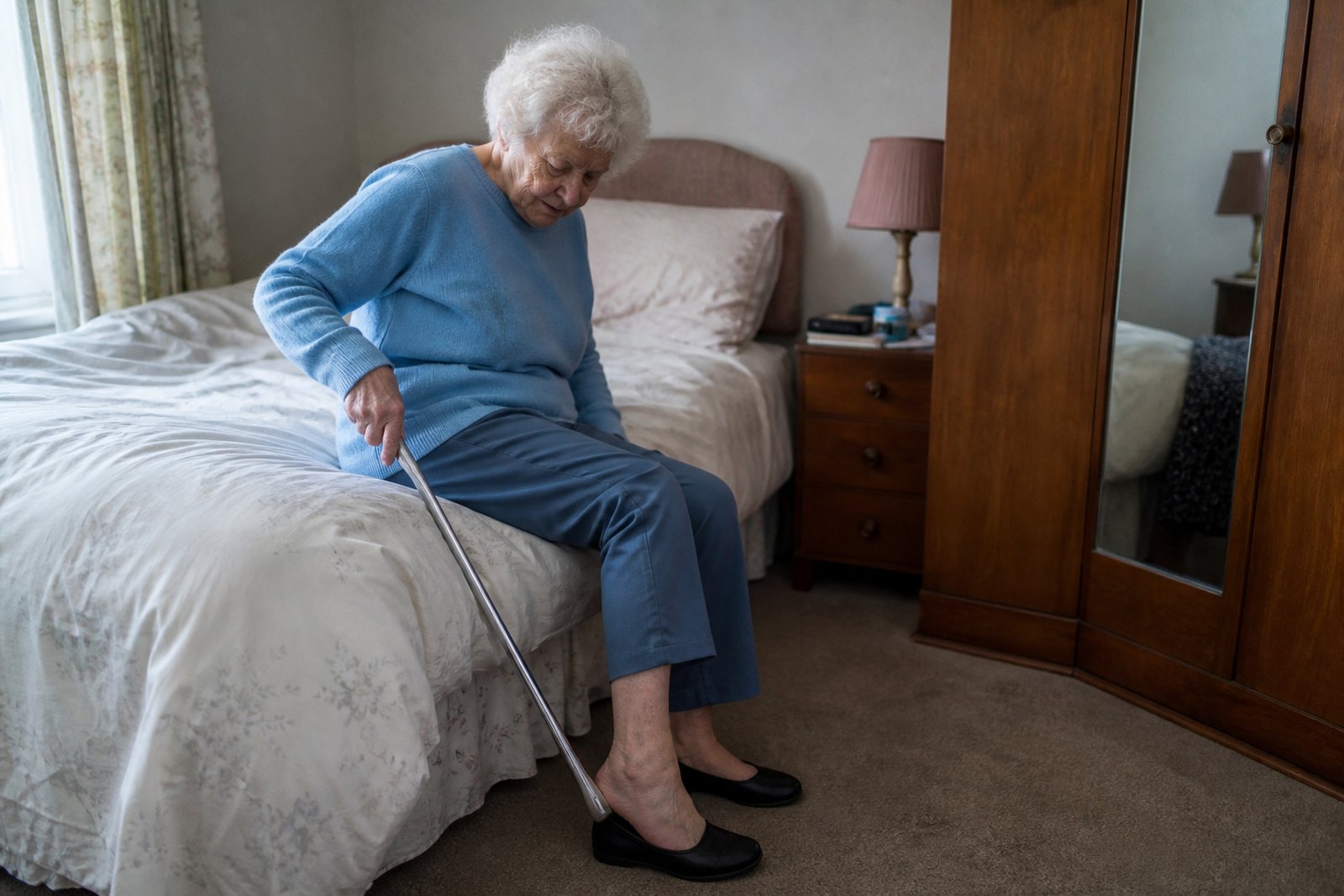
A long-handled shoe horn is a shoe horn on a handle of 50 to 70 centimetres, so shoes go on from a seated position with your back straight. It is one of the most used aids in any home it enters.
Length matters more than material. Sitting in the chair you actually dress in, the handle should reach your hand without you leaning forward. Metal ones flex less and last longer; plastic ones are lighter and occasionally snap. Some have a hook at the other end for pulling trousers up over the foot, which saves owning a separate dressing stick.
To use it, put the shoe on the floor, hold the blade inside the back of the shoe with the curve against the heel, slide your foot in over it, press down and draw the horn out. Never walk with it still in the shoe. Pair it with elastic laces and the shoe never needs tying again.
The other aids worth knowing
- Button hook. A wire loop on a chunky handle that pulls buttons through their holes, turning a fiddly pinch into a single pull. It helps stiff fingers, common with arthritis, and makes buttons possible with one hand.
- Elastic shoelaces. Fitted once, they turn lace-ups into slip-ons that still hold the foot properly. Far better than backless slippers, which are a genuine falls risk.
- Dressing stick. A rod with a hook at each end, for pushing clothing off the shoulders, pulling it over the feet, or catching a sleeve behind you.
- Zip pullers and rings. A loop through the zip tab gives fingers something bigger to hold.
None of these is expensive. Our plain-English guide to daily living equipment covers where they fit into the bigger picture.
Technique matters as much as equipment
- Sit down to dress. Standing on one leg to put trousers on is one of the most common moments for a fall at home. The edge of the bed or a sturdy chair removes the balance demand entirely.
- Dress the weaker side first. If one arm or leg is weaker, stiffer or more painful, put it in while the fabric is still loose. Undress in reverse, stronger side out first.
- Lay clothes out in order. Set everything out the night before, in sequence and the right way round. It removes decisions from the most tiring part of the morning.
- Pace it. If breathlessness or fatigue is the limit, dressing in stages with a rest between is a legitimate technique, not a defeat.
Clothing that does the same job as an aid
Sometimes the best dressing aid is a different garment, and here a little honesty saves money.
Elasticated waist trousers remove buttons and zips altogether and can be pulled up with a dressing stick. Look for a flat, non-roll waistband and a size that goes over swollen legs easily; ordinary high-street comfort-waist trousers usually do the job as well as anything sold specially, for less. Front fastening bras avoid reaching behind the back, alongside two free alternatives: fastening an ordinary bra at the front and swivelling it round, or a soft crop style pulled on over the head. A front hook and eye still needs a pinch grip, so magnetic or wide Velcro closures suit weak fingers better.
Adaptive clothing, meaning garments with magnetic closures, hidden openings or open backs, is genuinely useful for some people, particularly anyone dressed by somebody else. It is also often expensive and limited in range, and much of what it does can be had from ordinary clothes chosen with a practical eye: loose armholes, stretchy fabric, wide necklines, slip-on shoes with a firm heel. Keeping your own style is part of the point.
One-handed dressing after a stroke
Dressing one handed after a stroke is a skill with real technique behind it, and one of the things occupational therapists teach most often. The rule above, applied strictly: the affected arm or leg goes in first, every time, and comes out last. For a shirt or cardigan, thread the affected arm in fully, work the garment up over that shoulder, then reach round with the stronger arm. Clothing is far easier to manage laid flat on your lap than fought with in mid-air.
A button hook, elastic laces and a one-handed method for fastenings can between them make an independent morning realistic again. Balance is often affected too, so sitting to dress is the foundation rather than an optional extra. See our page on occupational therapy after stroke for how that support works more broadly.
Getting them without paying, and who to ask
Before buying, ask. If surgery is planned, the hospital occupational therapy team usually issues a sock aid, a long-handled shoe horn and a reacher on loan, free, before discharge. If you are already at home, an assessment through adult social care or the community equipment service can provide them, although small low-cost dressing aids are the items councils are most likely to expect you to buy yourself.
Bought privately, a sock aid is roughly 8 to 20 pounds and a long-handled shoe horn 6 to 15 pounds, and both are normally zero rated for VAT when bought for personal use by a disabled or chronically sick person. The money is rarely the problem; choosing the wrong type is. Our older people and independence service exists partly to stop a drawer filling with aids that were never the right ones.
Frequently asked questions
What is a sock aid and how does it work?
A sock aid is a gutter shaped former that holds a sock open. You roll the sock onto it, lower it to the floor by two long tapes, slide your foot in and pull the tapes so the sock unrolls onto your foot and the aid slides out behind the heel. Versions exist for socks, tights and compression stockings.
Is a rigid or a flexible sock aid better?
Rigid plastic ones are easier to load, hold their shape and come off the heel cleanly, which suits weak hands and anyone working one handed. Flexible fabric ones bend around the heel and are gentler on swollen feet and fragile skin, but need more grip to load. Try both if you can.
Can I get a sock aid or a long-handled shoe horn free?
Often, yes, before planned surgery, when hospital occupational therapy teams issue dressing aids on loan ready for discharge. Otherwise ask adult social care or the community equipment service, though small inexpensive items are the ones most likely to be treated as a self-purchase. Eligible equipment is zero rated for VAT.
How do you get dressed one handed after a stroke?
Sit down, and put the affected arm or leg into the garment first while the fabric is loose, working it up over the shoulder or hip before the stronger side goes in. Undress in reverse, stronger side first. A button hook and elastic laces handle the fastenings, and an OT can refine the method with your own clothes at home.
Next steps
If getting dressed has become slow, painful or precarious, a home assessment can pin down which aids and which techniques will help, which is usually a short list rather than a catalogue. Find your local occupational therapist through our areas we cover page, or see our prices page.
Talk to an occupational therapist near you
This guide is general information. For advice about your own situation - or someone you look after - a local occupational therapist can visit you at home and see it for themselves.
Choose your area: