

Raised Toilet Seats, Toilet Frames and Rails: Which One You Need and How to Get It
By Mobile Occupational Therapist • 19 August 2026 • 9 min read
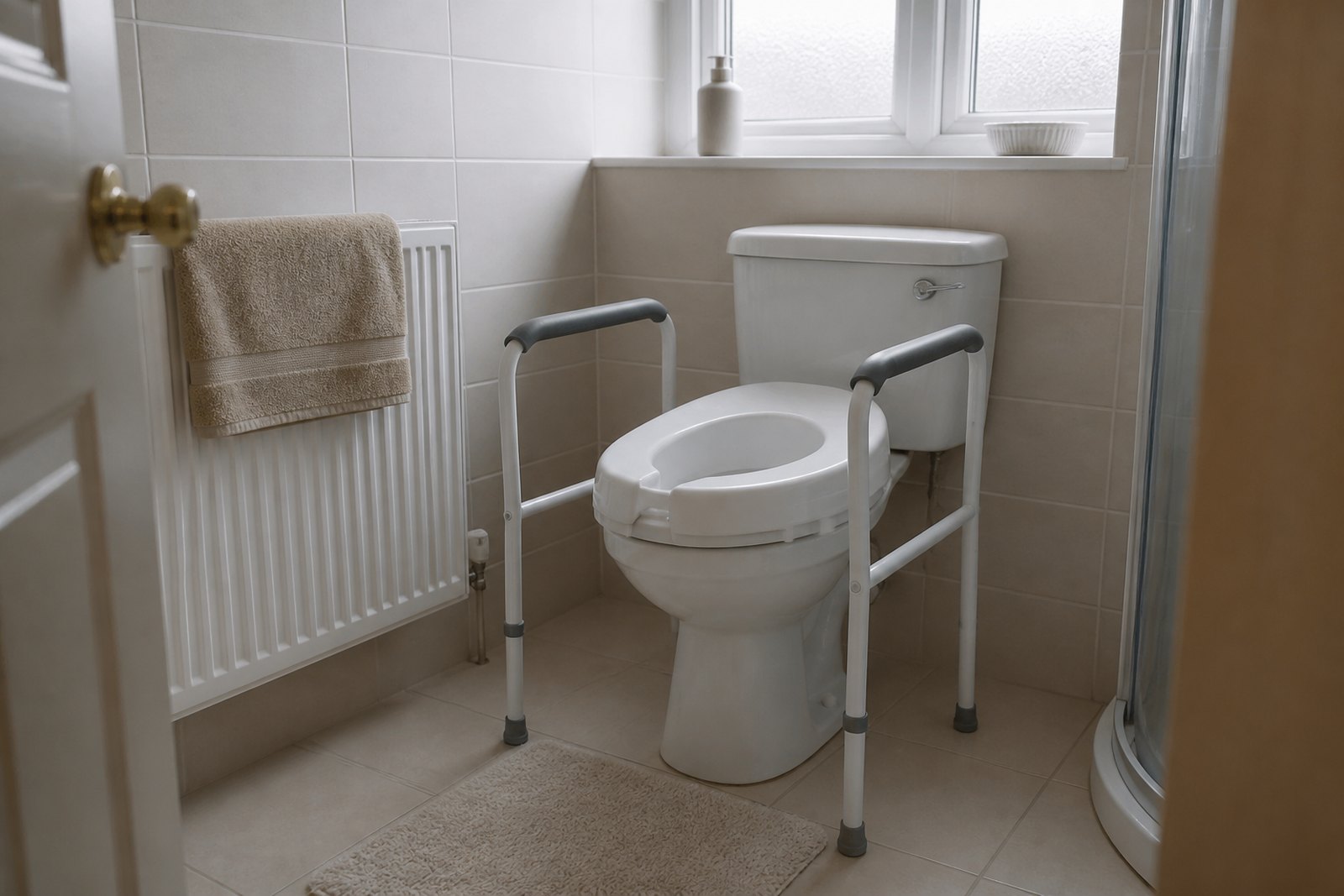
A raised toilet seat, a toilet frame and a fixed rail look like three versions of the same thing. They are not. They solve three different problems, and buying the wrong one is the commonest small mistake in home equipment: the seat arrives, it does nothing, and the person concludes that nothing will help. Getting on and off the toilet is one of the first things to become difficult and one of the last anybody mentions, so it is worth getting right first time.
The decision comes down to one question: is the difficulty pushing up from a low seat, or having nothing solid to hold? Height is solved by a raised toilet seat. Support is solved by a frame or a rail. Plenty of people need both, which is what the combined seat and frame is for. Watch the movement once and the answer is usually obvious.
Why the toilet is harder than it looks
A standard UK toilet sits at roughly 40 to 42cm, lower than most dining chairs and much lower than an armchair. Standing from that height needs good movement at the hips and knees and leg strength to push out of a deep position, often in a small room, at night, in a hurry.
It gets harder with knee or hip pain, after a joint replacement, with reduced leg strength, or with poor balance in the first seconds of standing. In many bathrooms the only things within reach are a basin, a towel rail or the cistern, none built to take a person's weight; our guide to grab rails covers what happens when people grab them anyway.
Raised toilet seats
A raised toilet seat adds height to the pan: less distance to lower into, less work to push out of. It is one of the most issued items in the country, and solves one thing: a seat that is too low.
- Heights. The usual options are 2, 4 and 6 inches, sold in some places as 5cm, 10cm and 15cm. Two inches is often enough after a knee replacement or with mild arthritis, four is the common choice, and six suits tall people or a stiff hip, while being far too much for many others.
- Clamp-on seats. These sit on the pan rim, held by a bracket or clamp underneath. Cheap, easy to fit and easy to remove, which matters where others share the bathroom. They can work loose, and do not fit every modern pan shape.
- Lid and seat replacements. These bolt on in place of the old seat, giving a raised toilet seat with a lid that looks like part of the toilet. More stable, no shifting under load, right for a permanent need. More work to fit, and they raise the seat for everybody.
- Seats with arms, sometimes sold as a disabled toilet seat. A moulded raised seat with fixed armrests, so height and support arrive together. A good answer where a floor frame will not fit, and generally the item people mean by a disabled toilet seat.
Higher is not safer, which surprises people. A seat that is too high leaves the feet dangling rather than flat on the floor, removing the stability and leverage that make standing safe, and it puts the body in a poor position for the bowel to empty. The aim is the lowest height at which the person can stand safely, feet flat and hips no lower than knees. If the only workable height leaves the feet off the floor, that needs assessing. After a hip replacement, the surgeon's or physiotherapist's own instructions about seat height and hip angle override anything general here.
Toilet frames
A toilet frame stands around the toilet and gives an armrest each side to push down on. It solves having nothing to hold, and nothing about height unless it comes with a seat.
- Free-standing frames. Four adjustable legs straddling the pan, no fixing needed. Quick, cheap, removable, the usual first choice. They need an even floor and space around the toilet, and can be nudged out of position by cleaning or by somebody leaning on one arm.
- Floor-fixed frames. The same shape, screwed down into the floor. Far more stable where somebody pulls hard on the arms or a free-standing frame slides. Fitting is a small job for a handyperson service.
- Arm height and width. Most frames adjust at the legs, and most are left as they arrived. Set them so the elbows are slightly bent with the hands on the arms, and check the frame is wide enough to sit between without catching the hips.
- The frame and raised seat combination. A toilet surround with an integral raised seat does both jobs in one item, and is what most people looking for a toilet frame for elderly parents need. If both height and support are a problem, start here.
Rails: drop-down and wall-fixed
Rails do the same job as a frame without the clutter, because they fix to the wall.
A wall-fixed grab rail beside the toilet, vertical or angled, suits somebody who needs steadying rather than something to press down through. Position matters far more than length, and the rail must be screwed into masonry or timber behind the plasterboard. One fixed into tiles and plaster alone comes off the wall at the worst moment, and suction rails should never take weight.
A drop-down rail is hinged to the wall behind the toilet and folds up out of the way. It is the answer where the toilet has a wall on one side only, or in a shared bathroom where a frame is a nuisance. Some have a supporting leg. They need a solid wall behind the toilet; on a stud wall the fixings must go into timber that may need adding first.
Which one do you need?
Watch what the difficulty actually is, rather than asking.
- Struggling to push up but steady once standing. Height, arms, or both: a raised toilet seat, a frame, or a combined surround.
- Standing up all right but unsteady in the first few seconds. Something fixed and solid to hold. Rails rather than a frame.
- Landing heavily on the way down. Usually height, often with arms to control the descent.
- Difficulty with clothing or with reaching. A different problem, needing dressing or reaching aids rather than a seat.
- Not getting there in time. Nothing at the toilet fixes that; look at the route, the lighting and the distance.
Safety points that matter
- Check the fixing regularly at first. Clamp-on raised seats can shift, particularly on non-standard pans, and a seat that moves as weight goes onto it causes falls.
- Check the maximum user weight. It varies widely, especially on frames, and is printed on the frame or in the instructions.
- Check the frame feet. Non-slip ferrules wear smooth, and bathroom floors are often wet.
- Make sure it fits the pan. Many modern and wall-hung toilets are not the shape older seats assume.
- Think about everyone who uses the bathroom. A raised seat that helps one person can make things harder for another, which is why removable seats and drop-down rails exist.
- Keep the route clear and lit. Many toilet-related falls happen on the way there at night, not at the toilet.
How to get a raised toilet seat or frame free
Raised seats, frames and rails are among the items most commonly issued by adult social care, usually after a free needs assessment you can request yourself without a GP referral. They are frequently supplied on loan at no cost, many councils fast-track small items, and rails are often fitted through a council handyperson service. Waiting times vary, and it is worth asking rather than assuming you have to buy.
Buying privately is straightforward and cheap. As a rough guide, a plain raised toilet seat is fifteen to forty pounds, one with arms forty to ninety, a free-standing toilet frame thirty to eighty, and a combined surround from around sixty; a drop-down rail costs more once fitting is included. Most people with a long-term condition or disability can buy this equipment without paying VAT. Get the type and the height right first: the commonest wasted purchase is a raised seat where the real problem was having nothing to hold.
Frequently asked questions
How high should a raised toilet seat be?
The lowest height at which you can stand safely, with both feet flat on the floor and hips no lower than knees. Common heights are 2, 4 and 6 inches. Too high is a genuine hazard: dangling feet remove the stability and leverage that make standing safe.
Do I need a raised toilet seat or a toilet frame?
A raised toilet seat solves a seat that is too low. A toilet frame solves having nothing to push up from. If both apply, a combined surround does both in one item. If you can push up well but feel unsteady once standing, fixed rails are usually better than either.
What is a disabled toilet seat?
It is not a technical term. People generally mean a raised seat with moulded armrests, or the higher pan and grab rails in an accessible public toilet. At home the equivalent is a raised toilet seat with arms, or a raised seat plus a frame or rail.
Which toilet frame is best for elderly parents?
The one matched to the difficulty and the bathroom. A free-standing toilet frame for elderly parents who need something to push on is usually enough; a floor-fixed frame is better where somebody pulls hard on the arms or the frame slides; a combined frame with a raised seat is right where the seat is too low. Set the arm height properly rather than leaving it as it came.
Next steps
If getting on and off the toilet has become difficult, it is worth sorting properly, because it affects confidence, sleep and how much somebody drinks during the day. An occupational therapist can check the height, the support and what will fit your bathroom. See our bathroom safety guide, find your local occupational therapist on our areas we cover page, or see our prices page for current guide pricing.
Talk to an occupational therapist near you
This guide is general information. For advice about your own situation - or someone you look after - a local occupational therapist can visit you at home and see it for themselves.
Choose your area: