

Mobility Aids for Elderly People: Which One and How to Get It
By Mobile Occupational Therapist • 24 October 2026 • 14 min read
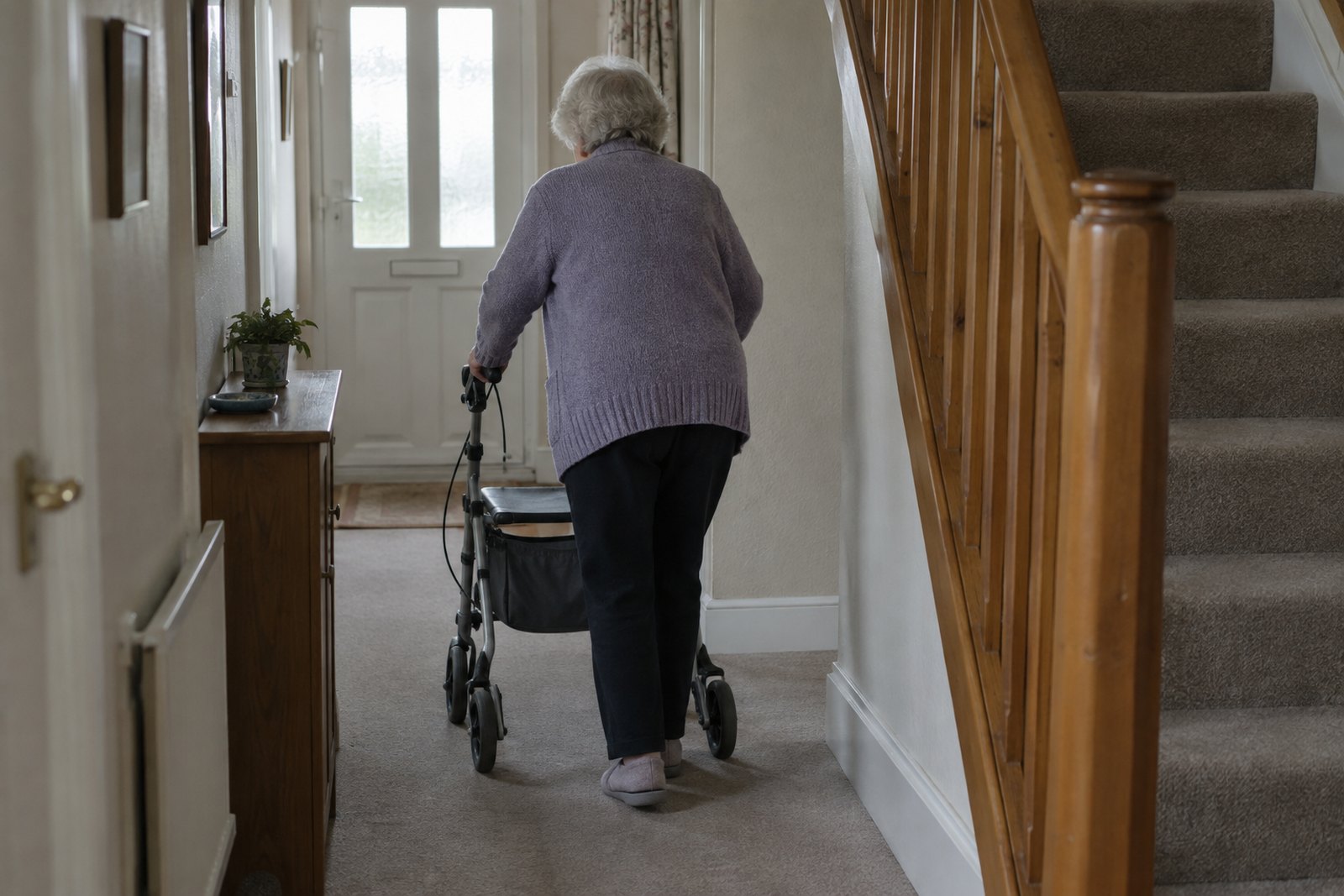
The right mobility aid depends less on age and more on what is actually going wrong. A walking stick helps if one leg is sore or your balance is a little off. A walking frame or wheeled walker helps if you need to lean properly on something. A trolley walker helps if the real problem is getting a cup of tea from the kitchen to the chair. A wheelchair or scooter is for distance, not usually for inside the house. And some of the most useful mobility aids are not things you walk with at all. Grab rails, bed levers and a higher chair often make more difference than any stick.
The other plain answer is that you may not have to buy anything. Walking aids are often supplied free through NHS physiotherapy, wheelchairs through NHS wheelchair services, and household equipment on loan from the council's community equipment service after an assessment. Buying privately is fine and often quicker. But get the type and the height right first, because a badly chosen or badly fitted aid can make a fall more likely, not less.
Start with the problem, not the product
Most families start with a thing. Mum is wobbly, so Mum needs a stick. It is worth stepping back and looking at the moments when things go wrong. Ask yourself, or ask her:
- Is the hard part getting up from a chair, bed or toilet, or is it the walking itself?
- Is it worse indoors, outdoors, or both?
- Is it short distances, or is she fine for ten minutes and then exhausted?
- Is one leg or one side worse than the other?
- Does she need her hands free to carry things?
- Does she get breathless, dizzy or suddenly tired?
- Are the stairs the main worry?
Each answer points somewhere different. Someone who struggles to stand up from a low sofa does not need a frame. They need a higher seat or a chair raiser. Someone who walks well but cannot carry anything needs a trolley, not a stick. Someone who is newly dizzy needs a GP before they need any equipment at all (more on that below).
Walking sticks
Who they suit: people who are fairly steady but want a bit of extra balance, or who have one painful hip, knee or ankle.
A standard single-point stick is the simplest option. Tripod and four-footed sticks stand up on their own and feel more stable on flat floors, but they are awkward on stairs, kerbs and uneven ground, where not all the feet touch down at once. Folding sticks are handy for bags and cars but check the locking joints regularly.
Height matters more than people think. As a rough guide, stand up straight in your usual shoes with your arms hanging by your sides. The handle should be about level with the crease of your wrist, so your elbow is slightly bent when you hold it. Too long and you hitch your shoulder up. Too short and you stoop. If one leg is worse, the stick usually goes in the opposite hand, so it moves forward with the weaker leg. A physiotherapist can check this for you in a few minutes.
Check the rubber tip, called the ferrule, every few weeks. Once the tread is worn smooth, it slips on wet floors. And resist the temptation to hand down a late relative's stick without checking it is the right height for the new owner.
Walking frames
Who they suit: people who need to take real weight through their arms, after hip or knee surgery, or with poor balance.
A frame without wheels gives the most support. You lift it, place it, step into it. It is steady but slow and tiring. A frame with two front wheels is easier to push along and suits people who find lifting hard, though it gives a little less security. Frames are mainly for indoor use and are never used on stairs. They are often issued by the hospital or community physiotherapist, who should also show you how to stand up and sit down with one, because pulling up on a frame is a common way to tip it over.
Rollators (wheeled walkers)
Who they suit: people who can walk a reasonable distance but need something to lean on and somewhere to rest.
Rollators have three or four wheels, hand brakes, and usually a seat and a bag or basket. Four-wheeled ones are steadier and most have a seat. Three-wheeled ones are narrower and easier to turn in tight spaces, but less stable. You need enough grip strength to work the brakes, and enough control not to let the rollator run away from you on a slope. They are mostly for outdoors and larger spaces. In a small terraced house they can be more of an obstacle than a help.
Our guide to walking frames, sticks and wheeled walkers goes through choosing and fitting each type in detail.
Trolley walkers
Who they suit: people who are reasonably steady at home but need both hands to carry things, or who reach for furniture as they go.
A trolley walker has two shelves or a tray on wheels, sized to lean on lightly while you push it. It lets someone carry a meal, a drink or their post safely from room to room, which is often what stops people eating properly. Trolleys are for indoors on fairly level floors, and they do not cope well with thick rugs or raised door thresholds. Make sure it is one designed for walking support. An ordinary kitchen serving trolley is not built to be leaned on and can tip or roll away.
Wheelchairs
Who they suit: people who cannot walk far or safely, either all the time or for longer trips out.
Self-propelled chairs have large back wheels the user pushes. Attendant-propelled and lightweight transit chairs have small wheels and need someone behind. Fit matters: seat width, seat depth, footplate height and the cushion all affect comfort, posture and the risk of pressure sores for anyone sitting for long periods.
For long-term needs, the NHS wheelchair service is the main route. Referral usually comes from a GP, physiotherapist or occupational therapist, and eligibility criteria vary between areas. For short-term use, such as a holiday or a few weeks after an injury, some local charities lend wheelchairs. Read more in our guide to NHS wheelchair services.
Mobility scooters
Who they suit: people who can walk a little and get on and off safely, but cannot walk far enough to get to the shops or the bus stop.
Scooters can give back a great deal of independence. They also ask a lot of the driver: good enough eyesight, the ability to twist and look behind you, sound judgement near kerbs and traffic, and somewhere dry to store and charge it. Under the current GOV.UK rules, class 2 scooters have a top speed of 4mph and are for pavements, and can only be used on the road where there is no pavement. Class 3 scooters can be used on the road at up to 8mph, must be limited to 4mph on pavements, and must be registered with the DVLA. Check the rules on GOV.UK before buying. Scooters are not usually supplied by the NHS.
If memory or judgement is changing, as it can with dementia, think hard and talk it over with the GP first. Our honest guide to mobility scooters covers the questions to ask before you spend the money.
Stairlifts and managing the stairs
Who they suit: people who can walk short distances and transfer on and off a seat safely, but for whom the stairs have become unsafe or exhausting.
A stairlift is a big purchase and it is not always the answer. It does not suit someone who cannot stand safely at the top landing, cannot swivel the seat and get off, or whose condition is changing quickly. Sometimes a second banister rail fixes the problem for a fraction of the cost. Sometimes a through-floor lift, or moving a bed downstairs, makes more sense. If money is the barrier, the council's Disabled Facilities Grant may help, and an occupational therapist's assessment is usually part of that process. See do you need an OT assessment before buying a stairlift.
Grab rails, bed aids and the equipment people forget
A great many wobbles and falls happen not mid-walk but during the transitions: getting out of bed, up from a chair, off the toilet, out of the bath, over the front step. That is where small equipment earns its keep.
- Grab rails by the front door, toilet, bath or shower give a solid handhold. Never use a towel rail, radiator, sink or door handle as a substitute. They are not built to take your weight.
- Bed levers (a short handle that tucks under the mattress) help someone sit up and stand from bed. These are different from full-length bed rails meant to stop someone falling out, which carry a real risk of entrapment and need proper assessment.
- Leg lifters help swing stiff or weak legs into bed.
- Chair and bed raisers lift furniture so standing up takes less effort.
- Raised toilet seats and toilet frames help with sitting down and getting up.
- Perching stools let someone sit while washing up or cooking.
In England, councils provide minor aids and adaptations costing up to £1,000 free of charge to people assessed as eligible, and many of these items are loaned rather than sold. Check with your council's adult social care team. Our guide to borrowing equipment from community equipment services explains how it works.
Why assessment and fitting matter
It is easy to assume any aid is better than none. It is not always true. The commonest problems are:
- A stick or frame at the wrong height, causing stooping, sore shoulders or a forward lean.
- A stick held in the wrong hand.
- A frame pushed too far ahead, so the person ends up reaching and off balance.
- A rollator used by someone who cannot reliably work the brakes.
- A wheelchair too wide to fit through the bathroom door, or with no proper cushion.
- A scooter bought for someone who cannot judge kerbs safely.
There is also a quieter problem. Equipment can paper over something that needs treating, such as weak legs that would improve with exercise, or dizziness caused by blood pressure or medicines. A short assessment looks at the person, not just the product.
How to get mobility aids free or on loan
NHS physiotherapy
Physiotherapists lead on walking, balance and walking aids. You can be referred by your GP, and many areas also let you refer yourself. A physio can assess walking, supply a stick or frame (often free), set the height and teach safe use, and give exercises for strength and balance.
NHS wheelchair services
For people with a long-term need for a wheelchair. Ask your GP, physiotherapist or occupational therapist about a referral.
Council community equipment
Contact your council's adult social care team and ask for a needs assessment. An occupational therapist or trained assessor will look at how you manage at home, and equipment is delivered on loan and collected when no longer needed. If someone is coming out of hospital, the hospital team can often arrange this before discharge.
Local charities
Some local charities and branches of national older people's charities lend short-term equipment, especially wheelchairs. Ask at your GP surgery or library what exists locally.
Buying privately and VAT relief
Buying your own is often faster and gives more choice, especially for sticks, rollators and trolleys. A few practical tips:
- Try before you buy where possible, in the shoes you normally wear.
- Measure doorways, hallways and storage space before buying anything wheeled.
- Check the maximum user weight and the returns policy.
- Be cautious with second-hand electrical equipment such as scooters and riser chairs unless it has been serviced.
If you are chronically sick or disabled, you may be able to buy equipment designed for disabled people without paying VAT. Being older is not enough on its own to qualify. Our guide to VAT relief on disability equipment explains who qualifies and how the declaration works, and GOV.UK has the official rules.
Red flags: when to see the GP first
A walking aid will not fix a medical problem. Book a GP appointment before buying equipment if there are:
- New falls, or more than one fall in recent months.
- Dizziness or light-headedness, especially on standing up.
- Blackouts or moments of not knowing what happened.
- A sudden change in walking over days rather than months. Infections and medicine changes can both do this.
- New unsteadiness after starting or changing a medicine. Do not stop any medicine yourself. Ask the GP or pharmacist.
- Pain, swelling or being unable to put weight on a leg after a fall.
Call 999 if someone has a drooping face, weakness in an arm or leg, or slurred or confused speech, as these can be signs of a stroke. Also call 999 for chest pain, a head injury followed by drowsiness or vomiting, or if someone has fallen, is hurt and cannot get up. If you are unsure how urgent something is, call NHS 111.
Where an occupational therapist fits
It helps to be clear about who does what. A physiotherapist leads on walking, balance, strength and walking aids. The NHS wheelchair service leads on wheelchairs. The GP looks for the cause of new falls or dizziness.
An occupational therapist looks at the whole day in the person's own home. Can they get out of bed, up from the chair, on and off the toilet, in and out of the bath, round the kitchen, up the stairs and over the front step? Then they recommend the equipment, adaptations or different ways of doing things that make those moments safer. Often the answer is small and cheap. Sometimes it is a bigger adaptation, and the occupational therapist's assessment supports a grant application.
Council occupational therapy is free, but waiting times vary. A private occupational therapist visiting at home can usually come sooner, advise before you commit to an expensive purchase such as a stairlift or scooter, and write a report you can share with the council or family. If the only question is the height of a walking stick, a physio is the right person.
Frequently asked questions
Can I just buy a walking stick from a shop?
Yes, and many people do. Make sure it is adjustable or cut to the right height, with the handle roughly level with your wrist crease when your arms hang down. If you are using a stick because of new falls or dizziness, see your GP as well.
Should my mum use a stick or a frame?
It depends how much support she needs. A stick is for light balance help or one painful leg. A frame is for people who need to lean real weight on it. If you are not sure, ask for a physiotherapy assessment rather than guessing, because the wrong aid can make walking harder.
Are mobility aids free on the NHS for older people?
Often, but not always. Sticks and frames are commonly supplied after a physiotherapy assessment, wheelchairs through NHS wheelchair services for long-term needs, and household equipment on loan from the council. Scooters and stairlifts are not usually NHS-provided, though a Disabled Facilities Grant may help with a stairlift.
Can someone push me along while I sit on my rollator?
No. Most rollators are not designed to be pushed with someone sitting on them and can tip or collapse. The seat is for resting with the brakes locked. If you need to be pushed, you need a wheelchair.
Do I need an assessment before buying a stairlift or scooter?
It is not a legal requirement, but it is wise for anything expensive. An assessment checks whether it will actually work for you now and as things change, and whether a cheaper option would do the job. Grant funding usually needs one.
Dad refuses to use his frame. What can we do?
Ask why. It may be pride, but it may be that the frame is the wrong height, does not fit through his doorways, or makes him feel less steady. A professional reassessment often solves the practical side, and sometimes a different aid he does not mind being seen with makes all the difference.
Next steps
If you would like someone to look at how things are going at home and which aids would genuinely help, see our equipment and aids and home assessment pages, or current guide prices, and choose your area below.
Talk to an occupational therapist near you
This guide is general information. For advice about your own situation - or someone you look after - a local occupational therapist can visit you at home and see it for themselves.
Choose your area: