
Kitchen Aids and Meal-Time Independence
By Mobile Occupational Therapist • 20 July 2026 • 7 min read
Cooking is one of those everyday tasks that quietly involves an enormous amount of physical effort - standing for long periods, reaching, gripping, lifting, and coordinating several things at once. When strength, grip, balance or energy change, cooking is often one of the first activities to become genuinely difficult, sometimes leading people to eat less well, rely more on ready meals, or lose confidence in the kitchen altogether. This guide covers the practical aids and layout changes that occupational therapists commonly recommend to help.
Why meal-time independence matters
Being able to prepare your own food, even simply, is closely tied to both nutrition and a sense of independence. Occupational therapy can help with finding practical ways to keep cooking manageable, rather than assuming the only alternative to full independence is relying entirely on others. Often, a handful of targeted changes make far more difference than people expect.
Seating and standing tolerance
Standing for the full duration of meal preparation can be tiring or unsafe for many people. A well-fitted perching stool - allowing someone to lean and take weight off their legs while remaining at working height - is one of the most useful and underused pieces of kitchen equipment. See our guide to choosing the right chair for more on getting the height right, since an ill-fitting stool can be more hindrance than help.
Grip and dexterity aids
This is the group of aids that costs the least and changes the most. Each one replaces a grip you can no longer make with a movement you still can - a lever, a whole-arm turn, or a push instead of a pinch.
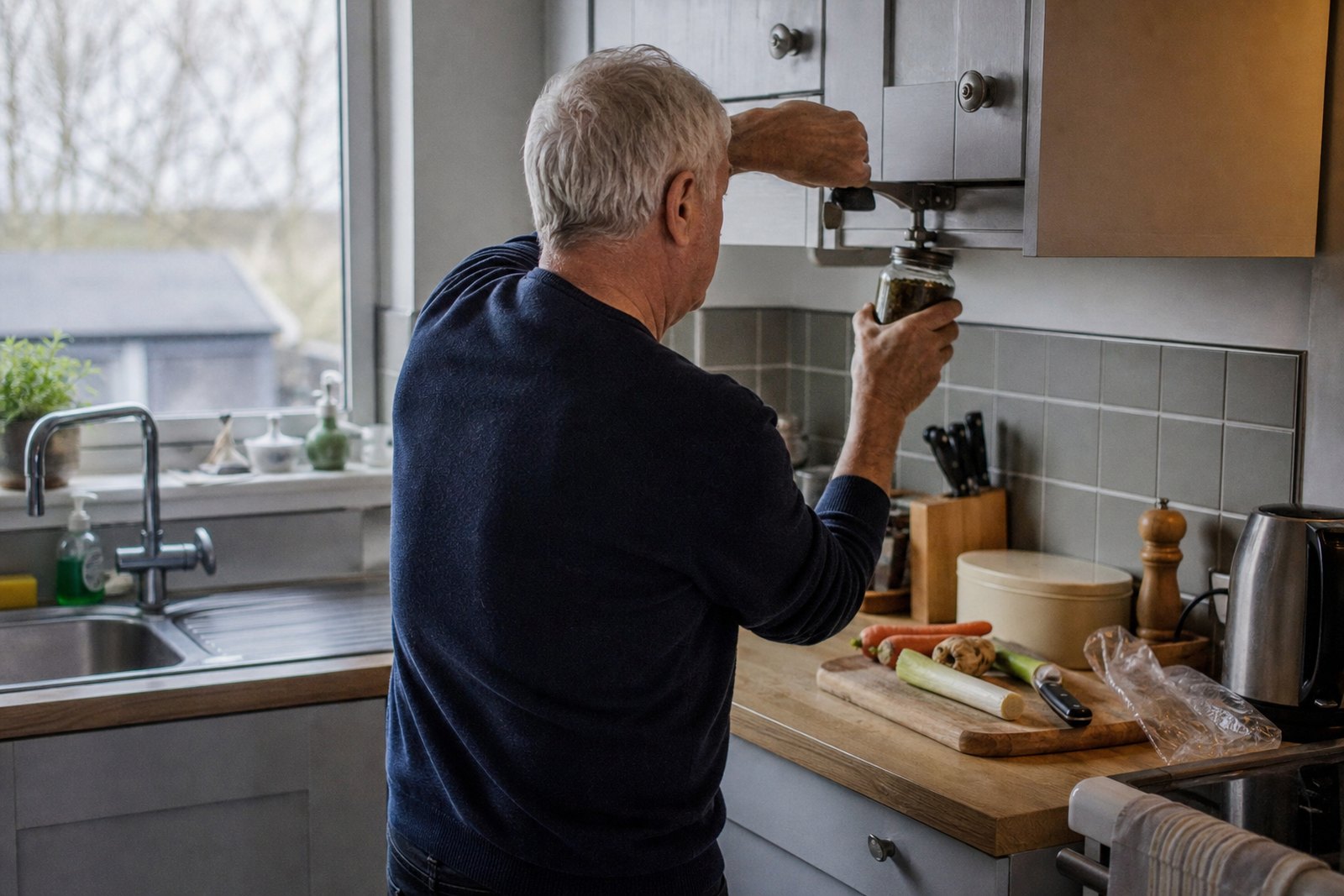
- A jar opener for arthritis is the classic. Cone-shaped and Y-shaped openers both grip the lid so your forearm does the twisting instead of your fingers, which is exactly the swap that painful thumb joints need. Under-cupboard versions clamp the lid while both hands turn the jar.
- A tap turner is a small lever that clips over a crosshead tap, converting an awkward wrist twist into an easy push. It is one of the cheapest aids in the house and one of the most missed, because taps are so ordinary that nobody mentions struggling with them.
- Easy-grip cutlery - sometimes called adaptive cutlery - has wider, cushioned handles that need far less finger closure to hold. Weighted versions steady a tremor, and angled versions help where the wrist will not turn far enough to bring a fork to the mouth.
- A plate guard clips onto an ordinary plate to give food something to be pushed against, making one-handed eating possible without a plate of chased peas. Plates with a built-in raised rim do the same job more discreetly.
- Non-slip mats under bowls, plates and chopping boards keep everything still during one-handed use. A damp cloth does the same job for nothing.
- Rocker knives and spiked chopping boards hold and cut food without a second hand, which matters after a stroke or hand injury.
If your hands are the main difficulty, it is worth reading our guide to hand function at home alongside this, because technique and joint protection often matter as much as the gadget.
Reducing lifting and carrying
Lightweight pans, kettles and crockery reduce strain considerably compared with heavier, traditional equipment. A kettle tipper is the standout here: a cradle that holds the kettle and lets you tip it to pour, so the full weight of a litre of boiling water never has to be lifted or held steady at arm's length. Where grip or arm strength has reduced, it removes one of the most genuinely dangerous moments in the kitchen day. A one-cup hot water dispenser does the same job differently, heating and delivering a single mug's worth at the push of a button - often the better answer for someone with a tremor or with only one usable hand.
Beyond the kettle, the principle is to slide rather than carry. Pans can be slid along the worktop instead of lifted, food can be plated at the hob rather than carrying a full pan to the table, and a kitchen trolley moves everything in one trip - particularly useful for anyone using a walking frame or stick who needs their hands free. A wire basket lowered into the pan lets vegetables be lifted out without draining a heavy pan of boiling water at all.
Layout and reach
Sometimes the most effective change isn't a product at all, but simply reorganising the kitchen: moving frequently used items to easy-reach heights, removing the need to bend into low cupboards or stretch to high shelves, and keeping a clear, uncluttered working area. This is often assessed as part of a wider equipment assessment, particularly where mobility around the kitchen - not just at the worktop - is a factor.
Eating, not just cooking
Meal-time independence covers eating as well as preparation. Weighted or angled cutlery can help where tremor or reduced coordination makes standard cutlery difficult to control, and plate guards or non-slip mats under plates can make eating with one hand considerably easier, relevant after a stroke or with conditions affecting one side of the body more than the other. Cups with two handles, or lightweight cups for anyone with reduced grip strength, are a similarly simple change that's easy to overlook until someone points it out.
Safety considerations
- Automatic shut-off devices for hobs and ovens can offer reassurance where memory or attention is a concern, such as with early dementia.
- Induction hobs stay cooler to the touch than traditional electric or gas hobs, reducing burn risk.
- Good task lighting over the main preparation area reduces the chance of a cutting or reaching mistake.
- Clear, uncluttered floor space reduces trip risk while carrying hot items.
When simplifying the task helps more than equipment
Not every solution is a product. Batch cooking on a good day and freezing portions, using a slow cooker to reduce active standing time, or accepting help with the more physically demanding parts of a meal while retaining control over what's cooked, can all preserve independence and choice without requiring full physical capability for every step. Part of what occupational therapy brings is honest judgement about which approach - equipment, routine change, or a combination - genuinely fits your situation.
Who benefits most from a kitchen assessment
- Anyone finding meal preparation increasingly tiring, painful or unsafe
- People recovering from surgery, stroke or a hand injury affecting grip and dexterity
- Older adults wanting to maintain independence in daily routines - see our older people and independence service
- Family members supporting someone who has started relying more heavily on others for meals than they would like
Frequently asked questions
Can an occupational therapist recommend specific kitchen products?
Yes - as part of an equipment assessment, an OT can suggest specific items matched to the exact task you find hardest, and explain where to source them. Recommendations are based on your actual kitchen and routine, not a generic list.
Do kitchen aids need to be expensive?
No - many of the most useful kitchen aids, such as jar openers and non-slip mats, are inexpensive and widely available. The value of an assessment is in matching the right item to the right task, not in finding costly products.
What if cooking has become impossible, not just difficult?
An occupational therapist can help you think through realistic options, from adapted equipment through to simplified routines or arranging support for the most demanding parts of meal preparation, while keeping as much genuine involvement and choice as possible.
Next steps
If meal preparation has become harder than it should be, an equipment assessment can make a real practical difference. Find your local occupational therapist via our areas we cover page, or see our prices page for current guide pricing.
Talk to an occupational therapist near you
This guide is general information. For advice about your own situation - or someone you look after - a local occupational therapist can visit you at home and see it for themselves.
Choose your area: