

Button Hooks, Zip Pullers and Easier Fastenings That Work
By Mobile Occupational Therapist • 9 October 2026 • 13 min read
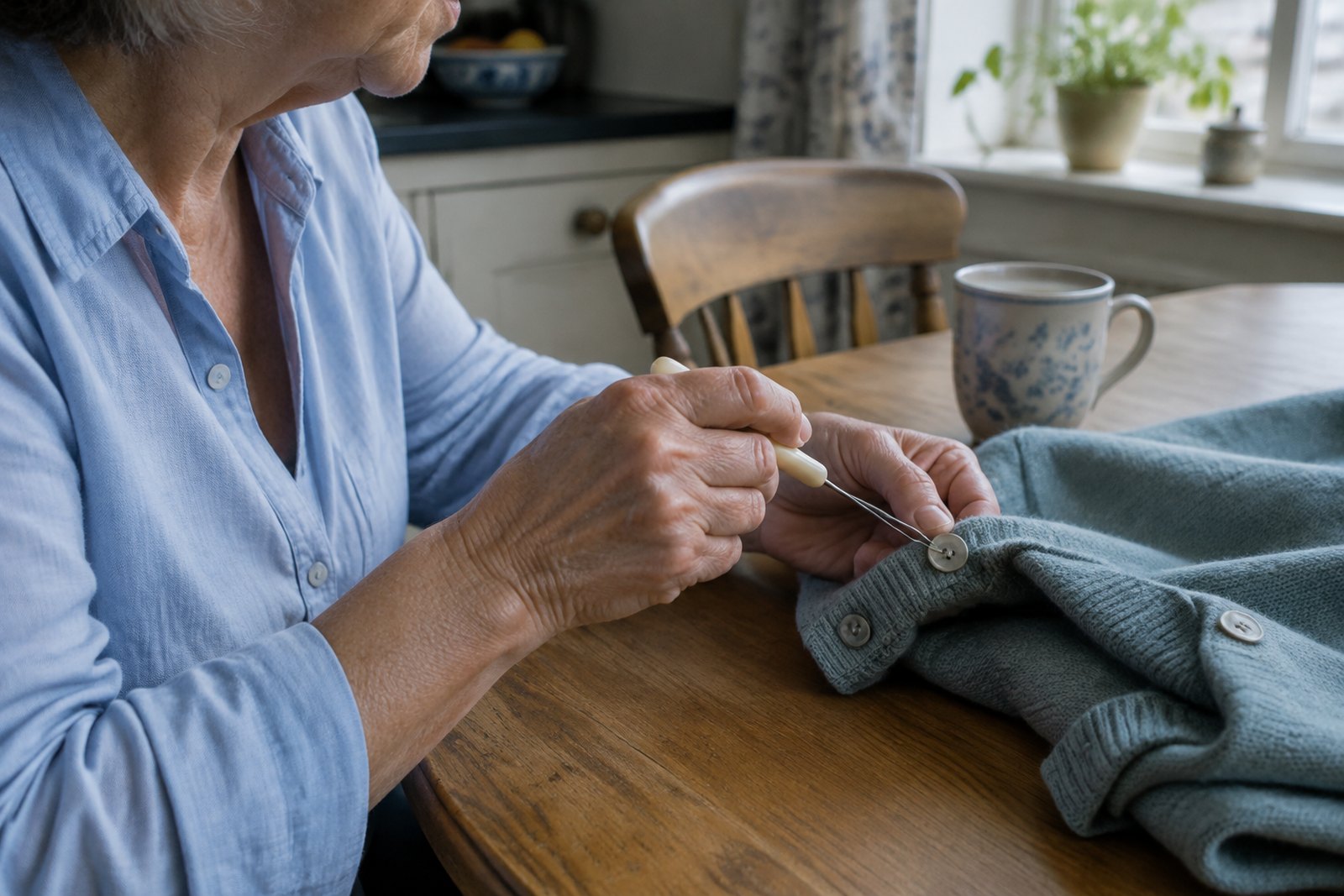
A button hook is a small handle with a wire loop on the end. You push the loop through the buttonhole, catch the button, and pull it back through. It does the fiddly part your fingertips can no longer manage, whether that is because of arthritis, a stroke, a tremor, numbness or a wrist in plaster. Most people get the hang of one within a few tries, and it is one of the least expensive dressing aids there is.
It is not the only answer, though, and sometimes not the best one. Zip pullers, zip rings, magnetic and hook-and-loop fastenings, elastic laces and a few changes to what you buy can remove the problem altogether. This guide explains how each one works, who it suits, and when the real issue is something an occupational therapist, GP or physiotherapist should look at.
How to use a button hook, step by step
Button hooks vary more than you would expect. Some have a thin handle like a pen, which is hopeless if your grip is weak. Others have a thick, soft handle you can hold in your whole fist. Some have a small metal hook on the other end for pulling zips. If gripping is the main problem, choose the chunkiest handle you can find. If you already have a thin one, a length of foam tubing pushed over the handle makes a big difference.
Practise first with the shirt or cardigan laid flat on a table, buttoned edges lined up. Once it makes sense, try it while wearing the garment, sitting down.
- Line the two edges up. Match the bottom button to the bottom buttonhole. Most people find working from the bottom up easier, because you can see what you are doing and the edges stay level.
- Hold the handle in your stronger hand, with the wire loop pointing away from you.
- Push the loop through the buttonhole from the outside, so it comes out on the inside of the fabric, next to the button.
- Hook the loop over the button. It should sit around the thread underneath the button, not just catch the edge.
- Pull the hook gently back through the buttonhole. The button turns on its side and follows the loop through.
- Twist the handle slightly and slide the loop off. The button settles flat on the outside.
- Move up to the next one. Rest between buttons if your hands tire.
Tips that make it easier
- Rest your elbows on a table if you have a tremor. Steadier forearms mean a steadier hook.
- Buttons sewn on very tightly are harder. A button with a little stalk of thread underneath (a shank) gives the loop something to catch. Anyone who sews can re-attach buttons this way.
- Larger buttons and looser buttonholes are kinder. Tiny shirt buttons are the hardest of all.
- Undoing is usually easier than doing up. Many people undo with their thumb, pushing the button back through, and only use the hook for fastening.
- Good light matters, especially if your eyesight is not what it was.
Zip pullers and zip rings
Zips cause two separate problems: gripping the small tag, and starting an open-ended zip on a coat. They need different solutions.
Gripping the tag
A zip ring or zip pull is a loop that clips onto the zip tag so you can hook a finger, or your whole hand, through it instead of pinching. You can buy them ready-made, or use a small key ring, a loop of cord or a loop of ribbon threaded through the hole in the tag. Put one on every coat, bag and trouser fly that gives you trouble.
A zip puller on a handle is a small hook on the end of a stick. You catch the tag with the hook and pull. It is useful for zips at the back of a dress or skirt, or if you cannot reach far because of a stiff shoulder. Many button hooks have one on the other end.
Starting a coat zip
Fitting the pin into the box at the bottom of a coat zip needs two hands and fine control. It is often the single hardest fastening in the house. Options worth trying:
- Leave the zip partly done up and put the coat on over your head like a jumper.
- Look for coats with a magnetic self-aligning zip, where the bottom ends snap together and you just pull up.
- Choose coats or fleeces that fasten with large toggles or hook-and-loop, or that have no fastening at all.
- Accept help with just that one step, if someone is around, and do the rest yourself.
Magnetic and hook-and-loop fastenings
These replace buttons rather than helping you do them.
Magnetic fastenings come in shirts made to look like ordinary button-up shirts, with small magnets hidden behind the buttons. The edges pull together when they get close. They suit people with very little finger movement and work well one-handed. You can also have favourite shirts converted: the buttons are sewn on top of the closed buttonholes for show, and magnets go underneath. If you have a pacemaker or any other implanted device, read the FAQ below before buying.
Hook-and-loop strips are cheap, easy to sew on and need almost no precision. The downsides are real, though. They catch on knitwear and tights, collect fluff, get noisier and weaker with age, and should be closed before washing. Wide strips with a tab you can grab are easier than thin ones.
Shoes: elastic laces, lace locks and other options
Bending to tie laces is as much of a problem as the knot itself, so think about both.
- Elastic laces replace normal laces and stay tied, turning a lace-up into a slip-on. Some are curly, some are straight with a toggle. Set them so the shoe still holds your heel firmly.
- Lace locks are small spring toggles. You pull the lace tight, slide the toggle down, and never tie a bow.
- Shoes with hook-and-loop straps are the simplest of all, and now come in styles that do not look clinical.
- A long-handled shoehorn means you can get your heel in without bending. A sock aid does the same for socks. Our guide to dressing aids and easier ways to get dressed covers both.
One warning. The easiest shoe to put on is a loose, backless slipper, and that is also one of the easiest ways to trip. Whatever you choose, it should grip your heel and stay on when you walk. If you have diabetes, poor circulation or numb feet, ask your GP practice about a podiatry check before changing footwear.
Cuffs, collars and ties
Shirt cuffs defeat a lot of people who can manage everything else, because you only have one hand free to do them.
- Elastic thread on cuff buttons. Sew the cuff buttons back on with elastic thread. The cuff stays buttoned permanently and stretches enough for your hand to slide through.
- Cufflink-style button connectors. These are two buttons joined by a short bar. You fit them through both cuff holes once, like a cufflink, and leave them there.
- Collar extenders. A small loop with a button on it fits through the top buttonhole and adds a little room at the neck. Useful if the top button is impossible, or if your neck size has changed. Under a tie, nobody can see it.
- Ties. Clip-on and pre-tied ties exist for good reason. Or loosen a tied tie, slip it over your head, and leave it knotted.
Clothing choices that remove the fastening altogether
Often the quickest fix is not an aid at all. Small changes when you next buy clothes can save a lot of daily frustration:
- Trousers and skirts with elastic or partly elasticated waists, so there is no button or fly to deal with.
- Polo shirts and tops with two or three large buttons, rather than a full row of small ones.
- Front-fastening bras, or soft pull-on styles with no clasp. If you prefer a back-fastening bra, fasten it at the front around your waist, then turn it round and pull the straps up.
- Stretchy fabrics and roomier sleeves, which are easier to get arms into, especially with stiff shoulders.
- Cardigans and wrap styles that close loosely or not at all.
- Leaving the top buttons done up on a shirt and pulling it on over your head.
None of this means giving up on looking like yourself. Plenty of ordinary high street clothing fits these rules if you know what to look for. If arthritis is behind the problem, it is also worth reading about joint protection for your hands, because repeated hard pinching of small buttons is exactly the kind of strain that guide helps you avoid.
Dressing one-handed
After a stroke, or with an arm in plaster or a sling, the rules change. A few principles help:
- Sit down, ideally on a firm chair with arms, so you are not balancing and dressing at once.
- Weaker or injured arm in first, out last. Put the sleeve on that arm and pull it well up to the shoulder before doing anything else.
- A button hook works one-handed, but the fabric tends to slide away from you. Rest your weaker forearm on the garment to anchor it, or do the buttons up with the shirt on your lap and put it on over your head.
- Magnetic fastenings, zip rings and elastic laces are especially worth having, because they need only one hand.
- Dress in stages if you tire easily. There is no rule that says it all has to happen at once.
For longer-term one-sided weakness, our guide to living with hemiplegia after a stroke goes into dressing and other daily tasks in more detail.
Helping a child learn buttons
Children learn buttons gradually, and most need lots of practice. Some tactics that help:
- Start with unbuttoning. It is easier, and success builds confidence.
- Begin with big buttons. An adult's cardigan laid on a table is a good practice garment. So is a simple homemade button strip: a ribbon with a large button sewn at one end and felt shapes with slits that the child threads on.
- Practise on clothes laid flat first, where they can see both hands, before doing buttons on themselves.
- Use backward chaining. You do every step except the last, and they finish it. Once that is easy, they do the last two steps, and so on. Finishing the job feels better than starting it.
- Make school mornings easier while they learn. Polo shirts, elastic or clip-on ties and hook-and-loop shoes take the pressure off, so practice happens at weekends when nobody is late.
A button hook is not usually the right tool for a child who is still learning, unless they have a physical condition affecting their hands. If your child is struggling noticeably more than others their age with buttons, pencils, cutlery or scissors, speak to their school or your GP. Our guide to fine motor skills by age explains what to look for.
Where an occupational therapist fits
Plenty of people can sort out buttons and zips with a few small aids and some changes to their wardrobe. You do not need a professional to buy a zip ring.
An occupational therapist is worth involving when the fastenings are part of a bigger picture. For example:
- Dressing as a whole has become hard, because of balance, reach, shoulder stiffness, pain or exhaustion, not just fiddly fingers.
- You have tried aids and they have not worked, or you are not sure which to choose.
- You have a condition that is likely to change, such as multiple sclerosis, Parkinson's or motor neurone disease, and want to plan ahead rather than react to each new difficulty.
- You are relearning dressing after a stroke or brain injury.
- Someone with dementia has stopped dressing themselves. Here the difficulty is often remembering the order of steps rather than finger strength, and aids can confuse more than help.
- You are a carer, and helping someone dress has become a daily struggle for both of you.
An occupational therapist will usually watch how you dress, look at how you grip and move, and suggest a mix of technique, equipment, clothing changes and routine. A private occupational therapist visiting at home sees your actual clothes, chair and bedroom, which makes the advice more practical. You can also ask for occupational therapy through your GP, who can refer you to NHS services, or through your council's adult social care team. Councils vary in what small items they supply, and many people simply buy small aids like button hooks themselves.
Other professionals lead in some situations:
- See your GP if you have new numbness, tingling or weakness in your hands, swollen or hot joints, or dexterity that is steadily getting worse without an obvious reason.
- Call 999 if weakness comes on suddenly, especially in the face or one arm, or with slurred speech. These can be signs of a stroke.
- A physiotherapist leads on shoulder stiffness, strength and movement.
- A hand therapist, who may be an occupational therapist or physiotherapist, is the right person after a hand or wrist injury or surgery.
Frequently asked questions
Is a button hook hard to use?
It feels awkward for the first few buttons and then usually clicks. Practise on a shirt laid flat on a table before trying it while wearing the shirt. If the handle is thin and hard to hold, a thicker handle or foam tubing over it often solves the problem.
Can you use a button hook with one hand?
Yes, though the fabric tends to slip away. Anchoring the garment with your weaker forearm helps, or button the shirt before putting it on and pull it over your head. Magnetic fastenings are often easier still for one-handed dressing.
Can I get a button hook or other dressing aids on the NHS?
Sometimes. An NHS or council occupational therapist may provide or recommend aids after an assessment, but what is supplied free varies between areas, and small, inexpensive items are often left for people to buy themselves. Ask your GP or council adult social care team what is available locally.
Are magnetic buttons safe if I have a pacemaker?
Magnets can interfere with pacemakers, implanted defibrillators and some other implanted medical devices. Before using magnetic clothing, check with the clinic or team that looks after your device, and follow the advice they give you. Hook-and-loop fastenings are an alternative that carries no such risk.
My dad has dementia and has stopped doing up his buttons. Will a button hook help?
Probably not on its own. In dementia the problem is often knowing what to do next rather than the physical action, and a new tool adds another step to remember. Simpler clothes with fewer fastenings, laying clothes out in the order they go on, and quiet prompting usually help more. An occupational therapist can look at the whole dressing routine with you.
What is the easiest shoe fastening if I cannot bend or grip?
Shoes with wide hook-and-loop straps, or lace-ups converted with elastic laces, combined with a long-handled shoehorn, mean you can put shoes on without bending far or tying anything. Make sure the shoe still grips your heel firmly so it does not slip off as you walk.
Next steps
If buttons and zips are just one part of a wider struggle with dressing, an occupational therapist can help you find the right mix of aids and techniques. See our equipment and daily living aids page, or current guide prices, and choose your area below.
Talk to an occupational therapist near you
This guide is general information. For advice about your own situation - or someone you look after - a local occupational therapist can visit you at home and see it for themselves.
Choose your area: