

Shower Chairs, Shower Stools and Bath Boards: Bathing Aids Explained
By Mobile Occupational Therapist • 19 August 2026 • 10 min read
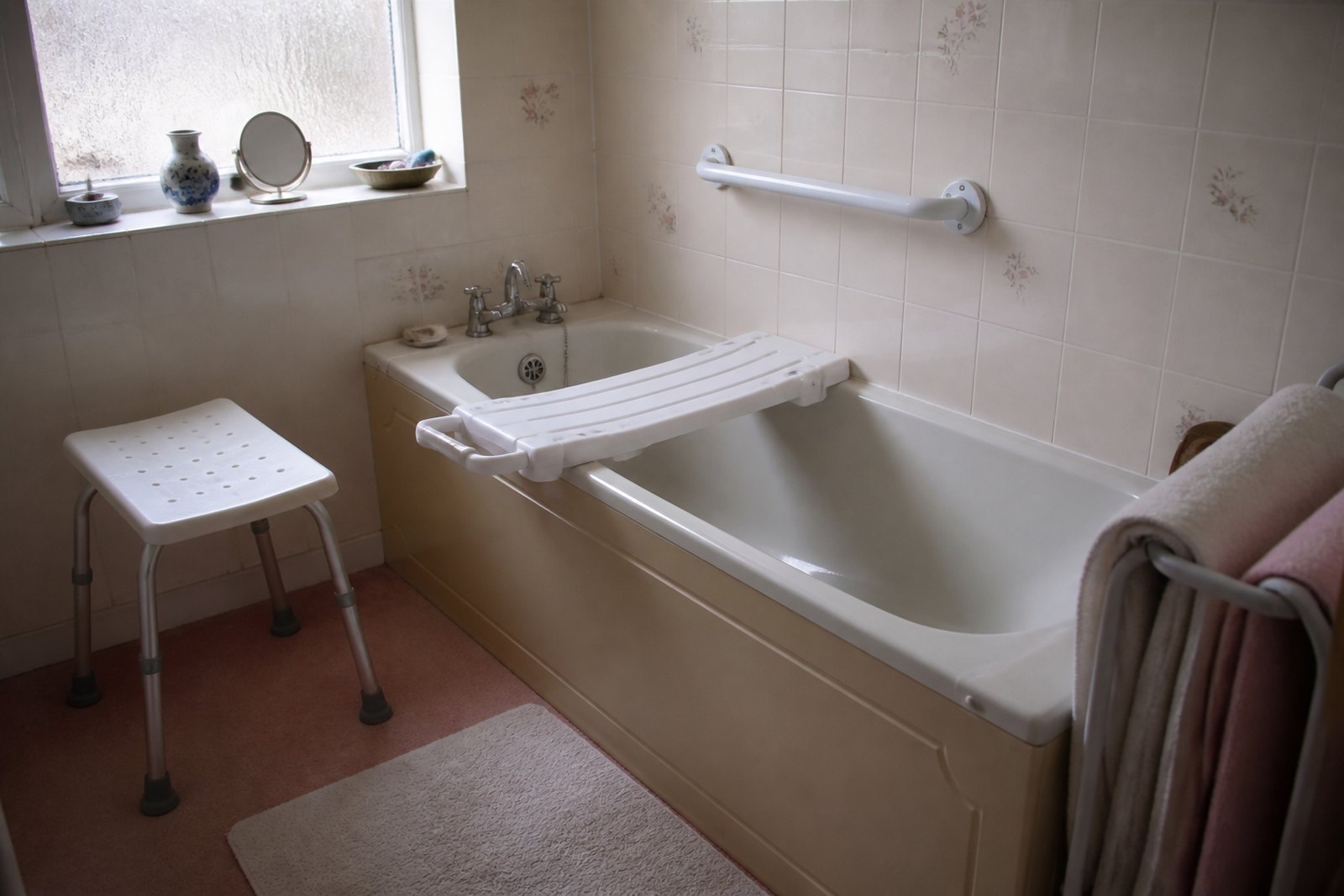
Washing is usually the activity people most want to keep doing themselves, and usually the one where difficulty is admitted last. It is also the highest-risk room in the house: hard surfaces, wet floors, awkward heights, and a task that has to be done partly undressed and often alone.
The good news is that the range of equipment is wide, most of it is inexpensive, and the right piece frequently restores independence completely. The difficulty is that the choice depends almost entirely on a single question people rarely ask directly.
The question that decides everything: bath or shower?
Almost every decision follows from whether the person is going to keep using a bath, or move to showering.
Getting into a bath means stepping over a rim roughly 50–60cm high, on one leg, on a wet surface - then lowering to the floor of the bath and, hardest of all, standing back up from near floor level. That last part is what most people lose first. Standing from the bottom of a bath needs more strength and range of movement than almost any other daily activity.
Showering removes the lowering and the standing, but adds standing balance for several minutes on a wet surface, sometimes with eyes closed while rinsing.
So the honest framing is: which of those two sets of demands can this person meet? Not "what equipment is available".
Aids for keeping the bath
Bath board
A board sitting across the top of the bath. You sit on it, swing your legs over, and wash from seated at rim height - never going down into the bath at all.
Suits: someone who can sit safely and swing their legs, but cannot get down to or up from the bath floor. Note: you are above the rim, so it is essentially a seated shower using the bath taps or a shower over the bath. It does not allow a soak.
Bath seat
Sits inside the bath, lower than a board, so you are partly down in the water. Useful when someone can lower a little way but not to the bath floor. Often used with a board - board to transfer in, seat to sit lower.
Bath lift
A battery-powered seat that lowers you to the bath floor and raises you back up. This is the one piece of equipment that genuinely lets someone keep having a proper bath when they can no longer get up unaided.
Suits: someone with reasonable sitting balance who wants to keep bathing. Points to check: it needs charging and it takes up the bath when not in use; battery failure with someone lowered into the bath is the scenario to ask the supplier about directly, as models handle it differently.
Grab rails and non-slip mats
Rarely enough on their own, but they make everything else safer. Position is what matters - see our guide to grab rails, and note that a bath rail clamped to the rim is not the same as a wall-fixed one.
Aids for showering
Shower stools and shower chairs
A shower stool or shower chair takes standing balance out of the equation entirely, which is very often the whole problem. The difference between the two is straightforward: a shower stool is a seat on four adjustable legs with no back and no arms, while a shower chair adds a backrest and usually arms. Choose the stool if someone sits confidently and wants room to move and wash; choose the chair if they need support behind them, tire quickly, or would benefit from arms to push up on when standing again.
Four things are worth checking before anything is bought, and they are the four that catch people out:
- The weight limit. Every shower stool and chair has one, it is often lower than people assume, and exceeding it is how legs bend and seats fail. Bariatric versions exist and are worth asking for rather than hoping.
- The feet. They should be rubber, in good condition, and flat on the floor. Worn ferrules on a wet floor are a genuine hazard, and they are a consumable - they need replacing, not ignoring.
- The height. Set so that feet rest flat on the floor with hips a little higher than knees. Too low and standing up again becomes the hardest part of the wash.
- The space. A shower chair with arms needs more room than people expect, and it has to be got in and out of the cubicle, not just fit inside it.
One warning that matters: a shower stool is not a perching stool, and the two are not interchangeable. Perching stools are not designed for wet use, and their forward-sloping seat is exactly wrong in a shower - see our guide to perching stools for the full explanation. Nor is a kitchen or garden stool a substitute, however similar it looks.
Wall-mounted fold-down shower seat
A fold-down shower seat fixes to the wall and folds flat when not in use, so the shower stays usable by everyone else in the house - which makes it the usual choice in a shared family bathroom, and the one most often fitted as part of a level-access shower. It needs proper fixing into a wall that can genuinely take it: the same substrate considerations as a grab rail, and considerably more load, since it carries a person's full seated weight plus the shock of them dropping the last inch onto it. This is not a job for wall plugs into tile alone, and it is the one item on this page we would never suggest fitting yourself.
Half-step
A small step for getting over a shower tray lip or bath rim, reducing the height of a single big step into two smaller ones. Cheap and frequently overlooked.
Long-handled sponges and tap turners
Small aids for reach and grip, which sound trivial and often make the difference between managing alone and needing help. Particularly relevant after a hip or shoulder operation, or with arthritic hands.
When adapting the bathroom is the honest answer
Sometimes equipment is patching over a room that no longer works, and continuing to add aids is the more expensive path. Signs it is time to consider the room itself:
- Two or three pieces of equipment are already in use and it is still difficult or frightening.
- Someone is washing at the basin because the bath or shower has become impossible - often not mentioned until asked directly.
- The difficulty is progressive, so today's solution will not hold for long.
- A wheelchair or walking frame cannot get into the room at all.
The usual conversion is a bath removed and replaced with a level-access shower - no tray lip to step over, room for a seat, and space for someone to help if needed. It is disruptive and not cheap, but for a progressive condition it is frequently the intervention that lasts.
Funding for this kind of work usually runs through a Disabled Facilities Grant, which is means-tested and requires an occupational therapy assessment. Our guide to the Disabled Facilities Grant explains the process.
A note on walk-in baths
Walk-in baths - with a door in the side - are heavily advertised to older people, and they suit some people well. Two things are worth knowing before committing, because they are rarely prominent in the advertising:
- You must sit in the bath while it fills, and again while it drains, because the door cannot open until the water is out. That is several minutes sitting wet and uncovered at each end, which many people find cold and unpleasant.
- You still have to stand up from a seated position inside the bath. If standing up is the difficulty, a walk-in bath may not solve it.
None of that makes them a bad product - it makes them a product worth assessing against the specific difficulty before spending several thousand pounds. This is exactly the kind of decision worth an independent opinion from someone with nothing to sell.
How to get bathing equipment
Smaller items - boards, seats, stools, rails - are commonly provided through local authority adult social care after a free needs assessment you can request yourself. Bath lifts are sometimes provided and sometimes not, depending on the area and the assessment. Major work goes through the Disabled Facilities Grant route.
Buying privately is straightforward. The one thing worth getting assessed first is which item, because bathing equipment is where people most often buy something that turns out to solve a different problem from the one they have.
Frequently asked questions
What bath aids are best for elderly people?
It depends entirely on whether they are keeping the bath or moving to showering. For keeping a bath: a bath board if they cannot get down to the bath floor, a bath lift if they want to keep having a proper bath. For showering: a shower stool or wall-mounted fold-down seat. There is no single best aid - the right one follows from which part of the task has become difficult.
What is the difference between a bath board and a bath seat?
A bath board sits across the top of the bath at rim height, so you never go down into it. A bath seat sits inside the bath, lower, so you are partly in the water. Boards are for people who cannot get down at all; seats are for people who can lower part-way. They are often used together.
Are walk-in baths worth it?
For some people, yes - but two points get little attention in the advertising. You have to sit in the bath while it fills and again while it drains, because the door cannot open with water in, which is several cold minutes at each end. And you still have to stand up from seated inside the bath, so if standing is the difficulty, it may not solve it. Worth an independent assessment before committing several thousand pounds.
Is a walk-in shower better than a bath for elderly people?
Often, because it removes the hardest part - standing up from near floor level. But it adds standing balance on a wet surface, so it is only better if that balance is there, or if a shower seat is fitted. A level-access shower with a seat suits most people who are finding a bath difficult.
Can I get bathing equipment free from the council?
Smaller items - boards, seats, stools and rails - commonly yes, following a free needs assessment you can request yourself. Bath lifts vary by area. Major work such as removing a bath for a level-access shower goes through the means-tested Disabled Facilities Grant.
Next steps
If washing has become difficult, or someone has quietly stopped bathing and started washing at the basin, that is worth acting on - it affects skin health, comfort and dignity, and it usually has a straightforward solution. An occupational therapist can assess the room and the movement together. See the areas we cover, our whole-bathroom safety guide, or current guide pricing.
Talk to an occupational therapist near you
This guide is general information. For advice about your own situation - or someone you look after - a local occupational therapist can visit you at home and see it for themselves.
Choose your area: