

Adapted Cutlery, Plate Guards and Drinking Aids: An OT's Guide
By Mobile Occupational Therapist • 5 October 2026 • 13 min read
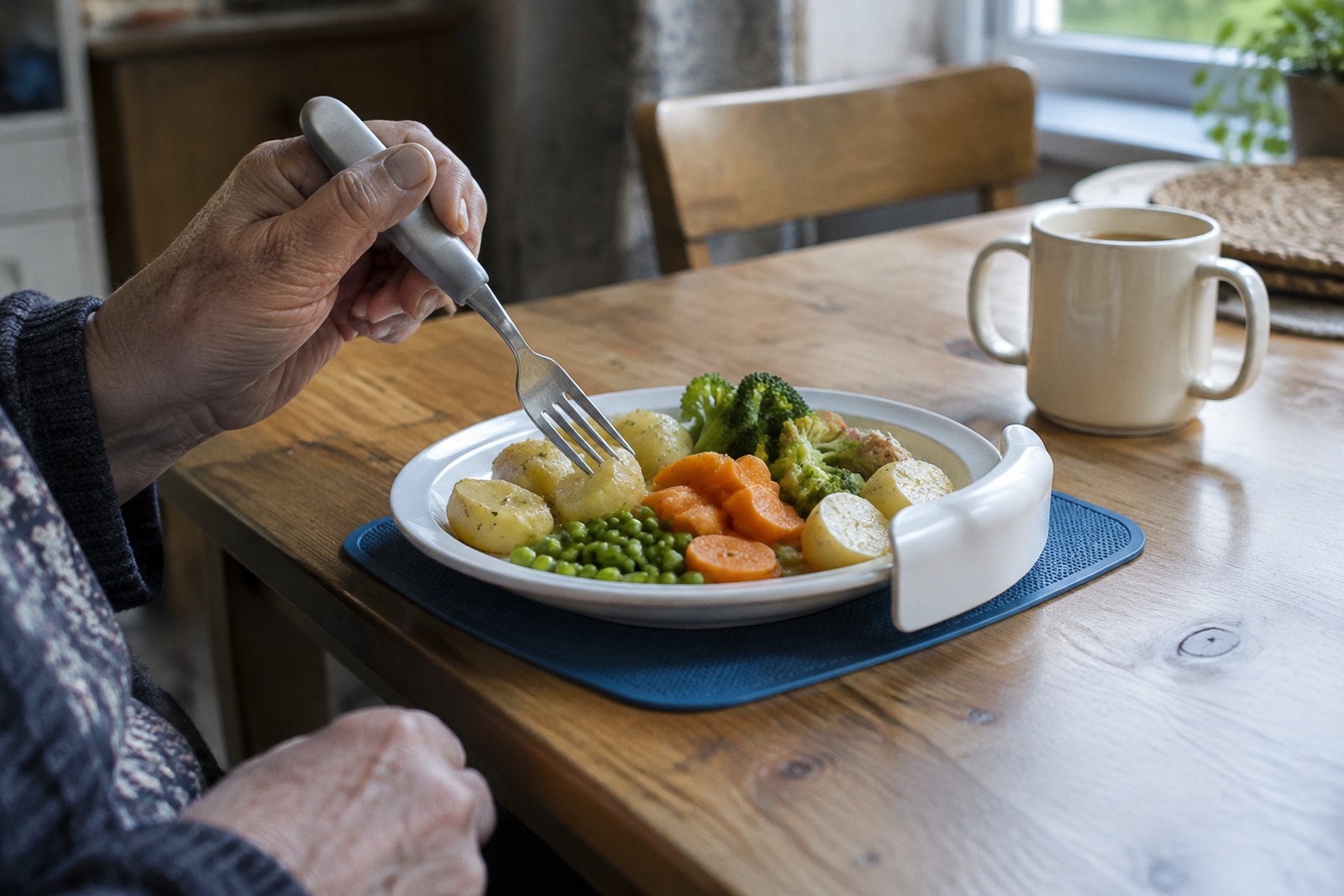
Adapted cutlery is ordinary cutlery changed so it is easier to hold and use. It might have a thicker handle, a bend in the neck, extra weight, or a blade that rocks instead of saws. Plate guards and scoop plates give food something to push against, so it ends up on the fork rather than on the table. Two-handled and lidded cups make drinking steadier and less messy. Between them, they solve most of the everyday problems people have at mealtimes when hands are stiff, weak, shaky, or when only one hand is working.
The right item depends on why eating has got harder, not on the diagnosis alone. Someone with arthritis usually needs a bigger, lighter handle. Someone after a stroke often needs to manage everything one-handed. Someone with a tremor may do better with weight. Most of this equipment is inexpensive, and a lot of it you can test with things already in your kitchen. One category is different: flow-control cups and thickened drinks are for swallowing problems, and they should only ever be used on the advice of a speech and language therapist. More on that below.
First, work out what the actual problem is
Before buying anything, watch a normal meal, or ask the person to talk you through one. Mealtime difficulties usually fall into a few groups, and each group points to different equipment:
- Gripping. The handle is too thin to hold, or holding it hurts.
- Reaching the mouth. The wrist, elbow or shoulder will not turn far enough to bring the spoon round.
- Cutting. There is not enough strength, or only one hand to work with.
- Chasing food. Peas and rice escape off the edge of the plate.
- The plate or bowl moving. It slides away every time the fork pushes against it.
- Shaking and spilling. Food falls off the spoon or drink slops out of the cup.
- Losing track. With dementia, the person may not recognise food on a busy plate, stop partway, or not know what the fork is for.
- Coughing or choking. This is a swallowing question, not an equipment question.
Often there is more than one. That is fine. Start with the problem that causes the most frustration or mess and solve that first.
Adapted cutlery: the main types
Built-up handles
These are knives, forks and spoons with thick, soft or textured handles. A fatter handle needs less finger bend and less squeezing to hold, which is why they suit stiff or painful hands. You can buy cutlery with the thick handle built in, or buy foam tubing that slides over your existing cutlery. The tubing is a cheap way to find out whether a thicker grip helps before spending more.
Watch the weight. Some built-up cutlery is light; some is surprisingly heavy. For weak or painful hands, lighter is usually better.
Angled and bendable cutlery
Angled cutlery has a bend between the handle and the bowl of the spoon or the head of the fork, so it reaches the mouth without the wrist having to turn. Some types are sold as left-handed or right-handed, so check before ordering. Bendable versions let you set the angle yourself, which is useful if you are not sure how much bend is needed. These help when the wrist, elbow or shoulder will not move freely.
Weighted cutlery for tremor
Weighted cutlery is heavier than normal. For some people with a tremor, the extra weight dampens the shake and makes it easier to keep food on the spoon. It does not work for everyone, and it is worth knowing that it can tire out weaker arms over a full meal. Try it for a whole meal, not just a few mouthfuls, before deciding.
Rocker knives and combined cutlery
A rocker knife has a curved blade. Instead of sawing back and forth while a fork holds the food still, you press down and rock it from side to side. That means you can cut with one hand, which is why rocker knives are a mainstay after a stroke. They also help when there is not enough strength to saw.
Combined cutlery merges two tools into one, such as a fork with a cutting edge on one side or a spoon with fork tines at the tip. Fewer tools means fewer swaps between hands. Take care with any item that has a cutting edge, especially for someone with reduced feeling in their lips or mouth.
Plates, bowls and keeping things still
Plate guards
A plate guard is a raised rim, usually plastic, that clips onto the edge of an ordinary plate. It gives you a wall to push food against so it slides onto the fork or spoon instead of over the edge. Most clip onto round plates of a certain size, so measure your plates first. A plate guard only needs to go on part of the rim, on the side the person pushes towards.
Scoop plates and high-sided bowls
A scoop plate has the raised edge built in, often higher on one side and sloping inwards. It does the same job as a plate guard but without anything to clip on or fall off. A pasta bowl or a deep dish you already own can do a similar job and is worth trying first. These suit anyone eating one-handed, anyone with poor coordination, and many people with dementia.
Non-slip mats
A non-slip mat is a thin, grippy sheet that goes under the plate, bowl or cup so it does not slide. It is one of the simplest and most useful things on this list. A slightly damp tea towel folded flat under the plate does a fair imitation and costs nothing. Some plates and bowls have a suction base instead. Non-slip matting is also handy for opening jars, which our guide to kitchen aids and mealtime independence covers along with preparing food.
Drinking aids
Two-handled cups
A two-handled cup lets you hold it with both hands, which spreads the weight and gives far more control. It helps people with weak or painful hands, people with a tremor, and anyone whose grip on one side is unreliable. Look for a size and weight that is manageable when full, because a large mug of tea is heavier than people expect.
Lidded cups
A lid stops spills when a cup is knocked or shaken. Some lids have a small slot or opening to drink through, so the person can still sip from the rim rather than suck through a spout. Lidded cups are useful for tremor and for drinks carried from room to room. If there are any signs of swallowing difficulty, such as coughing when drinking, ask for advice before using any cup with a spout or narrow opening, because these can change how quickly liquid reaches the back of the mouth.
Dignity matters here too. A spouted beaker can feel like a child's cup to an adult, and some people will drink less rather than use one. A plain lidded mug or a two-handled cup often goes down better.
Cut-out cups
These cups have a section cut away from the rim on one side, so the cup can be tipped to drink without the person needing to tip their head back. They can help people with limited neck movement. They are sometimes recommended for swallowing problems too, but if that is the reason, it should come from a speech and language therapist.
Flow-control cups and thickened drinks: not a do-it-yourself job
Flow-control cups deliver a small, set amount of liquid with each sip. Thickening powders change how runny a drink is. Both are used for dysphagia, which means difficulty swallowing safely. They are prescribed after a speech and language therapist has assessed the swallow, and the type and level are chosen for that person. Guessing can make things worse, or can hide a problem that needs proper investigation.
If someone coughs, splutters or sounds wet or gurgly when eating or drinking, takes a very long time to swallow, keeps getting chest infections, or is losing weight, speak to the GP and ask about a referral to speech and language therapy. If someone is choking and cannot cough, speak or breathe, call 999. Sudden new difficulty swallowing, especially with facial drooping, arm weakness or slurred speech, can be a stroke: call 999.
Who each one tends to help
Arthritis
Built-up, lightweight handles are usually the first thing to try, because they reduce the squeezing that hurts. Angled cutlery helps when the wrist will not turn. Two-handled cups take load off sore fingers. Our arthritis page has more on how an occupational therapist can help with everyday hand use.
Stroke
The big theme after a stroke is doing everything with one hand. A rocker knife or combined cutlery, a plate guard or scoop plate, and a non-slip mat together make one-handed eating far easier. Cutting food up in the kitchen before it reaches the table is another option, though many people prefer to do it themselves. If one side of vision is affected, food on that side of the plate may be missed, so turning the plate is worth knowing about. Our guide to stroke recovery at home covers relearning everyday tasks more widely.
Tremor and Parkinson's
Weighted cutlery, lidded cups, two-handled cups and non-slip mats are the usual starting points. Resting the elbow on the table and sitting close in can help as much as any gadget. A new tremor, or one that is changing quickly, should be seen by a GP, because the cause matters. There is more in our guide to Parkinson's and everyday tasks.
Dementia
Here equipment is only part of it. A plain plate in a colour that contrasts with the food and the table can make food easier to see. Patterned plates and busy tablecloths can be confusing. A scoop plate reduces mess and frustration. Keep the place setting simple, with just the cutlery needed. Finger foods can help someone who has stopped using cutlery reliably. Unfamiliar-looking equipment may not be used at all, so try it gently and watch.
How to try before you buy
Equipment that sits in a drawer helps nobody. A few ways to avoid that:
- Test with what you have. Foam tubing on existing cutlery, a damp tea towel under the plate, a deep pasta bowl instead of a plate, a mug held in both hands. If these help, the proper version probably will too.
- Try one change at a time. Otherwise you will not know what made the difference.
- Use it for a real meal. A few practice mouthfuls tell you little. Fatigue, weight and comfort show up over a full plate.
- Ask about demonstration centres. Some areas have a disabled living centre or equipment showroom where you can handle items. Your council or a local disability charity can tell you if there is one nearby.
- Check returns policies. Some sellers will not take back eating equipment once used, for hygiene reasons. Check before ordering.
- Check washing instructions. Not all handles and lids cope with a dishwasher or microwave.
Paying for it, and VAT relief
Most small eating aids are inexpensive, and many people simply buy them. Some councils provide small aids after an assessment, but policies vary, so it is worth asking adult social care. If you have a long-term illness or disability, equipment designed for disabled people can often be bought without VAT. The seller will usually ask you to fill in a short declaration; our guide to VAT relief on disability equipment explains who qualifies, and GOV.UK has the official rules.
Where an occupational therapist fits (and where they do not)
An occupational therapist looks at the whole mealtime, not just the cutlery. That includes how the person sits at the table, whether the chair is the right height, how far the plate is, what their hands, arms and shoulders can actually do, how tiring the meal is, and what matters to them about eating independently. They can suggest which equipment to try, show how to use it, and recommend changes to seating or set-up that often help as much as the equipment itself. A private occupational therapist visiting at home sees the real table, the real chair and the real plates, which is where problems show up.
An occupational therapist is not the right lead for everything:
- Swallowing problems are assessed by a speech and language therapist. Ask the GP for a referral.
- Weight loss or poor appetite should go to the GP first, who may involve a dietitian.
- A new or worsening tremor needs a GP to look at the cause.
- Sore mouth, loose dentures or tooth pain are for a dentist.
If you are unsure, starting with the GP is a sensible first step, but for choking or signs of a stroke, call 999.
Frequently asked questions
Can I get adapted cutlery free on the NHS?
Sometimes. If you are under an NHS or council occupational therapist, for example after a stroke, they may provide small aids. Provision varies a lot between areas, and many people end up buying their own. Ask your GP, hospital team or council adult social care what is available locally.
Does weighted cutlery work for Parkinson's?
It helps some people with tremor and not others. The only way to know is to try it over a full meal. If the arms tire quickly, a lighter option with a plate guard and non-slip mat may work better.
What is the difference between a plate guard and a scoop plate?
A plate guard clips onto an ordinary plate to add a raised edge. A scoop plate has the raised edge built in. A plate guard lets you keep using your own crockery; a scoop plate has nothing to come loose.
My mum coughs when she drinks. Should I buy her a spouted cup?
No, not without advice. Coughing when drinking can be a sign of a swallowing problem. Speak to her GP and ask about a speech and language therapy referral. They will advise on the right cup and drink consistency, if any is needed.
My dad is embarrassed to use special equipment. What can I do?
Start with the most ordinary-looking options: a deep bowl, a mug held in two hands, a placemat that grips. Many adapted items now look like normal tableware. Let him choose, and frame it around what he wants to keep doing, like eating with the family.
Can children use adapted cutlery?
Yes, and there are child-sized versions. If a child is struggling with cutlery beyond what is expected for their age, a paediatric occupational therapist can look at the underlying skills rather than just the tools.
Next steps
If mealtimes have become a struggle and you are not sure where to start, an occupational therapist can look at the whole picture at home. See our equipment and aids page, or current guide prices, and choose your area below.
Talk to an occupational therapist near you
This guide is general information. For advice about your own situation - or someone you look after - a local occupational therapist can visit you at home and see it for themselves.
Choose your area: