

Washing Aids: Long Handled Sponges, Toe Washers and Tap Turners
By Mobile Occupational Therapist • 14 October 2026 • 14 min read
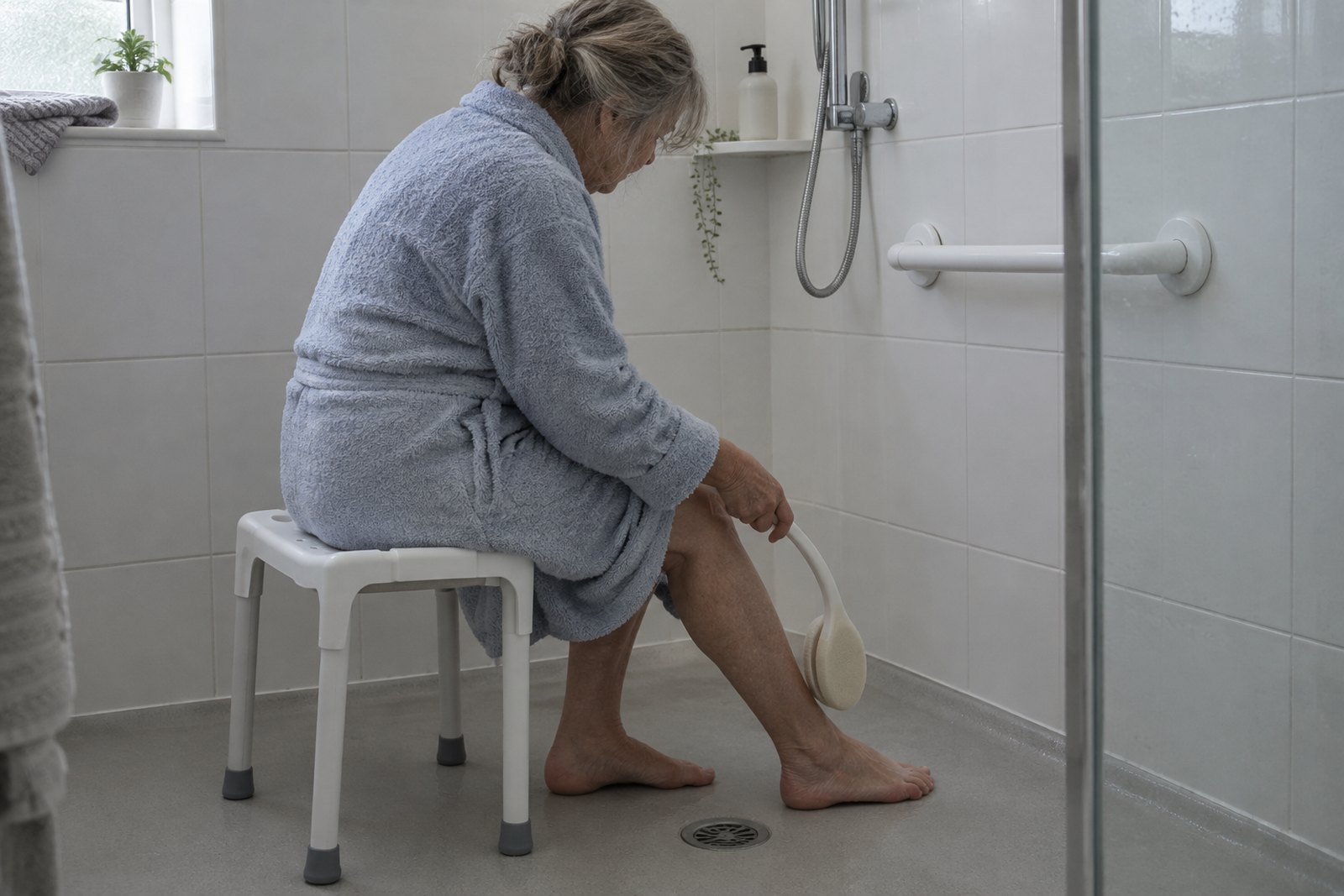
If bending down to your feet, reaching your back or gripping a slippery bar of soap has become hard work, there is a small set of cheap, simple washing aids made for exactly that. A long-handled sponge or brush reaches your legs, feet and back without you bending. A toe washer gets between your toes. A tap turner gives you leverage on stiff taps. Pump dispensers, wash mitts and soap on a rope deal with weak or painful grip. None of them is clever. Most of them work.
The useful question is not which gadget to buy. It is which part of washing is actually difficult, and why. Bending, reaching, gripping, balance and managing with one hand are different problems with different answers. This guide goes through each aid, who it suits, how to use it well and how to get one, including free routes. If getting in and out of the bath or shower is the main problem, our guide to bath and shower aids for older adults covers seats, boards and rails. This one is about the washing itself.
Start with what is actually hard
Before buying anything, run through a normal wash in your head, or watch yourself do it, and notice where it goes wrong. Most difficulties fall into one of these:
- Bending to your lower legs and feet, because of stiff hips, back pain, knee problems or recent surgery.
- Reaching your back, the back of your head or across your body, usually because of shoulder pain or stiffness.
- Gripping soap, flannels, bottles and taps, often with arthritis, a hand injury or weakness.
- Balance while standing, especially with wet feet, eyes closed for hair washing, or when tired.
- Using one hand, after a stroke, a broken wrist or with one arm in a sling.
- Feeling what you are doing, if sensation in your feet or hands is reduced, as it can be with diabetes or nerve damage.
Write down the two or three that apply. It makes the rest of this guide shorter, and it stops you buying a drawer full of things you never use.
Long-handled sponges and brushes
What they are
A long-handled sponge is exactly what it sounds like: a sponge on the end of a plastic handle, usually somewhere between the length of your forearm and the length of your whole arm. Many handles are curved so the sponge sits at a useful angle against your shins or back. Some have a soft bristle brush instead of a sponge, and some have a handle you can bend to the angle you want.
Choosing one
- Length. For feet and lower legs, you want enough handle to reach your toes while sitting upright. For your back, a curved handle usually works better than a long straight one.
- Handle thickness. If your grip is weak or painful, a fatter, softer handle is easier to hold than a thin hard one. A non-slip surface matters when it is wet and soapy.
- Weight. A big sponge holds a lot of water and gets heavy at the end of a long handle. If your wrists or shoulders are sore, a smaller head is kinder.
- Replaceable heads. Sponges get grubby. Being able to swap the head is cheaper than replacing the whole thing.
Using one well
Sit down if you can. Wet the sponge and put the soap or shower gel on it before you start, so you are not juggling a bottle at the same time. Work from the top down: thighs, knees, shins, then feet. Rinse with a hand-held shower head or a jug of water, then dry with a towel draped over the sponge end, or with a long-handled towel aid if you have one.
Afterwards, rinse the sponge well, squeeze it out and hang it somewhere it can dry properly. A sponge left soggy in the bottom of the shower tray will start to smell, and that is your cue to replace it.
Back brushes
Long-handled back brushes are the same idea with a curve designed for reaching between the shoulder blades. There is also a strap type: a strip of towelling or bristle with a handle at each end, which you hold behind your back and pull from side to side. The strap type needs both hands and a fair amount of shoulder movement, so it suits people whose problem is reach rather than shoulder pain.
Toe washers
A toe washer is a long handle with a thin, soft head, often a slim sponge or a flat flexible paddle, designed to slide between your toes. Some have a clip or loop for holding a piece of soap. A long-handled sponge cleans the top and sole of your foot well enough, but it is too bulky to get between the toes, which is exactly where moisture, dead skin and fungal infections like to sit.
Drying between the toes matters as much as washing. Some people fold a thin flannel or piece of kitchen roll over the toe washer head and use it as a dryer. Others use a long-handled foot dryer with a towelling head. Either works. Taking your time over this is worth it.
If you have diabetes or reduced feeling in your feet
If you have diabetes, the NHS advises checking your feet every day, because a small cut or blister you cannot feel can become a serious problem. Washing is a natural time to do it. A few practical points:
- Check water temperature with your elbow or a bath thermometer, not your feet. Reduced feeling means you can scald yourself without noticing.
- Look at the soles of your feet with a long-handled mirror, or a mirror propped on the floor. If you cannot see well enough, ask someone to look for you.
- Dry carefully between the toes, and follow your diabetes team's advice about moisturising. Diabetes foot advice usually says not to put cream between the toes.
- Do not cut your own toenails if your GP or podiatrist has told you not to. Ask about NHS podiatry.
Contact your GP practice or your foot protection service the same day if you notice a new cut, blister, sore, swelling, warmth or change in colour. If you have diabetes and your foot is hot, red and swollen, or part of your foot or a toe has turned dark or black, get help urgently the same day from your GP, foot protection service or NHS 111. If you also feel very unwell, shivery or have a high temperature, go to A&E or call 999.
Tap turners and lever taps
Old cross-head and round taps can be hard to turn if your hands are stiff, painful or weak. A tap turner is a handle that fits over the tap head and gives you a lever. Some have adjustable pegs that grip different tap shapes; others have a slot designed for cross-head taps. Before buying, check the shape of your taps. A turner designed for cross-heads will not grip a smooth round tap.
A more permanent answer is lever taps, which you can push on and off with the side of your hand or your forearm. Sometimes only the tap heads need changing; sometimes the whole tap. A plumber can advise. If you have had a council needs assessment, small adaptations like lever taps may be something the council can arrange, so ask before paying.
If anyone in the house has reduced feeling, confusion or slow reactions, scalding is a real risk. A plumber can fit a thermostatic valve that limits the hot water temperature at the tap or shower. It is worth asking about whenever taps are changed.
Grip: soap, dispensers and wash mitts
Small changes here make a surprising difference:
- Soap on a rope hangs round your neck or from the shower so it cannot be dropped. You can make your own by putting a bar in a mesh bag with a loop.
- Pump dispensers for soap, shampoo and shower gel can be pressed with the heel of your hand. Decant from screw-top bottles once and you are done.
- Flip-top bottles are easier than screw caps, if you must keep the originals.
- Wash mitts are towelling gloves that stay on your hand without gripping. Some have a pocket for a bar of soap.
- A towelling dressing gown dries you without rubbing with a towel, which helps if drying your back or legs is the hard part.
Grooming: hair, teeth, shaving and nails
Long-handled combs and hairbrushes help if lifting your arm to your head is painful or limited. Some have angled heads so you can reach the back without twisting your wrist.
For a weak grip, thicker handles help across the board. You can buy foam tubing that slides over toothbrushes, combs, razors and cutlery to make them fatter and softer to hold. An electric toothbrush and an electric razor both have chunkier handles and do more of the work for you.
Nails are harder. A nail brush with suction feet stays put on the side of the basin. Nail clippers fixed to a small base can be pressed with the palm of your hand. An emery board stuck to the edge of a table lets you file by moving the finger rather than the board. Toenails are often the point where professional help is the safest option, particularly with diabetes, poor circulation or thickened nails.
Hair washing usually involves leaning forward with your eyes shut, which is a balance problem in disguise. Washing hair sitting down with a hand-held shower head, or having it washed by a hairdresser or family member, is often safer than standing at the basin.
Washing with one hand
After a stroke or with one arm out of action, the tricky part is often washing the good hand and arm. A few ideas that work:
- A suction nail brush fixed to the basin lets you scrub the good hand and nails by rubbing them over it.
- A suction soap holder keeps the soap where you can reach it.
- For the good arm, drape a soapy flannel over your knee or the edge of the basin and rub your arm across it.
- A wash mitt on the good hand means you are not trying to hold a flannel at the same time.
- Pump dispensers and an electric razor take the two-handed jobs out of the routine.
If one side of your body has reduced feeling, check that side's skin as you wash, and check water temperature with the hand that has normal sensation.
After a hip replacement
Some surgical teams give hip precautions after surgery, such as not bending your hip beyond a right angle, not crossing your legs and not twisting. Others no longer give them routinely. Follow the advice your own team gives you, not general advice online.
If you have been told to avoid deep bending, a long-handled sponge and a toe washer are not optional extras for the first weeks. Wash sitting on a seat high enough that your hips are above your knees, and do not twist round to reach behind you. Washing is usually paired with dressing, so our guides to life after a hip replacement and to dressing aids and easier ways to get dressed fill in the rest.
Sitting down to wash
Nearly every aid in this guide works better when you are sitting. Sitting takes balance out of the picture, frees both hands, and saves energy if you get tired or breathless. It also means a slip with a soapy foot is far less likely to turn into a fall. A stable stool or chair at the basin, or a shower seat, is often the single most useful change, and the aids then do the reaching for you.
How to get washing aids
Through the council. Contact adult social care and ask for a needs assessment. If you are assessed as needing equipment to manage daily tasks, it is usually provided through the local community equipment service. Some councils provide small washing aids; others point people towards buying low-cost items themselves. Check your council's website for how it works where you live.
Through the NHS. If you are in hospital for a planned operation such as a hip replacement, the hospital occupational therapy team will often talk to you about washing and dressing before you go home, and may supply or advise on equipment.
Buying your own. Pharmacies, mobility shops and online sellers stock all of these. Most are inexpensive. If you have a long-term condition or disability, equipment designed for disabled people can be eligible for VAT relief; GOV.UK explains the rules.
Where an occupational therapist fits
For one simple item, you probably do not need anyone's help. Where an occupational therapist earns their place is when washing has become a struggle in several ways at once, or when you are not sure whether it is safe.
An occupational therapist looks at the whole routine: how you get to the bathroom, whether you can stand or should sit, which parts you can reach, how your grip and balance hold up, and what order makes the job easier. They can suggest which aids are worth having and which are not, show you how to use them, and say when the answer is a bigger change such as lever taps, a different seat, or washing at the basin instead of the shower. A private occupational therapist visiting at home sees your actual bathroom, which matters more than people expect.
Other professionals lead in some areas. A physiotherapist helps with strength, flexibility and movement after surgery or injury. A podiatrist looks after toenails, corns and foot problems, especially with diabetes. Your GP or practice nurse should see any skin problem, rash or wound that is not healing, and a district nurse may be involved if you have dressings. If you need another person to help you wash, ask the council for a needs assessment for care and support.
Frequently asked questions
Can I get a long-handled sponge free on the NHS?
Sometimes. After some operations, the hospital occupational therapy team may supply one. Otherwise, the council's community equipment service may provide washing aids if you are assessed as needing them, though some councils expect people to buy small, low-cost items themselves. Ask adult social care how it works locally.
What is the difference between a toe washer and a long-handled sponge?
A long-handled sponge has a fairly big head for washing legs, feet and back. A toe washer has a thin, slim head designed to slide between your toes, which a sponge is too bulky to reach. Many people find they need both.
Do tap turners work on all taps?
No. They are designed for traditional taps you twist, and different designs suit different tap heads. Check whether yours are cross-head or round before buying. They are not needed for lever taps or mixer taps you push or lift.
How do I keep a long-handled sponge clean?
Rinse it thoroughly after each use, squeeze out as much water as you can and hang it up to dry, rather than leaving it in the shower tray. Replace the head, or the whole aid, when it starts to smell or look worn.
Is it safe to wash my feet with aids if I have diabetes?
Yes, and it can make daily foot care easier. Use a soft head, test the water with your elbow or a thermometer first, dry carefully between your toes and check your feet afterwards, using a mirror or another person if needed. Get any new cut, blister or colour change checked the same day.
Do I need an occupational therapy assessment just for small washing aids?
Not usually. If one task is the problem, a single aid may solve it. An assessment is worth considering if washing feels unsafe, you have had a fall, several things have become difficult at once, or you are not sure what would help.
Next steps
If washing has become a daily battle and you would like someone to look at the whole routine in your own bathroom, see our equipment and aids page, or current guide prices, and choose your area below.
Talk to an occupational therapist near you
This guide is general information. For advice about your own situation - or someone you look after - a local occupational therapist can visit you at home and see it for themselves.
Choose your area: