

Kettle Tippers and Jar Openers: Who They Help and How to Choose
By Mobile Occupational Therapist • 21 October 2026 • 14 min read
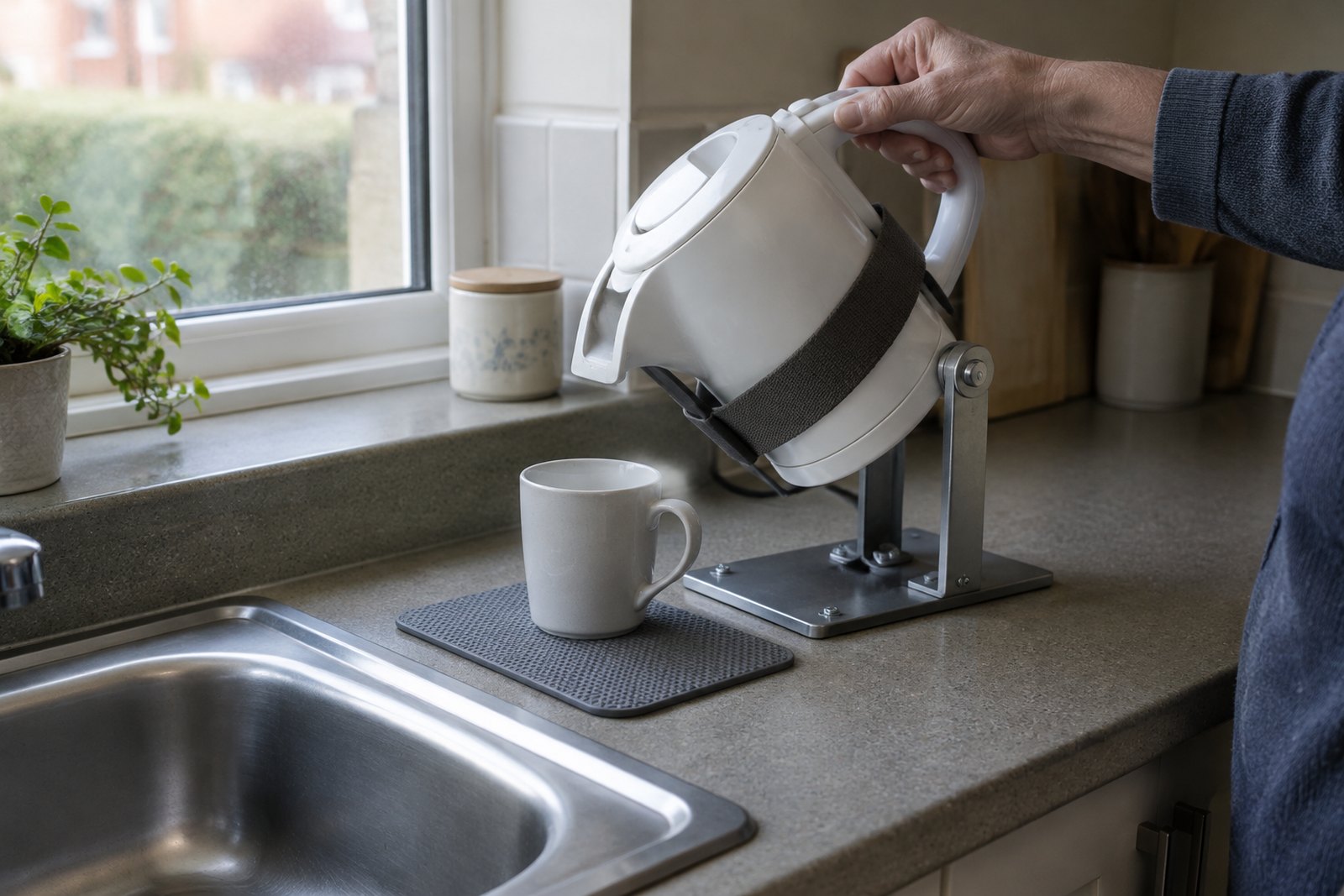
A kettle tipper is a cradle that holds your kettle and tilts it forward on a pivot, so you can pour hot water into a cup without lifting the kettle at all. A jar opener is any tool that gives your hand more grip or more leverage on a lid, from a simple rubber pad to a battery-powered gadget that twists the lid off for you. Both are small, inexpensive and easy to find. Both can make the difference between making your own cup of tea and waiting for someone else to do it.
They suit people with weak or painful hands, arthritis, a tremor, or the use of only one hand, whether that is after a stroke, a broken wrist or shoulder surgery. Which one is right depends on what exactly is hard for you: lifting, gripping, twisting or holding steady. This guide goes through each type, who it suits, how to set it up safely and when it is worth having someone look at the whole task with you. For the wider picture of kitchen equipment, from perching stools to adapted cutlery, see our guide to kitchen aids and mealtime independence. This page sticks to the kettle and the cupboard.
Why the kettle and the jar are where people give up
A full kettle is surprisingly heavy. Pouring from it means holding that weight away from your body, with your wrist bent, while controlling the angle and keeping it steady. That is close to the worst possible position for arthritic hands and the hardest possible task for a tremor. And the contents are boiling.
Jars are a different problem. A vacuum-sealed lid needs a strong grip and a hard twist, and most of that force goes through the small joints of the fingers and thumb. If those joints are sore, swollen or weak, the jar wins.
What often happens next is quiet. People drink fewer hot drinks, stop buying anything in a jar, or save things up for when family visit. If that sounds familiar, it is worth fixing. Drinking less is not a harmless habit, and losing the ability to make your own drink is often the first small step away from managing the kitchen at all.
Kettle tippers: what they are and who they suit
How a kettle tipper works
Most kettle tippers have three parts: a base that sits flat on the worktop, a platform or cradle that the kettle sits in, usually with a strap or bracket to hold it in place, and a pivot that lets the cradle rock forward. You boil the kettle in the cradle, then push gently on the handle or the back of the kettle. It tips, pours into the cup in front of it, and rocks back upright when you let go. The kettle never leaves the frame while it is hot.
Some tippers are designed around a particular size or shape of kettle and some are adjustable. Some are sold with a kettle included, which saves you working out whether yours will fit.
Who a kettle tipper suits
- Weak grip. You push rather than lift, so grip strength matters much less.
- Arthritis in the hands, wrists, elbows or shoulders. The tipper takes the weight, which fits well with the principles in our guide to arthritis and joint protection.
- Tremor. The frame steadies the pour. It will not remove every wobble, but it takes away the shaking that comes from holding a heavy weight in the air. Our guide to living with a tremor has more ideas.
- One hand. After a stroke, or with an arm in a cast or sling, you can pour with your good hand while the cup sits still on a mat.
- Fatigue or reduced strength, for example with MS, after a long illness or during cancer treatment.
- Unsteady balance. You are not holding a heavy, hot weight while standing, so you can keep a hand on the worktop.
Who it may not suit
A kettle tipper is not the answer for everyone. Be cautious if the person using it has memory problems or dementia, because the risk is not only the pouring but forgetting what they were doing halfway through. Strong involuntary movements that could knock the frame are another concern. So is poor eyesight, if you cannot see the water level rising in the cup. A small device that hangs on the rim of the cup and beeps or vibrates when the liquid nears the top, usually called a liquid level indicator, can help with that last one.
Setting up a kettle tipper safely
A tipper reduces lifting. It does not make boiling water safe. Set-up is most of the job.
- Choose the spot. A flat, solid, stable worktop, close to the sink and a socket, and well back from the edge. Not beside the hob, and not anywhere you have to stretch across.
- Check the fit. The kettle should sit firmly with the strap or bracket fastened and no wobble. Follow the tipper maker's instructions, including how a cordless kettle's power base is meant to sit.
- Tidy the cable. Keep it short and tucked back. A loop hanging over the edge can be caught by a sleeve, a walking frame or a pet.
- Fill only what you need. One or two cups' worth is lighter, boils faster and leaves less to spill. Topping up in place with a small, lightweight jug saves carrying the kettle to the tap, which is the whole point.
- Put cups on a non-slip tray or mat. Place the cup under the spout before you boil, in the same spot every time. A tray with a raised edge catches drips.
- Pour slowly. A small tilt is enough. Keep your face and other hand out of the way, and let the kettle settle back before you move the cup.
- Leave the kettle in the cradle. Never lift a full, hot kettle out of the frame.
Then there is the next problem: getting the drink to where you sit. Fill the cup only partway, use a lidded insulated mug, and think about a trolley rather than carrying it. Our guide to trolley walkers and kitchen trolleys covers this properly.
Alternatives to a kettle tipper
Hot water dispensers
A hot water dispenser heats a cupful of water on demand. You fill the reservoir now and then, press a button, and hot water flows into a cup placed under the spout. There is no lifting or tilting at all, which can make it a better choice than a tipper for a significant tremor or for someone using one hand.
Before buying, check how you will fill the reservoir (a jug of water is still a lift), whether the button is large and easy to press, whether there is a drip tray, and whether it sits steadily on your worktop.
Small or lightweight kettles
One-cup and travel kettles weigh much less when full. Lightweight kettles with large, easy-grip handles help too. But you still have to lift and pour, so they suit mild weakness better than a tremor. Pick one up empty in the shop if you can, and imagine it with water in.
Other ways round it
Some people have a family member or carer fill an insulated flask in the morning. The water will not stay boiling, but many find it hot enough for tea, and it is still hot enough to scald, so the same care applies. Others simply switch some drinks to cold. None of this is giving up. It is choosing where to spend your energy.
Jar openers: the main types
Before choosing, work out which bit is hard. Is it gripping the lid, finding the strength to twist, or holding the jar still? Different openers solve different problems.
Rubber grip pads
The cheapest option: a thin, grippy rubber disc or sheet you place over the lid. It turns a slippery lid into one you can hold. It suits mild weakness and costs very little. A larger non-slip mat under the jar also stops it spinning, which is half the battle if you only have one hand. You still need some grip of your own.
Lever and long-handled openers
These have jaws that close or adjust around the lid, attached to a long handle. The longer the handle, the more leverage, so you turn with your arm instead of your fingers. They suit arthritis well. Most need two hands, one on the jar and one on the handle.
Lid lifters
A small, flat-ended lever that you slide under the rim of the lid to let air in and break the vacuum seal. Once the seal goes, many lids turn easily with a rubber pad. Go gently on glass jars.
Under-shelf and wall-mounted openers
A V-shaped, ridged grip fixed under a cupboard or to a wall. You push the lid up into the V and turn the jar. The opener holds the lid, so you only have to hold and turn the jar. They suit people who cannot grip a lid at all and many people who have one working hand. It needs fixing in place, so ask someone handy with a drill, and fit it at a height you can reach without stretching or lifting your arm above your shoulder.
Stepped or cone openers
A cone or set of steps lined with grippy material that takes lots of lid sizes. Some sit on the worktop, some fix to a surface.
Electric jar openers
Battery-powered openers that sit on top of the jar. Press a button and arms clamp the lid and twist it off. They suit very weak hands, severe arthritis and one-handed use, with the jar on a non-slip mat. Check the range of lid sizes, what batteries it takes and whether you can change them yourself, and how heavy it is to lift onto the jar. Very tight or unusually shaped lids can defeat them.
Bottles, cans and ring-pulls
Bottle openers
For screw caps on plastic bottles, small multi-openers with stepped holes give a better grip and more leverage. For metal crown caps, a wall-mounted opener means you just push the bottle down and across. Sports-style caps or pouring jugs avoid the problem altogether.
Can openers
Manual openers with large, padded handles and a big turning key need less strength than standard ones. Electric can openers clamp onto the can and run on their own once started, and some work at the touch of one button, which helps with one hand or very weak grip. Side-cutting openers cut through the side of the rim rather than the top of the lid, leaving smoother edges than a traditional cut. Whatever you use, stand the can on a non-slip mat and treat opened lids as sharp.
Ring-pull aids
A small hook-shaped lever that slips under the tab so you lift a handle rather than prising with a fingernail. Worth knowing: many people with weak hands find ring-pulls harder than a good can opener, so an electric opener may solve both.
Shopping round the problem
Equipment is not the only answer. Pouches, squeezy bottles and cartons with easy caps can replace jars. A visitor can open jars and close them loosely again. Tipping jam or coffee into an easy-open container works too. Small changes, but they add up.
Matching the aid to the difficulty
- Painful or weak hands: kettle tipper or light kettle, lever opener, lid lifter, rubber pad, large-handled can opener.
- One hand: kettle tipper or hot water dispenser, under-shelf jar opener, electric jar and can openers, non-slip mats under everything.
- Tremor: hot water dispenser first, kettle tipper second, plus lidded mugs and a tray.
- Fatigue: electric options, and keeping everything for a drink in one spot so there is no walking back and forth.
- Poor sight: liquid level indicator, a cup in a colour that contrasts with the worktop, and a fixed position for the cup every time.
If something goes wrong: scalds, and when to see a doctor
For a scald, cool the area under cool or lukewarm running water for 20 minutes. Do not use ice, butter or creams. Take off clothing or jewellery near the burn unless it is stuck to the skin, then cover it loosely with cling film or a clean plastic bag. For anything more than a small, minor scald, go to A&E or call 999. If you are not sure, call NHS 111. The NHS burns and scalds page sets out exactly when to get help, and it is worth reading before you need it.
Also see your GP if your hands are getting weaker, you have numbness or tingling, or you have a new tremor. If a joint suddenly becomes hot, red and swollen, or you also feel feverish or unwell, get help the same day from your GP or NHS 111. Equipment helps you manage, but it should not hide something that needs looking at. Sudden weakness on one side, a drooping face or slurred speech is an emergency: call 999.
Where an occupational therapist fits
Plenty of people buy a jar opener, find it works and never think about it again. That is fine. An occupational therapist is worth involving when the kettle or the jar is one of several things getting harder, when there have been spills or near misses, when someone has only one working hand, or when there is a real question about whether boiling water is still safe, for example with dementia.
An occupational therapist looks at the whole task rather than one gadget: filling, boiling, pouring, carrying and sitting down with the drink. They can rearrange the kitchen so things are in reach, teach one-handed and joint-protecting ways of doing things, check whether memory or attention is affecting safety, and recommend the right type of equipment and where to get it. Some councils provide small aids after an assessment, but this varies, so ask your council's adult social care team. You can find out more on our equipment and aids page.
Other professionals lead on other parts. Your GP diagnoses and treats the cause of pain, weakness or tremor. A physiotherapist or hand therapist leads on exercises and splints after a fracture or surgery. A memory service or dementia team leads on diagnosis and support for memory problems.
Frequently asked questions
Can I get a kettle tipper free on the NHS?
Sometimes. If an assessment finds you have eligible care needs, councils in England should provide aids and minor adaptations that meet those needs free of charge, though many signpost people to buy low-cost items themselves. Contact your council's adult social care team, or in Northern Ireland your health and social care trust, to ask what they offer where you live.
Will a kettle tipper work with my kettle?
Not necessarily. Some tippers are made for a particular size or shape of kettle, and some are adjustable. Check the maker's guidance on which kettles fit, or buy a tipper that comes with a kettle included.
What is the best jar opener for arthritis?
The one that moves the effort away from your fingers. Long-handled lever openers, under-shelf openers and electric openers all do this. A lid lifter to break the seal first often makes any opener work better.
Is an electric jar opener worth it?
If your grip is very weak or you have one usable hand, often yes. If you have mild weakness, a rubber pad or lever opener may do the job for less. Check the lid size range and whether you can change the batteries yourself.
Is a hot water dispenser safer than a kettle tipper?
For a significant tremor or one-handed use, many people find it easier, because nothing tilts. Both still produce water hot enough to scald, so the same care with cups, trays and carrying applies.
Do I pay VAT on these aids?
You may not have to pay VAT on some equipment designed for disabled people if you have a long-term condition or disability. The rules are on GOV.UK, and the seller usually asks you to sign a short declaration.
Next steps
If the kettle or the jar is part of a bigger picture, an occupational therapist visiting at home can look at the whole kitchen with you. See our home assessment page, or current guide prices, and choose your area below.

Talk to an occupational therapist near you
This guide is general information. For advice about your own situation - or someone you look after - a local occupational therapist can visit you at home and see it for themselves.
Choose your area: