
VAT Relief on Disability Equipment: Who Qualifies and How It Works
By Mobile Occupational Therapist • 17 September 2026 • 8 min read
If you are chronically sick or disabled, you do not have to pay VAT on equipment that is designed or adapted for your condition, provided it is for your own personal use. This is called zero-rating, and it takes 20% off the price of eligible items such as riser recliner chairs, adjustable beds, wheelchairs, bath lifts and stairlifts. To claim it, you sign a short declaration confirming your eligibility, usually at the checkout or with the order form. You do not need to register with anyone, you do not need to be receiving benefits, and nothing is sent to HMRC. It is one of the most useful and least understood savings available - this guide explains how it works.
What VAT relief actually is
VAT is normally 20%. Zero-rating means the supplier charges no VAT at all, so an item priced at 600 pounds including VAT costs 500 pounds without it. On a small aid the saving is modest; on a stairlift or a profiling bed, typically a four-figure purchase, it is a serious amount of money.
People often call this "VAT exemption", and suppliers' websites use both terms loosely. Strictly it is zero-rating, but the effect is the same: you pay the VAT-free price. The rules attach to the person and the product together, not to either one alone.
Who qualifies
The legal wording is "chronically sick or disabled". You qualify if any of these applies:
- You have a physical or mental impairment with a long-term and substantial effect on your ability to carry out everyday activities.
- You have a condition the medical profession treats as a chronic sickness - long-term conditions such as arthritis, diabetes, multiple sclerosis or Parkinson's are the sort of thing HMRC has in mind.
- You are terminally ill.
Two groups specifically do not qualify: someone who is elderly but otherwise well, and someone with a temporary injury such as a broken leg. Being older does not itself count as being disabled, though there is a separate, smaller concession for over-60s, covered below.
The goods must be for your own personal or domestic use. A family member can do the buying and paying - a daughter ordering a riser recliner for her father, say - as long as the equipment is for the eligible person's own use and the declaration is made in their name. The relief does not cover equipment bought for business use, or by a care provider for general use among residents.
What equipment is eligible
The relief applies to goods that are designed or substantially adapted for use by disabled people. In practice that includes most of the equipment an occupational therapist would discuss with you:
- Mobility and transfer equipment - wheelchairs, hoists, transfer boards, stairlifts.
- Specialist furniture - riser recliner chairs, profiling and adjustable beds, specialist seating.
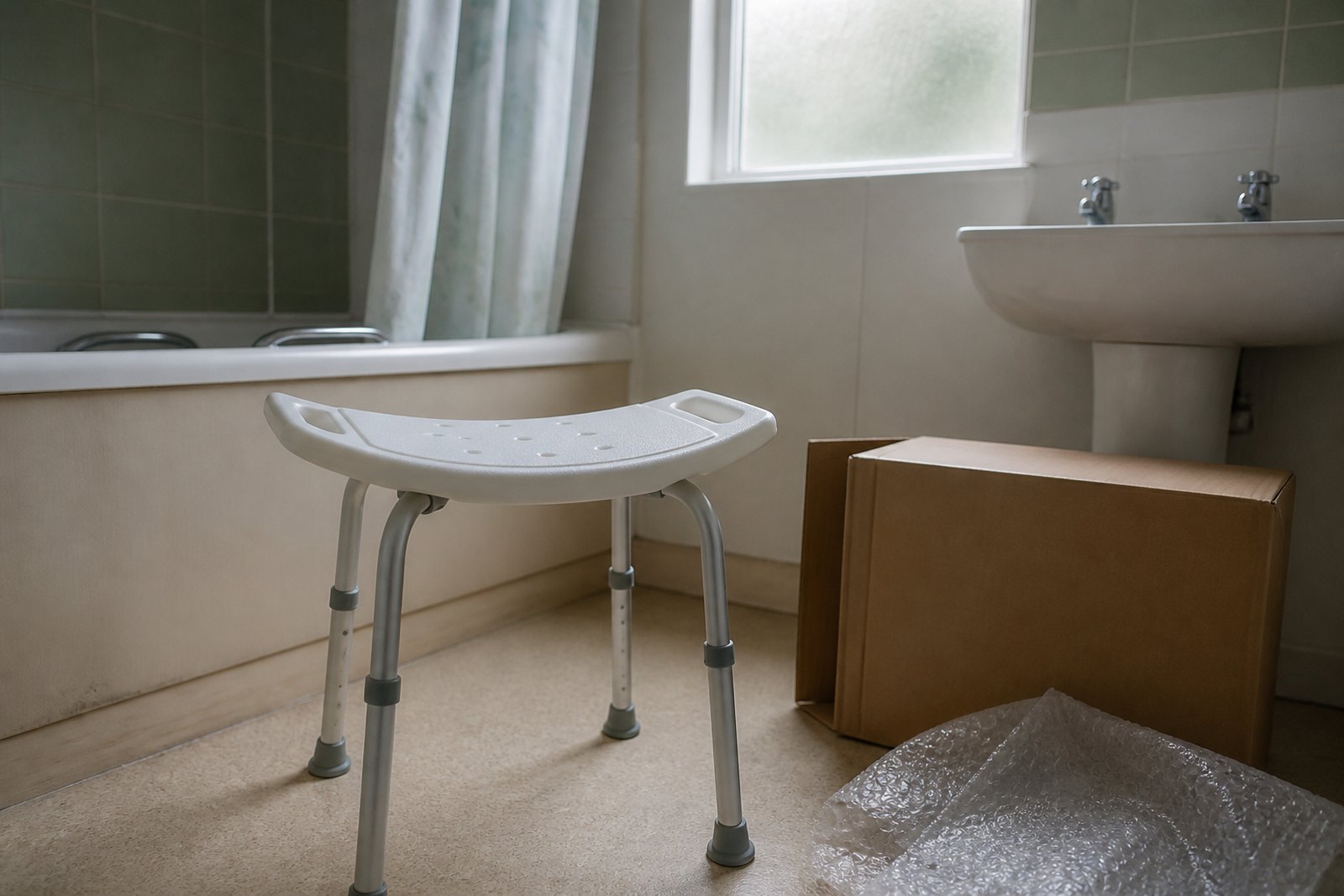
- Bathroom equipment - bath lifts, shower chairs and other aids designed for disabled users.
- Sensory equipment - low-vision aids and equipment designed for hearing loss.
- Installation, repairs, spare parts and maintenance of eligible items - the relief follows the equipment, so having your stairlift serviced is zero-rated too.
The test is the design of the product, not how you happen to use it. An ordinary armchair is not zero-rated because a disabled person sits in it, and a general-purpose gadget does not qualify just because it happens to help. Reputable suppliers list which products are eligible, often with a toggle between the VAT-inclusive and VAT-free price. If you are unsure whether a product genuinely suits your needs, our guide to equipment for daily living covers how to choose well, and an equipment assessment can settle it before you buy.
How the declaration works at checkout
This is the part that puts people off, and it should not, because it is genuinely simple. When you buy from a supplier who offers VAT relief, they ask you to complete a short eligibility declaration - online, usually a tick box and a text field for your name and condition; by post or in a shop, a one-page form. You are declaring that you are chronically sick or disabled and that the goods are for your personal use. That is the entire process.
- The supplier keeps the declaration in their records in case HMRC ever audits them - it goes nowhere else.
- You need one declaration per supplier, not one per order.
- Describing your condition only needs a plain phrase - "rheumatoid arthritis" or "multiple sclerosis" is enough. Nobody asks for your medical records.
- If a supplier does not offer a form, GOV.UK publishes a standard eligibility declaration you can complete and give them.
Do sign honestly - the declaration is a legal statement, and a false claim is the customer's responsibility, not the shop's. But if you meet the definition above, claim without hesitation. It exists precisely for you.
The common confusions, cleared up
- There is no registration scheme. You do not "register as disabled for VAT", and no card, certificate or number exists. The declaration at the point of sale is the whole mechanism.
- Nothing is sent to HMRC. Not by you, and not routinely by the supplier. Do not post your declaration to HMRC; it belongs with the retailer.
- You do not need to be on benefits. Eligibility does not depend on PIP, Attendance Allowance or any other award, and having no benefits in payment does not weaken your claim.
- You do not need a doctor's letter. Self-declaration is the system working as designed, not a loophole.
- It is not a refund scheme. If you are wrongly charged, you go back to the supplier for the refund - HMRC cannot repay a customer directly. Far easier to make the declaration at the time of purchase.
- VAT relief is separate from funding. It reduces the price of what you buy privately; it is unrelated to council equipment provision or the Disabled Facilities Grant, though they can all apply to the same overall project.
The over-60s reduced rate
If you are over 60 but do not meet the chronically sick or disabled definition, a smaller concession applies: certain mobility aids - grab rails, stairlifts, bath lifts, walk-in baths and similar - carry a reduced VAT rate of 5% rather than 20%, but only when the supplier both supplies and installs them in your home. Buying the item alone does not qualify, and no declaration of disability is involved. Ask any installer about it, because not all of them volunteer it.
Who benefits most from knowing this
- Anyone with a long-term condition buying equipment privately, especially larger items where 20% is a substantial sum
- Families buying equipment on behalf of a parent or relative who qualifies
- People arranging installation, servicing or repairs of existing eligible equipment
- Over-60s having mobility aids supplied and installed, via the separate reduced rate
Frequently asked questions
Do disabled people pay VAT on equipment?
Not on eligible equipment bought for personal use. Goods designed or adapted for disabled people - wheelchairs, riser recliners, adjustable beds, stairlifts, bath lifts and many more - are zero-rated when the buyer is chronically sick or disabled and signs a simple eligibility declaration. Ordinary goods that are not designed for disability remain standard-rated regardless of who buys them.
How does the VAT relief eligibility declaration work?
You complete a short written declaration for the supplier stating your name, your condition in plain words, and that the goods are for your personal use. Online this is usually a tick box during checkout. The supplier keeps it in their records; nothing goes to HMRC and there is no approval step. You need one per supplier.
Do I need to be registered disabled to get VAT exemption?
No. There is no registration for VAT relief and no official "registered disabled" status is required. You qualify by meeting the definition of chronically sick or disabled - a long-term impairment with a substantial effect on everyday activities, a chronic illness, or a terminal illness - and you confirm this yourself on the declaration. Receiving benefits is not required either.
Next steps
The saving is only worthwhile if the equipment itself is right, and that is where advice earns its keep - the wrong chair at 20% off is still the wrong chair. An occupational therapist can assess what would genuinely help at home before you commit, and point you towards eligible products. Find your local therapist through our areas we cover page, or see current guide pricing for assessments.
Talk to an occupational therapist near you
This guide is general information. For advice about your own situation - or someone you look after - a local occupational therapist can visit you at home and see it for themselves.
Choose your area: