

Freezing In Parkinson's: Cueing Strategies That Help
By Mobile Occupational Therapist • 22 September 2026 • 15 min read
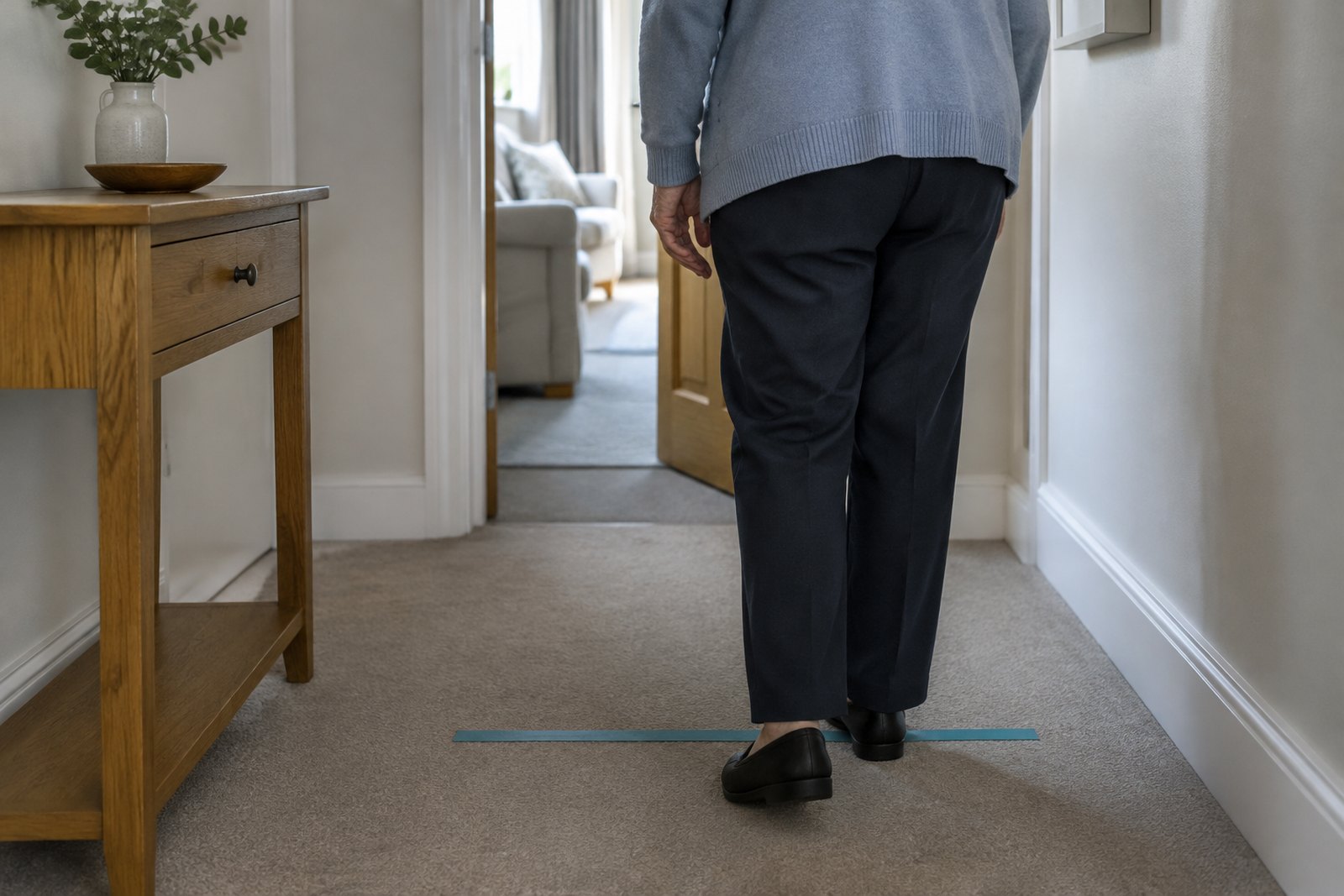
Freezing in Parkinson's (often called freezing of gait) is when your feet feel stuck to the floor even though you want to walk. It commonly happens in doorways, tight spaces, when turning, or when you are trying to start walking. It is frightening, frustrating, and a big reason people fall.
The most helpful approach is usually a mix of cueing strategies (simple prompts that help your brain and body restart movement), reducing common triggers at home, and getting the timing of support right so you are not being rushed. A physiotherapist often leads on walking practice and gait cueing, and an occupational therapist can help you set up your home and routines to make freezing less likely in the first place.
What freezing of gait is (and what it is not)
Freezing is a brief, sudden block in walking. People describe it as:
- Feet glued to the floor
- Shuffling without going forward
- Legs that will not step, especially for the first step
It often comes with a feeling of panic because you can see where you want to go, but your body will not cooperate.
Freezing is not the same as general slowness (bradykinesia), stiffness, or weakness, although those can make it harder to recover when you do freeze. It is also not the same as feeling faint or dizzy. If someone is actually lightheaded, has chest pain, is very short of breath, or is suddenly confused, that is a different problem. Seek urgent medical help, and call 999 if symptoms are severe, sudden, or you think it could be an emergency.
If freezing has appeared suddenly, is much worse than usual, or comes with new symptoms (for example a sudden change in walking, repeated falls, new confusion, new severe pain), contact your GP, NHS 111, or urgent services as appropriate. Sudden deterioration sometimes has a trigger that needs treating.
Common triggers (so you can spot patterns)
Freezing can look random until you start noticing what was happening just before it. Common triggers include:
- Doorways and thresholds (especially narrow ones)
- Turning (particularly tight pivots)
- Tight spaces like between furniture, around the end of a bed, or in a small toilet
- Starting and stopping (getting going, then stopping suddenly)
- Dual tasking (walking while talking, carrying something, thinking hard, or being given instructions)
- Rushing, being late, feeling watched, or feeling hurried
- Stress and anxiety (including fear of falling)
- Busy visual environments (patterns on carpets, clutter, lots of movement around you)
- Medication wearing off (many people notice freezing is worse when they are due a dose)
A simple first step is to keep a brief note for a week: when does freezing happen, where, and at what time relative to medication and meals. You are not aiming for perfect data. You are looking for a couple of obvious patterns you can act on.
For a wider overview of daily living changes that often help alongside freezing, see Parkinson's and everyday tasks: practical strategies and our main condition page Parkinson's.
What to do in the moment: a step-by-step reset
When freezing hits, most people try harder. They lean forward, push, and tense up. That often makes things worse. Try this instead.
Step 1: stop and make yourself safe
Pause. Breathe out. If there is something stable within reach (a rail fixed to the wall, a sturdy worktop), use it lightly for balance. Avoid grabbing at furniture that moves, like a wheeled chair or a lightweight table.
If you are in a risky place (top of stairs, at the edge of a kerb), the safest move may be to stay put and ask for help rather than forcing a step.
Step 2: straighten and shift your weight
Freezing often comes with a forward-leaning posture and your weight stuck on both feet. Gently:
- Stand tall (as much as you can), shoulders relaxed
- Shift weight left to right a few times, like slow swaying
- Or lift one heel, then the other, as a small rocking motion
The aim is to free one leg to become the stepping leg.
Step 3: choose one cue and commit to it
Pick one cue and do it clearly. Changing cue every second can make you feel more stuck. Options that work well for many people are below.
- Count a rhythm: "1, 2, 3, step" or "ready, steady, go"
- March on the spot for two or three marches, then step forward
- Step over something: an imaginary line, a floor tile edge, or a tape line on the floor
- Big first step: think "big step" and step with your stronger side first if you have one
Once you have restarted, keep the steps a little wider and more deliberate for a few paces. Many people refreeze when they immediately go back to tiny shuffles.
Turning: avoid pivots if you can
Tight turns are a classic freezing trigger. Instead of pivoting on the spot:
- Make a wide turn in a bigger arc, even if it means taking more space
- Think "U-turn" rather than "spin"
- If it helps, break the turn into parts: step, step, step, rather than trying to turn in one movement
If you freeze mid-turn, go back to the reset: stop, straighten, weight shift, then restart with a cue.
Cueing strategies explained in plain steps
Cueing is not a trick. It is a way of giving your brain a different route to generate movement. Some cues work better than others depending on the person, the stage of Parkinson's, and the situation. It is normal to have two or three that you rotate.
Auditory cues (sound and rhythm)
These cues use timing to drive stepping.
- Counting out loud: say a steady beat and step on the beat
- Clapping: a carer can clap a steady rhythm for you to step to
- Simple phrases: "big steps" repeated on each step
If music helps, keep it simple and predictable. The point is rhythm, not entertainment. Also, be careful with headphones around roads or in busy places.
Visual cues (something to step over or towards)
These cues give your feet a target.
- Tape lines on the floor in places you often freeze (for example just before a doorway). Place them perpendicular to the direction of walking so it is a "step over" line, and use a tape designed for floors that lies completely flat. Check it regularly and avoid placing tape where it could lift, catch a toe, or create an extra hazard (for example on stairs or over uneven thresholds).
- Follow floor tile edges as stepping targets.
- Laser cues (a line projected on the floor). Some walking aids have these, and some people use a separate device, but it needs assessing and practising. A cue that works brilliantly in the lounge can be a trip hazard in a cluttered hallway.
Visual cues can be very effective, but only if the walking area is clear and the cue is placed thoughtfully. Do not add more obstacles to step over than you need.
Movement cues (shifting, rocking, and "unlocking")
These cues are about changing weight and starting a step.
- Side-to-side weight shift before stepping
- Rocking forward and back (small movements) to get momentum
- Tap your thigh on the stepping side as a prompt
A physiotherapist can help you practise these safely and check whether a walking aid would make restarting easier or harder.
Cognitive cues (what you tell yourself)
Sometimes the cue is simply changing the instruction in your head.
- Replace "walk" with "step"
- Use "big" as your main instruction: "big step", "big turn"
- Look where you want to go, not at your feet, once you are moving again
Pick short phrases. Freezing moments are not the time for complex coaching.
How to practise cues without scaring yourself
Practice matters, but so does safety. Start in a clear space with sturdy support nearby. Do a few planned "stops and starts" and use your chosen cue to restart. If you live with someone, practise with them so they learn how to cue you in a way you actually like.
If freezing is frequent or you are falling, ask for physiotherapy input. You can also consider a private occupational therapist visiting at home to look at the environment and the daily routines that feed into freezing.
Setting up the home to reduce freezing triggers
You cannot redecorate Parkinson's away. But small layout changes can remove the exact situations that trigger freezing dozens of times a day.
Doorways and narrow routes
- Clear the doorway: no shoe racks, plants, bins, or piles waiting to go upstairs.
- Widen the route where you can by moving furniture back even a few centimetres.
- Add a visual cue before the doorway: a single tape line to step over can help some people.
- Improve lighting, especially between rooms with different light levels.
If you freeze at a particular doorway every day, treat it like a problem area, not a personal failing.
Turning points and tight corners
- Create turning space by removing occasional tables, footstools, and magazine racks from corners.
- Reposition chairs so you are not constantly weaving around them.
- Plan routes that avoid tight turns, even if they are slightly longer.
Turning is also where falls happen, so this effort pays back quickly.
Flooring, thresholds, and clutter
- Remove loose rugs and trailing cables.
- Keep floors visually calm where possible. Strong patterns can be distracting for some people.
- Be cautious with extra mats near sinks or doors. Non-slip is good, but edges you can catch are not.
If you are considering home adaptations, it can help to read home adaptations: how an OT assessment works.
Bed and night-time routes
Freezing often gets worse when you are tired, stiff, or half-awake. Night-time trips to the toilet are a classic moment for shuffling, freezing, and falls.
- Use a clear, wide route from bed to bathroom.
- Make lighting easy so you are not walking in the dark.
- Think about bed mobility, because struggling to turn and sit up can set the tone for the first few steps.
More on bed movement is in Parkinson's: getting in and out of bed and turning over.
Do less while you walk
This is an unglamorous one, but it works. If walking is your task, let walking be the task.
- Stop walking before you answer a question.
- Do not carry hot drinks while you are freezing-prone. Make a stop point, put the drink down, then walk.
- Take an extra few seconds rather than squeezing through.
That is not "giving in". It is choosing not to combine two difficult things at once.
If you are supporting someone: what helps (and what makes it worse)
Watching someone freeze is stressful. Your instinct is to pull them forward or push them from behind. Try not to. Pulling can throw their balance off and increase the risk of a fall or shoulder injury.
Better ways to help
- Stay calm and give time. Rushing is fuel for freezing.
- Use a cue: count a rhythm, say "big step", or ask them to step over an imaginary line.
- Offer your arm for them to hold for light support if this is already agreed and safe, and avoid pulling, dragging, or steering them by the arm.
- Reduce the pressure: if you are in a doorway, step back and give them space.
If you are regularly physically helping someone move, get proper advice on safer techniques. Our guide safe moving and handling for family carers explains what matters, and why "just lift" is rarely the answer.
Agree on a plan when you are both calm
In the middle of freezing is not the time to negotiate. Talk at a good moment and agree:
- Which cue words you will use
- Whether touch helps or annoys
- What to do on stairs (often: stop, hold the rail, do not force it)
- When to call for help
This reduces conflict and makes freezing less scary for both of you.
Medication timing and clinical review (in general terms)
Many people notice freezing is worse when medication is wearing off, or if doses are delayed. Some also notice that being "on" but rushed, stressed, or distracted still triggers freezing. The pattern matters.
Do not change Parkinson's medication on your own. If you think freezing links to dose timing, bring a simple diary to your Parkinson's nurse, GP, or neurologist. Say what you want help with: "I freeze in the hallway before my next dose" is more useful than "My walking is bad".
If freezing has increased, it is also worth asking for physiotherapy review. Physios can work on gait, turning, confidence, and strategies for specific situations like doorways and crowds.
Falls safety: reduce harm while you work on freezing
Even with great strategies, freezing can still happen. A safety plan stops a difficult symptom becoming an ambulance trip.
Make falls less likely
Falls prevention is broader than exercise. Footwear, lighting, clutter, routines, and transfers all count. Our practical guide falls at home: practical prevention beyond exercise is a good starting point.
Plan for "what if I do go down"
If you have already had a fall, plan for the next one while you are feeling OK.
- Keep a phone or alert device accessible, not charging in another room.
- Learn a floor recovery method appropriate for your abilities, and only use it if you feel well enough and do not have signs of injury.
- Think about how you will get help if you cannot stand.
This is covered in how to get up from the floor after a fall. If you are often alone, you may also want to read personal alarms, telecare and falls detectors.
When to get urgent help
If someone has fallen and may have a head injury, severe pain, a suspected fracture, or they cannot get up safely, seek urgent help. If in doubt, call NHS 111 for advice, or 999 in an emergency.
Where an occupational therapist fits
Freezing of gait is often treated as a "walking" problem, so physiotherapy is central. Occupational therapy fits when freezing is stopping you doing everyday life safely and consistently, especially at home.
A private occupational therapist visiting at home can help by:
- Identifying the exact environmental triggers in your home (doorways, furniture layout, bathroom set-up, stairs, lighting)
- Adapting tasks and routines so you are not freezing at the worst moments (for example when carrying items, rushing to the toilet, or turning in tight spaces)
- Recommending equipment and small adaptations that support safe transfers and reduce falls risk, without filling your home with obstacles
- Working with family so everyone uses the same cues and safer ways of helping
- Helping you plan ahead if symptoms are changing, including options for home adaptations and support
If you want to know what a home visit looks like, see what does an occupational therapist do on a home visit? and our occupational therapy home visit checklist.
If your main issue is gait speed, balance, and walking outdoors, a physiotherapist is usually the first professional to ask for. If swallowing, speech, or choking are concerns, a speech and language therapist is the right route. If falls are frequent, your GP can also consider wider medical causes and refer into local services.
On this directory, you can also read about neurological occupational therapy and home assessments to see what is typically covered.
Frequently asked questions
Is freezing in Parkinson's a sign things are getting worse?
Not always. Freezing can fluctuate with stress, fatigue, confidence, environment, and medication timing. It can increase over time for some people, but it can also improve with the right cueing strategies and by reducing triggers at home.
Why do doorways make my feet feel stuck?
Doorways combine several triggers at once: a narrow space, a change in flooring or lighting, and a need to time your steps accurately. A visual cue before the doorway, more space, and less rushing can make a noticeable difference.
Should I use a walking stick or frame if I freeze?
Sometimes, but not automatically. A walking aid can improve stability, but it can also add complexity, especially in tight spaces and turns. A physiotherapist can check fit and technique, and an occupational therapist can look at whether your home layout makes a particular aid practical.
Do laser cues actually work for freezing of gait?
They can help some people by providing a clear target to step over. They are not a universal fix, and they need safe set-up and practice so the cue itself does not become a trip hazard. Start with simple visual cues like a single tape line in one problem spot and build from there with professional advice.
What should I do if someone freezes on the stairs?
The priority is safety. Encourage them to stop, hold the handrail, and use a calm cue like counting or "big step". Do not pull them. If freezing on stairs is happening often, ask for clinical review and consider changes to the environment, because stairs are a high-risk place to be stuck.
Can anxiety make freezing worse?
Yes. Feeling watched, rushed, or afraid of falling can trigger freezing, and freezing itself can then increase anxiety. A plan that includes a cue you trust, more time, and fewer high-pressure situations can reduce that cycle.
Next steps
See our neurological occupational therapy or home assessments page, check current guide prices, and choose your area below.

Talk to an occupational therapist near you
This guide is general information. For advice about your own situation - or someone you look after - a local occupational therapist can visit you at home and see it for themselves.
Choose your area: