

How to Get Up From the Floor After a Fall
By Mobile Occupational Therapist • 29 August 2026 • 8 min read
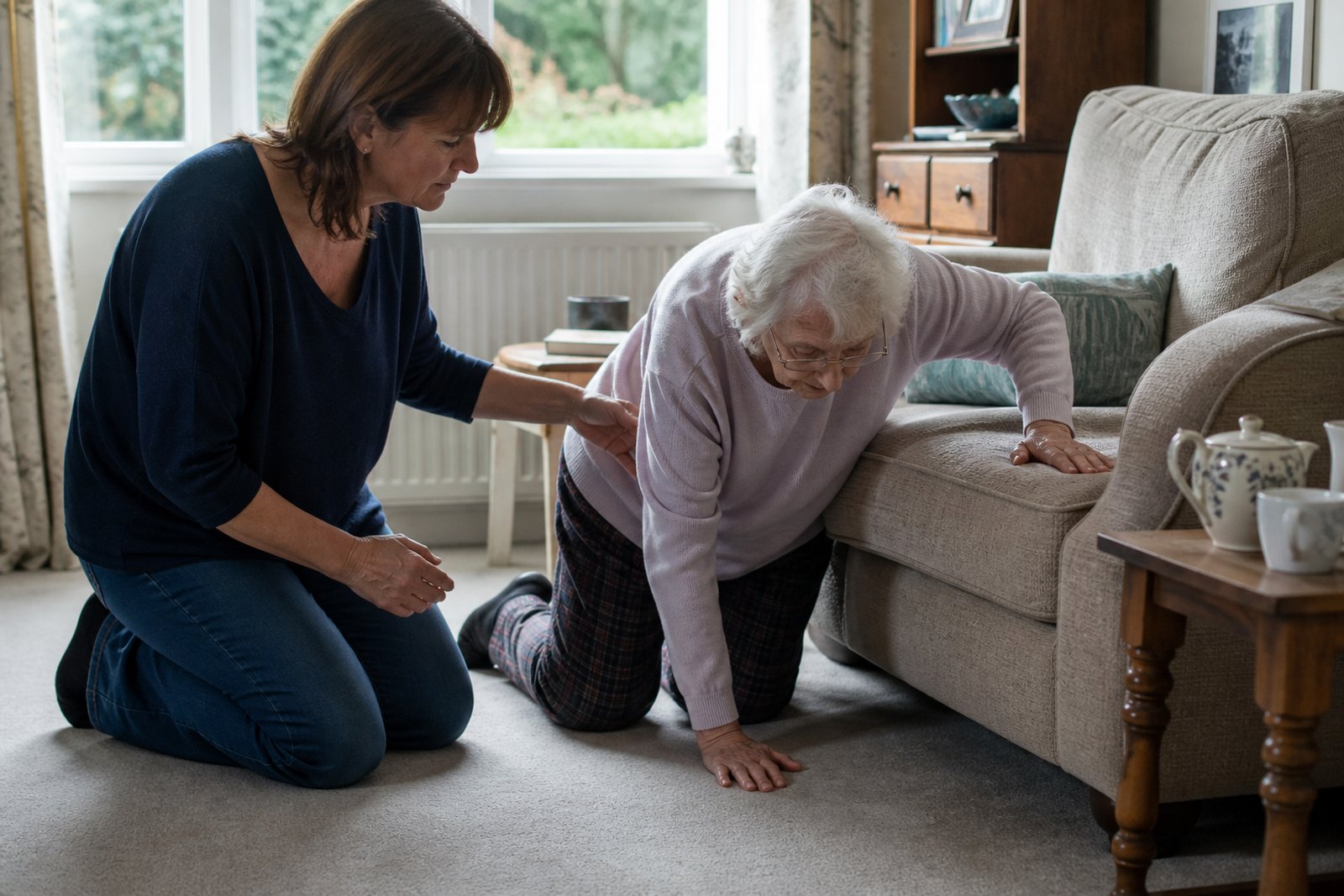
If you have fallen, do not rush to get up. First, lie still for a minute and check for injury - pain in your hip, back, neck or head, or a leg that will not take weight, means stay where you are and call for help. If you are not hurt, the safe way up is in stages: roll onto your side, push up onto your hands and knees, crawl to a sturdy chair or bed, place your hands on it, bring one foot forward so the knee is up, then push through your arms and legs to rise and turn to sit. Rest before you stand.
That is the whole method in one paragraph. The rest of this guide takes it slowly: how to check yourself first, when getting up is the wrong thing to do, and how to practise the manoeuvre before you ever need it.
Before you try to move: check for injury first
The biggest mistake after a fall is not staying on the floor too long - it is getting up too fast. Moving on a broken hip or an injured spine can turn a bad day into a much worse one. So lie still, take a few slow breaths, and check yourself. Do not try to get up if any of these apply:
- Pain in your hip, thigh or groin, or one leg looks shorter or turned outwards - possible signs of a broken hip.
- You hit your head, feel dizzy or sick, or things look blurred or strange - especially if you take a blood-thinning medicine, where any head knock needs checking.
- Pain in your back or neck, or tingling and numbness in your arms or legs.
- A limb will not take weight, or moving it causes sharp pain.
- You feel faint, short of breath or have chest pain - the fall may have a medical cause that matters more than the fall itself.
- You simply do not feel able. If your body is telling you no, believe it. Repeated failed attempts exhaust you and can cause a second injury.
If any of those apply, the job is no longer getting up - it is getting help and keeping warm.
When to call 999
Call 999 if you may have injured your head, neck, back or hip, if there is chest pain or breathlessness, if you cannot get up at all, or if someone you are with fell and is drowsy, confused or hard to rouse. Do not feel you are wasting anyone's time - an older person who has fallen and cannot get up is exactly who the ambulance service expects to hear from. If you are hurt but it does not feel like an emergency, NHS 111 can advise. If you cannot reach a phone, bang on the wall, shout, or press your pendant alarm if you wear one - that is precisely what it is for.
Keeping warm while you wait
Lying still on a floor, you lose heat quickly, and the cold is a danger in its own right - it is often the cold, not the fall, that does the harm when someone is down for hours. While you wait for help:
- Pull anything within reach over you - a coat from a chair, a towel, a throw, even a rug.
- Get something between you and a hard floor - a cushion under your head, clothing under your body. Tiles and laminate pull heat out of you from below.
- Keep moving what you safely can. Gently move your arms, hands and feet if it does not hurt, to keep blood flowing.
- Shift your weight a little from time to time if you can do so without pain - it protects your skin.
How to get up: the step-by-step technique
Only attempt this if you have checked yourself and found no sign of injury. Take it slowly, rest between every stage, and stop if anything hurts.
- 1. Rest first. Lie still for a minute and let the shock settle. Breathe slowly.
- 2. Roll onto your side. Bend your knees, turn your head the way you want to roll, and let your knees and arm follow. Rest.
- 3. Push up onto your hands and knees. Use your top arm to push your upper body up and work your way onto all fours. Often the hardest single move - take your time.
- 4. Crawl to something sturdy. A solid chair, sofa or bed. Not a stool, not anything on wheels, not a door that can swing. Crawl right up close to it.
- 5. Put both hands flat on the seat, still kneeling, close in.
- 6. Bring your stronger leg forward. Lift your stronger knee and plant that foot flat on the floor, so you are in a half-kneel.
- 7. Push up and turn. Push through your hands and front foot, bring the other leg up, and turn your bottom towards the seat.
- 8. Sit down and rest. Sit for several minutes before standing. Then tell someone you fell, even if you feel fine.
That last point is not an afterthought. Any fall in an older adult is worth mentioning to your GP, because falls usually have causes - medication, blood pressure, eyesight, hazards at home - and most can be treated or removed. Our guide to practical falls prevention at home covers what that looks like room by room.
Practise before you ever need it - backward chaining
Reading a technique is one thing; having it in your body is another. Therapists teach getting up from the floor using an approach called backward chaining: you learn the sequence in reverse, starting from the easiest, safest end. You begin by sitting on a chair and lowering yourself to half-kneeling and back up. Once that feels secure, you add the stage before it - all fours to half-kneel - and so on, until you can lower yourself all the way to the floor and get back up, each link of the chain familiar before the next is added.
Done this way, with someone alongside you the first few times, practising is safe and surprisingly reassuring. Many people who have fallen are more limited by the fear of falling again than by the fall itself, and knowing from experience that you can get yourself off the floor takes much of that fear's power away. This is exactly what an OT can teach in your own home, with your own furniture, as part of work on falls and frailty. If getting down to the floor is not realistic for you at all, that matters too - the plan then needs to be about summoning help fast, not self-rescue.
Pendant alarms: the plan for when you cannot get up
However good your technique, there may be a day when you cannot get up - and the difference between lying there for twenty minutes and lying there all night is usually a pendant alarm. Worn on the wrist or around the neck, one press connects you to a monitoring centre or alerts family, and fall-detector versions raise the alarm automatically even if you cannot press anything. They only work if they are worn, so the honest question is about habit: will you wear it in the bathroom, where many falls happen? Our guide to assistive technology at home puts alarms in context alongside sensors and simpler gadgets, and a phone kept in a pocket rather than on the hall table buys a lot of the same protection.
Who this matters most for
- Anyone who has already fallen once, even without injury - one fall is the strongest predictor of another
- People who live alone, where nobody would notice a fall for hours
- Anyone with a condition affecting balance or strength, such as Parkinson's or after a stroke
- Older adults who avoid activities because they are frightened of falling
- Family members who want a clear plan for a parent, rather than a vague worry
Frequently asked questions
How do you get up off the floor if you are elderly?
In stages, never in one movement: rest, roll onto your side, push up onto hands and knees, crawl to a sturdy chair, put both hands on the seat, bring your stronger foot forward into a half-kneel, then push up and turn to sit. Rest at every stage, and only attempt it after checking you are not injured.
What should you do after a fall if you are elderly?
Stay still and check for injury before moving. If there is pain in your hip, back, neck or head, or you cannot get up, call 999, keep warm with whatever is in reach, and wait for help. If you are unhurt, get up slowly using the staged technique, rest, and tell your GP about the fall - falls have causes, and most can be treated or removed.
What is backward chaining?
It is the way therapists teach getting up from the floor: learning the sequence in reverse, starting with the final, easiest step - moving between a chair and half-kneeling - and adding earlier stages one at a time as confidence grows. Each new step joins a chain you have already mastered, which makes practice safe and rebuilds confidence after a fall.
Next steps
If you or someone in your family has fallen, an occupational therapist can visit at home, teach the getting-up technique safely, look at why the fall happened and help with staying independent rather than just more careful. Find your local therapist via our areas we cover page, or see our prices page for current guide pricing.
Talk to an occupational therapist near you
This guide is general information. For advice about your own situation - or someone you look after - a local occupational therapist can visit you at home and see it for themselves.
Choose your area: