

Parkinson's Turning in Bed and Getting Out of Bed: What Helps
By Mobile Occupational Therapist • 25 October 2026 • 14 min read
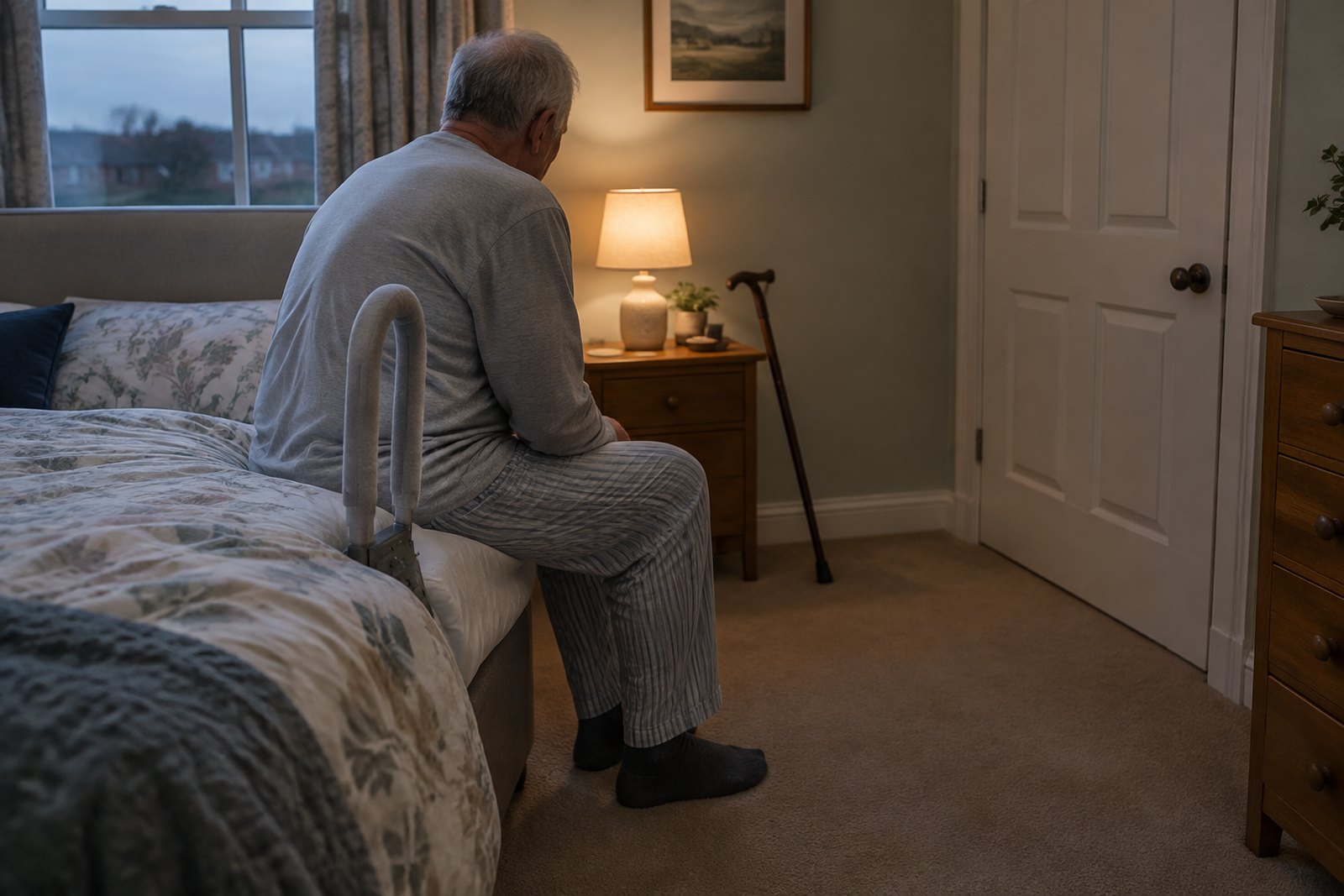
If you have Parkinson's and turning over in bed has become a slow, exhausting struggle, you are not imagining it and you are not alone. Bed mobility is one of the most common difficulties people with Parkinson's describe. The reasons are physical: stiff muscles, slow movement, and the fact that medication often wears off overnight, so you are at your stiffest exactly when you need to roll over or get up for the toilet.
The good news is that a lot can be done. Breaking movements into deliberate steps, changing how the bed is set up, using satin fabric carefully and adding a well-chosen bed lever can make a real difference for many people. This guide walks through each of those, plus how a partner or family member can help without pulling, and when to ask your Parkinson's nurse, GP, physiotherapist or occupational therapist for more.
Why bed is so hard with Parkinson's
Rolling over is something most people do many times a night without waking. It is an automatic movement, and automatic movements are exactly what Parkinson's disrupts. Several things tend to combine.
- Rigidity. Stiff muscles, especially in the trunk, make the twisting part of rolling hard. Many people find they can move their arms and legs but cannot get the middle of their body to follow.
- Slowness of movement. Movements get smaller and slower, so a roll that starts never quite builds enough momentum to finish.
- Night-time and early-morning "off" periods. Parkinson's medication is usually taken during the day. By the small hours, or first thing in the morning, its effect may have faded and symptoms return in full.
- The bed itself. Soft mattresses sink, heavy or tightly tucked bedding pins you down, and brushed cotton sheets and pyjamas grip each other like Velcro.
- Getting up quickly. Some people with Parkinson's feel dizzy or faint when they stand, because blood pressure can drop on standing. Combine that with a dark bedroom and an urgent need for the toilet and you have the classic set-up for a night-time fall.
None of this means you have to accept it. It means the usual way of moving no longer works on autopilot, so you need a different way that you do on purpose.
Turning over: a step-by-step method
Physiotherapists and occupational therapists working with people with Parkinson's usually teach movements broken into separate steps. The idea is to replace one automatic movement, which Parkinson's has made unreliable, with a short sequence of conscious ones. Saying the steps out loud, or counting "one, two, three, roll", often helps. Many people find a clear external cue like this gets them moving when they feel stuck.
To roll onto your left side (reverse it for the right):
- Bend your knees one at a time so both feet are flat on the mattress. This is the single most useful step. Bent knees act as a lever for the whole body.
- Turn your head to look the way you are rolling. Where the head goes, the body tends to follow.
- Reach your right arm across your body towards the left edge of the bed. If there is a bed lever or handle on that side, take hold of it.
- Let both knees drop to the left together. Their weight will start pulling your hips round.
- Follow through with your shoulders, pulling gently on the handle if you have one, until you are on your side.
- Make yourself comfortable by shuffling your hips back a little so you are not right on the edge.
If you get stuck halfway, do not try to force it. Go back to the start, take a breath and do the steps again, a bit bigger. Practising during the day, when your medication is working and you are less tired, makes the sequence more familiar when you need it at night.
Moving up the bed
Many people slide down the bed during the night and then cannot get back up to the pillows. With knees bent and feet flat, push down through your feet and lift your bottom slightly (a "bridge"), then shift your hips up the bed a little. Move your shoulders up to match, then repeat. Small shuffles work better than one big heave.
Getting out of bed safely
Sitting straight up from lying flat uses a lot of stomach muscle and is very hard when you are stiff. Rolling to the side first and using your arms is far easier.
- Roll onto your side facing the edge you will get out on, using the steps above. Make sure you are close enough to the edge but not on it.
- Bring your feet and lower legs over the edge of the bed.
- Push down on the mattress with your top hand, and press up onto your lower elbow.
- Keep pushing, moving from elbow onto hand, as your legs lower towards the floor. The weight of your legs going down helps lift your upper body up. It works like a seesaw.
- Sit on the edge of the bed with both feet flat on the floor. Stay there for a slow count of ten, or longer if you feel light-headed.
- Shuffle forward so your feet are slightly behind your knees, lean forward ("nose over toes"), and push up from the bed with both hands to stand.
- Stand still for a moment before you walk, and have your walking aid within reach if you use one.
That pause on the edge of the bed is not optional. If you feel dizzy, faint or unsteady, lie back down and try again more slowly. If light-headedness on standing happens often, tell your GP or Parkinson's nurse, as it can sometimes be helped.
Getting into bed
Do the same in reverse. Sit on the edge of the bed roughly where your hips will end up, not down by the foot. Lower yourself onto your elbow, then your side, while lifting your legs up onto the bed. Then roll onto your back if you want to. If lifting your legs is the hard part, a leg lifter can help (more on equipment below).
Setting up the bed to work with you
Mattress and bedding
- A firmer mattress is usually easier to roll on than a soft one you sink into. You do not necessarily need a new bed, but if yours is old and saggy it may be working against you.
- A lightweight duvet is easier to move under than layers of heavy blankets. Avoid tucking bedding in tightly at the sides and bottom.
- Brushed cotton and flannelette sheets and pyjamas add friction. Smoother cotton is easier.
Satin sheets and nightwear: helpful, but use them carefully
Many people with Parkinson's find satin or silky fabric makes turning dramatically easier, because it cuts friction between body and bed. Parkinson's UK and many therapists mention it. But the same slipperiness that helps you roll can make you slide off the bed when you sit on the edge, or slip as you push up to stand. So:
- Use a satin strip or half sheet, not a full satin bottom sheet. It should sit across the middle of the bed under your shoulders and hips, where you need to turn. Keep it well away from the edge where you sit to get up, and away from the foot of the bed where your feet push.
- Use satin on one surface, not both. Satin pyjamas on a satin sheet can be so slippery you cannot control yourself at all. Choose one or the other and see which helps.
- Make sure the edge of the bed has normal grip, and that your feet are on a non-slip floor surface, not a loose rug, when you stand.
- Stop using it if you feel you are sliding when sitting up, or if you have already slipped.
Slide sheets are a different thing. They are tubes of very slippery fabric used by carers to reposition someone in bed, and they should be put in for the move and taken out afterwards, not left in the bed. Our guide to using a slide sheet to move someone in bed explains how.
Bed height
When you sit on the edge of the bed with your feet flat on the floor, your hips should be level with or slightly higher than your knees. Too low and standing up takes much more effort. Too high and your feet will not reach the floor firmly, which is unsafe. Bed raisers can lift a low bed, and a high bed may need a thinner mattress or different base. If you share a bed, the height may need to suit the person with Parkinson's first.
Bed levers, handles and leg lifters
A bed lever (sometimes called a bed stick or bed handle) gives you something firm to pull on when rolling and to push up from when sitting up. Some fit under the mattress, some to the bed frame. They need to suit your bed and be fitted properly, with no gap between the handle and mattress where an arm, head or neck could get trapped. Our guide to leg lifters and bed levers covers the types and what to check.
A bed ladder or lifting pole can help with sitting up from lying, especially if your arms are stronger than your trunk. See bed ladders and lifting poles for who they suit. A simple leg lifter (a stiff strap with a loop for your foot) helps if lifting your legs onto the bed is the hard part.
For some people, particularly as Parkinson's progresses, a profiling bed with an electric backrest takes much of the effort out of sitting up. These can sometimes be loaned through your local community equipment service after an assessment.
The night-time trip to the toilet
Needing to pass urine at night is common in Parkinson's, and the route from bed to toilet is where many falls happen. A few changes help.
- Light the way. A lamp or touch light you can reach from bed before you sit up, and plug-in night lights or motion-sensor lights along the route.
- Clear the path. No rugs, cables, shoes or laundry baskets between bed and toilet.
- Plan for freezing. If your feet tend to stick at doorways, a strip of contrasting tape across the threshold to step over, or counting your steps, can help you through.
- Bring the toilet closer if needed. A urinal bottle or a commode by the bed for night-time use is not a defeat. It removes the most dangerous walk of the day.
- Keep a walking aid and glasses where you can reach them without twisting.
There is more on this in our guide to night-time safety.
Medication timing
Because symptoms often return overnight as medication wears off, the timing and type of medication can make a big difference to how you manage in bed. This is something to discuss with your Parkinson's nurse specialist, neurologist or GP. Do not change your doses or timings yourself. Keeping a simple diary of when turning or getting up is hardest, alongside when you took your tablets, gives them useful information.
If you are helping someone
Partners and family often want to help by pulling. Please do not. Pulling someone by the arms, or lifting under the armpits, can injure their shoulders and your back, and it takes over a movement they may still be able to do.
- Cue rather than lift. Talk them through the steps: "Bend your knees. Look at me. Reach for the handle. Drop your knees." A calm voice and a count can unlock movement.
- Guide gently with a hand on the hip or shoulder blade to help the direction, not to do the work.
- Give time. Rushing tends to make Parkinson's movement worse.
- Use a slide sheet properly if they need repositioning, and take it out afterwards.
- Ask for training if you are regularly doing physical help. Your back matters too.
If someone can no longer get out of bed with this kind of help, that is a sign to get a proper assessment rather than trying harder.
When to get medical help
A gradual change over months is worth raising with your Parkinson's nurse or GP. A sudden change over days, new confusion, or a sudden worsening of stiffness can have other causes, such as an infection, and needs a call to your GP or NHS 111. If someone has fallen and is hurt, cannot get up, has hit their head or seems unwell, call 999.
Where an occupational therapist fits
Several professionals can help with bed mobility, and they overlap. A physiotherapist usually leads on movement strategies, exercise, flexibility and the cueing techniques described above. Your Parkinson's nurse or neurologist leads on medication. NICE guidance on Parkinson's recommends that people are offered physiotherapy and occupational therapy when they have difficulties with movement or daily activities, so ask your GP or Parkinson's nurse about a referral.
An occupational therapist looks at the whole picture of the bedroom and the night: the bed height, mattress, bedding, the right lever or handle and whether it is safe on your bed, the route to the toilet, lighting, and whether a commode, urinal or profiling bed would help. They also watch how you actually move, and how a carer helps, and suggest safer ways for both of you. Council and NHS occupational therapists can do this, often with equipment on loan. A private occupational therapist visiting at home can be useful if you are waiting, want more time, or want independent advice before buying equipment.
Frequently asked questions
Why is turning over in bed harder than walking with Parkinson's?
Rolling relies heavily on the trunk twisting, and trunk stiffness is common in Parkinson's. It is also an automatic movement usually done half asleep, often when medication has worn off. That combination makes it one of the hardest movements for many people.
Are satin sheets safe for someone with Parkinson's?
They can be, if used carefully. Use a satin strip across the middle of the bed rather than a full sheet, keep the edge where you sit to get up non-slippery, and avoid satin pyjamas on satin sheets. If you or the person you care for slides when sitting up, stop using it.
Should I take my Parkinson's tablets at a different time to help at night?
Only on advice from your Parkinson's nurse, neurologist or GP. Tell them that nights or early mornings are difficult, and bring a short diary. They can review your medication safely.
Can a bed lever be fitted to any bed?
Not always. Some types do not suit divan bases, adjustable beds or very thick mattresses, and a poor fit can leave dangerous gaps. Check the bed type before buying, or ask an occupational therapist to advise.
Would a hospital-style bed help?
For some people, yes. A profiling bed with an electric backrest can take most of the effort out of sitting up, and some have height adjustment for standing. They are not right for everyone, and many couples prefer to keep sharing a bed for as long as possible. An assessment helps you decide.
Where can I get more Parkinson's-specific advice?
Parkinson's UK has detailed information and a free helpline, and your Parkinson's nurse specialist is a good first contact. Our guide to Parkinson's and everyday tasks covers dressing, eating and moving around the house.
Next steps
If nights have become a struggle, an occupational therapist can look at the bed, the equipment and the route to the toilet with you at home. See our neurological occupational therapy page, or current guide prices, and choose your area below.

Talk to an occupational therapist near you
This guide is general information. For advice about your own situation - or someone you look after - a local occupational therapist can visit you at home and see it for themselves.
Choose your area: