

Safe Moving and Handling for Family Carers
By Mobile Occupational Therapist • 14 September 2026 • 7 min read
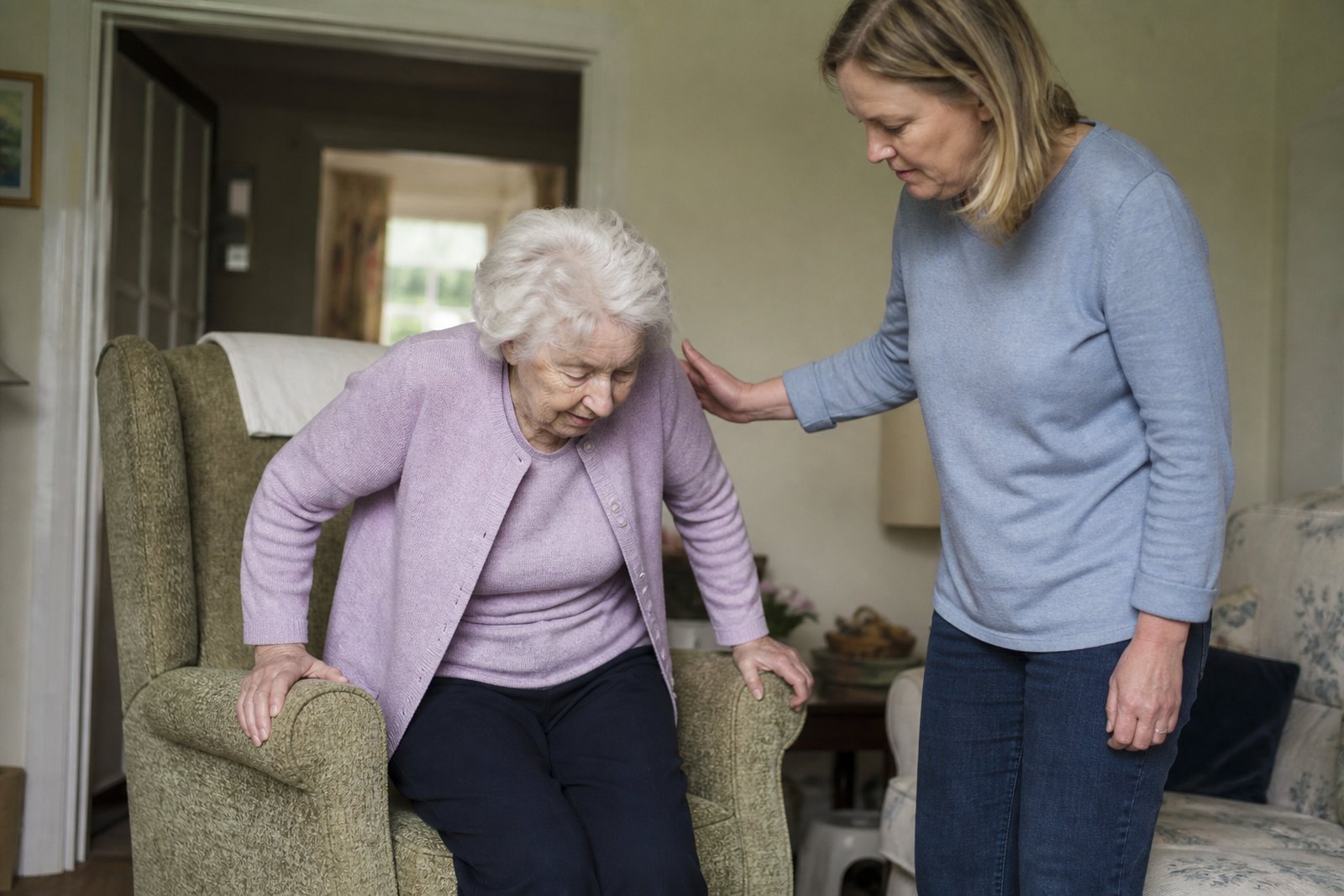
Care workers are not allowed to lift the full weight of another person. Not because they are weak or unwilling, but because decades of injured backs proved there is no safe way to do it - so their employers train them, provide equipment and write it into policy. Family carers, doing the same physical work at home, usually get none of that. They lift a husband from the floor, haul a mother up the bed, take a father's full weight on the stairs - out of love, in a hurry, with no training - and they get hurt in exactly the ways the professionals are protected from. If you are helping someone move at home, this guide is about doing it in a way that keeps both of you safe.
One rule sits above all the others, and it is worth stating before any technique or gadget: never lift another person's full weight. Not from the floor, not off the toilet, not up the stairs. Your spine cannot do it safely at any age, in any posture, however strong you are. Everything below is about what to do instead.
Help them move; do not move them
The most useful shift a family carer can make is from lifting to prompting. A person who is helped to use their own strength stays stronger, and a carer who guides rather than hauls stays uninjured. In practice that means slowing down and breaking a movement into steps: sit forward, feet back, hands on the chair arms, lean forward - "nose over toes" - and push up. Count them in so you move together. Steady rather than pull; guide at the hips or shoulder blades rather than dragging under the arms, which hurts and can genuinely injure a shoulder. If they use a frame or stick, bring it to them rather than becoming the walking aid yourself - a carer used as a support is a carer pulled over in a stumble. Our guide to getting walking aids properly fitted covers that side.
The equipment that replaces lifting
For each move that has become a struggle, there is usually a piece of equipment designed to take the strain, and much of it is available on free loan from your local community equipment service rather than something to buy - see our guide to hoists at home for the top end of the range, and how equipment loans work within it.
- Getting up from a chair: a firmer, higher chair or chair raisers often solve it alone; a riser-recliner does the work electrically.
- Turning in bed and moving up the bed: slide sheets let a person be repositioned with a fraction of the effort, gliding instead of dragging. They need to be shown once by someone who knows how - after that they are simple.
- Getting in and out of bed: a bed lever gives something solid to pull on; a profiling bed brings the person to sitting at the touch of a button.
- Car and chair transfers: transfer boards bridge the gap so the person slides rather than stands; a turning disc spares the shuffling half-turn.
- Standing transfers that keep failing: standing aids and, where needed, hoists take over entirely - prescribed after assessment, with training included.
The right equipment is specific to the person, the room and the move that is failing, which is why an assessment beats a catalogue. An occupational therapist will watch the actual transfer that is hurting you and prescribe for that, not for a generic patient.
If they fall: do not lift them up
The strongest instinct in the world is to get a fallen parent or partner off the floor immediately, and it is the moment most likely to injure you both. If they are hurt, or cannot get up with guidance, the answer is a call for help, not a lift. If they are unhurt, the safe route is talking them up through the stages - rolling over, onto hands and knees, up via a solid piece of furniture - while you steady and encourage rather than haul. It is worth reading and even practising this before it is ever needed: our step-by-step guide to getting up from the floor after a fall covers both the technique and what to do when it is not possible.
Look after the carer's back - it is infrastructure
Your back is what keeps this whole arrangement running, and it deserves the same planning as anything else. Make space before you help: a bed pulled away from the wall, a cluttered bedside cleared, decent light. Wear shoes with grip rather than slippers. Raise what can be raised - working bent double at a low bed is how backs are ruined gradually rather than dramatically. And treat pain as data: a back that aches after every transfer is telling you a move needs equipment or a different approach, not more willpower. If helping is becoming heavier month by month, that trend is itself worth an assessment, because it rarely reverses on its own.
Training and support exist for family carers
You do not have to work all this out alone, and you are entitled to more help than most carers ever ask for.
- Ask for a moving and handling assessment. If transfers are difficult, ask adult social care or the person's community nursing or therapy team for an assessment at home. An OT or physiotherapist will look at the specific moves, prescribe equipment and - crucially - show you how to do it.
- Ask for carer training. Many areas run free moving and handling sessions for family carers, often through local carers' centres. An hour with a slide sheet and someone who teaches this for a living is transformative.
- Get the framework around you assessed too. The person you care for may be entitled to support via a Care Act needs assessment, and equipment and adaptations often flow from it. You are entitled to an assessment in your own right as a carer - of what you can sustain, not just what you can physically do.
Who benefits most from getting this right
- Anyone regularly helping a partner or parent in and out of bed, chairs, cars or the bathroom
- Carers whose own back, shoulder or hip pain is becoming part of the routine
- Families taking over care after a hospital discharge, where the physical work often arrives overnight - see our guide to hospital discharge
- Anyone who has started dreading a particular transfer - dread is usually accurate
Frequently asked questions
How do I lift my elderly mother safely?
The honest answer is that you do not - there is no safe way for one person to lift another's full weight, which is why paid carers are not allowed to do it. The safe versions are helping her use her own strength with prompts and steadying, and using equipment - chair raisers, bed levers, slide sheets, and where needed standing aids or hoists - for the moves she cannot do. If a lift feels necessary, that transfer needs assessing, and you can ask adult social care for exactly that.
What equipment helps with transfers at home?
It depends which transfer is failing. Chair raisers and riser-recliners for standing up; bed levers and profiling beds for getting in and out of bed; slide sheets for repositioning; transfer boards and turning discs for bed-to-chair and car transfers; standing aids and hoists where standing is no longer reliable. Much of this is free on loan from community equipment services after an assessment, and the assessment is what matches the equipment to the person.
Can family carers get moving and handling training?
Yes. Ask the person's occupational therapist, community nurse or local adult social care team, and check with your local carers' centre - many run free practical sessions for family carers. If equipment such as a hoist or slide sheets is provided, training in using it safely should come as part of the package; if it did not, ask for it.
Next steps
If helping someone move is hurting you, or a transfer at home has started to feel unsafe, an occupational therapy home visit can assess the specific moves, arrange the right equipment and show you techniques that protect you both. Find your local occupational therapist via our areas we cover page, or see our prices page for current guide pricing.
Ready to find your local occupational therapist?
See the areas we currently cover, or check current guide pricing.