

Writing Slopes: Who They Help and How to Set One Up
By Mobile Occupational Therapist • 8 October 2026 • 13 min read
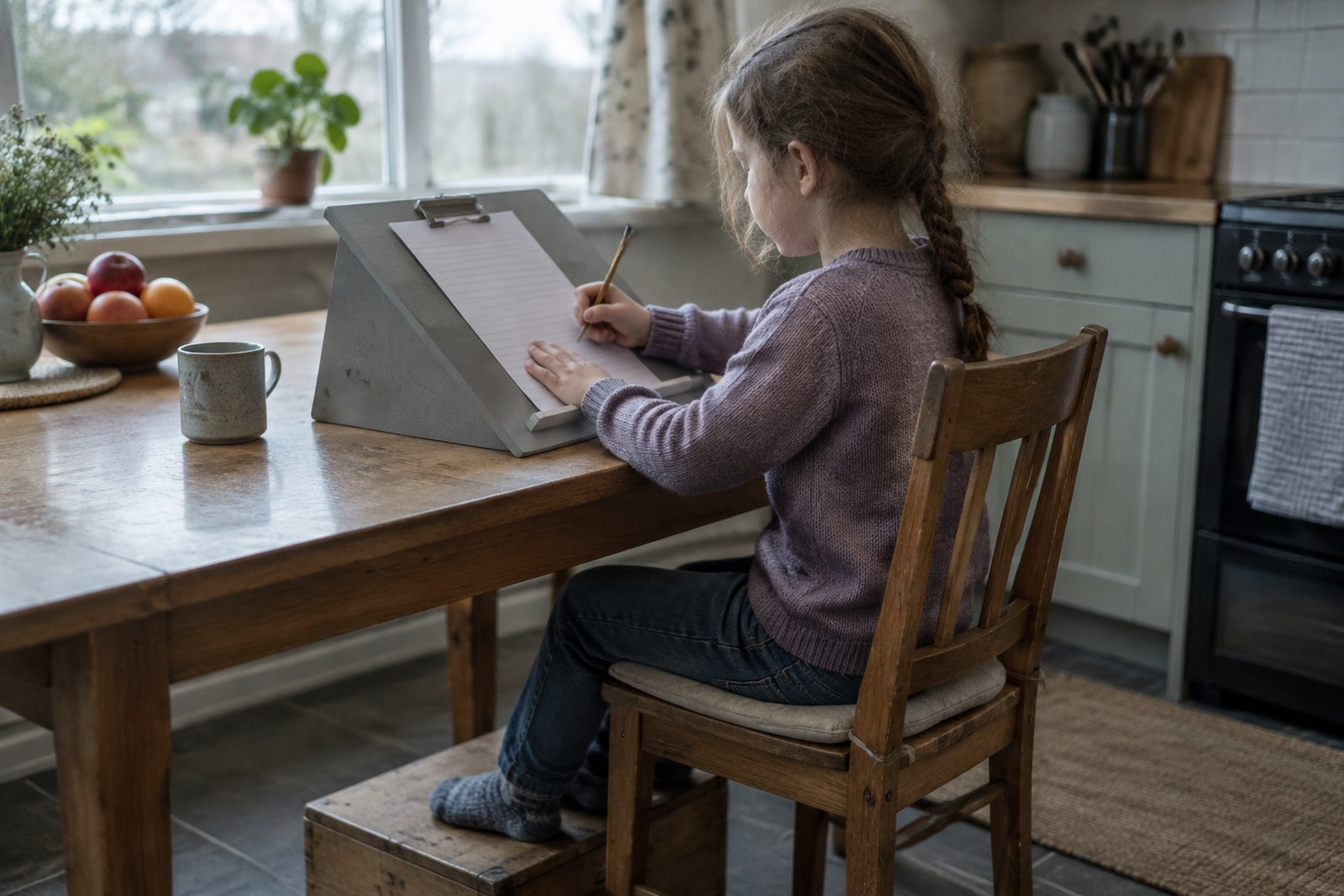
A writing slope is an angled board that sits on a desk or table, so you write on a tilted surface instead of a flat one. It can help children and adults whose handwriting is slow, messy, painful or tiring, especially when posture, wrist position, loose joints or vision are part of the problem. It will not fix every handwriting difficulty. But it is cheap, quick to try and easy to put away if it makes no difference.
The short version: try a large ring binder turned on its side for a week or two before you buy anything. Set it up with the writer sitting well, feet supported, paper tilted and held still. If writing becomes more comfortable, neater, or lasts longer before tiredness sets in, a proper slope is worth having. If nothing changes, the problem probably lies somewhere else, and that is when an occupational therapist can help work out what is actually going on.
What a writing slope actually is
Most writing slopes are a flat board on a wedge-shaped base. The higher edge sits furthest from you and the lower edge nearest, so the surface tilts down towards you. Typical features include:
- A ledge or lip along the bottom edge, so paper and pencils do not slide off.
- A clip at the top to hold paper or a book in place.
- A non-slip surface or rubber feet underneath, so the slope stays put on the table.
- Adjustable legs or settings on some models, so you can change the angle.
They come in plastic, wood and clear acrylic, in A4 and larger sizes, and some fold flat for carrying. Fixed slopes are often set at around 20 degrees. Adjustable ones let you go flatter or steeper. The same board doubles as a reading stand for books and worksheets.
Why an angled surface can help
Wrist position
On a flat desk, a lot of people who struggle with handwriting let their wrist bend downwards, or curl it round into a hook. Both make fine finger movements harder work. A tilted surface tends to bring the wrist into a slight upward bend, which is the position where the fingers usually move most freely and the pencil is easiest to control. Many writers press less hard and tire less quickly as a result.
Posture
A slope brings the work up and towards you. That means less leaning forward, less curling over the desk and less bending at the neck. For a child who slumps, props their head on one arm, or ends up almost lying on the table by the end of a page, this alone can make a visible difference. For adults, it can take the strain off the neck and upper back during long spells of reading or writing.
Visual angle
When you sit at a flat table, you look at the page at a shallow angle, so the top of the page is further from your eyes than the bottom. Tilting the page brings it closer to facing your eyes square on. Letters and lines look more even, and some people find it easier to keep their place. Some children also find it easier to switch between the board at the front of the class and their own page.
Who a writing slope can help
- Children with general handwriting difficulty, whose writing is slow, untidy, or makes their hand ache.
- Children with developmental coordination disorder (DCD, also called dyspraxia), who often find posture, pencil control and paper management hard all at once. Our guide to dyspraxia in children covers the wider picture.
- Children and adults with hypermobility, whose finger and wrist joints bend further than usual and who tire quickly when writing. See hypermobility in children.
- Children with low muscle tone, who find it hard to hold themselves upright at a desk for long.
- People with dysgraphia, where the physical act of writing is a persistent struggle. Our guide to dysgraphia explains the signs and what else helps.
- Some people with visual difficulties, once they have had a proper eye test. A slope does not replace glasses or specialist vision advice.
- Adults with neck or shoulder strain from reading and writing at a flat desk, and adults who find reading easier with the page tilted towards them.
It is just as useful to know who it probably will not help. If the difficulty is mainly with spelling, putting ideas into sentences, attention or reading words, a slope will not touch it. It is a physical tool for a physical problem.
Try a ring binder first
Before spending money, borrow the idea. A wide ring binder or lever arch file makes a perfectly good trial slope.
- Choose a binder with a fat spine, ideally several centimetres deep. Thin ones barely tilt.
- Turn it so the spine is furthest from the writer and the opening edge is nearest. The surface now slopes down towards them.
- Put something non-slip underneath. A piece of rubber drawer liner or non-slip matting works well.
- Clip the paper at the top with a bulldog clip, or tape the corners with masking tape.
- Use it for normal writing tasks for a week or two, not just once.
Things to watch for over that time:
- Is the writing a little neater, or more even in size?
- Can they write for longer before complaining of an achy hand?
- Are they sitting more upright, or still slumping?
- Do they say it feels easier, or do they keep pushing it away?
A binder has limits. The angle is fixed and fairly low, the rings can dig into the forearm, and it is small. But if it helps even a bit, a proper slope will probably help more. If it makes no difference at all after a fair trial, that is useful information too.
How to set up a writing slope properly
A slope on a badly set up table often achieves very little. The order matters: sort out the sitting first, then the slope, then the paper.
Start with the chair and table
- Feet flat and supported. On the floor, or on a footrest, a sturdy box or a stack of old phone directories if the chair is too high. Dangling feet make it much harder to sit still and upright.
- Hips right to the back of the seat, with knees roughly level with the hips.
- Table at about elbow height when the arms hang relaxed, or slightly above. At a kitchen table, a small child may need a firm cushion to sit on and a box under their feet.
- Chair pulled in close, so they do not have to lean forward to reach.
Choose the angle
Start low and go up gradually. Too steep, and the writing arm has to work against gravity, the shoulder starts to lift and tire, and paper slides. Too flat, and you lose the benefit. As a rough guide, you are looking for the wrist slightly bent upwards, the forearm resting comfortably on the board, and the shoulder relaxed rather than hunched. If the slope adjusts, try two or three settings over a few days and ask the writer which feels best.
Position the slope
The bottom edge should sit near the edge of the table, directly in front of the writer or nudged slightly towards the writing hand. The writing forearm should rest on the slope, not hang off the side. Older children and adults with longer arms may need a wider board for this.
Position and tilt the paper
- Right-handed writers: paper slightly to the right of the middle of the body, tilted so the top points a little to the left.
- Left-handed writers: paper slightly to the left of the middle, tilted so the top points a little to the right. This helps them see what they have written and discourages the hooked wrist many left-handers develop.
A simple check: the paper should roughly line up with the writing forearm.
Stop the paper moving
Paper that slides around is one of the most common, and most overlooked, causes of messy writing.
- Teach the non-writing hand to rest flat on the page as a helper hand. Many children need reminding for weeks.
- Use the clip, or tape the corners.
- Keep non-slip matting under the slope itself.
- Thick exercise books sit unevenly. Fold the book back on itself, or work on one sheet at a time where you can.
Check the grip
A slope can make a good grip easier to hold, but it will not create one. If the pencil hold is very awkward or tiring, our guide to pencil grip by age explains what is typical and what you can do at home.
Writing slopes at school
A slope used at home and never at school helps with homework and not much else. Consistency is the point.
- Talk to the class teacher or the SENCO (special educational needs co-ordinator). Many schools already have slopes and are happy to try one.
- Ask for it to be written down. If your child is on SEN support, the slope and how to set it up can go into their support plan, so it does not depend on one teacher remembering.
- Think about the practical side. Small classroom desks fill up fast. A secondary pupil moving between rooms needs something light, or a slope kept in key classrooms.
- Mind how it feels to the child. Some children hate standing out. Letting them choose a plain design, and using it only for longer writing tasks, often helps.
- Exams. For older pupils, the school decides on exam access arrangements. If a slope matters, raise it with the SENCO well ahead of time.
If your child has, or is being assessed for, an education, health and care plan (EHCP), an occupational therapy report can set out specific recommendations like this so the school knows exactly what is needed. GOV.UK explains how SEN support and EHCPs work in England.
Writing slopes for adults
Slopes are not just for children. Adults use them for:
- Neck and shoulder strain from long spells of handwriting, studying or reading paperwork at a flat desk.
- Reading difficulties, where tilting the page and keeping it still makes it easier to follow lines, sometimes alongside a reading ruler or good task lighting.
- Low vision, where bringing the page closer and at a better angle can make a magnifier easier to use.
- Hand or joint pain, where a better wrist position can make writing more comfortable.
At work, a slope or a document holder can be part of a wider workstation set-up. Our guide to DSE assessments and workstation set-up covers this. If neck pain keeps coming back, or comes with pins and needles, numbness or weakness in the arm, see your GP or a physiotherapist rather than relying on equipment.
When to get help instead of more equipment
A slope is a sensible first step. It is not the answer if:
- Writing is painful, not just tiring.
- A child is distressed by writing, avoids it, or is falling further behind despite trying.
- Skills are going backwards rather than slowly improving.
- A child has not had a recent eye test. Book one with an optician first. NHS sight tests are free for children under 16.
In an adult, a sudden change in handwriting needs a GP appointment. If it comes with sudden weakness, numbness, a drooping face or slurred speech, call 999 straight away, as these can be signs of a stroke.
Where an occupational therapist fits
Handwriting draws on a lot of things at once: sitting balance, shoulder stability, hand strength, grip, coordination, planning movements, visual perception and attention. When writing is hard, a slope addresses only part of that. An occupational therapist looks at the whole picture and works out which parts are causing the trouble.
An occupational therapist can:
- Assess posture, hand function, coordination and visual perception during real writing tasks.
- Say whether a slope is likely to help, and set it up correctly at home or at school.
- Suggest seating changes, grips, paper and pencil choices, and practical activities to build the underlying skills.
- Advise when typing or other ways of recording work should sit alongside handwriting.
- Write a report the school can act on, including for an EHCP.
On the NHS, children's occupational therapy is usually accessed through the school, the GP or a health visitor, depending on your area, and waits vary. A private occupational therapist can visit at home or school, which is often the most useful place to see writing as it really happens.
Other professionals lead in some situations. A physiotherapist is often the right person for core strength, hypermobility management or neck pain. An optometrist or orthoptist deals with vision. A speech and language therapist helps where language is the issue, and a specialist teacher or educational psychologist where reading, spelling or learning is the main difficulty. Your GP is the first stop for pain, numbness or any sudden change.
Frequently asked questions
What angle should a writing slope be?
There is no single right angle. Many fixed slopes sit at around 20 degrees, which suits a lot of writers. Start lower, go up gradually, and settle where the wrist is slightly bent upwards, the forearm rests comfortably and the shoulder is relaxed.
Can my child use a writing slope at school?
Usually, yes. Speak to the class teacher or SENCO. Many schools already have slopes, and if your child is on SEN support it can be written into their plan so it is used consistently.
Is a ring binder really as good as a proper slope?
Not quite, but it is a very good trial. It shows you whether an angled surface helps before you spend anything. If it does, a proper slope with a ledge, clip and better angle will usually be more comfortable.
Should left-handed children use a slope differently?
The slope is the same, but the paper goes slightly to the left of the middle of the body and tilts with the top pointing to the right. This helps them see their writing and avoid smudging and a hooked wrist.
Can a writing slope make things worse?
It can if it is too steep, slides around or is used without sorting out the seating. Some children find their arm tires quickly at first. If writing is clearly worse after a fair trial, stop and seek advice.
What age can a child start using one?
Children can use a slope from the early school years when they are doing regular writing and drawing. The set-up matters more than age, especially chair height and foot support.
Next steps
If a slope helps a little but handwriting is still a struggle, an assessment can show what else is going on. See our children's occupational therapy page, or current guide prices, and choose your area below.
Talk to an occupational therapist near you
This guide is general information. For advice about your own situation - or someone you look after - a local occupational therapist can visit you at home and see it for themselves.
Choose your area: