

Hypermobility in Children: Signs, Tiredness and What Helps
By Mobile Occupational Therapist • 20 September 2026 • 13 min read
Hypermobility in children usually means joints that bend further than most people's. It is common, especially in younger children, and on its own it is often harmless. Plenty of bendy children are good at gymnastics, dance and climbing and never have a problem. Many become less flexible as they grow.
For some children, though, it comes with a bundle of everyday trouble. Aching legs at the end of the day. Tiredness that seems out of proportion. Handwriting that hurts after a few lines, frequent trips and bumps, and a child who flops on every chair. If that sounds familiar, much of what helps is practical and can start this week, at home and at school. This guide covers the signs worth noticing, what you can do day to day, and who to see: the GP, a physiotherapist, an occupational therapist, or sometimes all three.
What hypermobility actually means
Joint hypermobility simply describes a range of movement. Elbows that bend slightly backwards, thumbs that fold back towards the forearm, knees that lock back when standing, the child who sits in positions that make adults wince. Doctors and physiotherapists sometimes use a short set of checks called the Beighton score to describe how widespread it is, but the score alone does not tell you whether there is a problem.
What matters is whether it causes symptoms. A child who is bendy and comfortable does not need treating. A child who is bendy and sore, tired or struggling with everyday tasks may need some support.
You may hear a doctor use terms such as hypermobility spectrum disorder (often shortened to HSD) or hypermobile Ehlers-Danlos syndrome (hEDS). These diagnoses are usually made by a doctor or specialist after a proper assessment, and this article does not try to help you decide whether either applies. The practical advice below is useful whatever label your child ends up with, or none.
Signs that hypermobility is causing problems
These are the things parents and teachers most often notice. None of them on its own proves anything, and each has other possible causes, which is why it is worth talking to the GP if several fit.
- Aches and pains, often in the knees, ankles, feet or hips, and often worse later in the day or after a busy one.
- Tiredness that seems more than the activity explains. The child who needs to sit down halfway round the supermarket, or comes home from school and collapses.
- Handwriting trouble. Pressing very hard, gripping the pencil tightly with finger joints bending back, sore hands after short pieces of writing, slow or messy work, or simply avoiding writing.
- Clumsiness. Tripping, bumping into things, dropping things, finding ball skills or riding a bike harder than friends do.
- Posture and sitting. Slumping, leaning on the desk, wrapping legs round chair legs, fidgeting, constantly shifting position, or preferring to lie on the floor.
- Fiddly tasks such as buttons, zips, laces, scissors or opening packets taking longer than you would expect.
- Sprains and joints that give way, or that feel as if they slip.
Some of these overlap with other things, such as developmental coordination disorder (sometimes called dyspraxia), so try not to settle on one explanation too early.
Why bendy children often get so tired
One common explanation is that when the soft tissues around the joints are looser, the muscles have to do more of the work of holding the body steady. Sitting upright, standing in a queue, holding a pencil: tasks other children do almost on autopilot can take more effort. Add poor sleep from aching legs, and a child who is trying hard to keep up, and tiredness builds over the week. The tiredness is real, not laziness, and it is worth saying that to your child out loud.
That said, tiredness has many causes. If your child is unusually tired, pale, losing weight, or the tiredness is new, see the GP rather than assuming it is the joints.
When to see a GP, call 111 or go to A&E
Book a GP appointment if your child has pain that keeps coming back, pain or tiredness that stops them doing normal things, frequent sprains or joints that slip, or you are simply worried. The GP can examine them, rule out other causes and refer on, for example to a children's physiotherapy service or a paediatrician.
Get help more urgently, through NHS 111 or a same-day GP appointment, if a joint is hot, red or swollen, if your child has a fever with joint pain, has a new limp or will not put weight on a leg, or has pain that regularly wakes them at night. If a joint dislocates and does not go back, there is an obvious deformity after an injury, or your child seems very unwell, go to A&E or call 999. These are not typical of hypermobility and need checking.
What helps at home
Pacing: steady beats boom and bust
Many hypermobile children have a familiar pattern: a great day, a big outing, then two days on the sofa. Pacing means spreading activity more evenly so the good days cost less.
- Break long activities into shorter chunks with sit-down breaks built in, rather than waiting until your child is exhausted.
- Look at the week as a whole. If Saturday is a party and swimming, keep Sunday gentler.
- Plan rest before it is needed on days out: a bench at the park, a buggy for younger children on long walks, a seat while you queue.
- Keep a simple diary for two or three weeks of activities, pain and tiredness. Patterns often jump out, and it is useful to bring to appointments.
Pacing is not the same as doing less overall. The aim is to keep your child active, which matters a great deal for strength, while avoiding the crashes.
Keep moving and build strength
Stronger muscles support loose joints, and regular activity is generally encouraged. Swimming, cycling, walking and many sports suit hypermobile children well. A physiotherapist is the right person to set specific strengthening exercises and advise on any sport that seems to cause trouble. At home, your part is mostly keeping activity regular and enjoyable, and gently discouraging party tricks where a child deliberately pushes joints to their extremes to impress friends.
Sleep and evenings
Aching legs in the evening are common in bendy children. A predictable bedtime routine, a warm bath and a quieter last hour often help. A mattress and pillow that keep the body comfortably supported can make a difference. If pain regularly wakes your child at night, contact NHS 111 or ask for a same-day GP appointment, as this is not typical of hypermobility and needs checking.
Self-care without the battle
- Choose clothes that are easier to manage: elastic waists, larger buttons, and shoes with hook-and-loop fastenings or elastic laces while laces are tricky.
- Let your child sit down to dress, especially for socks and shoes.
- Thicker-handled cutlery and toothbrushes can be easier to hold for children whose fingers bend back.
- Supportive, well-fitting shoes help many children. If feet roll in a lot or are sore, ask the GP or physio whether a podiatry assessment would be useful.
Sitting well: chairs, tables and footrests
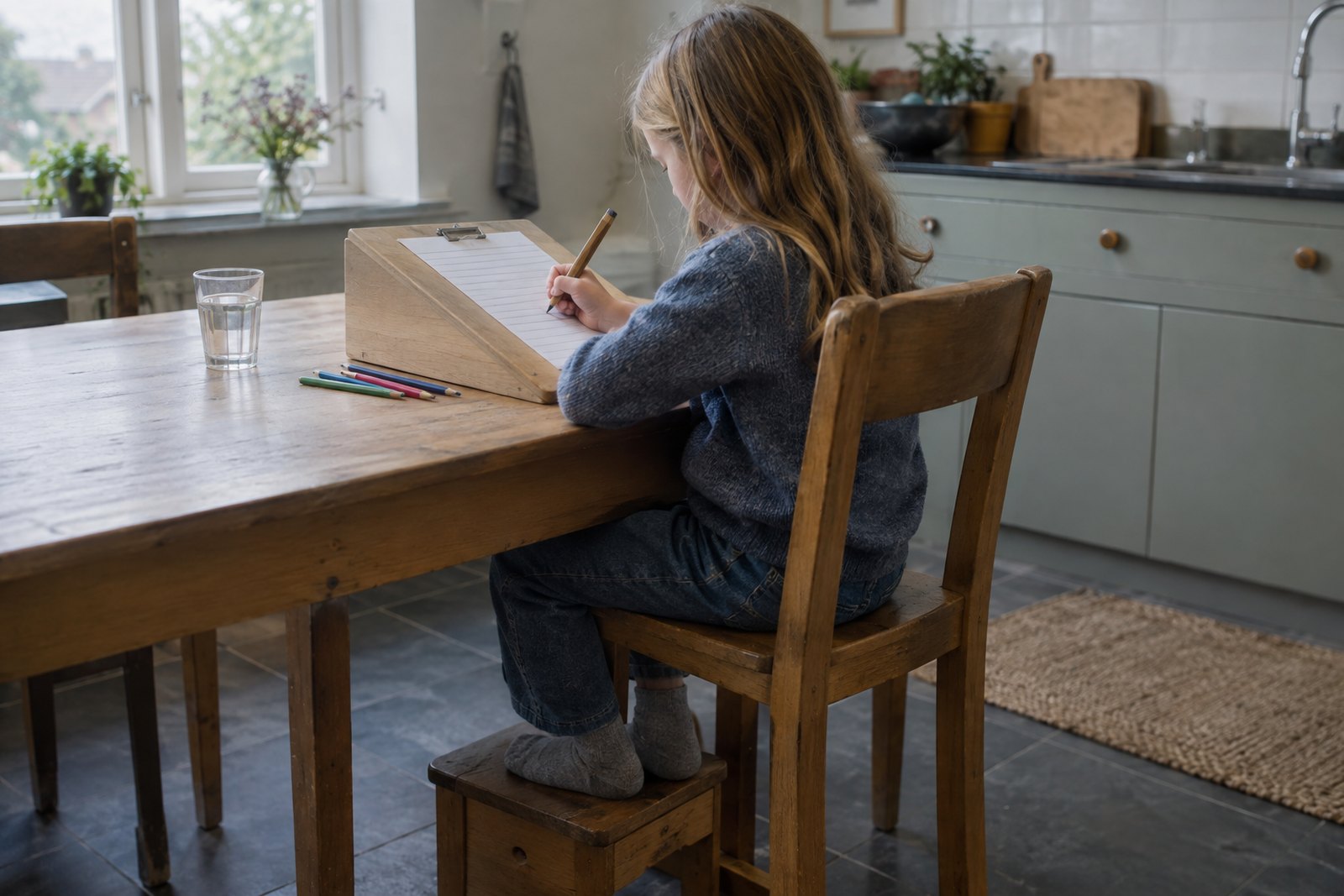
Good sitting is the unglamorous foundation for almost everything else, including handwriting. A child perched on a chair with feet dangling has to spend effort just staying upright.
- Feet supported. Feet flat on the floor or on a sturdy box or footstool, with knees and hips roughly at right angles.
- Table height. Roughly elbow height when sitting, so shoulders are relaxed rather than hunched.
- Back support. Sitting back in the chair, with a small cushion behind if the seat is too deep.
- Movement breaks. Even with a perfect set-up, sitting still is tiring. Short breaks to stand, stretch or fetch something help more than nagging about posture.
Homework, gaming and mealtimes are all good places to check this. Floor sitting is fine for play, but offering a few different positions, such as side sitting, cross-legged or lying on the tummy, means no single position is held for ages.
Handwriting and schoolwork
Handwriting is where hypermobility often shows most at school. Children whose finger joints bend back tend to grip harder to control the pencil, which tires and hurts the hand quickly. Things worth trying:
- Thicker pencils and pens, or a soft pencil grip, which need less pinching force.
- Pens that flow easily, so less pressure is needed to make a mark.
- A sloped writing surface, which many children find puts the wrist in a more comfortable position.
- Short bursts. Writing in shorter chunks, with a hand shake-out or stretch in between.
- Less copying. Printed worksheets, a copy of the board notes, or an adult scribing for long copying tasks.
- Typing. For older children with a lot of written work, learning to touch-type can save their hands. It is not giving up on handwriting. It is choosing the right tool for the job.
If writing is genuinely painful or your child is falling behind, an occupational therapist can look at grip, posture, hand strength and the whole set-up, and suggest specific changes.
Talking to school
Many schools are familiar with hypermobility, but they can only adjust what they know about. Start with the class teacher and the SENCO (the special educational needs co-ordinator). Things that commonly help include:
- A chair and table of the right height, and a footrest if needed.
- Permission to move, stretch or take short rest breaks.
- Easier writing tools and less copying.
- Somewhere to keep books so a heavy bag is not carried all day, or a bag with two padded straps worn on both shoulders.
- Adapting PE where needed, rather than sitting out altogether.
- Rest breaks or extra time in tests. For formal exams, access arrangements are applied for through the school, so ask the SENCO early.
- A plan for trips and long walks, including where to sit and rest.
In England, schools have a duty to support pupils with medical conditions, which can include an individual healthcare plan. Where a child needs more help with learning, support may come through SEN support or, for a smaller number of children, an education, health and care plan (EHCP). Wales, Scotland and Northern Ireland have their own systems. Check the current rules on GOV.UK or your own government's website; in England the charity IPSEA is also very helpful. A diagnosis is not always needed for a school to make sensible adjustments.
Where an occupational therapist fits, and where they do not
It helps to know who does what, because more than one professional may be involved.
- The GP is the first stop. They examine your child, rule out other causes and refer on. Conditions such as hypermobility spectrum disorder or hEDS are usually diagnosed by a doctor or specialist, sometimes after referral to a paediatrician or a children's rheumatology team.
- A physiotherapist leads on joint stability, strength, pain linked to movement, and getting back into sport. For many hypermobile children with pain, physiotherapy is the main treatment.
- An occupational therapist focuses on everyday tasks: handwriting, fine motor skills such as buttons and scissors, seating and posture at home and school, dressing and self-care, and managing tiredness through pacing and routines. An OT can also write practical recommendations for school.
- A podiatrist may help with sore feet and footwear.
- If pain or tiredness is affecting mood, confidence or school attendance, talk to the GP about support for that too.
NHS children's occupational therapy is available in most areas, though how you get referred and how long you wait varies. Some families choose a private occupational therapist, particularly for a clear picture of what is happening with handwriting and daily tasks, or for a written report to share with school. Our guide to NHS or private occupational therapy sets out the trade-offs, and how paediatric OTs help children thrive explains what sessions usually involve.
A private occupational therapist visiting at home can watch your child doing real tasks in their real setting, such as homework at the kitchen table, getting dressed or packing a school bag, which often shows more than a clinic room. If school needs written evidence, a functional assessment and report can set out what your child finds hard and what would help. What an OT will not do is diagnose the cause of joint pain or replace a physiotherapy exercise programme. If you are looking privately, check the therapist is registered with the HCPC and experienced with children; how to choose a private occupational therapist covers what to ask.
Frequently asked questions
Will my child grow out of hypermobility?
Many children become less flexible as they get older, and symptoms often settle as they grow stronger. Some carry hypermobility into adulthood. Either way, building strength and good everyday habits now is worthwhile.
Is hypermobility the same as Ehlers-Danlos syndrome?
No. Most hypermobile children do not have Ehlers-Danlos syndrome. Hypermobile Ehlers-Danlos syndrome and hypermobility spectrum disorder are diagnoses a doctor may consider when hypermobility comes with other symptoms. If you are worried, talk to the GP rather than trying to work it out from online checklists.
Should my hypermobile child stop PE or sport?
Usually not. Staying active builds the strength that helps protect loose joints. If a particular activity causes pain or repeated injuries, ask a physiotherapist how to adapt it rather than stopping altogether.
Does my child need a diagnosis to get help at school?
Not necessarily. Schools can and often do make practical adjustments based on what they see and what parents and professionals tell them. A letter or report from a health professional can make it easier to agree what helps.
Should we see an OT or a physio first?
If pain, sprains or joints giving way are the main problem, start with the GP and physiotherapy. If the main struggles are handwriting, dressing, sitting, fiddly tasks or getting through the day without running out of energy, an occupational therapist is often the right fit. Many children benefit from both.
Are aching legs at night normal in bendy children?
Aching legs in the evening or at night are common in hypermobile children, often after an active day. Pain that regularly wakes them, or comes with swelling, a limp, fever or feeling unwell, is not typical of hypermobility and needs same-day advice from NHS 111 or your GP.
Next steps
If hypermobility is making school or daily life harder for your child, see our children's occupational therapy page, or current guide prices, and choose your area below.
Talk to an occupational therapist near you
This guide is general information. For advice about your own situation - or someone you look after - a local occupational therapist can visit you at home and see it for themselves.
Choose your area: