

Pencil Grip: What Is Normal by Age and How to Help Handwriting
By Mobile Occupational Therapist • 19 September 2026 • 11 min read
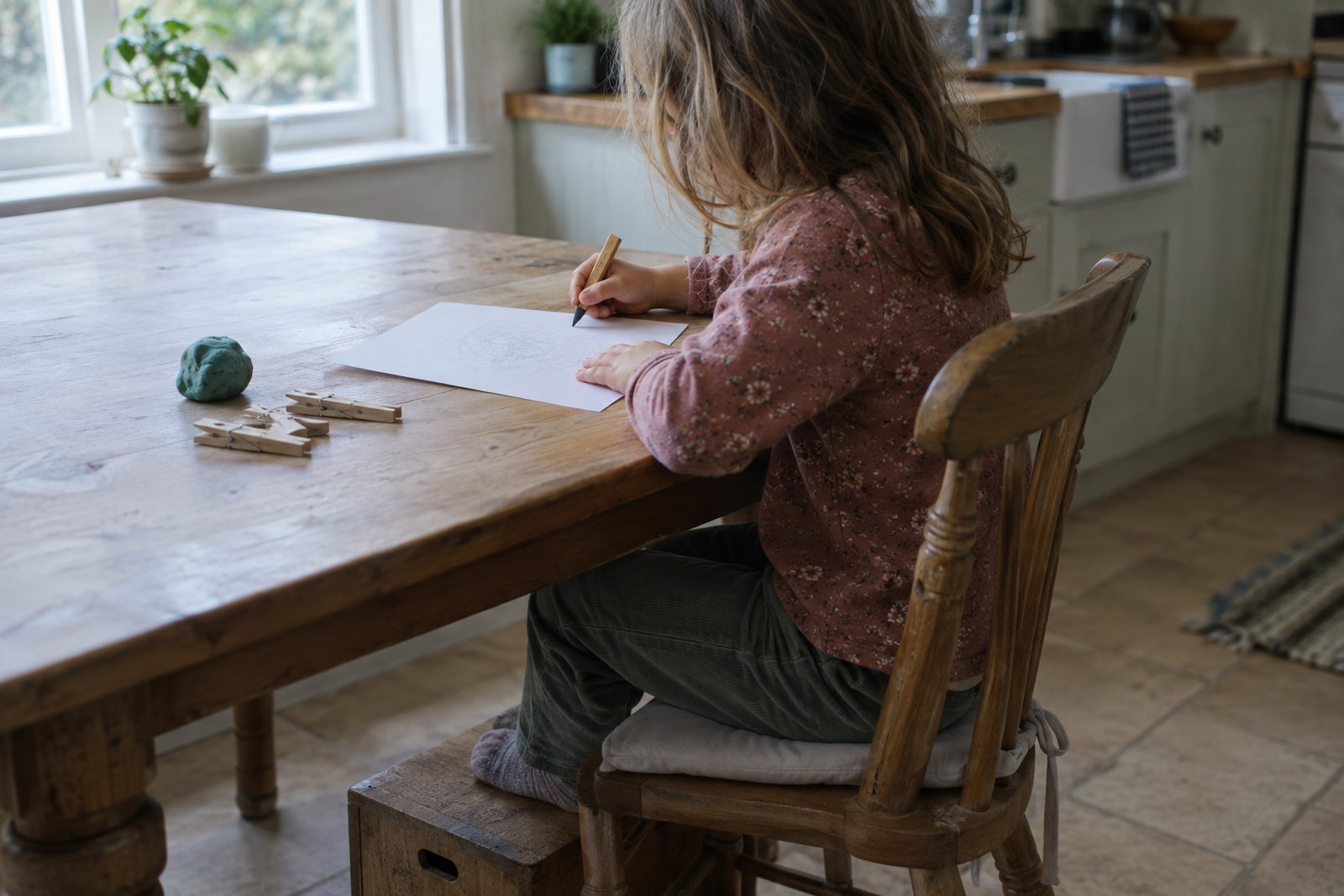
If you have searched for pencil grip because your child holds a pencil in a way that looks odd, here is the short answer. A grip does not need to look textbook to be fine. Most children move through several grips between about age one and age six or seven, and many end up with something slightly different from the classic tripod. If your child's writing is readable, they can keep going without pain, and they are roughly keeping up with their class, the grip is probably doing its job.
What deserves attention is what the grip is costing them: pain, tiring quickly, writing very slowly, or falling behind. This guide covers the usual stages by age, how to set up posture and paper, help for left-handers, which pencil grips are worth trying, games that build the skills underneath, and when an occupational therapist is worth seeing.
How pencil grip develops: the usual stages
The ages below are rough. A few months either side is normal, and the order matters more than the timing.
Around 1 to 2 years: the fist grip
Toddlers grab a crayon in their whole fist and scribble by moving the whole arm from the shoulder. The small hand muscles are not ready for fine work yet, so the shoulder does it.
Around 2 to 3 years: fingers pointing down
Many children then hold the crayon with the palm facing down and the fingers wrapped round it, pointing at the paper. Movement comes from the elbow and forearm, and scribbles start turning into lines, circles and dots.
Around 3 to 4 years: an early tripod or four-finger grip
The pencil moves into the fingers: thumb, index and middle finger (a tripod), or with the ring finger joining in (a quadrupod). The fingers mostly stay still, and the wrist or whole hand moves the pencil.
Around 4 and a half to 7 years: a mature grip
Gradually the fingers start moving the pencil on their own while the forearm rests on the table. Therapists call this a dynamic grip, and it allows the small, quick movements that letters need. Some children get there at five. Others are still refining it at seven.
Why an imperfect grip is often fine
Children used to be taught that the dynamic tripod was the only correct grip. Occupational therapists now generally accept that several mature grips work well:
- Dynamic tripod: pencil pinched between thumb and index finger, resting on the middle finger.
- Dynamic quadrupod: index and middle fingers both on top, pencil resting on the ring finger.
- Lateral tripod: the thumb presses across the side of the index finger instead of making an open circle.
- Lateral quadrupod: the four-finger version with the thumb across.
If your child uses one of these, writes legibly at a reasonable speed and has no aches, there is usually no reason to change it. Constant correcting can make a child self-conscious and slower, and put them off writing altogether.
A grip is more worth looking at when it comes with:
- pain in the fingers, hand, wrist or arm when writing
- shaking the hand out, or saying it is tired after a few lines
- white knuckles, snapped pencil leads, torn paper, or writing so faint it is hard to read
- a fist grip, or the thumb wrapped tightly over the fingers, well into the first years of primary school
- regularly swapping hands mid-task after about age five or six
An awkward grip is sometimes a child compensating for something else, such as very bendy joints, weaker shoulder and trunk muscles, or coordination difficulties. That is why fixing the fingers alone does not always work.
Get the set-up right first
Before buying anything, look at how your child sits. Kitchen chairs and tables are built for adults, and a child perched on one is working against gravity the whole time.
Posture
- Feet flat. If they dangle, put a sturdy box or step under them.
- Hips right back in the chair with the back supported. A cushion behind the back helps if the seat is too deep.
- Table at about elbow height, or a little above. Too high and the shoulders hunch. Too low and they slump.
- Both forearms on the table, so the fingers can do the fine work.
Paper position
- Place the paper slightly towards the writing-hand side, not straight in front.
- Tilt it. Right-handers usually do best with the top of the page turned a little to the left; left-handers with it turned to the right.
- Get the other hand holding the paper still. Children who leave that hand in their lap end up chasing the page round the table.
- A sloped surface helps some children keep the wrist in a better position. A large ring binder on its side, spine away from the child, is a free version.
Help for left-handed children
Left-handers push the pencil across the page, so they cover and smudge what they have just written, and some curl the wrist into a hook to see it. Things that help:
- Paper to the left of the body and tilted to the right. This alone often removes the need to hook.
- Holding the pencil a little further from the tip, so the writing stays visible.
- Sitting on the left of a right-handed sibling or classmate so elbows do not clash. Worth mentioning to school.
- Light coming from the right, so the hand's shadow does not fall on the work.
- Quick-drying pens once they move on from pencil, and left-handed scissors.
Never make a left-handed child switch hands. If a young child seems to use both hands equally, let them choose. Preference usually settles in the early school years, and if it has not, mention it to school.
Pencil grips: types and whether they help
Slip-on pencil grips are cheap and sometimes useful, but they are not a cure. They work best for children whose grip is nearly there and needs a nudge, and least well where the real issue is strength, coordination or posture.
- Triangular pencils and crayons. The three flat sides guide the fingers into a tripod. For many children this is all they need.
- Soft triangular sleeves. A rubbery grip that slides onto an ordinary pencil. Gentle and not very noticeable in class.
- Moulded grips with finger dips. Shaped places for thumb and fingers. Some are made for left or right hands, so check.
- Grips with a hood or wings. A small shield that stops fingers creeping down to the tip or crossing over the thumb.
- Fingertip pocket grips. Pockets hold each fingertip in place. More structured, and some children find them restrictive.
- Thick foam tubes. Make the pencil fatter and softer. Helpful for children who squeeze hard or whose hands ache.
Try one type for a few weeks, starting with drawing and colouring at home rather than school writing. If your child hates it, stop; a grip fought over every day does more harm than good. Short pencils, broken crayons and small bits of chalk do a similar job for free, because it is hard to fist-grip something tiny.
Games that build the skills under handwriting
Handwriting sits on top of other skills: a steady trunk and shoulder, strong small hand muscles, and eyes and hands working together. Ten to fifteen minutes of play most days usually does more than a long handwriting session at the weekend.
Hand strength and finger control
- Playdough or putty: roll tiny balls between fingertips, pinch, and dig out hidden beads.
- Tongs, tweezers and clothes pegs: sort pom-poms or dried pasta into an egg box, or peg cards on a string.
- Threading beads or pasta tubes onto a shoelace.
- Posting coins into a money box one at a time.
- Tearing paper into small pieces for collage, and peeling stickers.
- Spray bottles to water plants, which works the same muscles a pencil does.
- Snipping with child-safe scissors: paper fringes, straws, playdough sausages.
Shoulder and core
- Draw on a vertical surface such as paper taped to a wall or an easel. This puts the wrist naturally into a good writing position.
- Lie on the tummy propped on elbows to draw or do puzzles.
- Wheelbarrow walks, crawling and climbing at the park.
Letter formation
- Write letters with a fingertip in a tray of sand, salt or shaving foam.
- Draw letters on each other's backs and guess them.
- Use the same letter shapes your child's school teaches, so home and school match.
Stop while they are still enjoying it. If your child dreads every session, something is too hard, and that is useful information.
When handwriting difficulty is worth an assessment
Plenty of children write messily for a while and catch up. It is worth a proper look if:
- writing is painful, or the hand or arm aches regularly
- they tire much faster than other children and avoid writing
- they are much slower than classmates and work is left unfinished
- they are falling further behind despite practice and support
- there are other signs too, such as trouble with buttons, cutlery, scissors or ball games
- they are getting anxious, tearful or angry about writing
Start with the class teacher and the school SENCo. Ask what they see and what support is in place. If your child suddenly loses skills they had, or develops new weakness, numbness or pain in a hand or arm, see your GP promptly. If weakness comes on suddenly, especially on one side of the body, call 999.
Where an occupational therapist fits
Children's occupational therapists help with everyday tasks that are proving hard, and handwriting is one of the most common reasons families get in touch. An assessment typically looks at fine motor skills, posture and core stability, how eyes and hands work together, visual perception, motor planning, how much pressure a child uses, and the set-up at home and school. Standardised tests may be used to compare skills with other children of the same age.
You should come away knowing why writing is hard, with a practical home programme and recommendations for school, such as seating, sloped boards, extra time or a keyboard for longer work. A written report can support conversations about SEN support or an EHCP request in England. Our guide to paediatric occupational therapy explains more, and if coordination is a wider worry, see our page on developmental delay.
An occupational therapist is not always the first person to see:
- Optician: trouble copying from the board, losing the place, headaches or squinting point to an eye test first. NHS sight tests are free for children under 16.
- GP: for pain, painful bendy joints, tremor, lost skills, or if you wonder about dyspraxia (developmental coordination disorder). Diagnosis usually involves a paediatrician, often with occupational therapy input.
- Physiotherapist: where balance, posture or larger movements are the main problem.
- Educational psychologist or specialist teacher: if spelling, reading or getting ideas onto paper is the bigger issue.
- Speech and language therapist: if language difficulties are affecting what your child can write.
NHS children's occupational therapy exists, but referral routes and waits vary by area. Some families choose a private assessment at home or school. Our guide to NHS or private occupational therapy sets out the trade-offs, and how to choose a private occupational therapist explains how to check HCPC registration and children's experience.
Frequently asked questions
At what age should a child have a tripod grip?
Most children settle into a mature grip, tripod or one of the other functional versions, somewhere between about four and a half and seven. A four-year-old using a fist grip is not unusual. If your child is six or seven and still fisting the pencil, or writing hurts, raise it with school.
Should I keep correcting my child's grip?
Usually not, if their writing is legible, comfortable and fast enough. Nagging rarely changes a grip and often turns writing into a battle. With younger children, short crayons, triangular pencils and play shape the grip without anyone saying a word.
My child presses so hard the paper tears. What helps?
Try a fatter, softer grip, a soft pencil that marks easily, and warming up with putty first. Writing on a sheet laid over a thin mouse mat gives instant feedback: press too hard and the pencil goes through. Heavy pressure can mean a child is working hard to feel or control the pencil, sometimes linked to bendy joints, so mention it if it persists.
Should my child just use a keyboard instead?
For older children with lasting difficulty, learning to touch type alongside handwriting can take a lot of pressure off for longer pieces of work. Whether a laptop is used in class or exams is a school decision, and an occupational therapy report can support that conversation.
Is messy handwriting a sign of dyspraxia or ADHD?
Not on its own. Lots of children write untidily for a while. If handwriting difficulty sits alongside wider coordination problems, or difficulties with attention and organisation, talk to the school and your GP about assessment.
Next steps
If handwriting is causing pain, tears or falling behind, an assessment can explain why and what to do about it. See our children's occupational therapy page, or current guide prices, and choose your area below.
Talk to an occupational therapist near you
This guide is general information. For advice about your own situation - or someone you look after - a local occupational therapist can visit you at home and see it for themselves.
Choose your area: