

Dysgraphia: Signs in Children and Adults and What Helps
By Mobile Occupational Therapist • 28 September 2026 • 14 min read
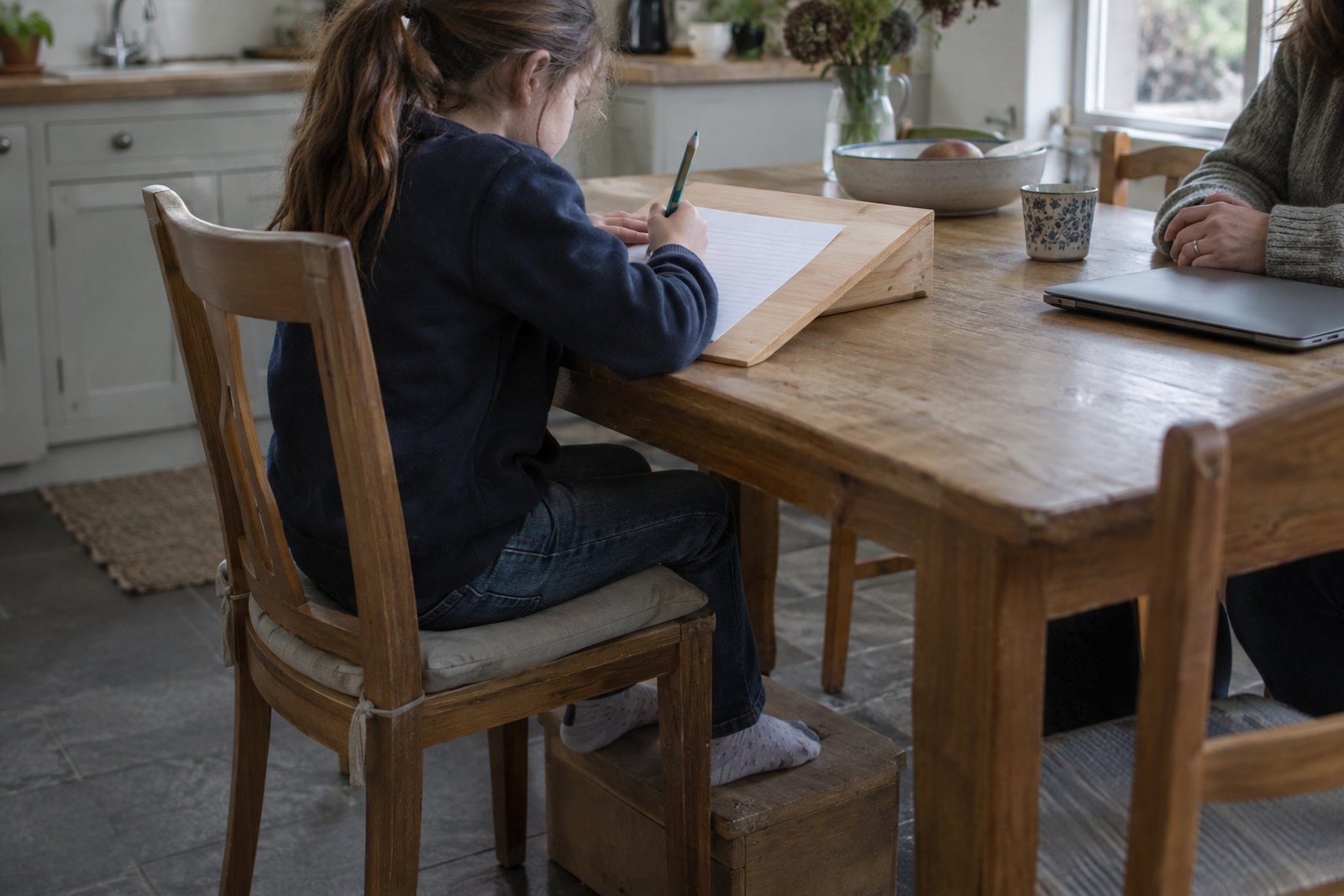
Dysgraphia is a word for a persistent difficulty with writing that is out of step with the rest of a person's abilities. That can mean the physical act of handwriting (forming letters, spacing, speed, a hand that aches after a few lines), the job of getting thoughts down on paper in an organised way, or both. A child who can tell you a brilliant story out loud and then produces three cramped, crossed-out lines is the classic picture. So is the adult who dreads filling in a form while someone watches.
In the UK you will not always hear the word. Many clinicians and schools describe it as a specific learning difficulty affecting writing, or treat handwriting problems as part of something else, such as developmental coordination disorder (DCD, often called dyspraxia), dyslexia or ADHD. The label matters less than the help, and a lot can be done: better posture and tools, less pointless copying, typing and speech-to-text, and proper adjustments at school, in exams and at work. This guide covers the signs by age, who assesses what, and what you can start doing at home today.
What dysgraphia actually is (and is not)
It helps to split writing into two jobs.
- The motor side. Holding the pen, controlling it, forming letters the same way each time, keeping them on the line, spacing words, and doing all of this fast enough to keep up with your thoughts without your hand tiring.
- The language side. Spelling, grammar, punctuation, and organising ideas into sentences and paragraphs.
Some people struggle mainly with one, some with both. A child with neat letters who cannot organise a paragraph has a different problem from a child bursting with ideas whose hand cannot keep up. Both get called dysgraphia, which is one reason the term confuses people.
Dysgraphia is not laziness, carelessness or a sign of low intelligence. Many people with it are articulate and bright, which is exactly why the gap between what they can say and what they can write is so frustrating. It is also not the same as messy handwriting. Plenty of people write untidily but quickly, comfortably and readably enough. It becomes a problem when it is persistent, does not improve with ordinary teaching and practice, and gets in the way of learning, work or confidence.
It often sits alongside other things. Handwriting difficulty is very common in children with DCD (see our guide to dyspraxia in children), and it frequently overlaps with dyslexia, ADHD and autism. That overlap matters, because the right help depends on what is driving the difficulty.
Signs of dysgraphia by age
Young children's writing is supposed to be wobbly, and children develop at different speeds. What you are looking for is a pattern that persists despite practice, and a clear gap between writing and everything else the child can do.
Pre-school and Reception
- Avoids drawing, colouring and mark-making when other children enjoy them.
- A grip that is very tight, very loose, or keeps changing hands and positions.
- Finds it hard to copy simple shapes such as a circle, cross or square.
- Tires quickly or says their hand hurts.
- Also struggles with other fine motor tasks such as cutting, buttons or cutlery.
At this age these are things to keep an eye on, not reasons to panic. Our guide to pencil grip by age explains what is typical.
Primary school
- Letters formed in odd ways, such as starting at the bottom or building them from separate strokes, and formed differently each time.
- Capitals and lower case mixed within words.
- Uneven size and spacing, with words running together or drifting off the line.
- Letter reversals that carry on well after classmates have stopped making them.
- Very slow writing, or fast writing nobody (including the child) can read back.
- Written work much shorter and simpler than what they can say out loud.
- Copying from the board is a particular struggle: they lose their place and fall behind.
- Pressing so hard the pencil snaps or the paper tears, or so lightly the writing is faint.
- Avoiding writing altogether: sudden toilet trips, endless pencil sharpening, tears at homework time.
Secondary school
- Cannot keep up with note-taking or longer written tasks.
- Handwriting falls apart as a piece goes on, or under time pressure.
- Pain or cramp in the hand, wrist or forearm.
- Difficulty planning and structuring essays even when they know the subject well.
- Written marks that do not reflect what they show in class discussion.
- Typing is noticeably easier, and they may already prefer it.
Adults
- Avoiding handwriting wherever possible, and feeling anxious about writing in front of others: a birthday card, a form at reception, a signature.
- Notes from meetings or training that you cannot read later.
- Writing that is slow, tiring or painful.
- Spelling and organising written work stays hard however much effort you put in.
- A long history of school reports saying you could do better if you took more care.
Many adults have never had a name for this. Finding one late can bring relief, irritation, or both. Either is reasonable.
When it is not dysgraphia: see a doctor
Dysgraphia is a long-standing pattern. A change is different. If an adult's handwriting suddenly changes alongside weakness or numbness on one side, a drooping face, slurred speech or confusion, call 999, as these can be signs of a stroke. Gradual changes, such as writing getting smaller and more cramped, a new tremor, tingling or numbness in the fingers, or weakness in the hand, should be checked by your GP. For a child, see the GP if they lose skills they previously had, or if writing difficulty comes with other new symptoms such as weakness, worsening clumsiness or headaches. If you are not sure how urgent something is, call NHS 111.
How dysgraphia is assessed in the UK
There is no single test, and no single profession owns writing difficulties. Different people look at different parts of the picture.
For children
Start with school. Talk to the class teacher and the SENCo (special educational needs coordinator), and bring examples: a piece of homework, a page from an exercise book, a note of how long it took. In England, children with special educational needs should get help through SEN support in school, following the SEND Code of Practice. Wales (additional learning needs), Scotland (additional support for learning) and Northern Ireland each have their own systems. GOV.UK and your council's local offer explain what applies to you.
Depending on what is going on, the people involved may include:
- A specialist teacher or educational psychologist, who looks at the learning side: spelling, written expression, reading, memory and processing. They can identify specific learning difficulties such as dyslexia. Schools can sometimes access an educational psychologist through the council; families also commission private assessments.
- An occupational therapist, who looks at the motor side: posture, core and shoulder stability, hand strength, grip, coordination, visual-motor skills, sensory factors, and handwriting speed and legibility measured against children of the same age.
- A paediatrician, usually via your GP, if DCD or another medical cause is suspected. A DCD diagnosis is made by a doctor, often with input from an occupational therapist or physiotherapist.
- A speech and language therapist, if the difficulty seems to come from language itself: vocabulary, building sentences or understanding.
If support at school is not enough and needs are significant, an Education, Health and Care plan may be the next step. Our guide to the EHCP process explains how it works and what an occupational therapy report adds.
For adults
Adults usually arrange a specific learning difficulty assessment privately, with a psychologist or a specialist teacher qualified to carry out diagnostic assessments. Students at college or university should talk to the disability or learning support service first; in England, students may be eligible for Disabled Students' Allowance, and GOV.UK sets out the current rules. An occupational therapist can assess the physical side and how writing affects your work and daily life. If you think DCD may be behind it, speak to your GP, although access to adult assessment varies a lot by area.
Practical help you can start at home
Get the position right first
Nobody writes well while sliding off a chair. Before buying anything, check:
- Feet flat on the floor, or on a footrest or sturdy box if they do not reach.
- Hips and knees roughly at right angles, back supported.
- Table at about elbow height when sitting.
- Paper tilted slightly and held still with the other hand. Left-handers tilt it the opposite way, and should not sit to the right of a right-handed sibling where elbows clash.
- Good light, from the side opposite the writing hand so the hand does not shade the page.
A sloped writing board, angled up away from the writer, helps many children and adults keep the wrist in a better position and see the page more easily.
Try different pens, pencils and grips
Let them try several and notice what feels comfortable. Options include thicker or triangular pencils, soft push-on grips, pens that glide with very little pressure (helpful for heavy pressers whose hands ache), and softer pencils for those who press too lightly. If a grip looks unusual but is comfortable, readable and fast enough, it usually does not need correcting.
Change the paper
- Raised-line paper, which lets the writer feel where the line is.
- Wider line spacing for children with large or uneven letters.
- Lined paper with the writing zone shaded or highlighted, to show where tall and short letters sit.
- Squared paper for maths, so columns of numbers stay lined up.
Warm up and practise little and often
A couple of minutes of hand warm-ups before homework can help: squeezing dough, using pegs or tongs, wall press-ups for shoulder strength. These help comfort and readiness rather than curing anything. For letter formation, short practice of five to ten minutes beats a miserable half hour. Practise letters in families that start the same way, trace first, then copy, then write from memory, and praise effort. Whether joined handwriting helps varies from child to child, so talk to school if it is becoming a battle.
Separate the ideas from the handwriting
This is the single most useful change many families make. Let your child tell you their story or answer first while you write it down or record it, then they write from that. Use mind maps or simple planning sheets, sentence starters, and a short checklist for checking work afterwards. It shows them their ideas are good, and it stops writing difficulty from hiding what they know.
Typing, speech-to-text and other technology
Many parents worry that typing is giving up. It is not. For many people with dysgraphia, typing is the route to showing what they can do, and the earlier it is learned properly, the more useful it becomes.
- Touch typing is worth learning, ideally with short regular practice. Two-finger typing is often no quicker than handwriting.
- Speech-to-text is built into most phones, tablets and computers now. It takes some practice to dictate punctuation and edit afterwards, but it can transform homework and work emails.
- Word prediction and spell check help with the language side.
- Photographing the board or getting printed notes and slides removes a lot of exhausting copying.
Keep some handwriting going for everyday essentials, such as names, short notes, forms and signatures, but stop treating long handwritten pieces as the only valid way to work.
Exam access arrangements
For GCSEs, A levels and many other qualifications in England, Wales and Northern Ireland, access arrangements follow rules set by the Joint Council for Qualifications; in Scotland the SQA has its own arrangements. Depending on the evidence, these can include extra time, rest breaks, use of a word processor, a scribe or speech recognition. A key principle is that the arrangement should reflect the student's normal way of working, so if your child will need a laptop in exams, they need to be using one in lessons well beforehand.
Speak to the SENCo or exams officer early, ideally well before Year 10, because evidence is gathered over time and schools have deadlines. Universities and professional bodies run their own processes, so ask their disability service or the exam board directly.
Dysgraphia in adults at work
You do not have to tell your employer, but doing so opens the door to support. If your difficulty has a substantial and long-term effect on day-to-day activities, it may count as a disability under the Equality Act 2010 (or the Disability Discrimination Act 1995 in Northern Ireland), which means your employer has a duty to make reasonable adjustments. Our guide to reasonable adjustments at work explains how to ask.
Useful adjustments often include typing rather than handwriting, speech-to-text or other software, templates for common reports, someone else taking minutes or notes being shared after meetings, extra time for written tasks, and a properly set up workstation to reduce strain. The government's Access to Work scheme can help pay for support and equipment that goes beyond reasonable adjustments; check current eligibility on GOV.UK.
Where an occupational therapist fits
An occupational therapist's strength is the physical and practical side of writing. They can assess posture, seating, hand strength, coordination, visual-motor skills, sensory factors and handwriting speed, then turn that into specific recommendations: the right chair and table height, a writing slope, grips and paper, a short home programme, and a clear view on when to move to typing. For children, a paediatric occupational therapist can write a report that school can use, including evidence for an EHCP. For adults, they can look at how writing affects your job and recommend workplace adjustments.
What an occupational therapist does not do is diagnose dyslexia, teach spelling or carry out an educational psychology assessment. If the main difficulty is with language, a speech and language therapist is the right person. If there are medical concerns, or any sudden change in writing, start with your GP.
Frequently asked questions
Is dysgraphia a recognised diagnosis in the UK?
The word is used, but less often than in some other countries. UK professionals more commonly describe it as a specific learning difficulty affecting writing, or as handwriting difficulty linked to DCD, dyslexia or ADHD. What matters is a clear description of the difficulty and what helps, because that is what unlocks support.
Is dysgraphia the same as dyslexia?
No, although they often overlap. Dyslexia mainly affects reading and spelling. Dysgraphia is about writing, which can be the physical act of handwriting, written expression, or both. Someone can have one without the other.
Will my child grow out of it?
Handwriting usually improves with age and the right support, but a true writing difficulty tends not to disappear entirely. The aim is to make writing comfortable and readable enough, and to give your child other ways, such as typing, to show what they know.
Should my child stop handwriting and just type?
Usually it is both, not either. Most children benefit from continuing to work on handwriting for short everyday tasks while learning to touch type for longer work. An occupational therapist or the school can help you judge the balance.
Can I be assessed for dysgraphia as an adult?
Yes. Adults usually arrange a specific learning difficulty assessment privately, or through a college or university disability service if they are studying. An occupational therapist can assess the physical side and its effect on work.
Does dysgraphia count as a disability at work?
It can, if it has a substantial and long-term effect on your normal day-to-day activities. It depends on your individual situation. ACAS and GOV.UK explain the Equality Act definition and your rights.
Next steps
If writing is causing daily struggle at school or work, an assessment of the physical side can give you clear, practical recommendations. See our paediatric occupational therapy or work and ergonomics pages, or current guide prices, and choose your area below.

Talk to an occupational therapist near you
This guide is general information. For advice about your own situation - or someone you look after - a local occupational therapist can visit you at home and see it for themselves.
Choose your area: