

Visual Perception Difficulties in Children: Signs and Activities
By Mobile Occupational Therapist • 3 October 2026 • 13 min read
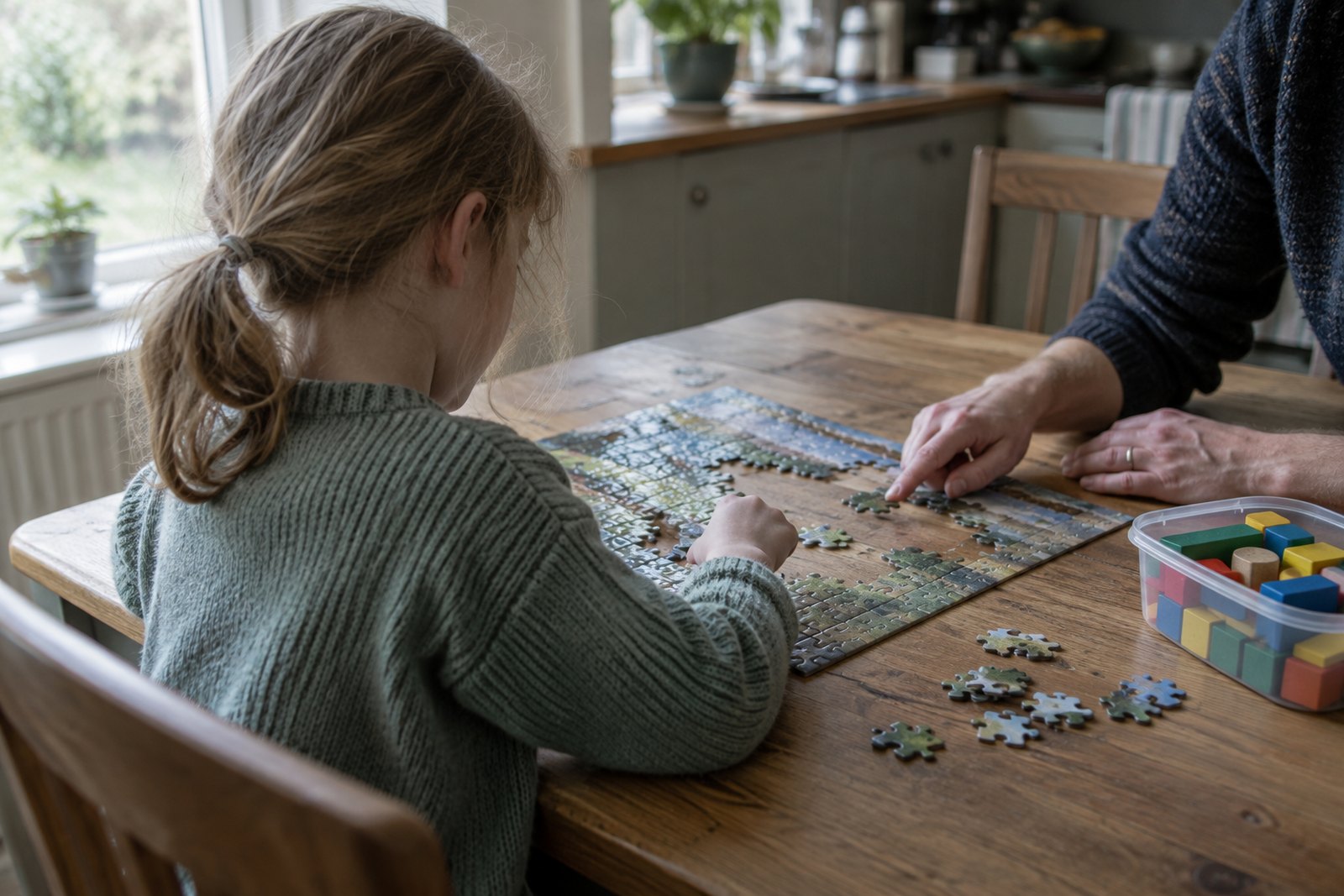
Visual perception is how the brain makes sense of what the eyes see. It is not the same as eyesight. A child can have perfectly clear vision and still struggle to pick out one word on a busy page, recognise a letter written in a different style, remember a shape long enough to copy it, or judge where things are in relation to each other.
If your child loses their place when reading, finds copying from the board exhausting, avoids jigsaws, or can never find their shoes when they are right in front of them, visual perception difficulties are one possible reason. They are not the only one. The first step is always an eye test with an optician, and an orthoptist if there are concerns about how the eyes work together. If eyesight turns out to be fine, there is plenty you can do at home and in school, and an occupational therapist can assess exactly which skills are causing the trouble.
What visual perception actually is
Think of the eyes as a camera and the brain as the person looking at the photographs. The camera can be working beautifully, but if the person looking at the pictures cannot sort out what is in the foreground, which way round something is, or what the blurry shape at the edge might be, the photographs are not much use.
Most children build these skills without anyone noticing, through years of play: stacking blocks, posting shapes, hunting for a favourite toy in a messy box, doing puzzles, drawing. Some children find it much harder. That might sit on its own, or alongside other things such as dyspraxia, autism, ADHD, a premature birth, or a wider developmental delay. Often there is no clear reason at all, and that is fine. Knowing which skills are tricky matters more than finding a label.
The component skills, in plain English
Therapists and teachers break visual perception into smaller skills. You do not need the jargon, but it helps to know what each one looks like in real life, because a child can be strong in some and weak in others.
Visual discrimination
Noticing the differences between things that look similar. Telling b from d, 6 from 9, a square from a rectangle, or spotting which picture is the odd one out.
Figure-ground
Picking out one thing from a busy background. Finding a word on a crowded worksheet, a red sock in a full drawer, or the teacher's writing among displays on a classroom wall. Children who struggle here often look disorganised when really they simply cannot see the thing they are looking for.
Form constancy
Recognising that something is the same even when it is bigger, smaller, turned round or in a different style. A letter a in a book can look quite different from a handwritten one. A child with weaker form constancy may not realise they are the same letter.
Visual memory
Holding a picture in your mind for long enough to use it. This includes remembering the order of things, which is why copying spellings or sums from the board can be so hard. The child looks up, looks down, and the information has gone.
Spatial relations
Understanding where things are in relation to you and to each other. Above, below, next to, in front, left and right. It affects letter reversals, spacing between words, setting out sums in columns, judging distance on the playground and following a map.
Visual closure
Recognising something when you can only see part of it. Reading quickly relies on this, because we do not look closely at every letter. It also helps with spotting a partly hidden toy or finishing a dot-to-dot picture in your head.
Two related abilities often get mixed in. Visual-motor integration is getting what you see out through your hand, which shows up in copying shapes and handwriting. Eye movements, such as following a line of text smoothly or both eyes working together up close, are a matter for an optician or orthoptist rather than a perception problem as such.
Signs at home and at school
No single sign means your child has a difficulty. Young children reverse letters, lose things and give up on puzzles. What matters is a pattern that persists, causes frustration, or holds them back compared with children their age.
At home
- Avoiding or getting very upset by jigsaws, dot-to-dots, mazes or building from a picture.
- Struggling to find things that are in plain sight, especially in cluttered drawers or cupboards.
- Getting lost or disoriented in familiar places such as a supermarket or a friend's house.
- Putting clothes on back to front or inside out more often than you would expect for their age.
- Difficulty with ball games, judging steps or kerbs, or bumping into things.
- Finding it hard to tidy away into the right places, even when they want to help.
- Tiring quickly with activities that involve looking carefully, then becoming cross or silly.
At school
- Losing their place when reading, skipping lines or words, or using a finger long after classmates have stopped.
- Copying from the board slowly or inaccurately, with letters, numbers or words missing or jumbled.
- Persistent letter and number reversals well beyond the early years.
- Uneven spacing, writing that wanders off the line, or difficulty keeping numbers in columns in maths.
- Trouble with shape work, symmetry, telling the time on an analogue clock, or reading graphs.
- Struggling with busy worksheets but managing better when the same task is set out simply.
- Being described as careless or not trying, when the effort is actually enormous.
Rule out eyesight first
Before anyone starts on visual perception, get your child's eyes checked. Some of the signs above, such as losing place, headaches, rubbing eyes or avoiding close work, can come from simple long-sightedness, astigmatism, or the eyes not working well together. Glasses or treatment might sort it out entirely.
An optician can test children of any age, including those who cannot yet read, using pictures and other methods. NHS sight tests are free for children under 16, and for young people under 19 in full-time education. Check the current rules on the NHS website. Tell the optician what you have noticed, not just that school asked you to come.
An orthoptist specialises in how the eyes move and work together, including squints, lazy eye and focusing problems. Children are usually seen by an orthoptist through a hospital eye clinic, after referral from an optician, GP or a school vision screening. If the optician mentions eye movements or eye coordination, ask whether an orthoptist referral would help.
Some things need more than a routine appointment. If your child develops a new squint, has a sudden change in their vision, or has headaches that wake them at night or come with vomiting, see your GP promptly or call NHS 111. Sudden loss of vision is an emergency: call 999 or go to A&E.
Everyday activities and games that help
The good news is that the best activities are ordinary, cheap and fun. A few principles make them work better.
- Little and often. Ten minutes most days beats an hour at the weekend.
- Start where they succeed. Pick a level they can nearly manage, then make it a touch harder.
- Stop before frustration. If they are melting down, the brain has stopped learning.
- Talk it through. Words like above, behind, next to and upside down help the brain organise what the eyes see.
For figure-ground and discrimination
- Spot the difference and hidden object pictures, starting with simple ones.
- I spy, using colours or shapes for younger children.
- Find the objects buried in a tray of dried rice, pasta or sand. Stay with young children during this and any game using buttons, beads or other small items, as they are a choking hazard.
- Word searches with a short list of large words, building up gradually.
- Sorting mixed buttons, beads or socks into matching groups.
For visual memory
- Pairs or matching card games, starting with six or eight cards face down.
- Put a few objects on a tray, let them look, cover it, take one away and ask what has gone.
- Show a short pattern of coloured blocks, hide it, and ask them to build it from memory.
- Ask them to remember a short shopping list from pictures and find the items in the shop.
For spatial relations
- Building with blocks or construction bricks from a simple picture or a model you make.
- Obstacle courses with instructions: go under the table, round the chair, over the cushion.
- Treasure hunts with picture clues or a simple map of one room.
- Copying peg-board or bead patterns, then trying them on squared paper.
For form constancy and visual closure
- Jigsaws, from large chunky pieces upwards. Doing the edges first teaches strategy.
- Dot-to-dot pictures and simple mazes.
- Finding a shape or letter in different sizes and styles around the house, on packets or in books.
- Drawing half a picture and asking them to guess what it is, or to finish it.
Everyday jobs that count
Laying the table, matching socks, putting shopping into the right cupboards, following a picture recipe, and helping to load the dishwasher all use these skills. They also build confidence, because the child is genuinely useful. At home, reduce the hunt: clear storage boxes, picture labels on drawers and a set place for school bags and shoes make daily life smoother while the skills develop. If pencil control is also a struggle, our guides to fine motor skills activities and pencil grip and handwriting pair well with these games.
Classroom adjustments worth asking for
Many helpful changes cost nothing and can start straight away. Talk to the class teacher first, and to the school's SENCO if you think your child needs more organised support.
- Giving a printed copy to work from on the desk instead of copying from the board.
- Sitting facing the board, near the front, rather than twisting round to see it.
- Worksheets with less on each page, plenty of white space and a clear, simple font.
- A reading ruler, a card with a window cut in it, or a finger guide to keep their place.
- Squared paper for maths so numbers stay in columns, and paper with clearer or raised lines for writing.
- Colour coding or highlighting to separate sections of a task.
- Extra time for copying, reading and written work, and fewer questions rather than rushing.
- A tidy, labelled place for their equipment and a visual checklist for what goes home.
- Recognition that tiredness and frustration are part of the picture, not bad behaviour.
In England, most children with these needs are supported through SEN support in their school. If difficulties are significant and the school cannot meet them with its usual resources, you can ask about an Education, Health and Care needs assessment. Our guide to EHCPs and what an occupational therapy report adds explains how that works.
Where an occupational therapist fits
An occupational therapist looks at how a child manages everyday life: schoolwork, play, dressing, eating and getting organised. With visual perception, they can work out which skills are the sticking point and how much they are affecting daily life, which is far more useful than a general sense that something is not right.
An assessment usually includes standardised tests of visual perception and visual-motor integration, observation of handwriting, drawing, play and self-care, and conversations with you and often the school. A good occupational therapist also looks at the bigger picture, including coordination, attention, sensory needs and fatigue, because visual perception rarely exists in isolation. Children with dyspraxia, for example, often have visual perceptual difficulties alongside motor ones.
You should come away with a written report explaining what was found in plain language, a home programme of activities, and specific recommendations for school that a teacher can act on. Some families then have a block of therapy sessions; others mainly use the report to guide home and classroom support.
On the NHS, children's occupational therapy is usually accessed through a GP, health visitor, school or paediatrician, and acceptance criteria and waiting times vary between areas. A private occupational therapist visiting at home or school can usually see a child sooner. Check they are registered with the HCPC and experienced with children. Our guide to paediatric occupational therapy covers what to expect.
An occupational therapist is not the right first port of call for everything. Eyesight and eye movement problems belong with an optician, orthoptist or eye doctor. Reading and spelling difficulties that might be dyslexia are assessed by a specialist teacher or educational psychologist. Speech and language concerns go to a speech and language therapist, and questions about attention or autism diagnosis to a paediatrician or local child development service. An occupational therapist can work alongside all of these.
Frequently asked questions
Is visual perception the same as eyesight?
No. Eyesight is how clearly the eyes see. Visual perception is how the brain interprets what they see. A child can have excellent eyesight and still find visual perception hard, which is why a normal eye test does not rule it out, and why it should still come first.
Will my child grow out of it?
Many children's skills improve with age, practice and the right support, and some catch up fully. Others continue to find certain tasks harder but learn strategies that work around them. Early support makes school less exhausting either way, so it is worth acting rather than waiting.
Is this the same as dyslexia?
Not exactly. Dyslexia mainly affects how the brain processes the sounds in words, though some children have both dyslexia and visual perceptual difficulties. If reading and spelling are the main worry, ask the school about a dyslexia screening or assessment as well.
Is reversing b and d a sign of a problem?
Usually not in the early school years, when it is very common. It becomes more worth noting if it carries on well into the junior years alongside other signs, such as losing place, copying difficulties or trouble with puzzles.
What age can visual perception be assessed?
Occupational therapists can observe these skills in young children through play, and many standardised tests are designed for children from around school age upwards. If you are worried about a pre-schooler, an assessment can still look at how they are managing play and self-care.
Can I get an OT assessment on the NHS?
Often, yes, through your GP, school or health visitor, though criteria differ between areas and some services focus on children with more complex needs. Ask what your local children's occupational therapy service accepts. A private assessment is another option if you want one sooner.
Next steps
Book an eye test first, then start a few of the games above and talk to your child's teacher. If you want a clear picture of which skills are holding your child back, see our children's occupational therapy page, or current guide prices, and choose your area below.

Talk to an occupational therapist near you
This guide is general information. For advice about your own situation - or someone you look after - a local occupational therapist can visit you at home and see it for themselves.
Choose your area: