

EHCP: What It Is, How to Apply and What an OT Report Adds
By Mobile Occupational Therapist • 21 September 2026 • 12 min read
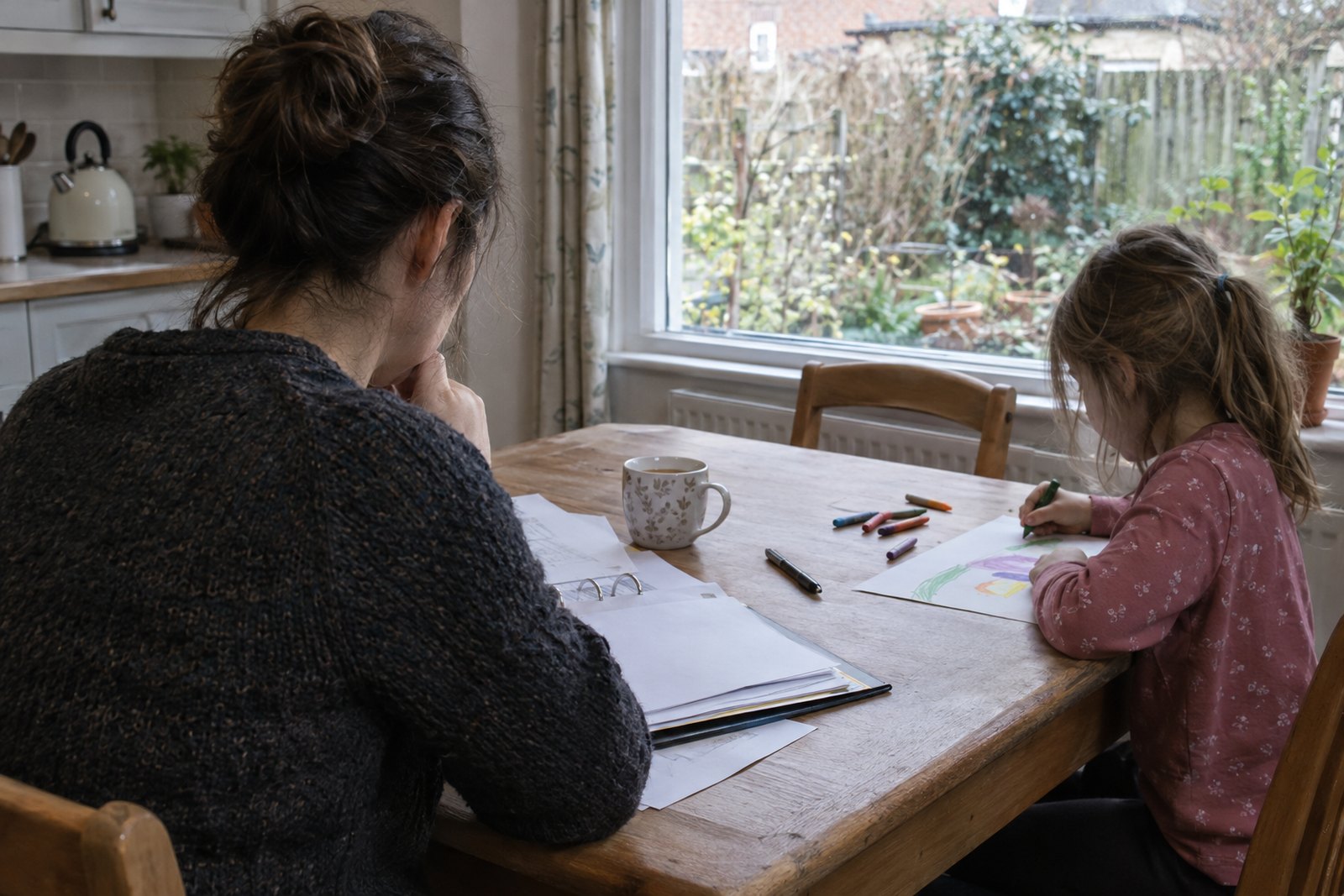
An EHCP, or Education, Health and Care Plan, is a legal document in England that sets out a child or young person's special educational needs and the support they must get to meet them. It is for children and young people aged 0 to 25 whose needs cannot be met by the help a nursery, school or college would normally provide from its own resources. The key difference from a school's own support plan is that the education support written into an EHCP is a legal duty on the local authority. It is not a wish list.
You can ask for one yourself. Parents do not need the school's permission, or a diagnosis, to request an EHC needs assessment. You write to your council's SEND team and say you are requesting one. The council then has to decide within six weeks whether to assess, and the whole process from request to final plan should take no more than 20 weeks. Those are the legal timescales set out in the SEND Code of Practice. Whether your council keeps to them is another matter, which is why it pays to know the steps.
This guide covers England only: Wales has its own additional learning needs system with Individual Development Plans, and Scotland uses Co-ordinated Support Plans under its additional support for learning law, so the steps below do not apply there.
Who an EHCP is for
Most children with special educational needs are supported through what schools call SEN support. The school assesses, plans, puts help in place and reviews it, usually with input from the SENCo (the teacher who coordinates special educational needs). For many children that is enough.
An EHCP is for when it is not. The legal test for an assessment is deliberately low: the council must assess if the child has or may have special educational needs, and may need special educational provision to be made through a plan. Notice the word may. You do not have to prove your case at the request stage, and the child does not have to have failed at SEN support for years first.
Signs it may be time to ask include:
- Your child is making little progress despite the school's support.
- They need more help than the school can realistically fund or provide.
- They are on a reduced timetable, often excluded, or struggling to attend at all.
- Several professionals are involved and nobody is joining the dots.
- A move to a new school or college is coming and you are worried the support will vanish.
How to request an EHC needs assessment
- Write to the council. Email is fine. Send it to the SEND or special educational needs team at your local authority and keep a dated copy. Some councils have a form, but you are not obliged to use it.
- Say clearly what you are asking for. A sentence such as "I am requesting an EHC needs assessment for my child under section 36 of the Children and Families Act 2014" removes any doubt.
- Explain briefly why. A page is plenty. Describe what your child finds hard, what the school has tried, and what happens as a result. Concrete examples help: "cannot dress for PE without an adult", "writes three lines in a 20-minute task".
- Attach what you have. School reports, any therapy or medical letters, the school's support plan. You do not need everything. The council's job is to gather the evidence.
Schools can request an assessment too, and young people aged 16 to 25 can request one for themselves. A parent's request has one advantage: you control the timing. Whoever makes the request, the clock starts on the day the council receives it.
If this feels daunting, every council has a free, impartial SEND Information, Advice and Support Service (usually called SENDIASS). They can talk you through it and often have model letters. The national charity IPSEA also publishes free model letters and legal guidance.
The statutory steps, in plain terms
Weeks 0 to 6: the decision to assess
The council considers your request and asks the school for its views. Within six weeks it must tell you whether it will carry out an assessment. If it refuses, it must explain why and tell you about your right to appeal.
Weeks 6 to 16: gathering advice
If the council agrees to assess, it must seek advice from you (and your child), from the school, from an educational psychologist, from health and from social care, plus anyone else whose input is reasonable. Health advice may come from a paediatrician, an NHS occupational therapist, a speech and language therapist or others. Those asked are expected to reply within six weeks. This is the stage where you can, and should, send in any independent reports you have.
Week 16: the draft plan
If the council decides to issue a plan, it sends you a draft. You then have 15 days to comment and to ask for a particular school or college to be named. Fifteen days goes quickly. Read the draft against the professional reports line by line.
Week 20: the final plan
The final EHCP should be issued no later than 20 weeks after your original request. It is then reviewed at least once a year at an annual review.
If the council says no
You can appeal to the First-tier Tribunal (Special Educational Needs and Disability) if the council refuses to assess, refuses to issue a plan, or issues a plan you disagree with. In most cases you must first contact a mediation adviser, though you do not have to go through with mediation. Appeal deadlines are strict and are set out in the decision letter. Check the current rules on GOV.UK and get advice from SENDIASS or IPSEA early.
What goes in each section of an EHCP
Every plan uses the same lettered sections:
- A - your child's views, interests and aspirations, and yours.
- B - their special educational needs. All of them, not just the main one.
- C - health needs related to their special educational needs.
- D - social care needs related to their special educational needs or disability.
- E - the outcomes the support is aiming for.
- F - the special educational provision: the support they must receive.
- G - health provision.
- H1 and H2 - social care provision.
- I - the school, college or type of setting.
- J - any personal budget.
- K - the advice and information gathered during the assessment, attached as appendices.
Sections B, F and I are the heart of it, and the ones the tribunal can order the council to change. A simple rule: every need in section B should have matching provision in section F. If a need is described in B with nothing in F to meet it, that is a gap worth challenging.
Why occupational therapy belongs in section F
Here is the bit many parents are not told. The law says that health or social care provision which educates or trains a child is to be treated as special educational provision. A great deal of occupational therapy does exactly that: teaching a child to dress, to manage a knife and fork, to form letters, to organise their equipment, or to use strategies to stay regulated in a busy classroom.
Why does it matter which section it sits in? Because the council has a legal duty to secure the provision in section F. If occupational therapy is only in section G, the duty to arrange it falls on the NHS commissioner rather than the council, and the tribunal cannot order changes to it, so in practice it is usually harder to secure and enforce. Councils sometimes place therapy in G by default. Ask why.
The SEND Code of Practice also says provision in section F should be detailed, specific and normally quantified, for example in terms of the type of support, the hours and frequency, and the level of expertise. Vague wording is the most common weakness in plans.
Weak wording looks like this:
- "Access to occupational therapy as required."
- "Opportunities to develop fine motor skills."
- "Regular sensory breaks."
None of these tells anyone who does what, how often or for how long. Compare an illustrative example of specific wording:
- "Direct occupational therapy from an HCPC-registered occupational therapist, one 45-minute session per week in school during term time, with a written programme updated each term."
- "A daily 15-minute fine motor and handwriting programme delivered by a teaching assistant trained and supervised by the occupational therapist."
- "A movement break of five minutes every 30 minutes in lessons, using a planned activity from the occupational therapist's programme."
The exact amount depends on the child, and it should come from a professional assessment, not from a parent or a council guessing. That is where an occupational therapy report comes in.
What an independent occupational therapy report contains
A good report written for an EHCP is not a general letter. It should be built so its findings can be lifted straight into the plan. Expect:
- Background. Birth and developmental history, diagnoses, previous therapy, and your and the school's concerns.
- Assessment methods. Which standardised assessments were used (for example of motor coordination, visual perception, handwriting speed or sensory processing), plus structured observation. The report should say why each was chosen. Our guide to sensory processing assessments explains some of these.
- Observation in real settings. Ideally at home and in school, since a child can look very different in a quiet clinic room.
- Findings in plain English. What the scores mean for daily life: getting changed for PE, eating lunch, copying from the board, coping in the dinner hall.
- Needs, written clearly enough to inform section B.
- Recommended provision, specified and quantified for section F: who delivers it, their level of training, how often, for how long, and how it will be reviewed.
- Suggested outcomes for section E.
- The therapist's qualifications and HCPC registration number.
When families commission one
You do not need a private report to get an EHCP. Plenty of families get a good plan without one. Families tend to commission an independent report when:
- The assessment included no occupational therapy advice, or only a brief note.
- The NHS service has discharged your child, has a long wait, or will only advise on health needs rather than school.
- The draft plan describes motor, sensory or self-care difficulties but section F is vague.
- You are appealing to the tribunal and need clear, independent evidence.
- Needs have changed and an annual review is coming up.
Timing matters. If you wait until the draft arrives, 15 days is rarely enough for a visit, school observation and a written report. Commissioning during the advice-gathering stage, or before an annual review, gives the report a chance to shape the plan rather than chase it. Councils must consider independent evidence, though they do not have to adopt it.
Before booking, ask whether the therapist regularly writes for EHCPs and tribunals, whether they will observe in school (the school must agree), how long the report takes, whether they will attend a tribunal if needed, and what each part costs. Our guide on how to choose a private occupational therapist covers the wider checks.
Where an occupational therapist fits, and where they do not
An occupational therapist looks at how a child manages the practical business of daily life: fine and gross motor skills, handwriting, dressing and eating, sensory processing, organisation and the physical set-up of the classroom, such as seating or writing aids. Our guide to paediatric occupational therapy explains the work in more detail, and a functional assessment and report is the usual format for EHCP evidence.
Other professionals lead in other areas, and an EHCP is often strongest with several voices:
- Speech, language and communication - a speech and language therapist.
- Learning, thinking and emotional needs - an educational psychologist, whose advice the council must obtain during the assessment.
- Diagnosis of autism, ADHD or developmental coordination disorder - a paediatrician or diagnostic team, though an occupational therapist often contributes.
- Emotional wellbeing or mental health worries - your GP, who can refer to children's mental health services. If you think your child is at immediate risk, call 999 or go to A&E.
- Legal advice on the process and appeals - SENDIASS, IPSEA or a solicitor who specialises in education law.
Frequently asked questions
Does my child need a diagnosis to get an EHCP?
No. The plan is based on needs, not labels. A diagnosis can help explain needs, but its absence is not a lawful reason to refuse an assessment.
Can the school stop us applying?
No. The council will ask the school for its views, and those views carry weight, but parents can request an assessment directly. If the school is supportive, ask the SENCo for a written summary of support tried so far to include with your request.
What can we do if the council misses the 20-week deadline?
Chase in writing, then use the council's complaints procedure. If that does not resolve it, you can complain to the Local Government and Social Care Ombudsman. SENDIASS or IPSEA can advise on the best route for your situation.
Does the council have to follow a private occupational therapy report?
It must consider it properly, but it is not obliged to adopt every recommendation. If you appeal, the tribunal weighs all the evidence, and clear, specific, well-reasoned reports tend to carry more weight than general ones.
Who actually provides the therapy once it is in section F?
The council has to make sure it happens. It may arrange this through the NHS, a commissioned service or an independent therapist, and sometimes through a personal budget. If provision in section F is not being delivered, raise it with the council in writing straight away.
Does an EHCP stop at 16?
Not automatically. A plan can continue up to age 25 if the young person stays in education or training and still needs it. From 16, young people gain more say in decisions about their own plan.
Next steps
If you think occupational therapy evidence would strengthen your child's EHCP, see our children's occupational therapy page, or current guide prices, and choose your area below.
Talk to an occupational therapist near you
This guide is general information. For advice about your own situation - or someone you look after - a local occupational therapist can visit you at home and see it for themselves.
Choose your area: