

Fine Motor Skills: Activities by Age and When to Get Help
By Mobile Occupational Therapist • 18 September 2026 • 14 min read
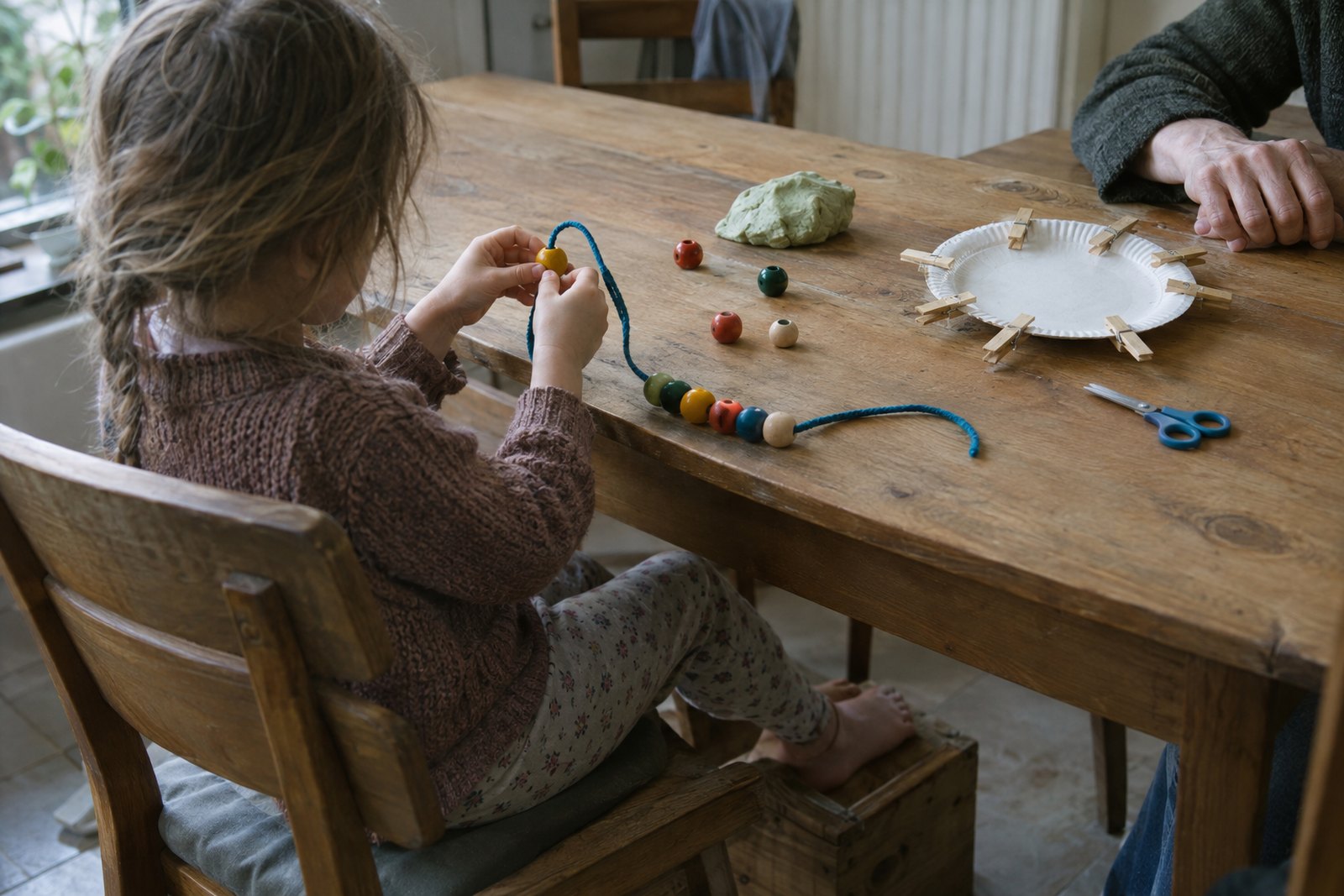
Fine motor skills are the small, precise movements of the hands and fingers, working together with the eyes. They let a child pick up a raisin, turn a page, hold a crayon, do up a button and, eventually, write their name. They rest on bigger foundations: a steady body, stable shoulders, and eyes and hands that cooperate. Children build these skills at very different speeds. A child who is a bit behind their friends is, most of the time, just a child who is a bit behind their friends.
The best help at home is plenty of ordinary, slightly messy play that uses the hands: squeezing, pinching, tearing, threading, posting and pouring. You do not need kits or apps. If your child is clearly struggling compared with others their age, avoids anything fiddly, gets very upset or worn out by hand tasks, or has lost skills they used to have, raise it with your health visitor, GP or school. Below you will find activities by age, the signs worth mentioning, and what a paediatric occupational therapist actually does.
What fine motor skills actually are
Most parents first notice fine motor skills when handwriting becomes an issue. But handwriting is the end product. Underneath it sit several separate abilities, and a problem with any one of them can show up as messy writing or a child who refuses to colour in.
- Postural control. A child needs a stable trunk and shoulders before the hands can be precise. Think of it as the foundations under the house.
- Grasp and release. Picking things up with the right amount of grip, then letting go where you meant to.
- Finger strength and isolation. Moving one finger without the others, and having enough strength in the small hand muscles to keep going.
- Using two hands together. One hand holds and steadies while the other does the work, such as holding paper while cutting.
- Hand-eye coordination. The eyes guiding the hand accurately.
- Motor planning. Working out how to do a new movement and in what order, then doing it.
This matters because the fix is not always more pencil practice. A child whose shoulders tire quickly may need more climbing and crawling, not more worksheets.
Rough age expectations, not a checklist
The ranges below are broad and describe what many children do, not what every child must do by a certain birthday. Children who were born early are usually judged against their corrected age in the early years. One skill arriving late on its own is rarely meaningful. A pattern across several skills, or a child who is getting distressed, is more worth noticing.
Roughly 1 to 3 years
Around the end of the first year many babies start picking up small things between thumb and finger. Through the toddler years, children typically begin to scribble with a fist grip, stack a few blocks, turn the pages of a board book, post shapes, and start feeding themselves with a spoon, messily. Hand preference often appears later in this period, but is not usually fixed yet.
Roughly 3 to 5 years
Preschool children often start holding crayons with their fingers rather than the whole fist, copy simple shapes such as a line, a circle and later a cross, snip with child scissors before learning to cut along a line, thread large beads, build taller towers and manage some parts of dressing, such as pulling on loose clothes or doing large buttons. Drawings of people usually go from a head with legs to something with a few more parts.
Roughly 5 years and up
In the early school years, children usually refine their pencil grip, learn to form letters and numbers, cut out simple shapes, manage most buttons and zips, and use a knife and fork with growing skill. Shoelaces arrive at very different ages, and plenty of children who are perfectly fine take a while with them. Handwriting speed and neatness keep developing well into the junior school years.
Fine motor activities for toddlers
At this age the aim is exploration, not achievement. Short bursts, lots of repetition, and letting them make a mess. Supervise closely, because toddlers still put things in their mouths.
- Posting games. Cut a slot in the lid of an old tub and let them post large lids, wooden spoons or chunky cards. Make the slot smaller as they improve.
- Tearing paper. Old magazines, junk mail and tissue paper. Tearing uses both hands in opposite directions and builds finger strength.
- Stacking. Blocks, plastic cups, empty food boxes. Knocking them down is half the fun.
- Playdough. Squashing, poking with one finger, rolling sausages. A simple homemade dough from flour, salt, water and oil works fine.
- Pouring and scooping. In the bath or in a washing up bowl, with cups and spoons. Always stay within arm's reach and empty the water straight after, because toddlers can drown in just a few centimetres of water.
- Sticker peeling. Bend the backing slightly so the edge lifts. Peeling takes real pincer precision.
- Finger feeding. Soft finger foods at mealtimes are one of the best fine motor activities there is.
- Turning pages. Board books first, then thicker paper books.
- Big crayons and chalk. Scribbling on a large sheet taped to the floor or a wall, or chalk outside on the patio.
- Crawling and climbing. Not a hand activity on the face of it, but weight-bearing through the hands and arms builds the shoulder stability that fine control depends on.
Fine motor activities for preschool children
Now you can add a bit more challenge, still through play. Most of these use things you already have.
- Threading. Large beads, cut-up straws or penne pasta onto a shoelace or pipe cleaner. Pipe cleaners are stiffer and easier to start with.
- Pegs. Peg socks onto a washing line, pegs around the edge of a paper plate, or pegs on a box. Pinching a peg is excellent for finger strength.
- Tongs and tweezers. Moving pompoms, cotton wool balls or dry cereal from one bowl to another with kitchen tongs, then smaller tweezers.
- Snipping. Child scissors on strips of thin card or straws. Snipping comes before cutting along a line, which comes before cutting curves.
- Playdough with tools. Rolling pins, cutters, blunt knives, hiding small objects inside for them to dig out.
- Drawing on a vertical surface. Paper taped to a wall or the fridge, or a window with washable pens. Working upright naturally puts the wrist in a good position.
- Lids and containers. A box of clean jars and tubs with screw lids to match and open.
- Water sprays. A plant sprayer to water the garden or wash a toy car. Squeezing the trigger strengthens the hand.
- Construction toys. Push-together bricks, starting with larger ones.
- Helping in the kitchen. Spreading butter, stirring, tearing herbs, sprinkling. Real tasks are often more motivating than pretend ones.
- Practising on themselves. Dressing a teddy, then practising big buttons and zips on their own coat while it is on the table.
Fine motor skills activities for school-age children
School-age children usually want activities that feel grown up, not like therapy. Build skills into hobbies and jobs.
- Crafts. Origami, friendship bracelets, sewing cards, simple knitting or finger knitting, collage with small pieces.
- Building and models. Small construction bricks, junk modelling with tape and glue, marble runs.
- Games. Card games (shuffling and holding a fan of cards is hard), pick-up sticks, jacks, tiddlywinks, games that use small pieces.
- Cooking. Cracking eggs, kneading bread, cutting soft food with a knife, grating cheese with supervision.
- Drawing for fun. Mazes, dot-to-dots, copying cartoons, tracing. These build pencil control without the pressure of handwriting.
- Everyday independence. Doing their own buttons, opening their lunchbox and wrappers, using a knife and fork at every meal, practising laces on a shoe placed on the table in front of them first.
- Strength play. Monkey bars, climbing frames, wheelbarrow walks, and pulling on a tug of war rope. Strong shoulders and grip help a tired writing hand.
- Putty and stress balls. Hiding beads in putty to dig out, or squeezing while reading or watching television.
Making it work in real life
The activities matter less than how you go about them. A few things that tend to help:
- Little and often. Five or ten minutes woven into the day beats a long session that ends in tears.
- Get the seating right. For table tasks, feet flat on the floor or a box, back supported, table roughly at elbow height. A child perched on an adult chair with dangling feet is spending effort on balance.
- Let them lead. If they love dinosaurs, thread dinosaur cut-outs. Interest buys you persistence.
- Step it down when needed. If something is too hard, make it bigger, softer or slower. Chunky crayons, thicker card, larger beads.
- Do not make it homework. If every bit of play turns into a lesson, children quite reasonably stop playing.
- Respect left-handers. Left-handed children may need left-handed scissors and paper angled the other way. Do not try to switch hands.
Signs worth raising
None of these is a diagnosis. They are reasons to have a conversation with someone who can look properly.
- Your child is clearly behind others of the same age across several hand skills, not just one.
- They avoid colouring, drawing, construction or anything fiddly, or melt down when asked.
- Their hand tires or hurts quickly when writing, or they press so hard the pencil snaps or the paper tears.
- Dressing, cutlery or opening packaging is much harder for them than for their friends and is affecting daily life.
- Handwriting is very slow or hard to read and is holding back schoolwork, even though they clearly understand the work.
- They seem generally clumsy, bump into things or struggle with balance, ball skills or riding a bike as well as hand tasks.
- They are very bothered by textures such as glue, paint or playdough, which can limit practice.
See your GP or health visitor promptly if a baby strongly favours one hand very early or seems to ignore one side of their body, if your child loses skills they previously had, if clumsiness or weakness is getting worse, or if joints are swollen or painful. If your child suddenly cannot use an arm or hand, has a drooping face or slurred speech, or you are worried they are seriously unwell, call 999. For urgent advice that is not an emergency, call NHS 111.
Who to talk to first
For children under five in England, your health visitor is usually the first port of call, and nursery staff often have useful observations. For school-age children, talk to the class teacher and the school's special educational needs coordinator (SENCo), and your GP. Check your child's eyesight too. NHS sight tests are free for children under 16, and poor vision can look a lot like poor coordination.
Other professionals lead on some things. A physiotherapist leads on gross motor problems such as walking, balance and very loose joints. A speech and language therapist leads on chewing, swallowing and speech. A paediatrician looks at the bigger picture if there may be an underlying condition, such as developmental coordination disorder (often called dyspraxia), which is diagnosed by a doctor, usually with input from therapists. If you have wider concerns about development, our page on developmental delay may help. If school support is not enough, in England you can ask the local authority for an education, health and care (EHC) needs assessment. IPSEA, listed in the sources below, explains how this works.
Where an occupational therapist fits
Occupational therapists look at how children manage the everyday activities that matter to them: play, self-care, eating, dressing and school work. Fine motor difficulties sit squarely in that territory. The broader picture is covered in our guide to how paediatric occupational therapy helps children.
What a paediatric OT assessment looks at
A paediatric occupational therapist will usually start by talking with you about your child's history, what they find hard and what you most want to change. Then they watch your child doing real things, often through play. They may look at:
- Posture, core stability and shoulder strength.
- Grip patterns, hand strength and whether one hand is used to help the other.
- Hand preference and how settled it is.
- Hand-eye coordination and copying shapes or letters.
- Motor planning: how your child copes with a new movement or task.
- Sensory factors, such as dislike of certain textures or seeking lots of pressure.
- Everyday tasks such as dressing, cutlery and opening containers.
- Handwriting, including speed, legibility and comfort, for school-age children.
They may use standardised assessments, which compare a child's performance with others of the same age. With your permission they may speak to school or nursery. You should get a report explaining what they found and practical recommendations, often including a home programme and ideas for the classroom. For autistic children, sensory and motor factors are often looked at together, as explained in occupational therapy for autistic children.
NHS or private
NHS children's occupational therapy is free, and how you get referred varies by area. Sometimes it is through a GP, health visitor, paediatrician or school. Private occupational therapy can usually be arranged directly and may be done at home or school. Our guide to NHS or private occupational therapy sets out the trade-offs. Whichever route, check the therapist is registered with the HCPC, and see how to choose a private occupational therapist for the questions worth asking.
What an OT will not do is promise a cure or a timeline. Many children improve a lot with the right practice and support. Some will always find fine motor work harder, and the goal then shifts to making daily life and school work manageable, for example with adapted equipment or other ways of recording work.
Frequently asked questions
At what age should my child be able to hold a pencil properly?
There is no single age. Many children move from a fist grip towards a finger grip during the preschool years and refine it in the early school years. A slightly unusual grip that is comfortable, fast enough and legible is often fine. Pain, fatigue or very slow writing are more important than how the grip looks.
Will screens and tablets hold back my child's fine motor skills?
Tapping and swiping use the hands in a limited way. The concern is less the screen itself and more that time on a screen is time not spent squeezing, building, drawing or climbing. A balance with plenty of hands-on play is sensible.
Is my child just lazy, or is something wrong?
Children who avoid hand tasks are usually avoiding something that feels hard, tiring or embarrassing. If avoidance is persistent and affecting daily life or school, it is worth getting it looked at rather than pushing harder.
Does poor fine motor skill mean my child has dyspraxia?
Not necessarily. Many children with slower fine motor development do not have any condition. Developmental coordination disorder is diagnosed by a doctor after other causes have been considered, usually when difficulties are significant and affect daily life. Your GP is the place to start that conversation.
Can an occupational therapist help with handwriting?
Yes. An occupational therapist looks at the building blocks behind handwriting, such as posture, strength, coordination and letter formation, and suggests practice and practical adjustments. If handwriting stays very hard, they can suggest alternatives such as touch typing, and work with school on what support is reasonable.
How long before I see a difference?
It varies a great deal between children. Little-and-often practice built into everyday life tends to help most. If you are working with an occupational therapist, ask them to agree specific goals with you so you can both see progress.
Next steps
If you would like a professional to look at your child's hand skills at home or school, see our paediatric occupational therapy page, or current guide prices, and choose your area below.

Talk to an occupational therapist near you
This guide is general information. For advice about your own situation - or someone you look after - a local occupational therapist can visit you at home and see it for themselves.
Choose your area: