

Tennis Elbow Brace: What It Does and Daily Changes That Help
By Mobile Occupational Therapist • 19 September 2026 • 14 min read
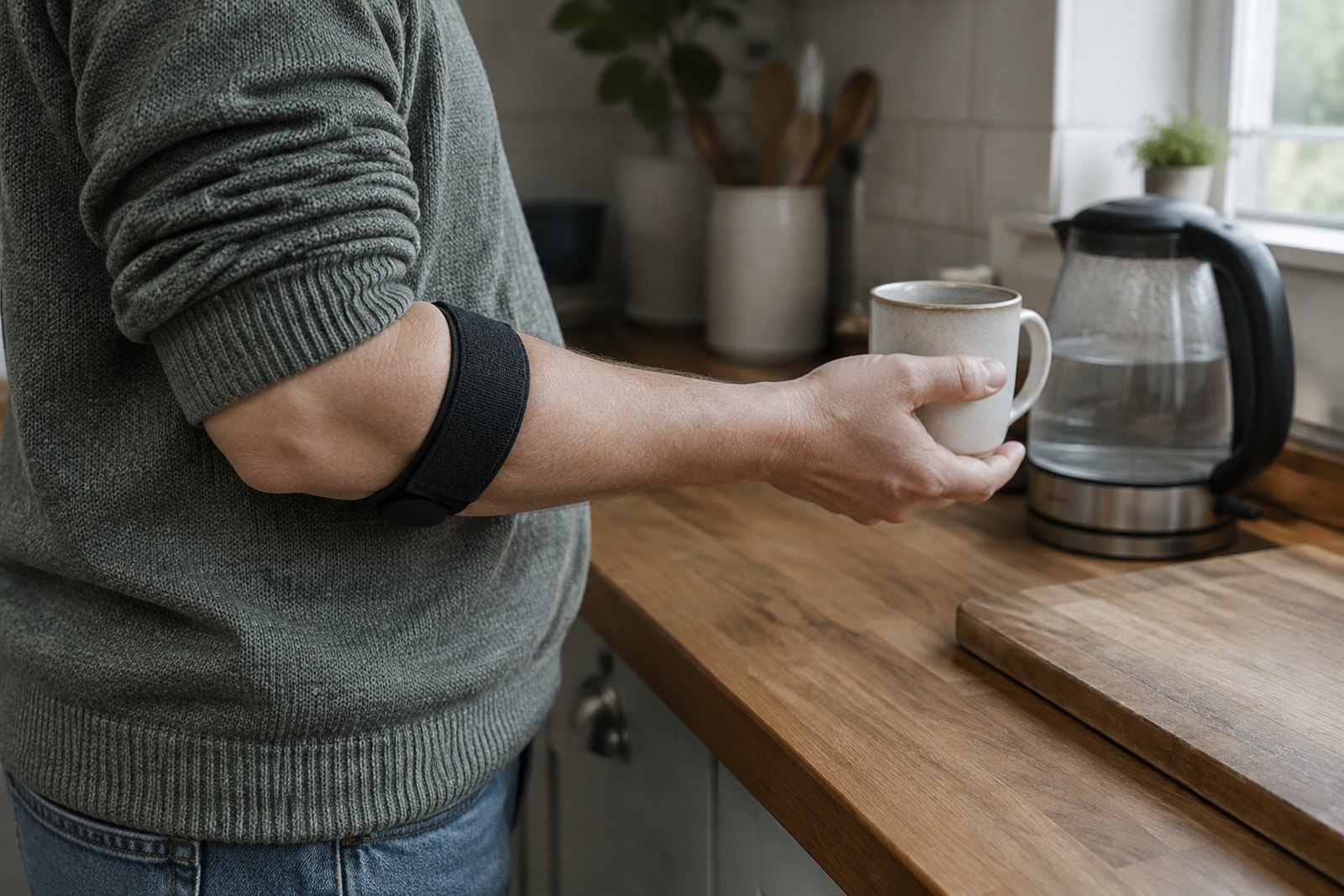
A tennis elbow brace, usually a strap that goes around the top of your forearm, can take the edge off the pain for some people while they are using their arm. It does not heal tennis elbow, and the research on whether it helps is mixed. Think of it as one small tool that may make everyday tasks more bearable. It works best alongside changes to how you grip and lift, and a gradual strengthening programme. Wearing it while carrying on exactly as before is unlikely to get you far.
If you want the short version: wear the strap a couple of finger widths below the bony point on the outside of your elbow, snug but not tight, and only while you are doing the jobs that hurt. Lift with your palm facing up where you can. Make handles thicker and loads lighter. Break up long spells of gripping, typing or using tools. If the pain is not settling after a few weeks of this, or you have numbness, weakness or swelling, see your GP.
What tennis elbow actually is
Tennis elbow, or lateral epicondylitis to give it its medical name, is pain on the outside of the elbow where the tendons of the forearm muscles attach to bone. Those muscles lift your wrist and fingers back and help you grip. Despite the name, most people who get it have never held a racquet. It tends to follow repeated gripping, twisting or lifting: decorating, gardening, a new job, a lot of mouse work, carrying shopping, or a sudden burst of DIY.
Typical signs are pain on the outside of the elbow that can spread down the forearm, pain when you grip, shake hands, turn a door handle, lift a kettle or pour, and sometimes a weak-feeling grip. The NHS describes it as a condition that usually gets better on its own, though this can take a while, and many people find it frustratingly slow. The aim of everything below is to reduce the strain on the tendon so it can settle, while keeping your arm working.
What a tennis elbow brace does
Most tennis elbow braces are counterforce straps. They are a band, often with a firm pad or gel cushion, that wraps around the upper forearm. The idea is that pressure over the forearm muscles changes how the pull of those muscles reaches the sore tendon, so less force goes through the painful spot when you grip.
You will see a few types:
- Simple straps with a hook-and-loop fastening and a pad that sits over the muscle.
- Straps with an air or gel cushion, which spread the pressure a little more.
- Elbow sleeves, which are a tube of stretchy fabric around the whole elbow. These are different. They offer warmth and compression but not the targeted pressure of a strap.
What the evidence says
Honestly: not a lot either way. Reviews of the research have not found clear proof that straps change the long-term outcome of tennis elbow. Some people report that a strap reduces pain during activity in the short term, and some feel no difference. A strap is inexpensive and low risk if fitted properly, so many clinicians are happy for people to try one. If it helps you grip a cup or get through a shift with less pain, that is worth having. If it does nothing after a week or two of sensible use, there is no point persevering.
What a strap will not do is fix the cause. If you keep doing the same task in the same way for the same length of time, the tendon is likely to keep complaining, strap or no strap.
How to wear a tennis elbow strap properly
Fit makes more difference than which strap you buy.
- Find the sore bony point on the outside of your elbow.
- Place the strap a couple of finger widths below it, on the fleshy part of your forearm, not over the joint itself. The pad, if there is one, usually sits over the muscle on the top and outer side of the forearm. Follow the instructions that come with your strap, as designs vary.
- Tighten it with your forearm muscles relaxed, so it is snug. When you then grip, you should feel it press firmly. It should not feel tight when your hand is at rest.
- Check your hand. Tingling, numbness, coldness, swelling or your fingers changing colour mean it is too tight or in the wrong place. Take it off.
Wear it for the activities that bring the pain on, such as gardening, a long spell of typing, carrying, or a game of tennis. Take it off when you are resting and at night. Wearing it all day, every day, is not usually advised, and some people find their skin gets sore. If you have poor circulation, diabetes affecting your hands, or reduced feeling in your arm, ask a pharmacist, GP or physiotherapist before using a strap.
Wrist splints: an alternative some clinicians use
Because the muscles that cause the trouble are the ones that bend your wrist back, some clinicians suggest a wrist splint instead of, or as well as, a strap. A simple wrist support that holds the wrist straight or very slightly bent back means those muscles do less work, which can give the tendon a rest.
These are sometimes used at night, or during particular tasks, for a limited period. The catch is that keeping the wrist still for long stretches can leave it stiff and weaker, which is not what you want for a tendon that needs to get stronger. So it is better to use a wrist splint on the advice of a physiotherapist, GP or hand therapist, who can tell you when and for how long. If you are already being treated, ask them whether a strap, a wrist splint or neither is the better fit for you. Our guide to hand therapy at home explains more about who provides splints and how.
Daily changes that ease the strain
This is where most of the real gains are. The principle is simple: the sore tendon hates gripping hard with the wrist bent back, twisting under load, and doing the same thing for a long time without a break. Change those three things and you take a lot of pressure off.
Lift with your palm up
Picking something up with your palm facing down, like grabbing a carrier bag or a full kettle from above, loads exactly the muscles that hurt. Turning your palm to face upwards, as if carrying a tray, shifts more of the work to the front of the arm.
- Carry shopping with your palms up, or hook bags over your forearm rather than gripping the handles.
- Lift boxes and laundry baskets with both hands underneath, held close to your body.
- Use a rucksack or a cross-body bag instead of a handbag held in one hand.
- Split heavy loads into several lighter trips.
Make gripping easier
- Thicker handles need less grip force. Foam tubing slipped over cutlery, pens, toothbrushes, garden tools and paintbrushes helps.
- Avoid tight pinching and wringing. Squeezing out cloths and mops is a classic trigger. Use a mop with a squeeze mechanism or let things drip dry.
- Kettles and pans. Fill the kettle with only what you need, or fill it from a jug. Use two hands on pans, or slide them rather than lifting. A kettle tipper and jar opener can take a lot of strain out of the kitchen; see our guide to kettle tippers and jar openers.
- Door handles and taps. Lever-style handles and tap turners need far less twisting than round knobs.
- Shaking hands. It is fine to offer your other hand.
Mouse, keyboard and phone
Computer work is a common cause, and an easy one to improve.
- Keep your wrist straight, not bent back, when you type. Lowering the keyboard or using it flat, without the little feet up, often helps.
- Have your forearms supported and your elbows roughly at desk height, close to your sides.
- Keep the mouse close so you are not reaching. Some people find a vertical-style mouse, which holds the hand in a handshake position, more comfortable. Others find swapping the mouse to the other hand for some of the day, or using keyboard shortcuts, gives the sore arm a break.
- Do not grip the mouse tightly. Notice whether you are clenching it when concentrating.
- Take short breaks often rather than one long break. Even a minute every half hour to drop your arms and move helps.
- Hold your phone with alternate hands, rest it on something, or use voice and hands-free options.
If you use a computer daily for continuous spells of an hour or more as part of your job, your employer must assess your workstation under the display screen equipment (DSE) regulations. Our guide to DSE assessments and setting up your workstation walks you through it, and our article on repetitive strain injury at work covers what to ask your employer for.
Tools, DIY, gardening and sport
- Choose lighter tools and ones with larger, padded handles. Power tools that vibrate a lot are hard on the elbow, so limit the time you use them in one go.
- For screwdrivers, a ratchet or powered version saves a lot of twisting.
- In the garden, use long-handled tools held with both hands, kneel closer to the job, and alternate tasks: ten minutes of pruning, then something that uses different muscles.
- For tennis, squash or badminton, a coach can check your backhand technique and grip size. A grip that is too small or too large makes you squeeze harder.
Pacing: the bit people skip
Pacing means spreading the load so the tendon is never pushed past what it can cope with. It is unglamorous and it works.
- Notice your triggers. For a few days, jot down what makes the pain worse and how long you can do it before it starts.
- Stop before the pain builds, not after. If gardening hurts after 40 minutes, do 25, then switch.
- Mix heavy and light jobs through the day and week. Do not save all the ironing, hoovering and gardening for Saturday.
- Some ache is acceptable. Mild discomfort that settles by the next morning is usually fine. Pain that is worse the next day is a sign you overdid it, so scale back a little.
Complete rest is not the answer either. Tendons tend to respond to the right amount of gradual loading, and stopping using the arm altogether can leave it weaker.
Gradual strengthening, taught by a physiotherapist
The treatment with the most support behind it for lasting improvement is a programme of exercises that slowly build up the strength of the forearm muscles and tendon. This might include holding a gentle contraction, or slowly lowering a light weight with the wrist, and increasing the load over weeks.
A physiotherapist is the right person to teach this. They will check the exercises are right for you, set a starting level, and tell you how much pain is acceptable during them. Doing too much too soon, or the wrong exercises, can flare things up. In many parts of England you can refer yourself to NHS physiotherapy without seeing a GP first; check your local NHS services or ask at your GP surgery. If you are not sure who does what, our guide to occupational therapists and physiotherapists explains the difference.
When to see your GP
See a GP, or contact NHS 111 if you cannot get an appointment, if:
- the pain is not getting better after a few weeks of resting the sore activities and making changes
- the pain is severe or stops you working or sleeping
- you have numbness, tingling or weakness in your hand or fingers
- the pain started after a fall or injury, or the elbow is very swollen
Get urgent help through NHS 111 if your elbow is hot, red and swollen, especially if you feel unwell or feverish, as this needs checking quickly. Go to A&E if you think the elbow is broken or dislocated. Call 999 if arm pain comes with chest pain, breathlessness, sweating or feeling sick, as arm pain can be a sign of a heart attack.
For pain relief, a pharmacist can advise what is suitable for you. Your GP may talk about other treatments if things are not settling. Ask them about the likely short-term and longer-term benefits of each, so you can decide what suits you.
Where an occupational therapist fits
Most people with tennis elbow will not need an occupational therapist. Self-care, sensible changes and physiotherapy are usually enough, and a physiotherapist leads on the exercise programme. Some hand therapists, who may be occupational therapists or physiotherapists, also make and fit splints.
An occupational therapist can be useful when the elbow is getting in the way of work or daily life and the usual advice has not been enough. For example, when your job involves heavy or repetitive gripping, when it keeps coming back, or when you have arthritis or another condition as well. A private occupational therapist visiting your home or workplace can:
- watch you do the tasks that hurt and work out exactly which movements are causing the strain
- suggest different ways of doing them, and equipment that reduces grip and twisting
- assess your workstation and recommend changes
- help you plan a pacing routine or a phased return to work, and write a report supporting reasonable adjustments
They will not diagnose your elbow or replace physiotherapy, and you should not expect them to.
Frequently asked questions
Should I wear a tennis elbow brace all day?
Usually not. Wear it for the activities that bring the pain on and take it off when you are resting. Wearing a strap all day can make skin sore and gives you no extra benefit when the muscles are not working.
Can I sleep in a tennis elbow strap?
It is generally best not to. Straps are designed to work when you grip. If night pain is a problem, ask a physiotherapist or GP whether a wrist splint at night might help you, rather than sleeping in a strap.
Is a strap or a wrist splint better?
There is no clear winner, and it depends on what you are doing and what your clinician advises. A strap is easy to use during activity. A wrist splint rests the muscles more completely but can cause stiffness if worn too much, so it is best used with professional guidance.
Is golfer's elbow the same thing?
No. Golfer's elbow causes pain on the inside of the elbow and involves the muscles that bend the wrist and fingers forward. The approach is similar: change how you grip and lift, pace your activity, and strengthen gradually with a physiotherapist's help. Straps are sometimes used for it too.
How long does tennis elbow last?
It varies a lot. Many people improve within weeks to months, but for some it lingers longer. Changing the activities that caused it usually makes the biggest difference to how quickly it settles. If it is not improving, see your GP.
Can I keep working and doing sport?
Often yes, with changes. Cut down or modify the tasks that hurt, use pacing, and talk to your employer about adjustments. If your work is heavy manual work, discuss it with your GP, who can issue a fit note suggesting changes rather than time off.
Next steps
If tennis elbow is making work or everyday tasks hard, see our work and ergonomics and equipment and aids pages, or current guide prices, and choose your area below.

Talk to an occupational therapist near you
This guide is general information. For advice about your own situation - or someone you look after - a local occupational therapist can visit you at home and see it for themselves.
Choose your area: