

Repetitive Strain Injury at Work: Symptoms and Practical Changes
By Mobile Occupational Therapist • 21 October 2026 • 14 min read
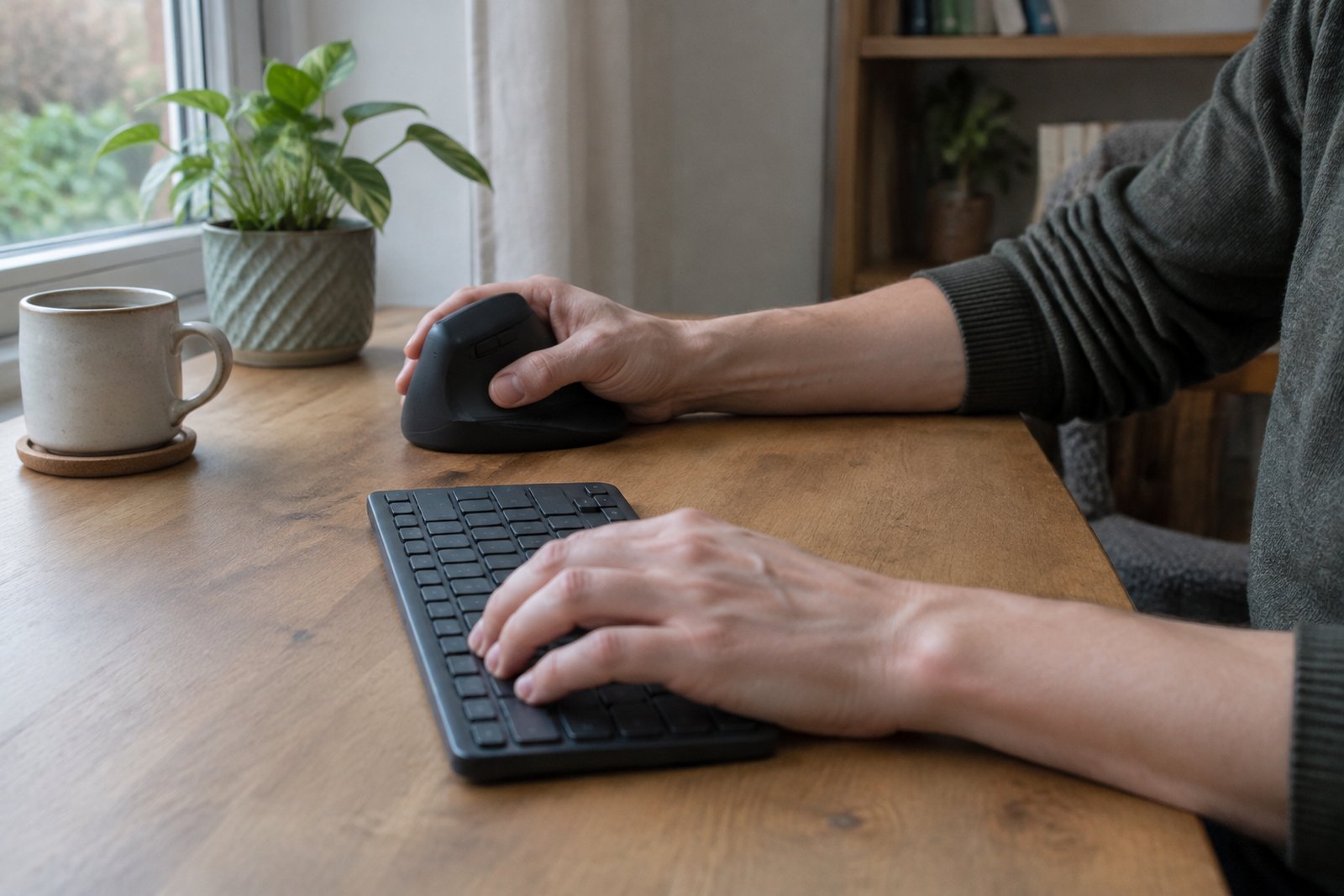
Repetitive strain injury, or RSI, is not one condition. It is an umbrella term for pain and other symptoms in the muscles, tendons and nerves caused by doing the same movements over and over, or by overusing one part of the body. It most often affects the wrists, hands, forearms, elbows, neck and shoulders. It is common in desk work, but just as common in warehouse and factory work, hairdressing, cleaning, building trades, music, food preparation and anywhere else the same action is repeated hundreds of times a day.
What to do about it comes down to three things. See your GP or a physiotherapist so the specific problem can be identified, because a squashed nerve and a sore tendon need different handling. Change the work itself, meaning the set-up, the tools and the pattern of your day, so the strain stops being repeated. And tell your employer, who has legal duties here. Most RSI settles when the cause is dealt with early. Delay can make RSI harder to treat, so it is worth acting early rather than waiting until you have time to stop.
What RSI actually means
You will see several names for the same territory. The Health and Safety Executive (HSE) talks about upper limb disorders and musculoskeletal disorders. A doctor may say work-related upper limb disorder, or may name a specific condition. RSI is the everyday term, and it is a useful one, as long as you remember it describes a cause rather than a diagnosis.
The common thread is load. Things that tend to add up to RSI include:
- Repetition - the same movement many times an hour, with little variation.
- Force - gripping hard, pinching, pressing or twisting.
- Awkward positions - wrists bent back or sideways, reaching forward, shoulders hunched, arms working above shoulder height.
- Holding still - clutching a mouse or holding your neck forward for hours is work for the muscles, even if nothing is moving.
- Vibration - from power tools and some machinery.
- Too little recovery - no pauses, long shifts, overtime, then more of the same at home.
- Pressure - tight deadlines and no control over your pace make people skip breaks and tense up.
Symptoms of repetitive strain injury
Symptoms vary depending on what is irritated, but the usual ones are:
- pain, aching or tenderness
- stiffness
- throbbing
- tingling, pins and needles or numbness
- weakness, or a feeling that your hand is clumsy
- cramp
There is often a pattern. At first, symptoms appear only during or after the task and ease overnight or at the weekend. Later they linger, start sooner in the day, wake you at night, and eventually may be there even when you are resting. The earlier in that sequence you act, the easier things usually are to turn round.
Some of the clearest clues come from outside work. Dropping cups, struggling with jar lids, finding the kettle heavy, avoiding washing your hair because your arms ache, or shaking out your hand after holding your phone are all worth noticing.
Why the GP visit matters
RSI tells you roughly where it hurts and why. It does not tell you what is wrong. A GP or physiotherapist will examine you, ask about your work and other activities, and may be able to name a specific condition. Common ones include:
- Carpal tunnel syndrome - pressure on a nerve at the wrist, usually causing tingling or numbness in the thumb, index and middle fingers, often worse at night. Our guide to carpal tunnel syndrome covers splints and daily changes.
- De Quervain's tenosynovitis - pain on the thumb side of the wrist, worse with gripping, pinching, twisting or lifting. See our guide to de Quervain's tenosynovitis.
- Tendinopathy - an irritated, overloaded tendon. Tennis elbow (outer elbow) and golfer's elbow (inner elbow) are the best known, and both are often linked to gripping and lifting.
- Trigger finger - a finger that catches, clicks or locks when you bend it.
- Other nerve problems - for example at the elbow, which tends to affect the ring and little fingers, or in the neck, which can send symptoms down the arm.
- Non-specific RSI - sometimes no single named condition is found. The pain is still real, and the same practical changes still apply.
This matters because the advice differs. Some conditions respond well to a splint at night, some to specific exercises, some need a referral. Other problems, including arthritis and some neck conditions, can look like RSI. Please do not diagnose yourself from the internet, and that includes this page.
When to get help quickly
- Call 999 if arm or shoulder pain comes with chest pain or tightness, breathlessness, sweating or feeling sick. Also call 999 for sudden weakness or numbness on one side of the body, a drooping face or difficulty speaking.
- Go to A&E or call 999 if you have numbness or weakness in both arms together with difficulty walking or controlling your bladder or bowels. Contact NHS 111 or your GP the same day if you have severe pain after an injury, a hot, swollen, red joint and you feel unwell or feverish, numbness or weakness that is getting worse quickly, or new numbness or weakness in both arms.
- Book a routine GP appointment if your symptoms have not improved after changing what you do and taking more breaks, if they wake you at night, if your hand feels weak or you keep dropping things, or if they are affecting ordinary life.
Changing your workstation
For desk work, the aim is neutral positions: wrists roughly straight, elbows close to your sides and bent at about a right angle, shoulders relaxed, and a screen you can see without craning your neck.
Chair and desk
- Set your chair height so your forearms are roughly level with the desk when your shoulders are relaxed.
- Your feet should rest flat on the floor. If raising the chair leaves them dangling, use a footrest or a sturdy box.
- Sit back so the chair supports your back, rather than perching on the front edge.
- Clear the space in front of you so the keyboard and mouse can come close. Put things you use often within easy reach, not at full stretch.
Screen
- Aim for the top of the screen to be at or slightly below eye level, roughly an arm's length away.
- If you use a laptop for long periods, raise it on a stand and use a separate keyboard and mouse. A laptop on its own forces you to choose between a bent neck and raised arms.
- If you work from paper, a document holder beside the screen saves repeated twisting.
Keyboard
- Keep the keyboard directly in front of you and close enough that you are not reaching.
- Type with a light touch. Many people hammer the keys far harder than needed.
- Try to keep your wrists floating and straight while typing. A wrist rest is for resting during pauses, not for anchoring your wrists while you type.
- Many people find the keyboard more comfortable with its back feet folded down, so the wrists are not bent upwards.
- A compact keyboard without a number pad brings the mouse closer to your body, which can ease the shoulder on that side.
- Split or angled keyboards suit some people with wrist or forearm pain. They take a while to get used to.
- Learning keyboard shortcuts for common actions can cut a surprising amount of mouse use.
Mouse
- Keep the mouse close to the keyboard and at the same height.
- Move it using your elbow and shoulder rather than flicking from the wrist, and do not grip it tightly.
- Options worth knowing about include a vertical mouse, held with the palm facing sideways as if shaking hands; a trackball, where you roll a ball with your thumb or fingers while the hand stays still; a larger mouse that fills the palm; a touchpad; or a pen-style device.
- Some people swap the mouse to their other hand for part of the day.
- Adjust the pointer speed so small hand movements cover more of the screen.
- Voice recognition software can take a lot of typing and clicking off sore hands, particularly for writing long documents.
An honest note: no single piece of equipment fixes RSI. A different mouse shifts the work onto different muscles, which often helps, but nine hours of clicking without a pause will still hurt. Try equipment before buying where you can, and give anything new a week or two before deciding.
Working from home and on the move
Kitchen tables, sofas and laptops on knees cause a lot of RSI. The same principles apply at home, and your employer's duties do not stop at the office door. Ask for a home workstation assessment, and see our guide to a DSE assessment and setting up your workstation. If you spend a lot of time on the phone, use a headset rather than wedging the handset between your ear and shoulder. Long spells of thumb typing on a phone count too.
Changing how you work: breaks and variety
Here is the frank part. Posture matters, but how long you hold any position matters more. The best set-up in the world still hurts if you never move from it.
- Short and often beats long and rare. HSE guidance favours short, frequent breaks over longer, infrequent ones.
- A change of activity counts. Taking a call standing up, filing, walking to speak to a colleague or refilling your water all give the same muscles a rest.
- Mix tasks through the day. Break typing-heavy work into chunks rather than doing it all in one afternoon.
- Use a reminder. A simple timer works better than good intentions, especially when you are absorbed.
- Notice tension. Check every so often whether your shoulders have crept up or you are gripping harder than you need to.
- Move gently in your breaks. A physiotherapist can give you exercises suited to your specific problem. Do not push through sharp pain to stretch.
- Plan for crunch periods. Symptoms often flare during deadlines and overtime, exactly when breaks get skipped.
- Count what you do outside work. Gaming, scrolling, knitting, DIY, gardening and carrying children all add load. You do not have to give them up, but they belong in the picture.
Tools and grips beyond the desk
RSI is not just an office problem. In manual and practical jobs, these changes often make a real difference:
- Thicker or padded handles need less grip force. Foam tubing can be added to some handles.
- Sharp, well-maintained tools need less effort. Blunt knives, scissors and cutters make your hand do the work.
- Tools shaped to keep the wrist straight, such as bent-handled designs, can suit some tasks.
- Avoid pinch grips where you can. Using the whole hand spreads the load. Spring-loaded scissors open themselves, which saves the hand doing it hundreds of times.
- Power tools can take the strain out of repeated twisting or squeezing, but vibration carries its own risk. HSE has separate guidance on hand-arm vibration, and your employer must manage it.
- Gloves that fit. Loose or bulky gloves make you grip harder.
- Work at the right height. Adjust bench heights and use a safe platform rather than repeatedly reaching above your shoulders.
- Rotate tasks between people so no one does the same motion all shift.
What your employer has to do
These are legal duties, not favours.
Display screen equipment
The Health and Safety (Display Screen Equipment) Regulations 1992 apply to workers who use screens daily for continuous periods of an hour or more. Broadly, your employer must assess workstations and reduce the risks found, plan work so there are breaks or changes of activity, provide an eye and eyesight test if you ask for one, and give you training and information. HSE guidance confirms this covers people working from home too. Check the detail on the HSE website.
Other kinds of work
All employers have a general duty to assess risks to health, including from repetitive and forceful tasks. HSE publishes guidance on musculoskeletal and upper limb disorders. Report symptoms through your workplace's process so the task itself can be reviewed, not just your arm.
Reasonable adjustments
If your condition counts as a disability under the Equality Act 2010, your employer must make reasonable adjustments. Broadly, that means an impairment with a substantial, long-term effect on normal day-to-day activities, where long-term usually means it has lasted or is likely to last at least 12 months. Adjustments might include equipment, changed duties, altered hours or a phased return. Many employers make sensible changes even when the legal test is not met. Our guide to reasonable adjustments at work explains how to ask. Acas has clear guidance, and the Access to Work scheme on GOV.UK may help with some costs in some situations. Your employer may also refer you to occupational health, and if you are signed off, your GP can use a fit note to suggest changes that would help you work.
Where physiotherapy and occupational therapy fit
Your GP leads on diagnosis, ruling out other causes, referrals and tests such as nerve studies if needed, fit notes and any discussion about medication.
A physiotherapist is often the main professional for RSI. They examine the problem, give targeted exercises and hands-on treatment, and guide a graded return to full activity. In many areas you can refer yourself to NHS physiotherapy. Check your GP practice or local NHS website.
A hand therapist, usually a specialist occupational therapist or physiotherapist, deals with specific hand and wrist conditions and makes custom splints. Access is usually through a GP or hospital referral.
An occupational therapist looks at what you actually do all day. A private occupational therapist visiting your workplace or home office can watch how you work, work out which tasks are causing the load, suggest equipment by type, help you plan breaks and pacing, and write a report your employer or occupational health team can act on. They can also help with the knock-on effects at home, such as cooking, dressing or opening things when your hands are sore. See our work and ergonomics page.
What an occupational therapist will not do is diagnose your condition, advise on medication or replace a physiotherapy exercise programme. The best results often come when physiotherapy and practical changes happen together.
Frequently asked questions
Is RSI a real medical diagnosis?
RSI is a recognised umbrella term rather than one specific diagnosis. Your GP may find a named condition such as carpal tunnel syndrome or tennis elbow, or may describe it as non-specific arm pain. Either way, the symptoms are real and worth taking seriously.
Can repetitive strain injury go away on its own?
Often it improves once the cause is reduced, especially if you act early. Simply waiting while doing the same work rarely helps. If changes and breaks have not made a difference, see your GP.
Should I wear a wrist splint?
It depends on the condition. Splints help some problems, such as carpal tunnel syndrome at night, but the wrong splint or wearing one all the time can cause stiffness. Ask your GP, physiotherapist or hand therapist before relying on one.
Can I be signed off work with RSI?
If your symptoms stop you working, your GP or another healthcare professional can issue a fit note. It can say you may be fit for work with changes, such as altered duties or hours, which often helps you stay in work while you recover.
Does my employer have to buy me a special mouse or keyboard?
Not automatically. Your employer must assess and reduce DSE risks, and if your condition counts as a disability they must make reasonable adjustments, which can include equipment. Raise it in writing, and ask for a workstation assessment.
Do the DSE rules apply if I work from home?
HSE guidance says employers' duties cover home workers who are DSE users. Ask your employer for a home workstation assessment. Check the current HSE guidance for the detail.
Next steps
If RSI is making work or home life harder, an assessment of how you actually work can show what to change first. See our work and ergonomics page, or current guide prices, and choose your area below.

Talk to an occupational therapist near you
This guide is general information. For advice about your own situation - or someone you look after - a local occupational therapist can visit you at home and see it for themselves.
Choose your area: