

Teaching a Child to Dress: Self Care Skills by Age and Stage
By Mobile Occupational Therapist • 15 October 2026 • 14 min read
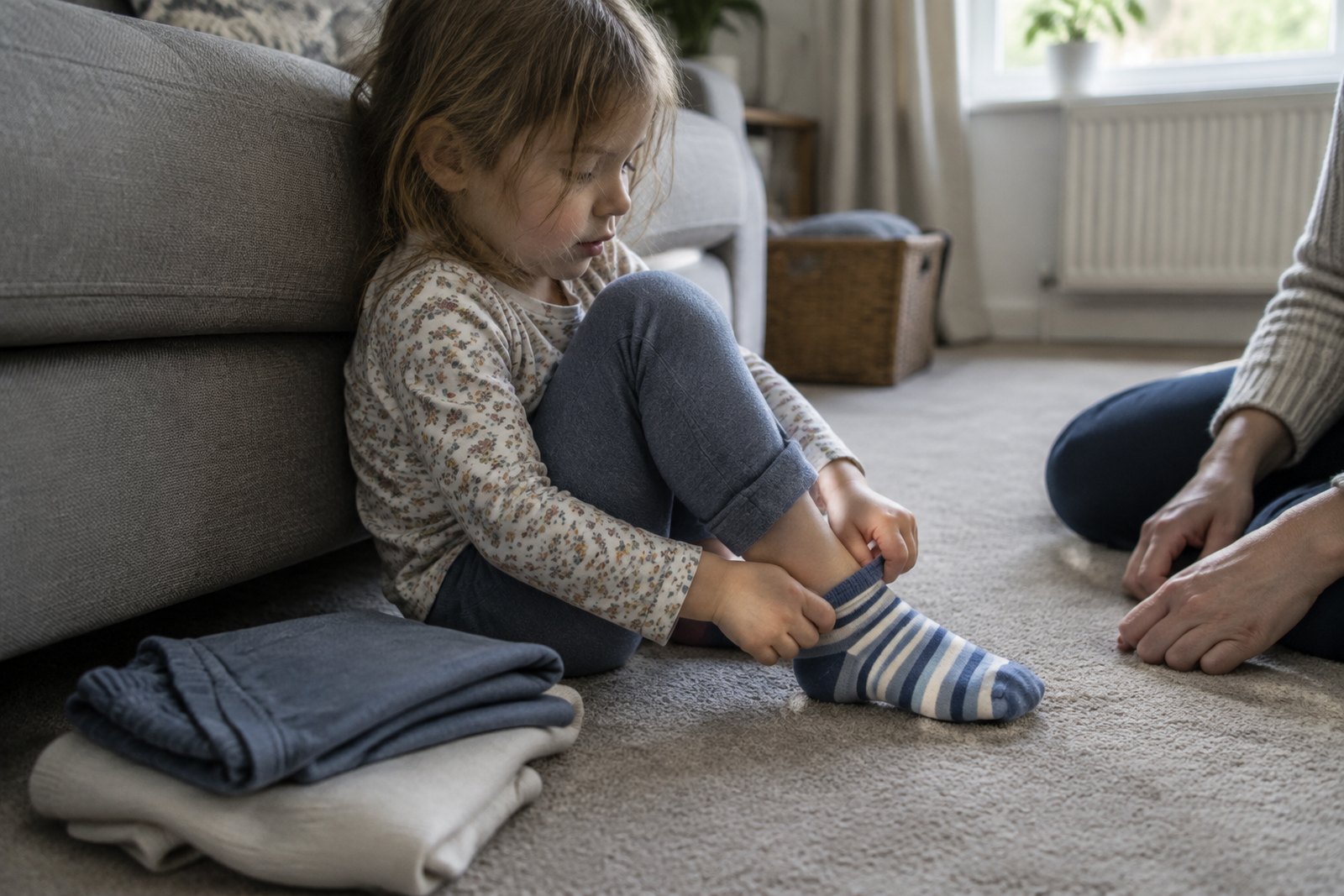
Most children learn to take clothes off long before they can put them on, and most are dressing themselves, with help on fiddly fastenings, by the time they start school. Laces, small buttons and getting everything the right way round often come later, sometimes a good deal later. The range of normal is wide, so a three year old who still needs plenty of help is not, on that alone, a cause for worry.
The quickest way to teach a child to dress is not to explain it better. It is to break it into small steps, let them finish the job rather than start it (called backward chaining, explained below), sit them down, choose clothes that forgive mistakes, and allow far more time than feels reasonable. If your child is still really struggling despite all that, or dressing comes with distress, pain or meltdowns, it is worth asking for an occupational therapy assessment.
Rough age stages: what to expect
These are rough guides, not deadlines. Children vary a lot, and children born early, or with additional needs, may follow their own timetable. What matters more than the exact age is whether your child is steadily moving forward.
- Around 1 year: helps by pushing an arm into a sleeve or a foot into a trouser leg. Pulls off hats and socks, usually in the car.
- Around 2: takes off socks, shoes without laces, loose trousers and an unfastened coat. Tries to put on hats and shoes, often on the wrong feet.
- Around 3: pulls up pants and loose trousers, puts on a loose top (often back to front), manages shoes with touch fasteners. May do large front buttons with help.
- Around 4: dresses with some supervision, does front buttons, and can pull a zip up once an adult has joined it at the bottom.
- Around 5 to 6: dresses mostly alone, starts turning clothes the right way out, and many begin joining zips. Shoelaces typically come later, often around 6 or 7, and later still for plenty of children.
Notice that taking off always comes first. Pulling a sock off needs very little precision, and the result is obvious. Putting one on needs both hands working together, a sense of where your foot is, and the patience to wrestle a heel into place. So treat undressing as a real skill worth praising. It is the foundation for everything else.
Backward chaining: let them finish, not start
This is the single most useful technique, and it sounds more technical than it is. You do all the steps of a task except the last one, and your child does the last step. Once they can do that reliably, you stop one step earlier and they do the last two. And so on, until they are doing the whole thing.
Pulling up trousers, for example:
- You help them sit, put both feet in, pull the trousers up to the knees, help them stand and pull up to the hips. They pull the waistband up over their bottom. Done.
- Next week, you stop at the knees. They stand and pull up the rest.
- Then you stop once both feet are in. They pull up from the ankles.
- Then you hold the trousers open and they put their own feet in.
- Finally they pick the trousers up and do the lot.
Why it works: every attempt ends in success, and the child gets the satisfying bit, the moment the job is finished. Compare that with starting a task, getting tangled halfway and an adult taking over. One builds confidence and the other builds the belief that dressing is something grown-ups do. Some children do better learning from the first step forward, and an occupational therapist can help you work out which suits your child, but backward chaining is a good place to start for most.
Set them up to succeed
Sit down to dress
Standing on one leg to put on trousers or socks is a balancing act, and wobbling uses up attention your child needs for the task. Sitting on the floor with their back against the sofa or a wall, or on a low step or stool with feet flat on the floor, takes balance out of the equation. A corner of the room is even better because there is support on two sides. Plenty of adults sit to put socks on for exactly the same reason.
Same place, same order
Dress in the same spot, in the same order, every day. Lay the clothes out in the order they go on, either left to right or in a pile with the first item on top. Pants, then trousers, then vest, then top, then socks is a common order, but the best order is the one you stick to.
Clothes that make it easier
- Elasticated waists rather than buttons and zips on trousers.
- Tops with wide necks and roomy sleeves, and no fastenings.
- Shoes with touch fasteners and a wide opening.
- Socks that are not too tight. Thin, snug socks are surprisingly hard to get on.
- Soft, stretchy fabrics rather than stiff denim or narrow cuffs.
- For school, look for elasticated uniform trousers and skirts, clip-on ties and polo shirts rather than shirts with small buttons.
None of this is cheating. It lets your child succeed at the parts they can do while their hands catch up with the harder parts.
Front and back markers
Getting things the right way round is one of the last skills to arrive. Help by making the back obvious: a coloured mark or stitch inside the back of the neck, or simply teaching "label at the back". Choose tops and pants with a picture on the front where you can.
For tops, there is a useful trick. Lay the top flat with the back facing up and the neck furthest from your child. They put both arms into the sleeves from the bottom, then lift the top up and duck their head through. It comes out the right way round almost every time.
Socks and shoes
The tricky part of a sock is the heel. Start with backward chaining: you put the sock on as far as the ankle and they pull it up. Then you stop at the heel, and they work it over. Socks with a coloured heel help children see where the heel should go. Show them how to stretch the opening with both thumbs. Sitting on the floor with the knee bent, or with the foot resting on the opposite knee for older children, makes it easier to reach.
For shoes, a simple trick helps with left and right. Cut a sticker in half and put one half inside each shoe. When the shoes sit side by side and the picture matches up, they are the right way round. A loop on the back of the heel gives something to pull on.
Leave laces until your child is ready, often well into primary school. Practise at a calm time with a spare shoe on the table, not on a school morning. Laces in two different colours make it easier to follow which end is which. Until then, touch fasteners or elastic laces are perfectly fine.
Coats: the flip trick
Many nurseries teach this, and it works like magic for small children.
- Lay the coat on the floor, opened out, with the inside facing up.
- Your child stands at the hood or collar end, so the hood is by their feet and the coat looks upside down to them.
- They bend down and push both arms into the sleeves.
- Keeping their arms in, they lift the coat up and over their head.
- The coat slides down their back and they are wearing it.
Once they have it, a low hook at home helps them hang the coat up and get it down again without help.
Buttons and zips
Start buttons on a garment laid on the table or on their lap, where they can see what both hands are doing, before trying on their own body. Big, flat buttons and slightly loose buttonholes are easiest. Begin with the bottom button, which is easier to see, and use backward chaining here too: you push the button halfway through and they pull it the rest of the way. Front buttons come before cuff buttons, which are hard even for many adults.
With zips, joining the two halves at the bottom is the hardest bit. Do that part for them at first, and let them pull the zip up. A ring or loop attached to the zip tag gives small fingers something bigger to grip. Practise joining the zip on a coat laid flat on the table before trying it while wearing it.
If your child finds pinching and gripping hard generally, our guide to fine motor skills activities by age has play ideas that build the same hand skills. For older children and teenagers whose hands are weak or unsteady, tools such as button hooks and zip pulls can help, and these are explained in our plain English guide to dressing aids and easier ways to get dressed.
Picture sequences and fewer words
Many children find a visual sequence easier than spoken instructions. Take photos of your child wearing each item in the order they go on, and stick them in a strip on the wardrobe door or bedroom wall. They can move a peg along, turn each picture over, or tick it off. This often helps autistic children, children with ADHD and children who find it hard to hold several instructions in their head.
When you do talk, keep the words short and the same each time. "Arms in. Head through. Pull down." A running commentary is well meant but can make it harder to concentrate.
Give it time (and do not teach it on school mornings)
School mornings are the worst possible time to learn anything. Everyone is rushed, and a child who senses the hurry often slows down or gives up. Do the teaching at weekends, after a bath, or when getting into pyjamas at night, when it does not matter how long it takes.
On school days, help as much as you need to and keep their part to one or two steps they can already manage. Lay clothes out the night before. Some children enjoy a race against a sand timer, though others find a timer stressful, so watch how yours responds. And resist redoing things in front of them. A slightly wonky jumper worn proudly is worth more than a neat one put on by you.
Why dressing can be genuinely hard for some children
If your child has had plenty of patient practice and is still finding it very difficult, there is usually a reason, and it is rarely laziness or defiance.
Motor reasons
Dressing asks a lot of the body: balance, core strength, both hands working together, knowing where your limbs are without looking, and planning a sequence of movements. Children with developmental coordination disorder (also called dyspraxia), hypermobility, low muscle tone, cerebral palsy or other physical conditions may find it harder and tire more quickly. These children often struggle with other everyday things too, such as cutlery, pencils, ball games or PE.
Sensory reasons
Some children are very sensitive to how clothes feel. Labels, seams in socks, tight waistbands, certain fabrics, or the change in temperature when clothes come off can feel genuinely unbearable. That can look like refusal or a tantrum. It helps to cut labels out (carefully, so no scratchy stub is left), try seam-free socks, wash new clothes a few times before wearing, and let your child choose from a small range of clothes they find comfortable. Other children seek out tight clothing or prefer to be barely dressed. Both are worth noticing.
Attention and organisation
Some children can do every step but get lost halfway, distracted by a toy or the television. Turn screens off, dress in a quiet spot, and use the picture sequence so they can see where they are up to.
When to ask for an occupational therapy assessment
Consider getting help if:
- Your child is a long way behind other children their age, despite regular, patient practice.
- Dressing difficulties sit alongside other struggles, such as being very clumsy, falling often, or finding cutlery, drawing or PE hard.
- Getting dressed causes daily distress or meltdowns, or your child will only wear a handful of items.
- They get unusually tired, sore or achy while dressing.
- They are about to start school and cannot yet manage their clothes for the toilet or PE. Our school readiness checklist covers the everyday skills that matter most.
Some changes need a doctor rather than a therapist. If your child loses skills they used to have, or develops new weakness, unsteadiness or pain, see your GP promptly. If weakness comes on suddenly, or your child is suddenly unwell, call 999. For children under five, your health visitor is also a good first contact, and at school the special educational needs coordinator (SENCO) can help.
Where an occupational therapist fits
Occupational therapists help people manage everyday tasks, and for children dressing is one of the main ones. A paediatric occupational therapist visiting at home can watch your child getting dressed in their own room with their own clothes, which tells them far more than a clinic can. They look at why it is hard: balance, strength, coordination, motor planning, sensory sensitivity or attention. Then they build a step by step plan, suggest clothing and simple equipment, and show you how to practise in a way that fits your household.
They can also write a report for school, or to support a request for extra help such as an education, health and care plan in England (or the equivalent support plan in Scotland, Wales or Northern Ireland), setting out what your child needs. They do not diagnose conditions such as autism or developmental coordination disorder on their own; that is usually led by a paediatrician, often with input from occupational therapy or physiotherapy. If the main difficulty is walking, running or gross movement, a children's physiotherapist may lead. If it is understanding or following language, a speech and language therapist may be the right person.
NHS children's occupational therapy is available, though referral routes vary by area, often through your GP, health visitor or school, and waits can be long. A private occupational therapist can see your child sooner and at home. You can read more on our children's occupational therapy page.
Frequently asked questions
At what age should a child be able to dress themselves?
Most children dress themselves with some help by around four, and manage most clothes alone by five or six, apart from laces and small buttons. These are rough guides. Steady progress matters more than hitting a particular birthday.
Should I let my child go out with their top on back to front?
Often, yes. If it is safe and warm, letting them wear what they managed tells them their effort counts. Gently point out the label next time rather than whipping it off at the door.
My child dresses at nursery but refuses at home. Why?
This is very common. Nursery has routine, other children to copy and less chance of a grown-up stepping in. At home, children are often tired and know you will help. Try the same small steps and calm routine nursery uses, and ask staff which tricks they use.
Is it normal for a seven year old not to tie laces?
Plenty of children are still learning laces at seven, and some take longer. If laces are the only difficulty, keep practising calmly and use touch fasteners in the meantime. If your child struggles with lots of hand tasks, it is worth mentioning to your GP or school.
My child will only wear soft joggers. Should I worry?
Strong preferences are common and often about comfort. It is worth looking into if the list of tolerable clothes is very short, if new clothes cause real distress, or if it gets in the way of school, swimming or going out. An occupational therapist can look at sensory reasons.
Can my child get an occupational therapy assessment on the NHS?
Yes, NHS children's occupational therapy exists, but how you get referred and how long you wait depends on where you live. Ask your GP, health visitor or school SENCO about local referral routes.
Next steps
If dressing is a daily struggle and you would like someone to look at why, see our children's occupational therapy page, or current guide prices, and choose your area below.
Talk to an occupational therapist near you
This guide is general information. For advice about your own situation - or someone you look after - a local occupational therapist can visit you at home and see it for themselves.
Choose your area: