

School Readiness Checklist: The Everyday Skills That Matter
By Mobile Occupational Therapist • 20 September 2026 • 15 min read
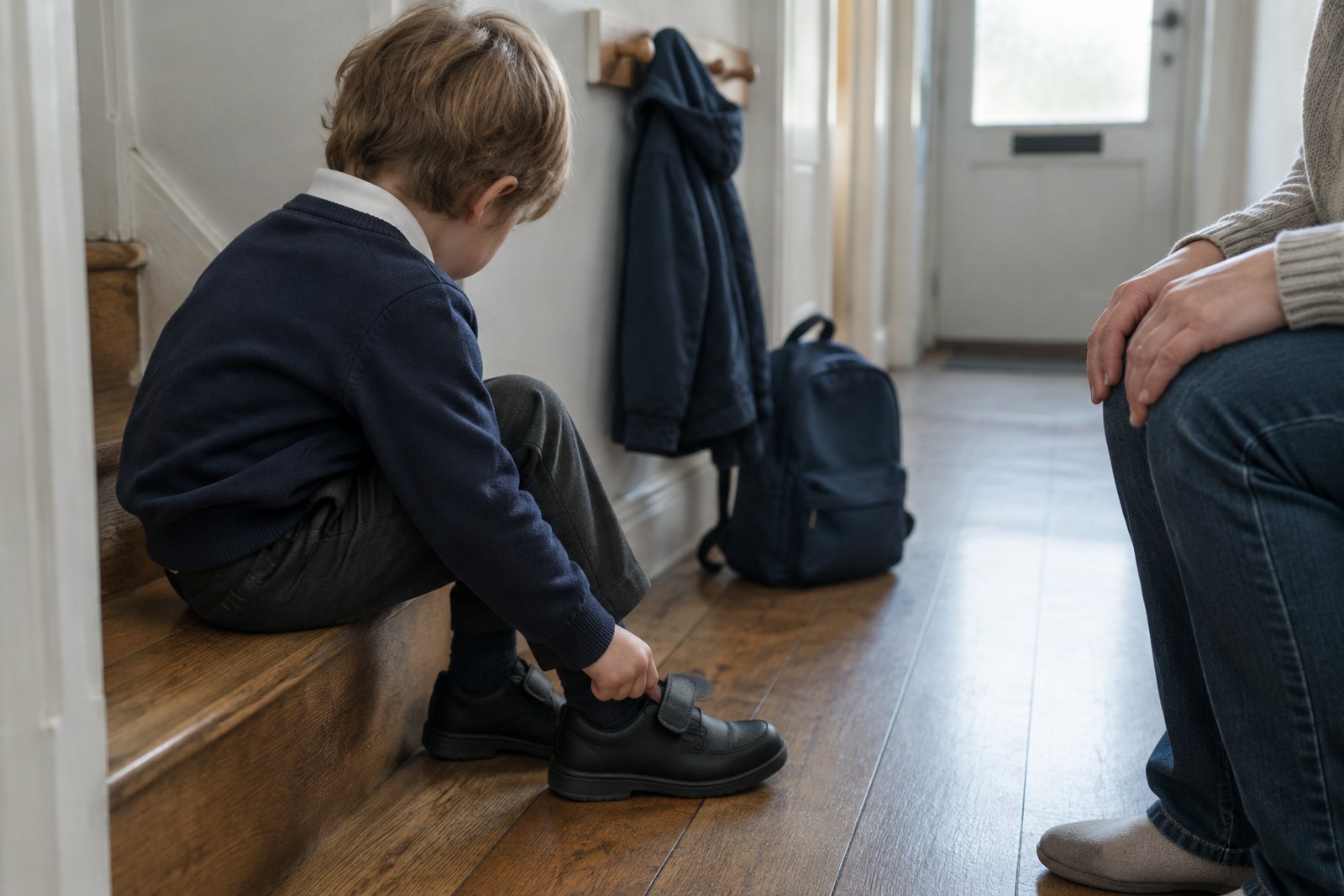
For a child starting reception, school readiness is mostly not about letters and numbers. Teachers will teach your child to read. What they cannot easily do, with a full class and perhaps one teaching assistant, is help every child to the toilet, do up every coat and open every yoghurt. The skills that make the first term easier are the everyday ones. Going to the toilet and wiping. Getting changed for PE. Eating lunch in a busy hall. Opening a packet. Sitting on the carpet for a few minutes. Holding a pencil. Saying goodbye at the door.
Your child does not need to have all of these sorted by September. Very few four-year-olds do, and reception staff expect a wide spread. The aim is to get each one moving in the right direction, so your child spends less of the day stuck and waiting for an adult. Below is a practical checklist with ways to practise at home that need no special kit, followed by an honest guide to when a gap is worth raising, and who with.
Why the everyday skills matter more than letters
A child who can write their name but cannot manage their own trousers will spend part of the day anxious, waiting or wet. A child who cannot yet write their name but can use the toilet, eat lunch and find their coat will usually settle and learn. In England, reception follows the Early Years Foundation Stage, which treats communication and language, personal, social and emotional development, and physical development as the prime areas. In plain terms: the basics come first, and schools know it.
There is also a confidence point. Every small thing a child can do for themselves is one less moment of feeling lost in a big room. Independence at four is as much about the feeling of 'I can do it' as the skill itself.
The school readiness checklist
Work through these over the spring and summer before school starts. Pick one or two at a time rather than all eight. Practise when nobody is in a hurry, which means not at quarter past eight on a weekday morning.
1. Using the toilet on their own
What it looks like: your child can tell an adult they need the toilet (or just go), pull clothes down and up, wipe, flush and wash their hands. Accidents still happen in reception, especially in the first few weeks, and staff are used to them.
- Practise wiping. Plenty of children are still being wiped at home. Teach front to back, and checking the paper. If you use wet wipes at home, try ordinary toilet paper too, because that is what school will have.
- Try unfamiliar toilets. Use toilets in cafes, libraries and friends' houses. Loud hand dryers frighten some children, so it helps to meet them in advance.
- Choose easy clothes. Elasticated waists rather than buttons and belts. If your child struggles, leave fiddly tights and dungarees until later in the year.
- Teach the words. Make sure your child knows how to ask to go, and that asking is always fine.
- Pack spare clothes if the school asks, and tell your child they are there and nobody minds.
If your child is regularly soiling, holding on, straining, has pain when pooing, or seems to need a wee very often, speak to your GP or health visitor. If needing to wee a lot comes with being very thirsty, tired or losing weight, or a child who was dry starts wetting again, see your GP the same day, as these can be signs of type 1 diabetes. Constipation is common in young children, is often behind daytime accidents, and is treatable. Wetting at night is a separate issue and is common at this age.
2. Getting changed for PE
What it looks like: taking off a jumper and shirt, putting on a PE top, swapping shoes for plimsolls or bare feet, then getting back into uniform roughly the right way round, in a room full of other children doing the same. Nobody expects it to be quick.
- Undressing comes first. Children usually manage taking things off before putting them on. Start there and praise it.
- Use backward chaining. You do most of the task and your child finishes the last step, such as pulling the top down over their tummy. When that is easy, they do the last two steps. Finishing the job gives them the win.
- Teach a front and back trick. Label at the back, or a small mark inside the collar. Lay the top face down, put arms in, then pull it over the head.
- Sit down to dress. Sitting on the floor or a low step makes balance far easier when putting legs into shorts or trousers.
- Make it a game. Race a sand timer, dress a teddy, raid the dressing-up box. It all counts as practice.
- Label everything. Every child in the class will own the same jumper.
Small buttons, stiff zips and school ties are hard for many four-year-olds. Hook-and-loop shoes, polo shirts that pull over the head and clip-on ties (if your school uses ties) remove whole problems at a stroke.
3. Managing a coat, shoes and bag
- The coat flip. Lay the coat on the floor, inside facing up, hood by your child's feet. They push their arms into the sleeves and flip it over their head. Most children love this one.
- Zips. Starting the zip is the hard part. You start it, they pull it up, and slowly hand over the starting. A loop of ribbon on the zip pull gives more to grip.
- Hanging up. Check the coat has a hanging loop. Put a low hook at home and make hanging it up part of coming in.
- Shoes on the right feet. Cut a sticker in half and put one half inside each shoe. When the halves meet in the middle, the shoes are on the right feet.
- Recognising their things. A distinctive keyring or patch on the bag helps a child find it on a crowded peg.
4. Eating lunch in the hall
School lunch is a lot. It is noisy and time-limited, the food may be unfamiliar and the cutlery heavier than at home. In England, children in reception, year 1 and year 2 at state-funded schools can have free school meals under the universal infant free school meals scheme, so many children will have a hot dinner. Ask your school how lunch works.
- Practise with a knife and fork. Spearing with a fork, pushing food onto it, and cutting soft food such as pancakes or fish fingers. Staff help with harder cutting.
- Notice how long meals take. Without nagging, see whether your child can eat a meal in a reasonable time without the television on.
- Carry a tray. A tray with a plate and cup is a real balancing skill. Practise with plastic plates.
- Drink from an open cup and from the type of water bottle the school uses.
- Look at the menu. Many schools publish theirs. Trying a few of the dishes at home makes lunch less of a surprise.
If your child eats a very narrow range of foods, often gags or chokes, or is losing weight, speak to your GP or health visitor. Chewing and swallowing difficulties are usually assessed by a speech and language therapist, and very restricted eating may need a wider team.
5. Opening packaging and lunchboxes
Packed lunches bring their own test: yoghurt tubes, cheese strings, crisp packets, cartons with tiny straws, lunchboxes with stiff clips. Staff do help, but there are many children and few adults.
- Do a practice lunch. Pack exactly what you plan to send and let your child open everything without help. You will find the problem items in one go.
- Teach the tricks. Crisp packets: pinch the top with both hands and pull apart. Yoghurt pots: find the tab and peel slowly.
- Swap what cannot be opened. Decant into a small tub, but test the lid first. Some tubs are harder than the packet.
- Build grip strength through play. Playdough, pegs, squeezing sponges in the bath, tearing paper, squirting water bottles in the garden.
6. Sitting on the carpet and at a table
Reception has carpet time: short stretches sitting and listening to a story or instructions. Wriggling is normal. What helps is the stamina to sit without slumping, and the ability to wait for a turn.
- Build core strength through play. Climbing, swinging, crawling through tunnels, wheelbarrow walks, lying on their tummy to draw or do puzzles. A strong trunk makes sitting less tiring.
- Practise listening. A short story without a screen, building up a minute or two at a time.
- Check the chair at home. At the table, feet should rest on something firm, either the floor or a sturdy box, with the table at roughly elbow height. Dangling feet make sitting harder work.
- Play turn-taking games. Simple board and card games teach waiting better than any lecture.
Some children find sitting still genuinely hard because of how their bodies process movement and touch. Our guide to the eight sensory systems explains why some children seem to need to move in order to concentrate.
7. Holding a pencil, and the strength behind it
Your child does not need to be writing before school. Handwriting is taught in reception. What helps is the groundwork: strength in the shoulders and hands, and some control.
- Big movements first. Painting at an easel, chalk on the patio, a big brush and a bucket of water on a wall. Working upright strengthens shoulders and wrists.
- Small tools. Short, broken crayons and chalk encourage a fingertip grip because there is no room for a fist.
- Finger games. Threading beads, posting coins into a money box, picking up pom-poms with tongs, peeling stickers.
- Scissors. Child-safe scissors, thumb on top. Snipping strips of card or playdough is a good start.
- Marks, not words. Lines, circles and crosses. Some children will be writing their name, many will not, and both are fine.
Do not force a particular grip at four, because grips are still developing. If your child is still swapping hands a lot well into reception, grips the pencil so hard they tire quickly, or avoids drawing altogether, mention it to the teacher.
8. Saying goodbye at the door
- Practise short separations. Time with a grandparent, a friend's house, a club. Leave, and come back when you said you would.
- Keep the goodbye short and the same. A hug, a phrase, then go. Lingering usually makes it harder for you both.
- Make school familiar. Read picture books about starting school, walk past the building, look at any photos the school sends.
- Practise asking for help. Role-play the key sentences: 'I need the toilet', 'I can't open this', 'I don't feel well'.
- Expect some tears. Many children cry at drop-off and are fine minutes later. Ask the teacher how your child was once you had gone.
What not to worry about
- Reading, or writing their name perfectly.
- Tying shoelaces.
- Cutting up meat.
- Sitting completely still.
- Being young for the year. A summer-born child may be almost a year younger than some classmates, and teachers allow for it. In England children do not have to be in school until the term after their fifth birthday, and parents of summer-born children can ask about starting reception a year later. Check the rules on GOV.UK and your council's admissions pages.
When a gap is worth raising
One skill a bit behind is normal. What matters is the pattern. It is worth raising if:
- your child is struggling in several of these areas, not just one
- they are noticeably behind children of a similar age at running, climbing, balancing or using their hands
- they have lost a skill they used to have
- everyday tasks cause real distress or meltdowns, not just reluctance
- they are very clumsy, fall often or bump into things more than other children
- they react very strongly to noise, clothing, food textures or being touched
- their speech is hard for others to understand, or they struggle to follow simple instructions
Start with the nursery or school
Your child's key person at nursery will have watched them for months, often alongside many other children of the same age. Ask what they see. Nurseries usually pass information to the school, and you can ask them to include your concerns. Once your child has a place, the school's special educational needs coordinator (SENCO) is the person to talk to. Schools can put support in place without a diagnosis.
Health visitor, school nurse or GP
Before school, the health visiting team can talk through development and refer on. Once your child starts, the school nursing team takes over. See your GP for anything that may be medical: losing skills, pain with toileting, frequent falls, or worries about hearing. If you are worried about eyesight, you do not need to wait for a school check; NHS sight tests are free for children at high street opticians. If your child suddenly loses skills or seems unwell, contact your GP or NHS 111 the same day, and call 999 in an emergency.
Which therapist
NHS children's therapy referrals usually come through a GP, health visitor, nursery or school, and routes vary by area. Speech, language and swallowing are for a speech and language therapist. Walking, running and balance are usually for a physiotherapist. Self-care, hand skills and sensory difficulties are where an occupational therapist comes in. If you are worried about development more broadly, our page on developmental delay explains the usual routes.
Where an occupational therapist fits
Children's occupational therapists look at the everyday things a child needs to do and what is getting in the way. Before school, that means toileting, dressing, eating, hand skills, sitting, and coping with the noise and bustle of a classroom. Our guide to paediatric occupational therapy covers this in more detail.
A private occupational therapist visiting at home can watch your child play, dress, use a pencil and scissors, and tackle a lunchbox, then talk with you about what they noticed. You should come away with a short, practical programme built around your child's routine, ideas for clothing and equipment, and strategies the school can use. A written report can help when you talk to the SENCO. For children with strong reactions to noise, textures or touch, see our page on sensory processing differences.
Be clear about limits. An occupational therapist does not diagnose autism or ADHD on their own; that is done by specialist teams, usually led by a paediatrician or psychiatrist. Developmental coordination disorder (sometimes called dyspraxia) is normally diagnosed by a paediatrician, often with therapy input. NHS children's occupational therapy is free but waits can be long, while private therapy is usually quicker. Our guide to NHS or private occupational therapy helps you weigh it up.
Frequently asked questions
What should my child be able to do before starting reception?
Ideally, ask for and use the toilet with a little help, take off and put on a coat and simple clothes, feed themselves, recognise their own things and manage a few minutes on the carpet. Nobody expects all of these to be perfect, and reception staff help children who are still learning.
Is it a problem if my child is not fully toilet trained by September?
Schools cannot simply refuse a child because they are not yet toilet trained, and many children have accidents in the first term. Tell the school early so they can plan. If there are signs of constipation, pain or frequent soiling, see your GP, because treating the cause often helps more than extra training.
Does my child need to write their name before school?
No. It is nice if they can, but writing is taught in reception. Hand strength, shoulder stability and enjoying drawing are a far better foundation than early handwriting drills.
How do I tell the school about my child's needs before they start?
Ask for a meeting with the class teacher or SENCO once you have your place, and bring any nursery notes or reports. Many schools hold induction sessions or home visits in the summer term, which are a good time to raise practical things such as toileting or eating.
Can I refer my child to an occupational therapist myself?
Some NHS children's services accept parent referrals, but many need a referral from a GP, health visitor or school; ask your health visitor what happens locally. You can contact a private occupational therapist directly without a referral.
My child is fine at school but melts down at home. Is that normal?
Very common in the first term. Children often hold it together all day and let go with the people they feel safest with. A snack, quiet time and an early bedtime help. If it carries on for months or is getting worse, talk to the teacher.
Next steps
If several of these skills are a real struggle, an assessment at home can turn worry into a plan. See our children's occupational therapy page, or current guide prices, and choose your area below.
Talk to an occupational therapist near you
This guide is general information. For advice about your own situation - or someone you look after - a local occupational therapist can visit you at home and see it for themselves.
Choose your area: