

Teaching a Child to Use Cutlery: Knife and Fork Skills by Age
By Mobile Occupational Therapist • 5 October 2026 • 11 min read
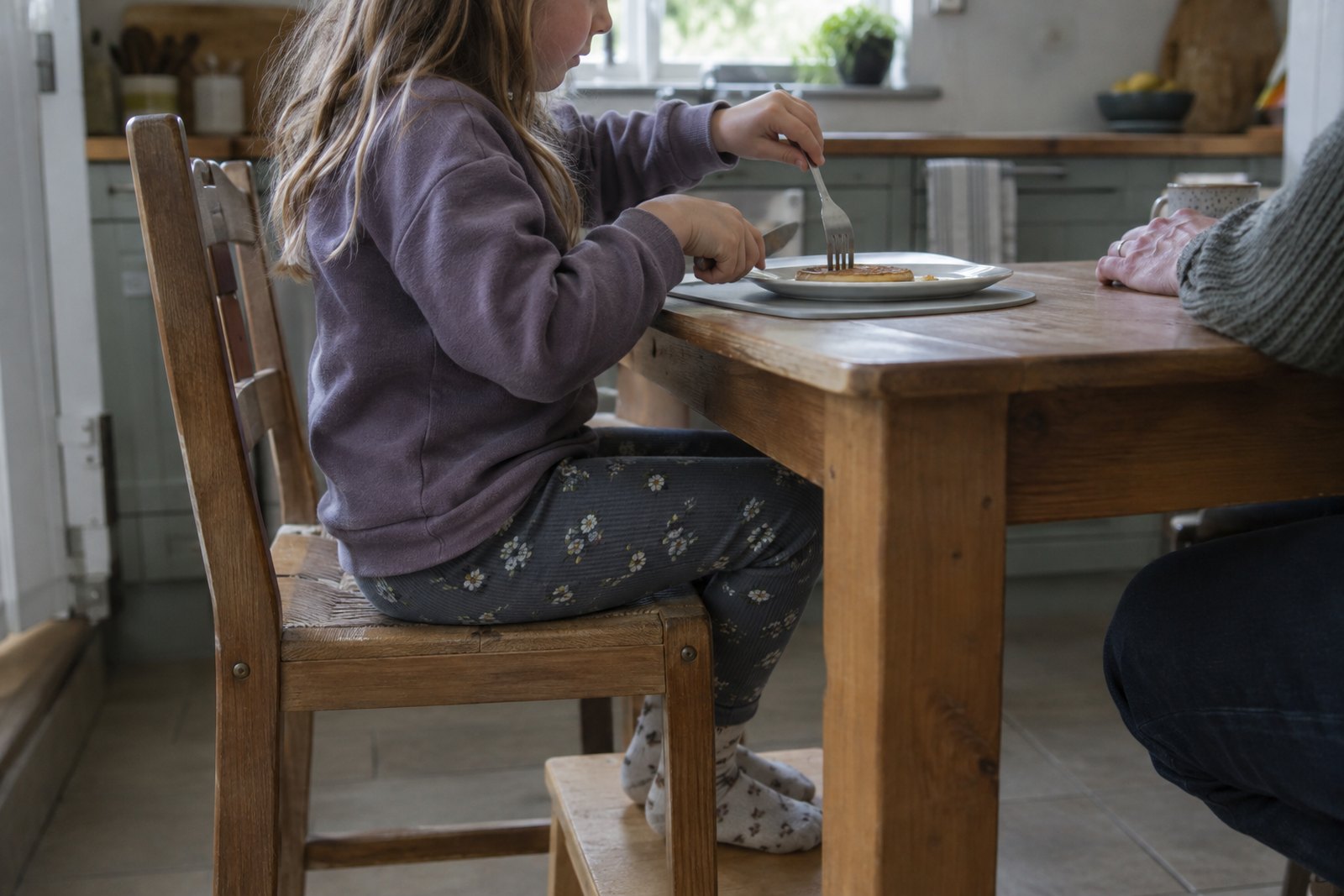
Most children manage a spoon and fork fairly well by the time they start school. Using a knife and fork together to cut soft food usually comes somewhere between about five and seven. Cutting firmer food like chicken or sausage neatly and without help often takes until eight or nine, sometimes longer. If your child is behind that, they are in large company. A knife and fork is one of the hardest everyday skills a young child learns, because both hands do different jobs at once while the body has to stay still and upright.
The good news is that it can be taught. It is mostly practice, the right chair and the right cutlery, not a special trick. Below are rough ages, the skills underneath, a step-by-step way to teach cutting, help for left-handers and messy eaters, school lunch tips, and when it is worth asking an occupational therapist to take a look.
Rough ages: what to expect
Ranges are wide. Treat these as broad signposts, not a test.
- Toddlers use fingers and a spoon, with plenty missing the mouth. Stabbing with a chunky fork usually follows.
- Around three to four: spoon and fork used fairly reliably, often in a fist grip. Some start spreading with a blunt knife.
- Around four to five: spreading butter, cutting very soft food with the side of a fork, trying a knife and fork together with help.
- Around five to seven: knife and fork together for soft foods, with mess and frequent help with anything tougher.
- Seven onwards: gradually cutting firmer food independently. Plenty of adults still wrestle with a tough piece of meat.
What matters more than the exact age is whether your child is slowly getting better. A child who is steadily improving is usually on track. A child who is stuck, or falling further behind classmates, is worth a closer look.
The skills underneath a knife and fork
When cutlery is hard, the problem is rarely the cutlery. It is usually one of these building blocks, and knowing which one helps you choose what to practise.
Two hands doing different jobs
Cutting needs one hand to hold still while the other moves. This is bilateral coordination, and it grows through ordinary play: threading, tearing paper, using scissors, holding a bowl while stirring. Some children also avoid reaching across the middle of their body. Our guide to crossing the midline and bilateral coordination has activities to try away from the table.
Grip and hand strength
Young children often hold cutlery in a fist, handle sticking up like a dagger. That is normal early on. The more mature grip, with the index finger along the top pressing down, needs strength in the small muscles of the hand. Playdough, clothes pegs, squeezing sponges in the bath and tearing bread all help.
Posture
You cannot use your hands well if your body is busy trying not to slide off the chair. Children with lower muscle tone often slump, lean on an elbow, prop their head in a hand or wriggle constantly. They are not being rude. They are tired. If that sounds familiar, our article on hypotonia and low muscle tone in children explains what helps.
Planning the movement
Cutting is a sequence: hold the food, place the knife, saw, lift, eat. Some children understand what to do but struggle to plan the movement and get the order right. Small steps, done the same way every time, help.
Sitting well comes first
This is the cheapest and most overlooked fix. Before changing anything else, look at how your child sits.
- Feet supported. Dangling feet make a child unstable. Put a sturdy box or step under their feet so the soles are flat, with knees and hips roughly at right angles.
- Table at the right height. Roughly tummy or lower chest height, with elbows resting just above it. A firm booster cushion helps if the table is too high, as long as it does not slide.
- Pulled in close, bottom at the back of the seat, plate directly in front.
Many parents find the mess drops noticeably once feet are on a box and the chair is pulled in.
Practise away from the plate
Meal times are a poor time to learn. Your child is hungry, there is time pressure and people are watching. Give the movement a chance to bed in at other times.
- Playdough cutting. Roll sausages and cut them with a plastic knife and fork, or flatten a 'pizza' and cut slices. Make the dough firmer as they improve.
- Soft foods first. At relaxed snack times try banana, pancakes, omelette, fish fingers, soft potato or cheese slices. Then move to cooked carrots, sausages and chicken. Leave tough meat until last.
- Pretend play. Cafe games, feeding a teddy, toy food joined with hook and loop tape that they cut apart.
- Helping in the kitchen. Spreading butter, cutting soft fruit with a blunt knife, holding a bowl while stirring, always supervised.
Child-sized cutlery and grips
Adult cutlery is long, heavy and slippery for small hands. Child-sized cutlery with short, chunky handles is easier to control. Look for a knife with a rounded tip and a gently serrated edge, which grips food better than a smooth blade, a fork with short prongs that still spear food, and handles with a flat top where the index finger can rest. A non-slip mat under the plate stops it skating about.
Some children need more: built-up handles, angled cutlery, a rocker knife or a plate with a raised edge. Our guide to adapted cutlery, plate guards and drinking aids explains the main types. Try ordinary child cutlery first, though, because specialist kit is often not needed.
How to teach cutting, step by step
Sit beside your child, not opposite, where everything is mirror image and confusing. Use the same words every time. For a right-handed child:
- Fork in the left hand, knife in the right. The fork is the 'holder', the knife is the 'saw'.
- Fork prongs down, index finger along the back pointing towards the food. 'Pointy finger on top.'
- Press the fork into the food firmly enough that it does not slide.
- Index finger on top of the knife handle, never on the blade, other fingers wrapped underneath.
- Put the knife right next to the fork prongs. Small pieces are easier than big ones.
- Saw back and forth, pressing gently. 'Push and pull' works better than pressing straight down, which squashes food.
- Lift the piece on the fork and eat it. Start again.
Teach one step at a time. You can do the holder job yourself while they practise sawing, then swap. Praise what they get right rather than correcting everything at once. A few cuts of a pancake with praise beats a whole dinner of struggle. If they are tired or upset, cut the rest and try again tomorrow.
Left-handed children
Many left-handed children find it more natural to hold the knife in the left hand and the fork in the right. That is fine. Eating comfortably matters more than convention. Others prefer the usual way, which is also fine. Let them try both, and sit on their left when demonstrating so your hands match. Our article on left-handed children has more tips. If your child still swaps hands a lot with no clear preference once they start school, mention it to school or an occupational therapist, as it can be part of a wider coordination picture.
Sensory and messy eating
Some children struggle with cutlery because of how food and mess feel, not because of their hands. Signs include gagging at certain textures, refusing mixed or lumpy food, getting upset by sticky hands, not noticing food on their face at all, or finding noisy dining areas overwhelming.
What helps: a damp cloth within reach, separating foods on the plate, serving familiar foods alongside new ones, and calm meal times. Messy play away from meals, with dry pasta, rice or foam, can make mess feel less threatening over time. Do not insist on cutlery for every food if it makes your child anxious. Eating comes first.
If your child eats a very small range of foods, is losing weight, is not growing as expected, or meals cause real distress, see your GP. That may need a paediatrician, dietitian or speech and language therapist rather than cutlery practice.
School lunch tips
School dinners are fast, noisy and public. A child who manages at home may still struggle there.
- Tell the school your child is still learning, and ask whether lunchtime staff can discreetly cut food when needed.
- Practise the menu. Many schools publish it, so practise the trickier items at home.
- Ask about their own cutlery if the school's is heavy or adult-sized.
- Consider packed lunches with foods that need no cutting: wraps, sandwiches, chopped fruit, pasta salad.
- Check they are eating. Some children quietly skip food they cannot manage. A lunchbox that keeps coming home full is worth asking about.
If cutlery is part of a wider pattern of difficulty, speak to the school SENCo (special educational needs co-ordinator).
When difficulty points to an assessment
Most children who struggle are simply still learning. Ask for help if your child is well behind classmates and not improving with practice, also finds dressing, buttons, handwriting, scissors or ball skills hard, seems clumsy or tires quickly sitting up, or meals regularly end in tears. Persistent coordination difficulty across everyday tasks can be a sign of developmental co-ordination disorder, also called dyspraxia. Our guide to dyspraxia in children explains the signs and how diagnosis works.
Where an occupational therapist fits
An occupational therapist looks at the whole task: seating, grip, strength, coordination, planning and sensory issues, as well as the cutlery, plate and table. Watching a real meal at home is often more revealing than a clinic. They can suggest seating changes, equipment worth trying (and what is not worth buying), a practice plan in small steps, and advice or a written report for school, which can support a request for extra help at school, such as SEN support or an EHCP in England.
NHS children's occupational therapy is usually reached through your GP, health visitor, school or paediatrician, and criteria and waits vary by area. A private occupational therapist visiting at home can assess at your own kitchen table.
An OT is not always the right person. See your GP if your child often coughs, chokes or gags when eating, or sounds wet or gurgly after drinking, as swallowing needs a speech and language therapist. If a child is choking, encourage them to cough. If they cannot cough, cry or breathe, shout for help, start choking first aid (back blows, then abdominal thrusts for children over one) and call 999 if it does not clear quickly.
Frequently asked questions
What age should a child use a knife and fork?
Most children use a knife and fork together for soft food somewhere around five to seven, with independent cutting of firmer food coming later. Ranges are wide, and steady progress matters more than the exact age.
Which hand should the fork go in?
The usual UK way is fork in the left hand, knife in the right. Many left-handed children find the reverse easier, and that is perfectly acceptable.
Is it OK for my child to eat with their fingers?
For finger foods, yes. Eating well matters more than eating tidily, especially for a child who finds cutlery tiring. Save practice for relaxed moments rather than every meal.
My child holds the fork in a fist. Should I correct it?
In younger children a fist grip is normal. Show the 'pointy finger on top' grip and praise it when you see it, but do not battle at every meal. If an older child cannot manage any other grip, mention it to school or an occupational therapist.
Should I buy a rocker knife?
A rocker knife cuts with a rocking motion in one hand, which can help children who find two-handed tasks very hard or have weakness on one side. Many have a sharp blade, so they need close supervision and are best tried on an occupational therapist's advice. Most children are better off learning with an ordinary child's knife and fork first.
Do I need a diagnosis to see an occupational therapist?
No. An assessment is about how your child manages everyday tasks, with or without a diagnosis. NHS referral routes vary by area, and you can contact a private occupational therapist directly. Check they are registered with the HCPC.
Next steps
If cutlery is one of several everyday things your child finds hard, see our children's occupational therapy page, or current guide prices, and choose your area below.
Talk to an occupational therapist near you
This guide is general information. For advice about your own situation - or someone you look after - a local occupational therapist can visit you at home and see it for themselves.
Choose your area: