

Crossing the Midline and Bilateral Coordination: Activities at Home
By Mobile Occupational Therapist • 20 October 2026 • 12 min read
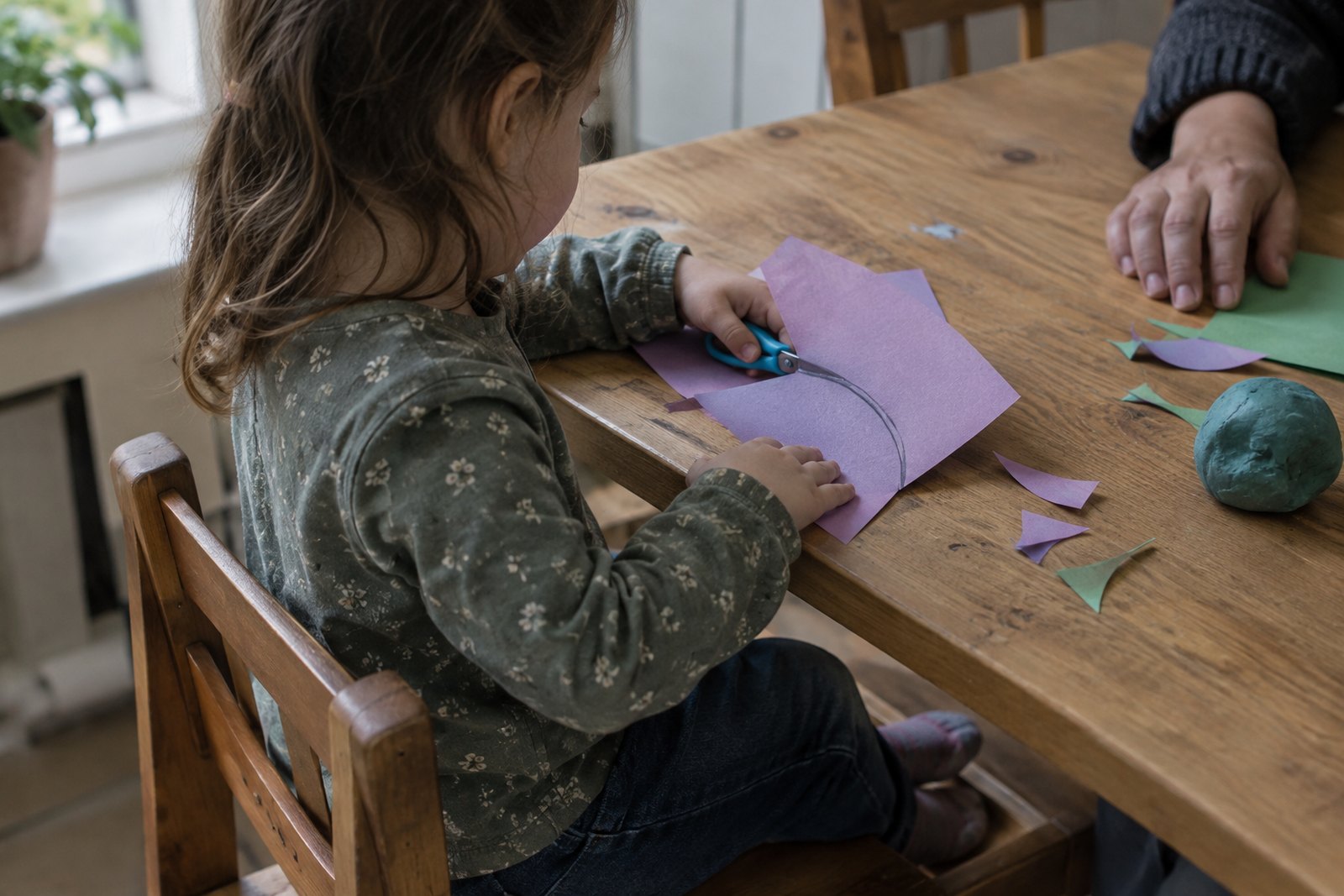
Bilateral coordination is a child's ability to use both sides of the body together. Sometimes both hands do the same thing, like clapping. Sometimes they take turns, like climbing a ladder. Most often, one hand leads and the other helps, like holding the paper still while the other hand cuts. Crossing the midline means reaching across the imaginary line down the middle of the body, so the right hand works on the left side and the left hand on the right.
Both skills matter because so much of daily life needs them: getting dressed, using scissors, writing, eating with a knife and fork, catching a ball, riding a bike. Most children pick them up through ordinary play, and most of the play that builds them is cheap, messy and fun. If your child keeps swapping hands halfway through a task, turns their whole body rather than reach across, or struggles with two-handed jobs that friends of the same age manage, it is worth doing more of the activities below. If it is affecting everyday life or you are worried, an occupational therapist can assess it properly.
What bilateral coordination actually means
It sounds technical. It is really just two hands (and two feet) learning to work as a team. There are three broad kinds, and children usually get them roughly in this order.
Both sides doing the same thing
Clapping, pushing a ball with both hands, jumping with feet together, rolling dough with a rolling pin. This is called symmetrical movement and it tends to come first.
Both sides taking turns
Crawling, walking, climbing stairs, pedalling a bike, swimming front crawl. One side moves, then the other, in rhythm. This is alternating movement.
One hand leading, one hand helping
This is the one that matters most for school and self-care. The leading hand (usually the dominant hand) does the skilled bit. The helping hand holds, steadies and positions. Think of cutting paper, spreading butter, threading beads, doing up a zip, or holding the page still while writing. Children who find this hard often look as if one hand has forgotten it has a job.
What crossing the midline means
Imagine a line running from the top of your child's head, down the nose, to between the feet. Crossing the midline is any movement where a hand, foot or eye goes over that line: reaching across to pick up a cup on the other side, drawing a long line across a page from left to right, touching the opposite knee, kicking a ball that has rolled to the other side.
When a child avoids crossing the midline, they often do it in clever ways. They swap the pen into the other hand when the line reaches the middle of the page. They shuffle their chair along. They twist their whole body round so the object ends up in front of them. None of this is naughty, it is simply the easiest route for them.
Why it matters for everyday things
Here is where these skills show up in real life:
- Dressing: one hand holds the fabric while the other pushes the button through. Pulling up trousers, doing a zip and tying laces all need two hands working together. Our guide to teaching children to dress themselves goes through this stage by stage.
- Cutting: the scissor hand opens and closes while the helping hand turns the paper. This is often the first place parents notice a problem.
- Writing and drawing: the helping hand steadies the paper, and the writing hand needs to travel across the page without swapping. See our guide to pencil grip by age for the writing side.
- Eating: using a knife and fork together, holding a bowl while scooping, opening a lunchbox.
- Ball skills and PE: catching with two hands, throwing across the body, skipping, star jumps, swimming strokes.
- Bikes and scooters: pedalling is alternating, steering is symmetrical, and balancing ties it all together.
A child who finds these harder may also tire more quickly, get frustrated, or start avoiding the activities altogether. That avoidance is often what turns a small difficulty into a bigger one, because they then get less practice.
How these skills usually develop
Every child is different, and ranges are wide. In broad terms:
- Babies start bringing their hands together in the middle, then begin passing toys from one hand to the other.
- Toddlers use two hands to hold bigger objects, bang toys together, and start to reach across their body, though often they still use whichever hand is nearest.
- Preschool children begin to show a clearer hand preference, and the lead-and-help pattern develops: holding a pot while stirring, steadying paper while scribbling, snipping with scissors.
- By the early school years, many children cross the midline without thinking about it, have a settled preferred hand, and can manage two-handed tasks like cutting along a line, threading and simple fastenings. Skills like tying laces and riding a bike often come later and vary a lot.
Many children show a clear hand preference somewhere around four to six, but some take longer and that alone is not a cause for worry. For a wider picture of milestones, see our guides to fine motor skills by age and gross motor skills.
A word on reading and learning
You will find plenty online claiming that crossing the midline is the secret to reading, maths or concentration, and that a few exercises will fix learning difficulties. Be wary. There is no good evidence that midline exercises improve reading or academic learning in general. What these skills clearly do affect is practical stuff: handwriting, cutting, dressing, sport, and how tiring the school day feels. That is reason enough to work on them. If your child is struggling with reading or learning, talk to their teacher or the school's SENCo, because the answer is likely to lie elsewhere.
Signs a child may be finding it hard
One of these on its own usually means nothing. A pattern of several, that sticks around, is worth paying attention to:
- Switching hands halfway through drawing, colouring or eating.
- Turning the whole body or moving the paper rather than reaching across.
- No settled hand preference well into the school years.
- The helping hand sitting idle, so the paper slides away while they draw or cut.
- Finding scissors, buttons, zips or a knife and fork much harder than classmates do.
- Struggling to catch with two hands, or to do star jumps, skipping or swimming strokes.
- Being slow to learn to pedal or balance on a bike or scooter.
- Getting upset with, or avoiding, crafts, construction toys or PE.
Coordination difficulties sometimes form part of a wider picture, such as developmental coordination disorder (often called dyspraxia). Our guide to dyspraxia in children explains how that is diagnosed. Plenty of children with patchy two-handed skills do not have any diagnosis at all, though, and just need more practice.
Activities to try at home
The best activities are ones your child actually wants to do. A few minutes of play most days beats a long session they hate. You do not need special kit.
For toddlers and preschool children
- Clapping and action songs: pat-a-cake, rhymes with hand movements, banging two saucepan lids together.
- Big ball play: roll a large, soft ball back and forth using both hands.
- Playdough: squash it flat with both hands, roll a sausage, use a rolling pin, pull it apart.
- Pouring: one hand holds the cup, the other pours from a jug, in the bath or at the sink.
- Tearing paper: tear old magazines into strips for a collage. Both hands pull in opposite directions.
- Big threading: large beads or pasta tubes onto a shoelace or pipe cleaner. Stay with your child throughout, as small pieces and laces are a choking risk for young children.
- Stickers: peeling a sticker off the sheet needs one hand to hold and one to pick.
For school-age children
- Cutting practice: start with snipping strips into confetti, then straight lines, then curves. Make sure the helping hand holds and turns the paper.
- Construction toys: interlocking bricks that need pushing together and pulling apart.
- Cooking: stirring while holding the bowl, rolling and cutting biscuit dough, spreading butter, peeling a banana or satsuma.
- Lacing and sewing cards: one hand holds the card, the other pushes the lace through.
- Catching games: start with a balloon or a large soft ball, then move to smaller balls and bean bags.
- Skipping, star jumps and animal walks: crab walk, bear walk and frog jumps all make both sides work together.
- Bikes, scooters and swimming: all brilliant if your child enjoys them.
Games for crossing the midline
- Big rainbow drawing: tape a large sheet of paper to the wall or floor and draw huge arches from one side to the other without swapping hands. Chalk on the patio works too.
- Figure-of-eight tracing: draw a large sideways eight and follow it with a finger, a toy car or a paintbrush with water.
- Cross-crawl marching: touch the right hand to the left knee, then left hand to right knee, to music.
- Bean bag pass: sit back to back and pass a bean bag round, twisting to each side.
- Sorting from one side: put a pile of toys or pegs on your child's left and a pot on their right, then swap. Keep the bottom still so the arm has to do the reaching.
- Ribbon dancing: wave a ribbon or scarf in big sweeping movements across the body.
- Simon says: "touch your left ear with your right hand" is surprisingly hard and usually very funny.
Everyday jobs count too
Folding towels, pairing socks, wiping the table with big sweeping movements, sweeping with a brush, carrying a tray, opening jars and pegging out washing are all two-handed practice. Children often take them more seriously than games because they are real jobs.
Making it work
- Let your child use their preferred hand. Do not try to change which hand they favour.
- Gently remind the helping hand of its job: "Can your other hand hold the paper for you?"
- Set things up so reaching across is natural, rather than telling them off for swapping hands.
- Make things easier before making them harder. Thicker lines, bigger balls, larger beads.
- Stop while it is still fun.
When to ask for an assessment
Think about asking for an occupational therapy or physiotherapy assessment if:
- the difficulties are clearly affecting dressing, eating, handwriting or play,
- your child is noticeably behind classmates and practice is not helping much,
- school has raised concerns about handwriting, PE or independence,
- your child is becoming distressed, avoiding tasks or losing confidence.
Some things need a doctor rather than activities. See your GP or health visitor if a baby or toddler strongly favours one hand very early, or seems to use one arm or leg much less than the other, as this can be a sign of weakness on one side. If a child suddenly stops using one side of their body, or their face droops or their speech changes, call 999 straight away. If they gradually lose skills they used to have, get medical advice the same day from your GP or NHS 111.
Where an occupational therapist fits
An occupational therapist looks at how coordination affects the things your child actually needs to do: dressing, eating, writing, cutting, playing and managing at school. They will usually watch your child doing real tasks, may use standardised assessments, and look at related things like hand strength, posture, body awareness and attention. They can then give you a practical plan for home, ideas or equipment for school (such as adapted scissors or a writing slope), and a report if you need one.
A physiotherapist is often the better first person if the main worries are about balance, walking, running, jumping, muscle tone or posture. There is overlap, and many children see both. A paediatrician is the person who diagnoses conditions such as developmental coordination disorder, usually after a GP referral, often with therapy input. Speech and language therapists lead on talking, understanding and swallowing. Your child's teacher and SENCo can help with support in class.
NHS children's occupational therapy is available, though referral routes differ by area. Ask your GP, health visitor or school what applies where you live. Some families also choose a private occupational therapist, who can visit at home and see your child in their everyday surroundings. Our children's occupational therapy page explains what that involves.
Frequently asked questions
Is it normal for a young child to switch hands?
Yes. Toddlers and many preschool children use whichever hand is nearest and swap freely. It becomes more worth noticing if a school-age child still regularly swaps hands mid-task and finds two-handed jobs hard.
Should I make my child use their right hand?
No. Let your child settle on whichever hand suits them. Left-handedness is perfectly normal. Encourage them to stick with the hand they started with during a task, rather than pushing a particular hand.
Do midline exercises help with reading?
There is no good evidence that they do. They can help with practical skills such as handwriting, cutting and sport. If reading is the worry, speak to your child's school.
How much practice does my child need?
Little and often works best. A few minutes of play built into the day, most days, is more realistic and more effective than a long session that ends in tears.
Does my child need a diagnosis to see an occupational therapist?
No. An occupational therapist can assess the practical difficulties without a diagnosis. If they think something more is going on, they may suggest you talk to your GP about a referral.
Will my child grow out of it?
Many children catch up with time and practice. Others have ongoing difficulties that improve with the right support and strategies. An assessment can help you understand which seems more likely and what will help most.
Next steps
If two-handed tasks or reaching across the body are making everyday life harder for your child, see our children's occupational therapy page and assessments and reports page, or current guide prices, and choose your area below.
Talk to an occupational therapist near you
This guide is general information. For advice about your own situation - or someone you look after - a local occupational therapist can visit you at home and see it for themselves.
Choose your area: