

Left-Handed Writing in Children: Paper, Grip and Scissors
By Mobile Occupational Therapist • 25 September 2026 • 13 min read
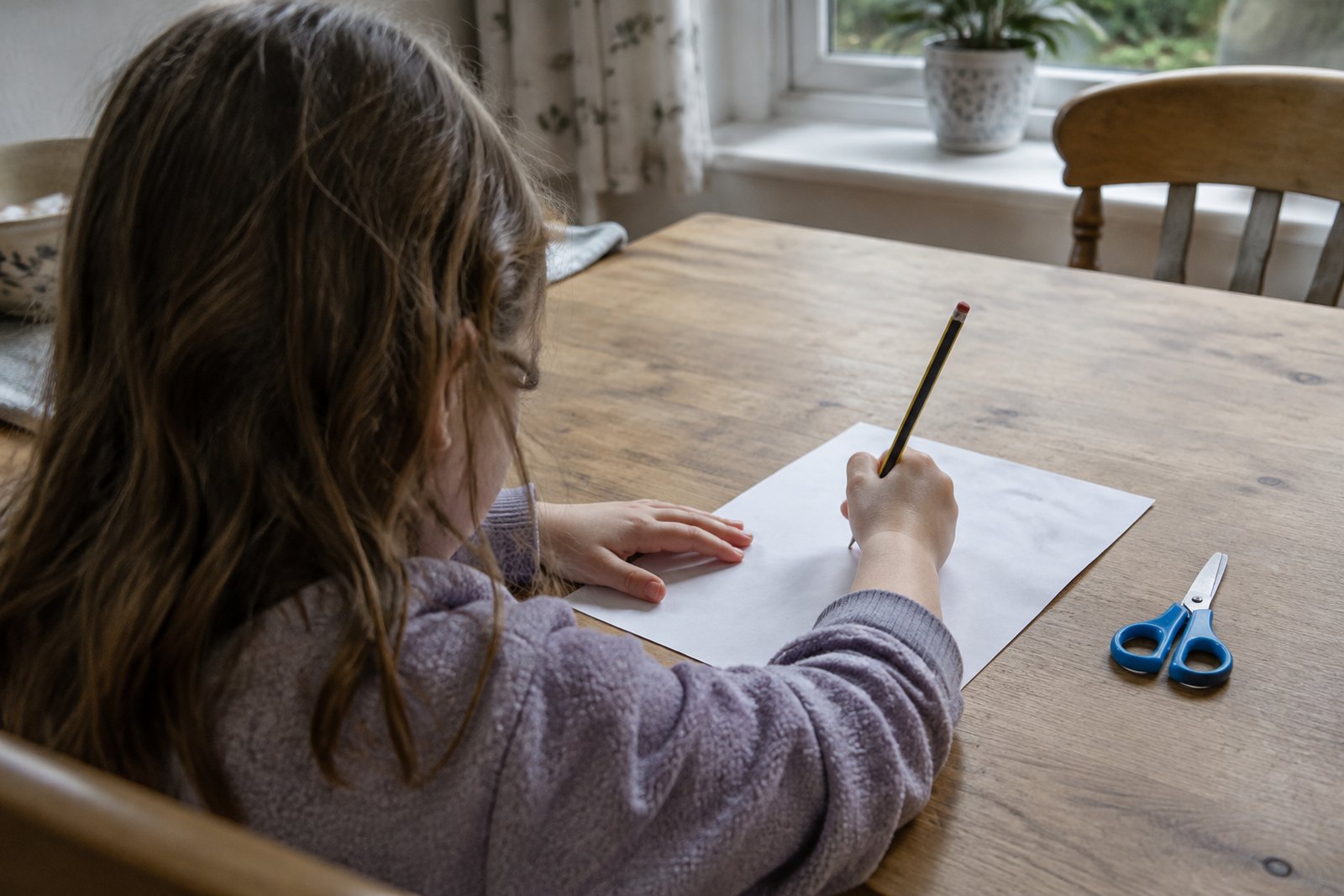
If your child writes with their left hand, the most useful thing you can do is let them. Do not try to switch them. Then make three small changes. Tilt the paper to the right. Encourage them to hold the pencil a little further up so they can see what they have written. And buy proper left-handed scissors with the blades reversed, not just a pair with a differently shaped handle.
That covers most of it. Left-handed children are not at any disadvantage in ability, but almost everything in a classroom was designed for right-handers, from the direction a pen travels across the page to which way the blades on a pair of scissors sit. A few adjustments at home, passed on to school, stop the smudging, the hooked wrist and the quiet frustration that some left-handed children put up with for years without mentioning it.
Do not switch hands
A generation or two ago, left-handed children were often made to write with their right hand. Plenty of grandparents still remember it. There is no good reason to do this. It tends to produce slower, more effortful writing and a child who feels they are doing something wrong.
Hand preference is not a choice your child is making to be awkward. It reflects how their brain is organised for skilled movement. Your job is to help the left hand work as well as it can, not to change it.
The same goes for gentle nudging. Always handing them the spoon in the right hand, or moving the crayon across to the other side, is a softer version of the same thing. Put things down in the middle and let them choose.
When hand preference has not settled yet
Many toddlers swap hands freely, and that is normal. A clear preference usually develops gradually through the preschool years, and it is common for it still to be a bit unsettled when a child starts school. Some children write with one hand and throw or eat with the other. That is mixed handedness, and it is not a problem in itself.
If your child is still swapping at school age, watch rather than decide for them. Notice which hand they use for the most skilled jobs: drawing, threading beads, picking up small pieces, using a fork. Put the pencil down in front of them, centred, and see which hand reaches for it. Over time one hand usually takes over for fine work. If it is still genuinely unclear and they are also struggling with coordination more generally, that is worth raising with school or an occupational therapist (more on that below).
Strong hand preference in a baby
The opposite situation is the one to act on. Babies under about 18 months do not usually show a firm preference for one hand. If a baby very clearly uses one hand and seems to ignore or avoid using the other, mention it to your health visitor or GP. Often there is a simple explanation, but an early one-sided preference can sometimes be a sign of weakness or reduced movement on the other side, and that needs checking rather than waiting to see.
Getting the paper in the right place
This is the single biggest change for most left-handed writers, and the one most often missed in a classroom set up for right-handers.
- Move the paper to the left. Place it slightly to the left of the middle of your child's body, in line with their writing arm, rather than straight in front of them.
- Tilt it to the right. Turn the page clockwise, so the top of the paper points towards the right. Right-handers tilt the other way. The aim is for the page to lie roughly along the line of the forearm, so the wrist stays straight and sits below the line of writing. A noticeable angle is usually needed. Experiment until the forearm rests comfortably and the writing hand can travel along the line without twisting.
- Hold the paper with the right hand. The non-writing hand steadies the page and slides it up as the writing moves down. Children often forget this and chase the paper around the table.
A small piece of tape on the table marking where the corner of the page goes helps a younger child find the position without being reminded every time. Some children also find a sloped surface helps them see their work and keep the wrist straight. Our guide to writing slopes explains who they suit and how to set one up.
Holding the pencil
A left-handed child holds a pencil in the same basic ways as a right-handed child. What differs is where the hand sits in relation to the writing.
Grip a little higher
Right-handers pull the pencil across the page, so their hand trails behind the words. Left-handers push it, which means their hand travels over what they have just written and hides it. Holding the pencil a little further back from the point, roughly a couple of centimetres, lets them see the line they are writing on and the letters they have just formed.
Many children work this out for themselves. If yours grips right down at the tip and leans over to see, a small mark or a wrapped elastic band on the pencil shows where the fingers go. Do not push it too far up, as a very high grip gives less control.
For what grip is typical at each age and when an unusual grip actually matters, see our guide to pencil grip by age.
Avoiding the hooked wrist
Some left-handers curl the wrist over the top of the line so the pencil points back towards them. This is the hooked wrist. Children usually develop it for a sensible reason: it lets them see their writing and keeps the hand off wet ink. The trouble is that, for some children, it can put strain on the wrist, become tiring or uncomfortable in longer pieces of work, and make faster writing harder later on.
Telling a child to straighten their wrist rarely works on its own. It is more effective to remove the reasons for the hook:
- Tilt the paper to the right. Most hooking starts with paper placed straight.
- Keep the paper to the left of the body, not in the middle.
- Hold the pencil a little higher so they can see the writing.
- Use pencils and pens that do not smudge, so they are not protecting the page with their hand.
With a young child just learning to write, it is worth setting this up early. An older child or teenager who has hooked for years but writes legibly, at a reasonable speed and without pain, may be best left alone. Changing an established habit takes a lot of effort and is only worth it if it is causing a real problem.
Sitting in the right place
At a shared table, a left-handed child should sit on the left of a right-handed child. That puts both writing arms on the outside, so elbows do not clash every few words. The same applies at the dinner table, where a left-hander sitting to the right of a right-hander spends the whole meal bumping arms.
It sounds trivial. For a child who sits in the wrong seat every day, it is not. Most teachers are happy to arrange it once it is mentioned. If your child does homework with a desk lamp, put the lamp on the right so their writing hand does not cast a shadow over the page.
Showing them how to form letters
Letters are formed the same way whichever hand is used, with the same starting points and directions, which matters once joined handwriting begins. A few left-handers naturally cross a t or draw a horizontal line from right to left. That is usually fine, as long as the letter looks right and joins easily.
If you are right-handed, demonstrating can feel awkward. Two things help. Sit opposite your child rather than beside them, so they can copy your movement as if in a mirror. Or demonstrate slowly with your own left hand, which is clumsy but shows the direction of travel clearly. For ideas that build control without endless worksheets, see our guide to handwriting practice at home.
Equipment that genuinely helps
Left-handed scissors
Right-handed scissors used in the left hand do two unhelpful things. The natural squeezing action pushes the blades apart instead of together, so the paper folds and tears rather than cuts. And the top blade sits over the cutting line, so the child cannot see where they are cutting. Many left-handed children are wrongly thought to be poor at cutting when the scissors are the problem.
True left-handed scissors have the blades reversed, not just the handles reshaped. Some scissors sold as suitable for either hand only have symmetrical handles with ordinary right-handed blades. To check, hold the scissors with the blades pointing away from you. On left-handed scissors the top blade is on the left. On right-handed scissors it is on the right.
Ask school whether proper left-handed scissors are available in the classroom, and whether your child knows where they are kept. If your child also has weak or tired hands, spring-opening or loop scissors come in left-handed versions too.
Pens, pencils and smudging
- Pencil smudges less than most ink. A slightly harder pencil lead smudges less than a very soft one.
- Quick-drying ink makes a real difference once pens are introduced. Some gel and liquid inks stay wet for longer and smear under the hand.
- Because left-handers push the pen, a smooth-flowing pen helps. Scratchy or dry pens tend to catch and dig in.
- If school uses fountain pens, nibs designed for left-handers exist. Check what school allows before buying anything.
- A scrap of paper under the writing hand protects the page while the ink dries.
Rulers, sharpeners and books
- Rulers: left-handed rulers have the numbers running from right to left, so a child drawing a line from right to left can read the measurement from zero.
- Sharpeners: left-handed versions turn the other way, which many children find easier.
- Notebooks: a spiral binding on the left digs into the hand. Pads bound at the top, or books folded flat, avoid this. Ring binders have the same problem, so taking the sheet out to write is fine.
- Computers: the mouse can be moved to the left and the buttons swapped in the settings.
Everything else
Knitting, sport and music all have left-handed questions of their own, and the honest answer is that left-handers manage well in all three: some knit in the usual way and some in mirror image, many sports reward left-handers, and most instruments are learned in the standard way, though guitars can be strung the other way round if a child really struggles.
Where an occupational therapist fits
Being left-handed is not a reason to see an occupational therapist. Most left-handed children need nothing more than the adjustments above, plus a teacher who knows about them.
An occupational therapist can help when something else is going on. That might look like:
- handwriting that stays much slower or harder to read than classmates' writing, even with the paper, grip and seating sorted
- pain, aching or tiredness in the hand or arm when writing
- difficulty with scissors, cutlery, buttons or zips even with the right tools
- general clumsiness, bumping into things or difficulty learning new physical skills
- hand preference still not settled at school age alongside wider coordination difficulties
- a child who avoids writing, rushes it or gets upset about it
An occupational therapist looks at sitting posture, the table and chair, grip, hand strength, coordination, how the eyes and hands work together and how a child plans movements. They then give practical, specific changes for home and school, and can write a report that school can use. Sometimes these difficulties are part of developmental coordination disorder; our guide to dyspraxia in children explains the signs. You can read more about occupational therapy for children on our services page.
Other people lead in some situations. A baby with a strong early hand preference should be seen by the health visitor or GP first. If your child squints, holds work very close or complains of headaches when reading, book an eye test with an optician; NHS sight tests are free for children under 16. Speech or language worries go to a speech and language therapist, and day-to-day support in class is arranged through the school's SENCO. If your child gradually loses skills they had, or develops new weakness in an arm or hand over days or weeks, see your GP promptly. If weakness comes on suddenly, or comes with a drooping face, slurred speech, severe headache or confusion, call 999.
Frequently asked questions
Should I encourage my left-handed child to use their right hand?
No. There is no benefit in switching hands, and it can make writing slower and more frustrating. Help them use their left hand well instead.
My child uses both hands. Is that a problem?
Not usually. Many young children swap hands, and some settle later than others. Watch which hand they use for detailed tasks and let them choose. If they are also struggling with coordination, talk to school or an occupational therapist.
Do left-handed children really need special scissors?
Yes. Right-handed scissors push apart in the left hand and hide the cutting line. Make sure the blades are reversed, not just the handles, by checking that the top blade is on the left.
Will a left-handed child always have messy handwriting?
No. With the paper tilted, a sensible grip and pens that do not smudge, left-handed children can write just as neatly as anyone else. Messy writing that does not improve with these changes is worth looking into.
Is it too late to fix a hooked wrist?
It is easiest to prevent when a child is first learning. In an older child who writes comfortably, legibly and at a good speed, it may not need changing at all. If it causes pain or slows them down, an occupational therapist can help.
What should I tell my child's teacher?
Ask for your child to sit on the left of a right-handed partner, for left-handed scissors to be available, and for the paper to be tilted to the right. Most teachers are glad to know.
Next steps
If writing or cutting is still a struggle after these changes, a private occupational therapist can assess what is getting in the way. See our children's occupational therapy page, or current guide prices, and choose your area below.

Talk to an occupational therapist near you
This guide is general information. For advice about your own situation - or someone you look after - a local occupational therapist can visit you at home and see it for themselves.
Choose your area: