

Hypotonia: Low Muscle Tone in Children and What Helps Day to Day
By Mobile Occupational Therapist • 20 October 2026 • 14 min read
Hypotonia means low muscle tone. Tone is the slight tension your muscles hold even when you are completely relaxed, a bit like the tension in a guitar string before anyone plays it. A child with low tone has muscles that feel softer and floppier at rest, so their body has to work harder to hold itself upright and steady. It is not the same as weakness, although the two often go together, and it is not a diagnosis. It is a sign that something is going on, and the reason can range from nothing serious at all to a condition that needs specialist care.
So the short answer is this. If you think your child has low muscle tone, see your GP, who can refer you to a paediatrician to look into why. Alongside that, there is a lot you can do at home, starting today, to make sitting, playing, eating, dressing and school easier. This guide covers both. And if you have a baby who is suddenly floppy and unwell, do not read on: call NHS 111 or 999 now.
Urgent signs in babies: get help the same day
Some babies are a little floppy from birth and are otherwise well, feeding and growing. That needs checking, but not in a panic. A baby who becomes floppy, or is floppy and also unwell, is different. Get help the same day if your baby:
- is floppy and also seems unwell, unusually sleepy or hard to wake
- is struggling to feed, taking much less than usual, choking or tiring quickly during feeds
- has fewer wet nappies than normal
- has a high temperature, a rash, or a cry that sounds weak, high-pitched or different
- seems to be losing skills they already had, such as holding their head up
Call 999 or go to A&E if your baby is struggling to breathe, is breathing very fast or making grunting noises, has blue or grey lips or skin, is very floppy and cannot be roused, or has a fit. For anything else on the list above, call your GP surgery for an urgent same-day appointment or call NHS 111. Trust your instinct. You know what normal looks like for your baby.
The same rule applies to older children. If a child who was fine starts losing strength, losing skills, falling much more, or struggling to swallow or breathe, that needs an urgent medical review, not a wait-and-see approach.
What low muscle tone actually means
Tone and strength are easy to confuse. Strength is how much force a muscle can produce when you ask it to work. Tone is the background readiness of the muscle when it is resting. A child can have low tone and still be strong enough to climb a frame, but they have to switch more effort on to get started and to keep their body stable while they do it. That is why children with low tone often tire quickly. Holding themselves together uses up energy other children do not have to spend.
Low tone often goes hand in hand with very flexible joints. If your child can bend their fingers back a long way or sits in positions that make you wince, you may find our guide to hypermobility in children useful too, as a lot of the daily-life advice overlaps.
Why it needs a doctor to look into it
Hypotonia has many possible causes. In some children no cause is found and they gradually improve as they grow. In others it is part of a condition such as Down syndrome or another genetic condition, some types of cerebral palsy, a condition affecting the nerves or muscles, or a range of rarer conditions. Babies born early can have lower tone for a while. Low tone is also often seen alongside developmental coordination disorder (dyspraxia) and in some autistic children.
You cannot tell which of these applies by looking, and neither can an occupational therapist. A paediatrician will usually ask about pregnancy, birth, feeding and milestones, examine your child, and decide whether any tests are needed. Start with your GP or health visitor. Write down what you have noticed and when, and take videos on your phone of anything that is hard to describe, such as how your child sits or walks. It saves a lot of "well, they do it at home".
What hypotonia can look like
Every child is different, but parents commonly notice some of these.
In babies
- Feeling floppy when held, as if they might slip through your hands under the arms
- Head lagging behind when you gently pull them up to sitting
- Arms and legs lying out flat rather than tucked in
- Feeding that is slow, tiring or messy
- Rolling, sitting, crawling or walking later than expected
In toddlers and older children
- Slumping in chairs, leaning on tables, walls or people, propping their head on a hand
- Sitting in a W shape on the floor, with knees bent and feet out to the sides (see our guide to W-sitting in children)
- Tiring quickly, wanting to be carried, or flopping onto the floor after short spells of activity
- Walking with feet wide apart, tripping often, avoiding climbing or playground equipment
- An open mouth, dribbling, or messy eating past the age you would expect
- A weak or awkward pencil grip, tired hands when drawing, slow dressing
A child with low tone is often described as lazy, clumsy or not trying. They are usually trying very hard. It just costs them more.
Seating: start with the feet
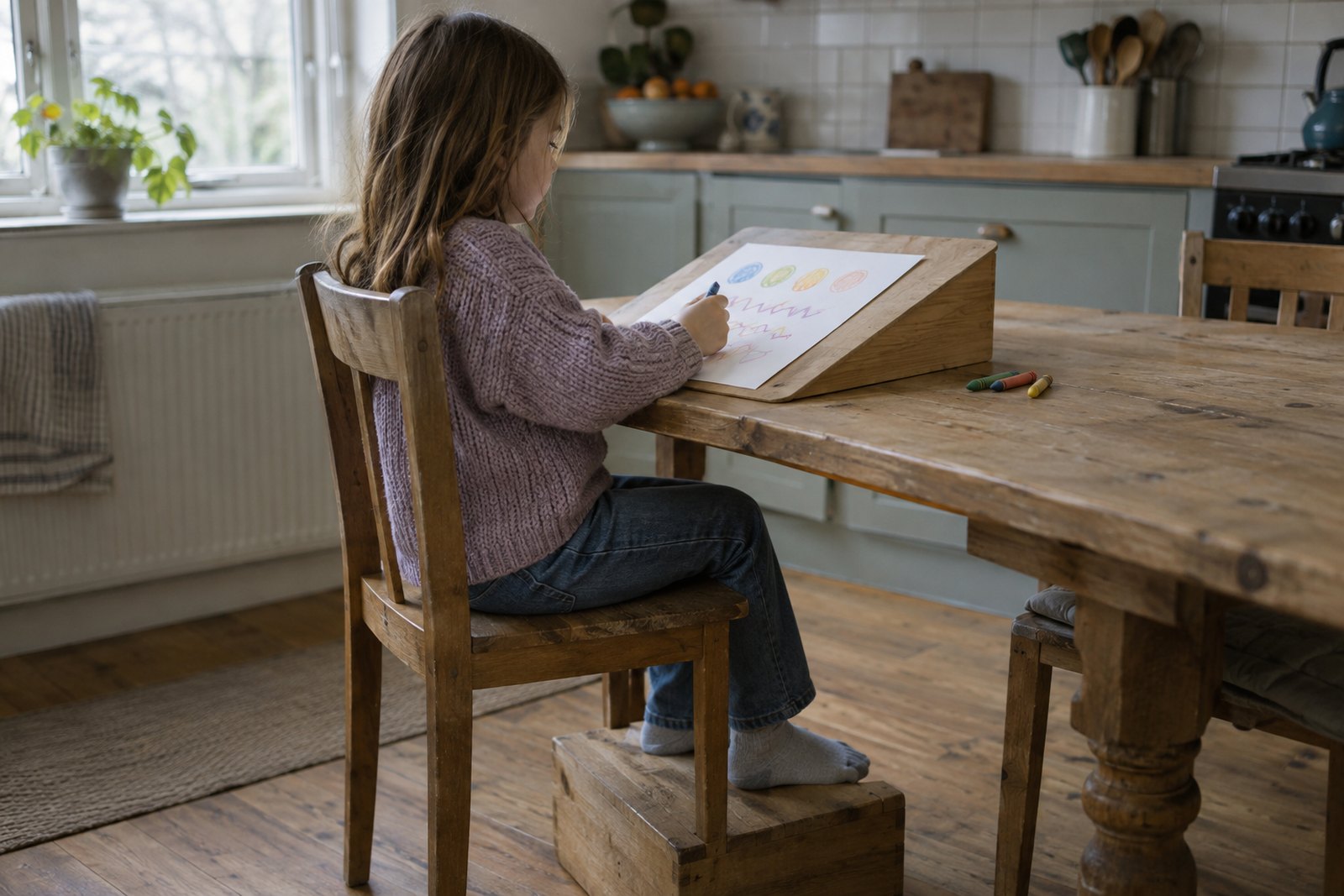
If you change one thing this week, change how your child sits. A child with low tone who sits with their feet dangling has nothing to push against, so they slump, wriggle or hook their legs around the chair to feel stable. Once the body is supported, the hands and brain are free to get on with eating, drawing or homework.
- Feet flat. Feet should rest flat on the floor or on something firm. A sturdy box, a step, or a pile of large books taped together works fine.
- Hips back. Bottom right to the back of the seat, with the back supported. If the seat is too deep, a firm cushion behind the back can bring it forward.
- Roughly right angles. Hips, knees and ankles bent at about a right angle is a good starting point.
- Table at the right height. Roughly elbow height when seated. Too high and shoulders hunch, too low and they slump forward.
- Sides if needed. Younger children may do better in a chair with arms or sides to lean against.
On the floor, give alternatives to W-sitting: sitting cross-legged against a sofa, lying on their tummy propped on elbows, kneeling, or sitting on a small low stool. You do not need to nag every time. Just make the other positions easy and comfortable.
Short, active play that builds core stability
Core stability means the muscles around the trunk and shoulders that hold the body steady so the arms and legs can move well. You build it through play, little and often, not through long exercise sessions a tired child will hate. Five to ten minutes a few times a day usually goes further than one big session.
- Tummy time for babies, only when they are awake and you are watching, starting with short spells on your chest (always put your baby to sleep on their back), and lying on the tummy to play, read or watch something for older children
- Animal walks: bear walks on hands and feet, crab walks, frog jumps, commando crawling under a line of chairs
- Wheelbarrow walks, holding at the thighs rather than the ankles to start with
- Pushing and pulling: pushing a laundry basket of toys across the room, pulling a sibling on a blanket, tug of war
- Climbing: the playground, a low climbing frame, clambering over sofa cushions on the floor
- Ball games: kneeling to throw and catch, lying on the tummy to roll a ball to and fro
- Swimming, which many children with low tone enjoy because the water supports them
Stop before your child is exhausted, not after. Ending on a good moment means they are more willing next time. If your child gets breathless, unusually tired or in pain with activity, mention it to your GP or the physiotherapist. A physiotherapist can give you a programme tailored to your child.
Hands, fine motor skills and handwriting
Hands work best when the shoulders and trunk are steady, which is why seating and core play come first. Then build hand strength and control through things that do not feel like practice.
- Playdough or putty: squashing, rolling, hiding small objects to dig out
- Clothes pegs onto card or a washing line, using tongs or tweezers to pick things up
- Tearing paper, screwing it into balls, using squeezy water toys in the bath
- Working on a vertical surface such as an easel, a whiteboard on the wall, or paper taped to a window, which strengthens shoulders and encourages a better wrist position
- Building with small bricks, threading large beads, posting coins into a money box
For writing, try chunkier pencils or crayons, or a soft pencil grip, and keep sessions short. A writing slope tilts the page towards the child, which can help posture and wrist position. Our guide to writing slopes explains who they help and how to set one up. If your child is falling behind with handwriting, it is worth asking school about typing, scribing or other ways to show what they know.
Dressing, eating and the toilet
Dressing
Standing on one leg to put trousers on is hard if your balance and tone are low. Let your child sit to dress, either on the floor with their back against a wall or sofa, or on a low stable seat with feet on the floor. Choose easier clothes for busy mornings: elastic waists, loose necks, touch-fastening shoes, larger buttons. Lay clothes out in order, the right way round. Teach one step at a time and let them finish the last step themselves so they get the win. Allow more time than seems reasonable. It usually is.
Eating and drinking
Good seating with feet supported makes a real difference at mealtimes. Cups with lids or a straw, bowls with higher sides and heavier cutlery can help. If your child coughs or chokes with food or drink, has frequent chest infections, struggles to chew, or is not gaining weight, tell your GP. A speech and language therapist, and sometimes a dietitian, leads on feeding and swallowing difficulties.
The toilet
A child perched on an adult toilet with legs dangling has to work hard to stay balanced, which makes it harder to relax and go. A step or footstool under the feet and a child seat insert can help a lot. If toilet training is taking much longer than expected, mention it to your health visitor or GP, as there can be several reasons.
Tiredness and pacing the day
Many children with low tone run out of energy sooner than their friends, and tiredness often shows up as meltdowns, clumsiness or refusing to walk. Plan the day so harder tasks come when your child is fresh, mix active and quiet activities, and build in rest before they hit the wall. A buggy or being carried for longer walks is not spoiling them. It means they have energy left to enjoy where they are going.
School and nursery
Talk to the class teacher and the SENCO (special educational needs coordinator) early. Useful adjustments might include:
- A chair and table that fit, with a footrest if feet do not reach the floor
- Somewhere to lean or a chair during carpet time
- Movement breaks and active jobs, such as taking the register to the office
- Pencil grips, a writing slope, extra time, or reduced writing
- Help or extra time with changing for PE, and PE that is adapted rather than avoided
- A plan for tiredness later in the day
Most children are supported through the school's own SEN support. If your child's needs are more complex, an education, health and care plan may be appropriate. Our guide to EHCPs explains how that works in England and what an occupational therapy report can add.
Who does what: paediatrician, physio, OT and others
The paediatrician looks for the cause, decides on any tests, and coordinates medical care. This always comes first, especially in babies.
A physiotherapist usually leads on gross motor development, posture, balance, walking and strengthening. For many babies and young children with low tone, physio is the main therapy, and they may also advise on supportive footwear or orthotics.
A speech and language therapist leads on feeding, swallowing and speech.
Where an occupational therapist fits
An occupational therapist focuses on the everyday things your child needs and wants to do: sitting at the table, using their hands, drawing and writing, dressing, eating with cutlery, using the toilet, joining in at nursery or school. An occupational therapist can assess how low tone is affecting those tasks, look at seating at home and school, suggest equipment and easier ways of doing things, build fine motor skills through play, and write reports for school or an EHCP application. They work alongside the physio and paediatrician, not instead of them.
NHS children's occupational therapy is usually accessed through a referral from your GP, paediatrician, health visitor or school, depending on your area. Some families also choose a private occupational therapist, who can visit at home and see how things work in your own kitchen, bathroom and bedroom. An occupational therapist cannot diagnose the cause of hypotonia, so a private assessment is not a substitute for seeing a doctor.
Frequently asked questions
Will my child grow out of hypotonia?
It depends on the cause. Some children with no underlying condition improve a great deal as they grow and get stronger. Others have low tone as part of a lifelong condition, although function often improves with practice and the right support. Your paediatrician is the best person to talk this through with.
Is low muscle tone the same as muscle weakness?
No. Tone is the tension in a muscle at rest, strength is how much force it can produce. They are linked, because low tone means the child has to work harder and may build strength more slowly, but they are not the same thing.
Can exercise increase muscle tone?
Exercise and play will not usually change tone itself very much, but they build strength, stamina, balance and core stability, which makes daily life easier. That is why regular active play matters, and why a physiotherapist's programme is often worth following.
Is hypotonia a sign of autism?
Not on its own. Low tone is seen in some autistic children, and in children with dyspraxia and many other conditions, but plenty of children with low tone are not autistic. If you have wider concerns about communication, play or behaviour, raise them separately with your GP or health visitor.
Should I stop my child W-sitting?
Many children with low tone W-sit because it feels stable. There is no need for constant correction, but it helps to offer and encourage other positions, such as cross-legged against support or lying on the tummy, so they build strength in different ways.
Do I need a referral to see an occupational therapist?
For NHS children's occupational therapy, yes, usually from your GP, paediatrician, health visitor or school. You can contact a private occupational therapist directly without a referral, but your child should still see a doctor about the low tone itself.
Next steps
See our children's occupational therapy page, or current guide prices, and choose your area below.
Talk to an occupational therapist near you
This guide is general information. For advice about your own situation - or someone you look after - a local occupational therapist can visit you at home and see it for themselves.
Choose your area: