

Catheter Bag Basics: Leg Bags, Night Bags and Daily Life
By Mobile Occupational Therapist • 19 September 2026 • 14 min read
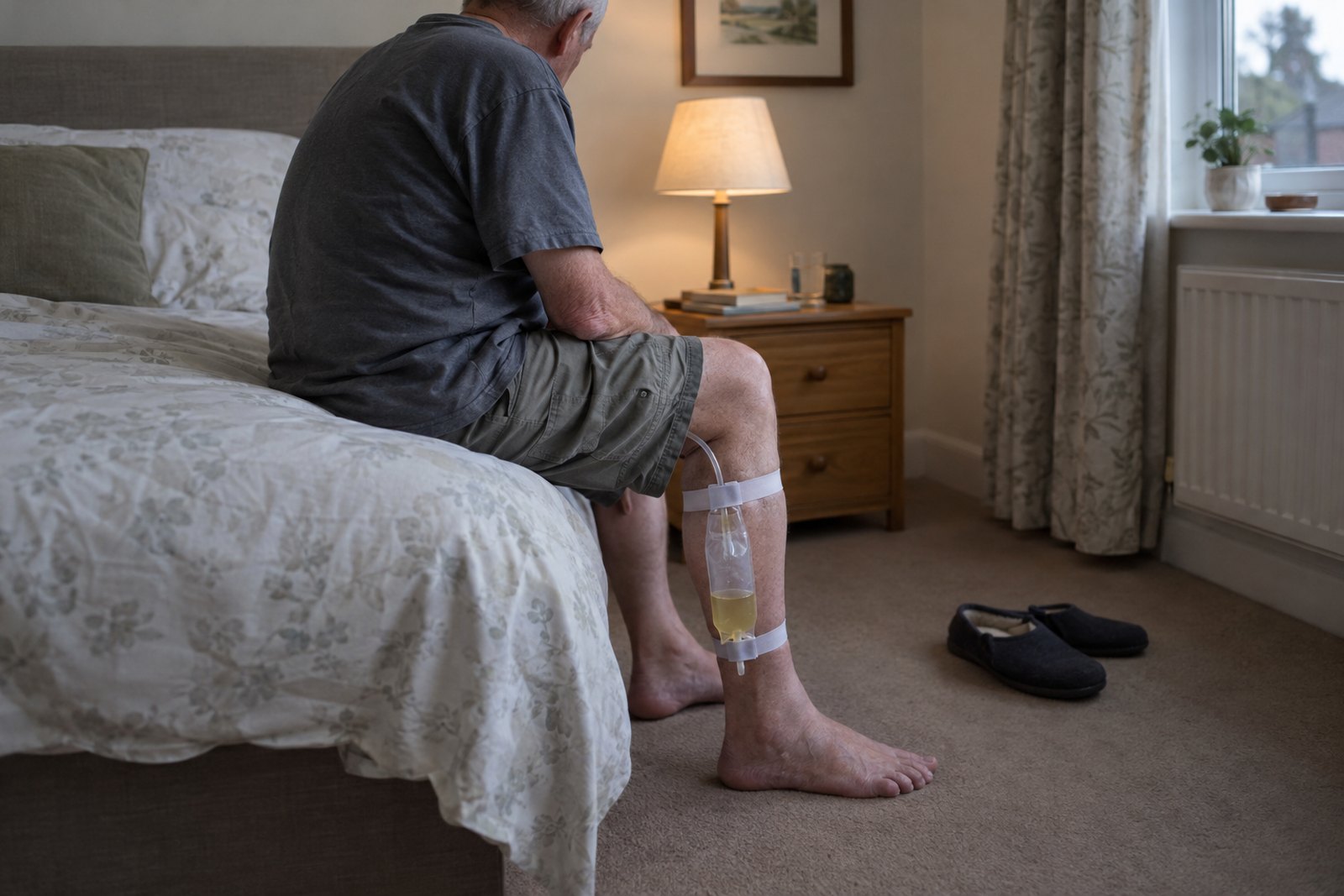
Living with a urinary catheter usually gets easier once you have a routine that works for your body and your home. For most people, that routine is a leg bag during the day (smaller, strapped to your thigh or calf) and a larger night bag connected at bedtime so you do not need to get up as often.
This article explains how catheter bags work in plain English, what "keep it closed" actually means day to day, how to manage clothing, showering, sleep and going out, and when to seek urgent help. Your district nurse, continence nurse or urology team should lead your catheter care and teach you exactly how to empty and change your equipment. If anything you were taught does not match what is below, follow your clinical team's advice and ask them to show you again.
what you have: catheter types and bag options
urethral catheter
This goes through the urethra (where you normally pass urine). A small balloon holds it in place inside the bladder. It is connected to a drainage bag or sometimes a valve.
suprapubic catheter
This goes through a small opening in the lower tummy, directly into the bladder. Many people find it more comfortable long term and easier for intimacy, but it still needs careful daily management to avoid pulling and infection. Your nurse will advise about cleaning the skin around the site and when dressings are needed.
leg bag in the day, night bag at night
A leg bag straps to the leg and fits under clothing. At night, many people connect a larger night bag to the outlet of the leg bag (or directly to the catheter, depending on what you have been taught). The night bag has more capacity so sleep is not constantly interrupted.
The general aim is to keep the drainage system closed and draining freely. That means you avoid disconnecting things unless you have been shown how and you keep the tubing unkinked and the bag below bladder level.
catheter valves
Some people use a catheter valve instead of a drainage bag during the day. The valve stays attached to the catheter and you open it at intervals to empty urine into the toilet. This can suit people with good bladder capacity and the ability to remember and manage regular emptying. It is not right for everyone, so only use a valve if your urology or continence team has advised it.
the non-negotiables: the few rules that prevent most problems
Most catheter problems come down to three things: pulling, blockage, or infection risk. These basics reduce all three.
- Keep the bag below the level of your bladder. If the bag is held higher, urine may not drain properly and can flow back.
- Avoid kinks and loops in the tubing. Check it after dressing, after using the toilet, and after getting into bed.
- Secure the catheter and tubing so it cannot tug. Pulling can cause pain, leakage, bleeding, and accidental removal.
- Keep the system closed as you have been taught. The more you disconnect, the more chance bacteria have to get in.
- Empty the bag regularly. An overfull bag is heavy and more likely to pull, leak, or back up.
- Hand hygiene every time. Before and after emptying, changing or handling the outlet tap.
If you only take one thing from this page: if drainage suddenly stops, do not "wait and see" for hours while you feel unwell. Blockage can become urgent quickly.
day to day routine: emptying, changing and positioning
emptying a catheter bag without making a mess
Your nurse should show you the exact method for your bag. In general, it helps to make the steps repeatable: same place, same order, same supplies.
- Choose a spot where you can sit or stand safely and comfortably, with good light.
- Have toilet paper ready so you are not juggling.
- Wash your hands before and after.
- Try not to let the outlet tap touch the toilet, your skin, or the floor.
- When finished, check the tap is properly closed and the tubing is not twisted.
If you have shaky hands, poor grip, or arthritis, the tap can be surprisingly fiddly. This is one area where an occupational therapist can be genuinely useful with practical workarounds and the right equipment choices. Our plain English guide to equipment for daily living explains the sort of small aids that can make routines easier.
changing bags: follow the schedule you were given
Some leg bags are designed to stay connected for several days, and night bags are often changed more frequently. The "right" schedule depends on the type supplied and your clinical plan. Do not guess and do not extend use because it feels wasteful. Ask your district nurse or continence service to write down:
- how often to change the leg bag
- how often to change the night bag
- whether the night bag is single-use or can be rinsed (many are single-use)
- what to do if you run out
straps, sleeves and securing the tubing
A leg bag should feel secure, not tight. Too loose and it pulls. Too tight and you can get swelling, skin problems, or a pressure area.
Practical checks:
- After you stand up, the tubing should not be taut. You should be able to move your knee and hip freely.
- The bag should sit flat against the leg so it does not swing when you walk.
- Check the skin under straps daily, especially if you have fragile skin, swelling, diabetes, or reduced sensation.
- If you get red marks that do not fade, blistering, or broken skin, contact your nurse. You may need a different method of fixation.
If you find bending down hard (for example after surgery or with back pain), you might use a long-handled aid to help manage clothing and tubing without overreaching. See grabbers and reachers for what to look for and how to avoid unsafe twisting.
showering, washing and skin care
hand hygiene and basic cleaning
You do not need fancy cleaning routines. Consistency matters more.
- Wash hands before and after handling the catheter, valve or bag tap.
- Wash the skin around the catheter (and the suprapubic site, if you have one) as advised by your nurse, usually with water and mild soap. Pat dry.
- Keep an eye out for soreness, discharge, or a new smell from the site or urine.
can you shower with a catheter bag?
Many people shower as normal with the catheter and leg bag in place, then dry the bag and straps afterwards. Some prefer to shower with the night bag disconnected and the leg bag attached, to keep things simpler and reduce disconnections. What matters is that you do not accidentally pull the catheter, and you follow the connection method you have been taught.
If you are unsteady in the shower, address that first. A slip with a catheter can mean a painful tug. If you need practical help with getting in and out, seating, or grab rails, our guide to bath and shower aids explains the main options and the safety trade-offs.
drinking enough
Unless you have been told otherwise by your GP, nurse or hospital team (for example because of heart or kidney problems), drinking enough fluid helps keep urine flowing and may reduce blockage risk. "Enough" varies by person. If you are unsure what you should aim for, ask your clinical team for a clear daily target and what counts (water, tea, etc).
clothing, comfort and getting out of the house
clothing that makes life easier
Most people find a leg bag easier to manage with trousers or skirts that are not skin-tight. You need enough room to check the tubing, empty the bag, and adjust straps. Darker fabrics can feel less stressful if you are worried about leaks.
Two simple, useful ideas:
- Plan for access. If you cannot easily reach the outlet tap in a public toilet, it becomes a problem quickly. Practise at home, fully dressed.
- Carry a small "just in case" kit. Tissues, a spare night bag if you are staying over, hand gel for when soap and water are not available, and a disposable bag for waste. Your nurse can tell you what is appropriate for your equipment.
walking, stairs and sitting down
A leg bag should not change how you move, but it can if the tubing catches, the bag swings, or the straps slip. Do a quick check before you walk far: tubing free, bag secure, outlet tap closed.
If sitting down is difficult because of hip or knee pain, a higher chair or raised toilet seat can reduce strain and reduce the chance you tug the catheter while lowering yourself. See toilet aids for what can help and what to measure.
night time: sleeping with a catheter and night bag
connecting the night bag
Your nurse will show you whether your night bag connects to your leg bag outlet or directly to the catheter. The general principles are:
- avoid unnecessary disconnections
- keep the tubing unkinked
- make sure urine has a downhill route into the night bag
positioning the night bag safely
Keep the night bag below bladder level. Many people use a stand or hang the bag from the bed frame. Avoid placing it where it can tip, be trapped under bedding, or become a trip hazard if you get up in the night.
If you are up several times a night, think about how safe your route is: lighting, clear floor, and footwear that does not slip. If you have had falls or near misses, start with our falls guide: falls at home.
turning in bed without pulling the catheter
Pulling often happens at night. A few practical fixes:
- Leave enough slack in the tubing for turning.
- Try routing the tubing so it exits towards the side you usually sleep on.
- If you share a bed, agree where the tubing and bag will be so it does not get trapped.
If you have pain when moving in bed, or you struggle to reposition, do not force it. Speak to your nurse or GP, and consider whether you need help with bed set-up or handling. A private occupational therapist visiting at home can look at your bed height, lighting, and how you manage night time routines, and suggest safer ways to move.
getting supplies on prescription and who to contact
In the UK, catheter bags and related supplies are usually provided on prescription. How you get them varies by area. You may have:
- a delivery service arranged via your GP prescription
- supplies ordered by your district nursing team
- a continence service that manages your products and reviews
If you are running low, do not wait until you have none left. Contact the service that normally supplies you and ask what the re-order process is, how long it takes, and what to do in an emergency.
If you have repeated leaks, blockages, skin problems under straps, or you cannot manage the tap or valve, ask for a review rather than soldiering on. Often it is the wrong bag size, the wrong fixation method, or a routine that does not match your mobility and hand function.
sex and intimacy when you have a catheter
This is a real concern for many people, and it is not silly. It is also very individual and depends on catheter type, comfort, confidence, and any underlying condition.
General points that often help:
- Choose a time when you are not rushed, and your bag has been emptied.
- Plan how the tubing will be secured so it cannot be pulled.
- For some couples, different positions reduce tugging.
- If pain, bleeding, or new discharge happens, stop and contact your nurse or GP.
If you have a suprapubic catheter, some people find it easier for intimacy because the catheter is away from the genitals. But it still needs to be well secured and comfortable. If you feel unsure, ask your continence nurse for specific guidance. They have had this conversation before.
when to get help: warning signs you should not ignore
Catheters can be safe, but problems can escalate quickly. Trust your gut. If you are worried, seek help.
contact your nurse or NHS 111 urgently if
- no urine is draining and you have lower tummy pain or swelling
- you can see blood clots in the tubing or bag, or heavy bleeding
- you have fever, feel hot and shivery, or flu-like
- you or the person you care for becomes confused or unusually drowsy
- there is new severe pain around the catheter or suprapubic site
call 999 if someone is very unwell
If you suspect sepsis or someone is very unwell (for example severe breathlessness, collapse, mottled skin, or you cannot keep them awake), call 999. Say they have a urinary catheter and you are concerned about infection or blockage.
If the catheter has come out and it was meant to stay in, seek urgent same day help immediately (go to A&E or follow urgent advice from NHS 111), especially if it is a suprapubic catheter as the tract can start to close within hours. Do not try to reinsert it yourself.
where occupational therapy fits (and where it does not)
District nurses, continence nurses and urology teams lead catheter care: catheter changes, infection management, and deciding which catheter and bag system is appropriate. An occupational therapist does not replace that.
Occupational therapy helps when the catheter routine is clashing with real life, especially if you have arthritis, weakness after a stroke, tremor, poor vision, fatigue, breathlessness, or a bathroom that is awkward to use.
practical problems an occupational therapist can help with
- Hand function: making the outlet tap and straps manageable with limited grip or one-handed use, and reducing pain while you do it. If hand pain is part of the picture, you may also find hand therapy at home useful.
- Vision and set-up: better lighting, contrast, and predictable storage so you can manage your supplies safely.
- Bathroom access: seating, rails and layout so you can empty the bag without rushing or overbalancing.
- Night time routines: safer bed to toilet route, reducing trips, and making sure the night bag set-up does not create falls risks.
- Carer strain: simplifying routines so you are not doing fiddly tasks half asleep, and reducing awkward bending and twisting.
If you want help choosing and setting up everyday aids, you can read our equipment and aids service page, or start with a wider home assessment if there are several issues going on at once.
Frequently asked questions
how often should a catheter bag be emptied?
Empty it often enough that it does not become heavy or overfull, and exactly as your nurse has advised. Many people empty when it is around half to two thirds full, but your routine may differ. If you are having leaks, pulling, or backflow, ask for a review.
can I sleep on my side with a catheter and night bag?
Usually yes, as long as the tubing is not trapped or kinked and the bag stays below bladder level. Many people find it helps to leave a little slack and route the tubing to the side they sleep on most.
what should I do if no urine is draining into the bag?
Treat this as urgent, especially if you have lower tummy pain, swelling, fever, or feel unwell. Contact your district nurse or continence team urgently, or call NHS 111. Call 999 if someone is very unwell or you suspect sepsis.
can I shower with a leg bag on?
Many people do, and then dry the bag and straps afterwards. The key is to avoid tugging and avoid unnecessary disconnections. If you are unsure what is recommended for your specific catheter and bag type, ask your nurse to show you.
how do I get catheter bags on prescription?
This varies by area. Some people order through their GP prescription (often with home delivery), and others through the local continence service or district nursing team. If you do not know your route, phone your GP surgery or ask your district nurse who normally organises your supplies.
can an occupational therapist help if I cannot manage the straps or tap?
Yes. If grip, tremor, pain, one-handed use, or poor vision is making catheter care hard, an occupational therapist can assess how you do the task at home and suggest safer techniques, positioning, and appropriate aids. They can also help adapt the bathroom routine so you are not rushing or overreaching.
Next steps
See our home assessment page or equipment and aids, check current guide prices, and choose your area below.

Talk to an occupational therapist near you
This guide is general information. For advice about your own situation - or someone you look after - a local occupational therapist can visit you at home and see it for themselves.
Choose your area: