

Grabber Tool: How to Choose a Reacher and Use It Safely
By Mobile Occupational Therapist • 9 October 2026 • 14 min read
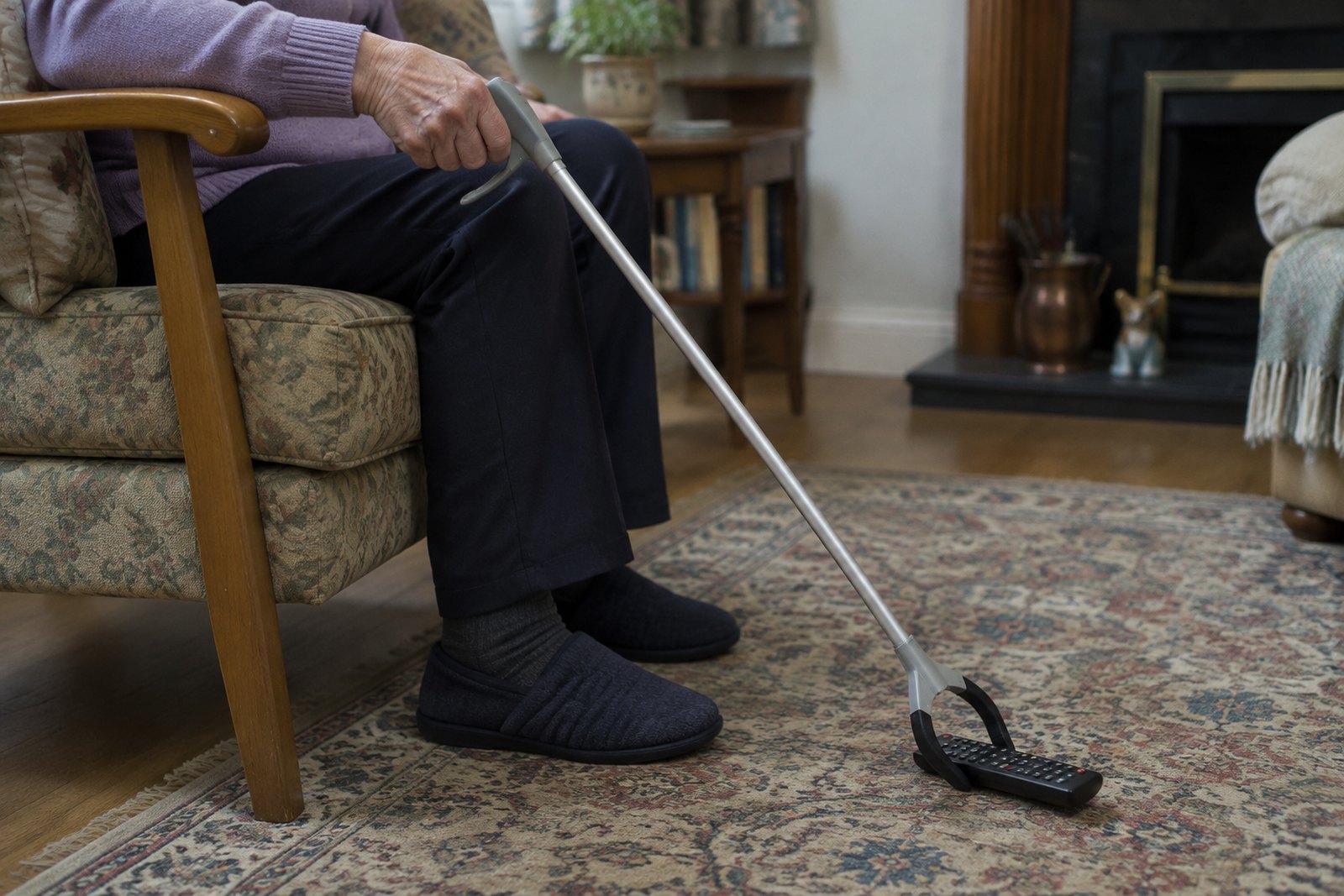
A grabber tool (also called a reacher, a reacher grabber, a pick up tool or a "helping hand") is a long, light stick with a handle and trigger at one end and a small pair of jaws at the other. You squeeze the trigger, the jaws close, and you pick something up without bending down or stretching. It is one of the cheapest and most useful pieces of everyday equipment there is.
To choose one, think about three things: what you most need to pick up, how strong your grip is, and where you will be when you use it (standing with a frame, sitting in an armchair, or in a wheelchair). For most people, a lightweight grabber of medium length with a rotating head and a comfortable trigger does the job. The rule that matters more than any feature is simple. A grabber brings light things to you. It does not let you stretch further than is safe, and it is not a way to get things down from the top shelf.
Who a grabber actually helps
Grabbers are not only for older people, and they are not a sign of giving up. They help anyone for whom bending, twisting or stretching is painful, risky or simply off limits for a while.
- After a hip replacement or hip fracture. Many people are advised to avoid bending deeply for the first weeks. A dropped sock or the TV remote on the floor becomes a real problem. A grabber solves it.
- Back pain. Repeatedly bending to pick things up can aggravate a sore back. A grabber lets you keep moving around the house without that constant stooping.
- Wheelchair users and people who sit most of the day. From a seated position, the floor and the back of the worktop are both a long way off. A grabber extends your reach without leaning out of the chair.
- Limited reach for other reasons. Stiff shoulders or knees, arthritis, recovery from shoulder surgery, multiple sclerosis, Parkinson's, a stroke affecting one side, or simply feeling unsteady when you bend down.
- Dizziness when bending. Some people feel light headed when they bend over and come back up. A grabber removes the trigger. If dizziness is new or getting worse, though, mention it to your GP rather than just working around it.
Types of grabber and what the differences mean
They all look broadly similar, but small differences make a big difference in daily use. Here is what to look at.
Length
Grabbers come in a range of lengths. Longer ones reach further, but they are heavier at the tip, harder to control, and awkward in small spaces. Shorter ones are easier to steer and better for wheelchair users and for picking things up from a seated position close by. If you mainly need to reach the floor while standing, measure roughly from your hand (arm hanging relaxed by your side) to the floor. You want something that covers that distance without you bending. Many people end up with two: a longer one for standing and a shorter one by the chair or bed.
The trigger and the handle
This matters most if your hands are weak or painful. A small trigger that you pull with one or two fingers can be hard work with arthritis or after a stroke. Look for a large lever that you squeeze with the whole hand, and a handle that is chunky enough to hold without gripping tightly. Some grabbers have a forearm cuff or support, which takes strain off a weak wrist. If squeezing any trigger hurts, that is worth raising with an occupational therapist or hand therapist, because there may be a better approach than forcing it.
The jaws
Jaws vary more than you might think:
- Rubber cups or pads grip smooth things like a remote, a mug or a tablet box without slipping.
- Ridged or serrated jaws grip fabric well (socks, tissues, a towel) but can scratch or let go of smooth, rounded objects.
- Wide jaws pick up bigger items like a cereal box or a cushion edge. Narrow jaws are better for small, fiddly things.
Rotating head
A rotating head lets you turn the jaws through 90 degrees, so you can grip something lying flat or standing upright without twisting your wrist or your body. It is one of the most useful features and worth having, especially if twisting is something you have been told to avoid.
Magnetic tip
A small magnet in the end of the jaws picks up things like keys, pins, paper clips, needles and hair grips. It will not pick up anything that is not magnetic, so do not rely on it for everything that falls on the floor. Useful, but a bonus rather than essential.
Folding grabbers
A folding grabber packs down to fit in a bag or the car door pocket. Handy for days out, holidays and the car. The hinge adds a little weight and a point that can loosen over time, so check it locks firmly before you rely on it.
Weight
A grabber you find heavy is a grabber you will stop using. Aluminium shafts are light and rigid. Pick one up and hold it out at arm's length for a few seconds: if your wrist is tired already, try a lighter or shorter one.
Extras worth having
- A locking trigger that keeps the jaws closed, so you can carry something without holding the squeeze the whole time.
- A small hook or peg on the shaft, useful for pulling up a sock, hooking a bag handle or drawing clothes towards you when dressing.
- A clip or loop so you can hang it on a walking frame, wheelchair or hook on the wall.
A litter picker is a cousin of the grabber. It is usually longer with cruder jaws. Fine in the garden, but generally less precise around the house.
What grabbers are good at, and what they are bad at
Knowing the limits is what keeps a grabber safe.
Good for
- Picking up dropped light items: post, remotes, glasses cases, phones, tissues, pens, socks, slippers.
- Moving light things towards you on a table, bed or worktop.
- Helping with dressing, such as drawing trousers or pants up over your feet, or retrieving clothes you have laid out.
- Reaching into the back of a low cupboard or the washing machine drum for small, light items.
Not for
- Heavy items. Most grabbers are designed for light objects. Glass bottles, tins, full jars, saucepans and books are likely to slip, and a heavy thing dropping onto your foot or a hard floor is a hazard in itself.
- Anything above head height. Do not use a grabber to pull things down from high shelves or the top of the wardrobe. You cannot control the weight at the end of a long stick, and if it slips it falls towards your face and head. You also tend to tip your head back and lean, which upsets your balance.
- Hot things. Not for the oven, the hob or a kettle.
- Pulling or pushing hard. It is not for opening heavy doors, dragging furniture or yanking stuck items.
- Walking. A grabber is not a walking stick and will not take your weight.
- Very flat, thin items. A single sheet of paper flat on a carpet is fiddly. Slide it to the edge of a rug or against a skirting board first, or use a grabber with rubber pads.
How to use a grabber safely
The danger with a grabber is not the tool itself. It is the temptation to use it as a way to stretch a bit further than you should. People fall while leaning out to reach something, grabber in hand.
- Get close first. Move yourself towards the object so it is directly in front of you, not off to one side.
- Stand or sit steady. Feet flat and slightly apart if standing. If you use a frame, stand within it with one hand on it. If you are seated, sit upright and well back in a stable chair with arms.
- Keep your body still. Let the grabber do the reaching. Do not lean forward, bend sideways or twist at the waist. If you have to lean, you are too far away. Move closer instead.
- Grip, then check. Close the jaws, lift slightly and check the object is secure before bringing it up.
- Bring it to you, not you to it. Draw the object up to waist height and take it with your free hand, or put it straight onto a table or trolley.
- Put the grabber away. Never leave it lying on the floor, where it becomes a trip hazard.
If you use a wheelchair, put the brakes on before reaching, and avoid reaching far out over the side where the chair could become unstable. For more on staying upright day to day, see our guide to preventing falls at home.
Using a grabber after a hip replacement
This is where grabbers earn their keep. Advice after hip surgery varies between hospitals and depends on the type of operation. Some people are given specific "hip precautions" (often things like not bending the hip too far, not crossing your legs and not twisting on the operated leg). Others are given fewer restrictions. Always follow what your own surgical team, physiotherapist or occupational therapist told you, and ask them if you are not sure.
If you have been told to avoid deep bending, a grabber helps you:
- Pick up anything you drop without bending down.
- Get dressed, by drawing pants and trousers up over your feet before you stand (operated leg first is the usual advice, but check what you were shown).
- Retrieve things from low cupboards, the fridge salad drawer or the bottom of the washing machine.
Things to watch:
- Do not twist round to pick something up beside or behind you. Turn your whole body with small steps, using your frame or sticks, until the object is in front of you.
- Do not reach down past your knees from a low chair. Sitting in a low, soft seat makes your hip bend further. Use a firm chair at the right height.
- Keep the grabber with you as you move around, ideally clipped to your frame, so you are not tempted to bend "just this once".
Many people are given or advised about a grabber before they leave hospital, alongside a sock aid, long handled shoe horn and long handled sponge. Our guide to life after a hip replacement covers the rest of that kit.
Keep it where you actually need it
A grabber in the hall cupboard is no use when you drop your glasses in the bedroom at 2am. Things go on the floor where you spend time, so think about where those places are.
- By your chair. Hooked on the side of the armchair or leaning in a secure spot where it will not slide to the floor.
- By the bed. Morning dressing and night time drops are the commonest moments of need.
- In the kitchen. Hung on a hook at hand height.
- On your frame or wheelchair, so it moves with you.
- In the car, a folding one, for dropped keys and parking tickets.
Grabbers are inexpensive enough that having two or three is often more sensible than carrying one round the house.
The alternative: make reaching unnecessary
A grabber is a fix for one moment. Rearranging your home can remove the problem altogether, and it often helps more.
- Move everyday things to between waist and shoulder height. Mugs, plates, the kettle, regular food, medicines, toiletries and clothes you wear most.
- Empty the bottom and top shelves of anything you use often. Store rarely used things there, and ask someone else to get them down when needed.
- Fit a letter basket or cage behind the letterbox so post never lands on the mat.
- Use a tray or trolley to move things around instead of carrying several items at once.
- Raise things up. A higher chair or bed, a wall mounted socket or a shelf at the right height can save a lot of bending.
- Use long handled tools for specific jobs: a long handled sponge for washing, a long shoe horn, a sock aid, a long handled dustpan.
- Keep a basket on a table by the chair with the things you reach for every day: phone, glasses, remote, tissues, water.
If you need something more than a grabber, many councils lend daily living equipment through community equipment services, usually after an assessment.
Where an occupational therapist fits
You do not need a professional to buy a grabber. They are widely sold and easy to try. But if you find yourself relying on one constantly, or reaching is just one of many things that have become hard, an occupational therapist can look at the bigger picture.
A private occupational therapist visiting at home can:
- Watch how you actually move around your home and spot where reaching, bending and twisting are causing difficulty or risk.
- Suggest whether a grabber is the right tool, which type suits your grip and posture, and what else would help.
- Practise safe techniques with you, including dressing and getting things from low places if you have hip precautions.
- Recommend changes to how your kitchen, bedroom and bathroom are organised, and advise on equipment and daily living aids such as chair raisers, perching stools or rails.
- Look at falls risk more broadly if you feel unsteady.
Other professionals lead on some things. Your surgical team and physiotherapist decide your hip precautions and exercise programme. A physiotherapist is the right person for strength, balance and walking. If grip or hand pain is the main problem, a hand therapist or your GP may be the first step. And new back pain should be checked by your GP or NHS 111. Get urgent help (call 999 or go to A&E) if back pain comes with numbness around your bottom or genitals, new problems controlling your bladder or bowels, or weakness in both legs.
Frequently asked questions
Can I get a grabber free on the NHS?
Sometimes. If you have had hip or knee surgery, the hospital team may provide one or tell you where to get one. If you have an assessment from your council's adult social care or an NHS community team, they may arrange a loan of small aids. Otherwise most people buy their own, as they are inexpensive. Ask your GP surgery, hospital team or council what is available locally.
What length of grabber should I get?
Long enough to reach the floor from where you stand or sit without bending, but no longer, because extra length makes it heavier and harder to control. Wheelchair users and people using one mainly from a chair often find a shorter one easier. If in doubt, try a medium length first.
Can I use a grabber if I have arthritis in my hands?
Usually yes, but choose carefully. Look for a large, whole hand lever rather than a small finger trigger, a thick handle, a lightweight shaft, and ideally a locking trigger so you do not have to keep squeezing. If it still hurts, an occupational therapist or hand therapist can suggest alternatives.
Can a grabber help me get dressed?
Yes. Many people use one to pull pants and trousers up over their feet, pick up clothes and hook items towards them. It works best alongside a sock aid and long handled shoe horn. A grabber alone is not great for putting socks on.
How long will I need one after a hip replacement?
That depends on your operation and what your surgical team advises. Some people need one for a few weeks, while others keep using it because it is simply handy. Ask at your follow up appointment when it is safe to bend normally again.
Is it safe to use a grabber to get things off high shelves?
No. A grabber is not designed to lift weight above your head. Objects can slip and fall onto your face, and you are likely to lean back and lose balance. Move things you use often to a lower shelf, and ask someone else to help with anything stored high up.
Next steps
If reaching and bending are making daily life harder, see our home assessment page, or current guide prices, and choose your area below.

Talk to an occupational therapist near you
This guide is general information. For advice about your own situation - or someone you look after - a local occupational therapist can visit you at home and see it for themselves.
Choose your area: