

Living One-Handed: Practical Tips At Home
By Mobile Occupational Therapist • 27 September 2026 • 15 min read
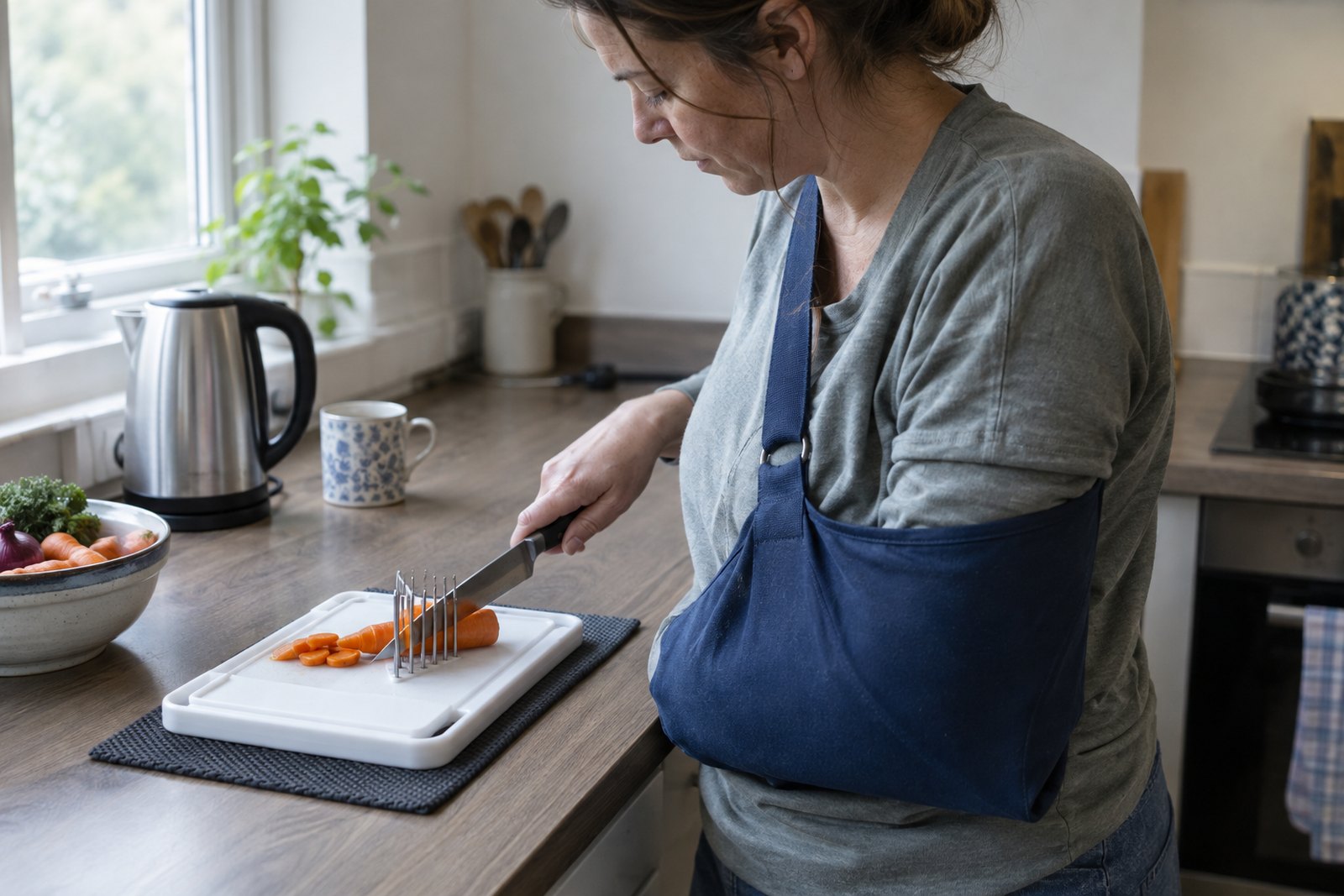
If you are suddenly living one-handed, the hard bit is not just strength. It is the small, constant tasks: opening a packet, making a hot drink, pulling on socks, carrying your phone and a plate at the same time. The quickest way to cope is to stop trying to do everything "normally" and set things up so the work happens against something stable, such as a non-slip mat, a corner of the worktop, a wall, or a chair arm. Avoid bracing hot, sharp or heavy items against your body.
This guide is for anyone managing with one arm for a while or long-term, including after a broken wrist or arm, hand surgery, stroke, amputation, or a painful shoulder or elbow. You will find practical one handed living tips you can try today, plus what an occupational therapist (OT) can do if you want tailored help at home.
Start with a one-handed "base camp" at home
Before you buy anything, make your environment do the holding. Most one-handed problems are really "I need a third hand" problems.
Set up one main workspace
- Pick one spot where you will prepare food and make drinks. Clear it so you are not reaching around clutter.
- Use non-slip as your default: a non-slip mat under a chopping board, bowl, plate, mixing jug, or phone.
- Bring items to you: keep the things you use every day between waist and shoulder height. Avoid low cupboards and high shelves if you are unsteady or in pain.
- Sit for fiddly tasks: sitting reduces the chance of dropping things and makes you less tired.
Think "bigger, lighter, simpler"
- Bigger handles are easier to grip, especially if your working hand is sore or weak.
- Lighter items reduce strain and reduce the chance of spills. Decant into smaller containers if you need to.
- Simpler steps: if it takes five steps and two lids, you will hate it by day three. Streamline.
Protect the arm you are not using
If you have a cast, splint or surgical repair, follow your hospital advice about lifting, twisting and weight-bearing. The fastest way to be one-handed for longer is to do too much too soon. If your one-handed living is due to stroke-related weakness, you may also have reduced sensation or awareness in that arm, which makes knocks and burns more likely.
If you are recovering from a fracture, this guide sits alongside your rehab advice. You may find our article on broken wrist recovery at home helpful.
One handed kitchen tips (and the aids that actually help)
The kitchen is where most people lose confidence, because the consequences of a mistake feel bigger: heat, sharp tools, heavy pans and slippery food. The aim is not to become "brilliant" at one-handed cooking. It is to eat and drink safely, without exhausting yourself.
Prep and food choices that reduce the problem
- Use ready-chopped options where you can: chopped veg, grated cheese, cooked chicken pieces, microwavable rice, pre-washed salad. This is not cheating. It is energy management.
- Pick meals that do not need draining at first (draining pasta one-handed can be risky). Tray bakes, one-pot meals, jacket potatoes and slow cooker style meals tend to be easier.
- Batch small: cook enough for two portions, not ten. Big heavy pans are harder to control one-handed.
Stabilise everything
- Non-slip matting under bowls, plates and boards reduces the need to grip and brace.
- A spiked chopping board or board with a food-holding spike can hold items like potatoes, onions or fruit so you can cut with the other hand. Take your time and position it so the blade moves away from your body.
- A bowl with a non-slip base or a bowl wedged into the corner of the sink can make mixing and washing easier.
- Use the corner of the worktop: it can hold a board steady better than the middle of a surface.
Opening jars, bottles and packaging
Packets are often the worst part of cooking one-handed. The trick is to stop wrestling with the packet and change the method.
- Jar and bottle opening aids can give you grip or leverage, or allow you to brace a jar while you twist the lid.
- Use scissors rather than tearing. Spring-loaded or easy-squeeze scissors can help if your working hand is weak.
- Decant when you have help: if a friend is visiting, ask them to open and decant difficult items into easier-to-open containers.
- Choose packaging you can manage, even if it is not your usual brand. Pop-tops and wide lids are often easier than tight vacuum seals.
For a plain-English overview of openers and hot-drink aids, see kettle tippers and jar openers.
Hot drinks without burns
Making tea or coffee is one of the most common ways people burn themselves when they are adapting. You are pouring boiling water while also trying to steady the cup.
- Sit down to make hot drinks, especially in the first couple of weeks.
- Move the kettle less: fill it with smaller amounts so it is lighter, or use a tipper so you are not lifting and twisting at the same time.
- Use a stable mug and put it on a non-slip mat so it cannot skid away.
- Do not carry a full mug across the room. Make the drink where you will drink it, or use a lidded cup if that is safer for you.
Carrying food and drinks
If you have one working hand, you cannot safely carry a plate and open a door at the same time. Plan for that rather than fighting it.
- Use a tray with a non-slip surface and carry smaller amounts.
- Wear something with pockets for your phone and tissues so your hand stays free.
- Consider a trolley for moving meals, drinks or laundry from room to room, but only if your walking is steady and you can control it safely. A trolley can make falls worse if it runs away from you.
More on safe options is in trolley walkers and kitchen trolleys.
Dressing with one hand: make it boring and repeatable
Dressing is where people often get stuck because it is time-pressured, and you are doing it in a small space, often while standing on one leg. The goal is not perfect outfits. It is predictable steps, in the right order, with clothes that cooperate.
Clothes that are easier one-handed
- Loose tops and wider arm holes are easier than tight sleeves.
- Front-opening tops can be simpler than pulling things over your head if shoulder movement is painful.
- Elastic waistbands are easier than buttons and zips at first.
- Socks and underwear are often the hardest: sit down, and consider aids if bending and grip are a problem.
- Shoes: slip-on styles, stretchy laces or one-handed fastening systems reduce the daily battle.
The basic rule: affected arm first, affected arm last
If one arm is weaker, painful or in a sling, put that arm into sleeves first when dressing, and take it out last when undressing. This reduces pulling and twisting through the shoulder and elbow.
Go slowly. If you feel sharp pain, pins and needles, increasing swelling, or your fingers change colour, stop and seek medical advice.
Simple techniques that help
- Sit down to dress. Standing and hopping makes falls more likely.
- Lay clothes out in order (underwear, trousers, top, jumper). One-handed searching wastes energy.
- Use your body as a "second hand": trap fabric against your hip, thigh or the edge of the bed to hold it while you pull.
- Choose one "good enough" method and repeat it. Constantly inventing new approaches is tiring.
If you want specific suggestions for tools and techniques, see dressing aids and easier ways to get dressed.
Washing and grooming when you have one working hand
Keeping clean can become surprisingly difficult one-handed, especially if you cannot get the non-working arm wet, or you cannot reach your back. Safety matters here because bathrooms are slippery, and fatigue plus hot water is a bad mix.
Bath or shower: choose the safest option for you
- If you are unsteady, a shower is often safer than stepping over a bath, but only if you can stand or sit safely.
- If you are tired, sitting to wash reduces risk. Many people do better with a chair or stool in the bathroom, but it needs to be the right height and stable.
- If you have a cast or surgical dressing, check your hospital advice about keeping it dry.
Tools and set-up that reduce the effort
- A long-handled sponge helps you reach your back, legs and feet without twisting.
- Pump bottles for soap and shampoo mean you do not need to flip lids and squeeze with two hands.
- A soap-on-a-rope or soap in a holder can reduce dropping.
- A non-slip mat on the shower floor can improve grip, but it must lie flat so you are not tripping on edges.
Teeth, hair, shaving and skincare
- An electric toothbrush reduces the fine motor work your hand has to do, especially if your working hand is tired.
- Stabilise your arm by resting your elbow on the sink edge while shaving or applying makeup, to reduce wobble.
- Go for "low maintenance" for now: a simpler hairstyle, less frequent shaving, or switching to easier-to-apply products can buy you breathing space.
Phones, writing, work and daily admin
One of the most frustrating parts of managing with one arm is not the big tasks. It is all the tiny admin: texts, banking apps, forms, keys, door entry systems, signing for deliveries. The best approach is to use accessibility features and reduce the number of times you need to do the fiddly thing.
Make your phone easier one-handed
- Turn on voice dictation for texts and emails.
- Use voice control for calls, timers and reminders.
- Increase text size so you are not squinting and dropping the phone.
- Use a stand so you can tap without holding the phone at the same time.
If you have had a stroke, you may also have visual or attention changes which make phones harder. It is worth asking your rehab team for advice if you notice new problems with reading, scanning or concentration.
Writing with one hand
- Use a heavier pen or a pen with a built-up grip if your hand cramps.
- Use a non-slip mat under paper, or a clipboard, so the page does not slide away.
- Reduce handwriting where you can: typed notes, voice notes, or pre-printed labels.
If you are trying to work or study
If one-handed living is affecting your job, it is reasonable to ask for adjustments. That might be speech-to-text software, changes to tasks, extra breaks, or temporary changes to targets. If your employer has occupational health, they can advise on workplace changes. An OT can also help with work set-up and routines if you need practical strategies at home as well as at work.
Carrying, housework and getting out of the house
Carrying is where one-handed living turns into "I cannot do anything", because so many daily tasks involve carrying something while also opening a door, holding a rail, or using a stick. You can often solve this with a different way of carrying, not by forcing your hand to do more.
Ways to carry things safely
- Use a bag across the body so your working hand is free for balance and doors.
- Use a small rucksack rather than a carrier bag if you are walking outside.
- Use pockets for phone and keys, so you are not juggling.
- Break loads down: two small trips are safer than one big trip.
Housework: do the minimum, differently
- Lower your standards temporarily. This is not laziness. It is recovery, or adaptation.
- Slide rather than lift: move items along a worktop, table or the floor where appropriate.
- Use long-handled tools if bending and reaching is difficult, but make sure you can control them without twisting your wrist.
- Ask for specific help: "Can you change the bedding and take the bin out?" works better than "I am struggling".
Safety: where people come unstuck
When you have one working hand, you are more likely to burn yourself, cut yourself, trip, or drop something heavy. Most accidents happen when you are tired, rushing, or trying to do a two-handed task one-handed.
Kitchen and hot drink safety
- Slow down around heat. Let things cool slightly before moving them.
- Avoid carrying boiling water if you can. Make hot drinks where you will drink them.
- Keep sharp knives simple: if you cannot stabilise food properly, do not force it. Choose foods that do not need much cutting, or ask for help.
Falls risk
- Do not carry items on stairs if you need the handrail. Do separate trips or keep essentials upstairs and downstairs.
- Keep floors clear and deal with trailing chargers and rugs. One-handed living often means you cannot "catch yourself" as easily.
- Wear stable footwear rather than socks on smooth floors.
When to get urgent medical help
Call 999 if you or someone you are with has signs of stroke such as face drooping, arm weakness, speech problems, or sudden confusion. Call 999 for chest pain or severe breathlessness, or if a hand becomes cold or blue. Also seek urgent same-day medical help (NHS 111 or A&E) if there is severe uncontrolled pain, a new deformity after a fall, or if the hand becomes very swollen or numb.
If you are unsure but it is not an emergency, contact NHS 111 or your GP.
Where an occupational therapist fits (and where they do not)
An occupational therapist helps you do daily activities more safely and independently, using a mix of practical techniques, equipment, and home set-up changes. If you are living one-handed, a private occupational therapist visiting at home can be useful because they can look at your actual kitchen, bathroom, stairs, chair heights and routines, not a generic checklist.
What an OT can help with
- Choosing and setting up one-handed equipment so it is safe and suited to you, rather than buying things that end up in a drawer. Our overview of options is in occupational therapy equipment for daily living.
- Task breakdown: step-by-step ways to wash, dress, cook and manage medication packaging using one hand.
- Home safety: reducing burn and falls risk, and making sure you can manage doors, keys, stairs and carrying.
- Workable routines that match your energy and pain levels, especially after surgery, stroke or a flare-up.
Who else you might need
- GP or hospital team for pain that is not controlled, wound concerns, suspected infection, new swelling, new numbness, or any sudden change in function.
- Physiotherapist for strength, range of movement and exercise programmes, especially if you are rebuilding shoulder or elbow function.
- Hand therapy (often provided by specialist OTs or physiotherapists) for splinting, scar management, swelling, and graded hand and wrist exercises after injury or surgery. See hand therapy at home.
- Speech and language therapist if there are swallowing or communication changes after stroke.
When it is worth getting a home visit
If you are stuck on essential tasks (toileting, washing, getting dressed), you are having near-misses with boiling water or stairs, or you are relying on a family member for everything, a home visit can quickly identify safer methods and the right aids. If you are coping but it takes you hours and wipes you out, that also counts.
If you want support specifically with equipment and practical one-handed set-up, you can read about equipment and aids support.
Frequently asked questions
How long does it take to get used to living one-handed?
Many people find the first 1 to 2 weeks are the hardest, because everything is new and slow, but it varies and it can take longer. After that, you usually build a small set of routines that make daily life less mentally tiring. If you are recovering from surgery or fracture, it can still feel up and down as restrictions change and you start using the arm again.
What are the most useful one handed kitchen aids?
For many people, the biggest wins are non-slip matting, a way to stabilise food (such as a spiked board), and openers for jars and bottles. If lifting and pouring are difficult, a kettle tipper or a safer hot drink set-up can reduce burns risk.
Is it safe to cook one-handed?
It can be, but it depends on your balance, fatigue, sensation and confidence. Start with cold meals and microwaved options, then move to simple hob or oven tasks once you have a stable set-up. If you are having near-misses with knives or boiling water, step back and change the method rather than pushing through.
What is the easiest way to get dressed with one arm?
Sit down, choose loose clothing, and dress the affected arm first (and undress it last). Front-opening tops and elastic waistbands are usually easier while you are adapting. If fastenings are the main issue, dressing aids can make a big difference.
When should I seek medical help for arm or hand problems?
Seek urgent help for sudden one-sided weakness, facial droop, speech problems, severe pain after a fall, a new deformity, or a hand that becomes cold, blue, very swollen or numb. Contact your GP or NHS 111 if pain, swelling or function is not improving as expected after injury or surgery, or if you are worried about a wound or cast.
Can an occupational therapist help if my one-handed living is long-term?
Yes. OTs work with people who are permanently using one hand as well as people recovering. A home visit can focus on long-term ways to cook, wash, dress, manage tech and set up your home so you are not constantly improvising.
Next steps
See our equipment and aids page or home assessment page, or current guide prices, and choose your area below.
Talk to an occupational therapist near you
This guide is general information. For advice about your own situation - or someone you look after - a local occupational therapist can visit you at home and see it for themselves.
Choose your area: