

Trolley Walkers and Kitchen Trolleys: Carrying Things Safely at Home
By Mobile Occupational Therapist • 9 October 2026 • 13 min read
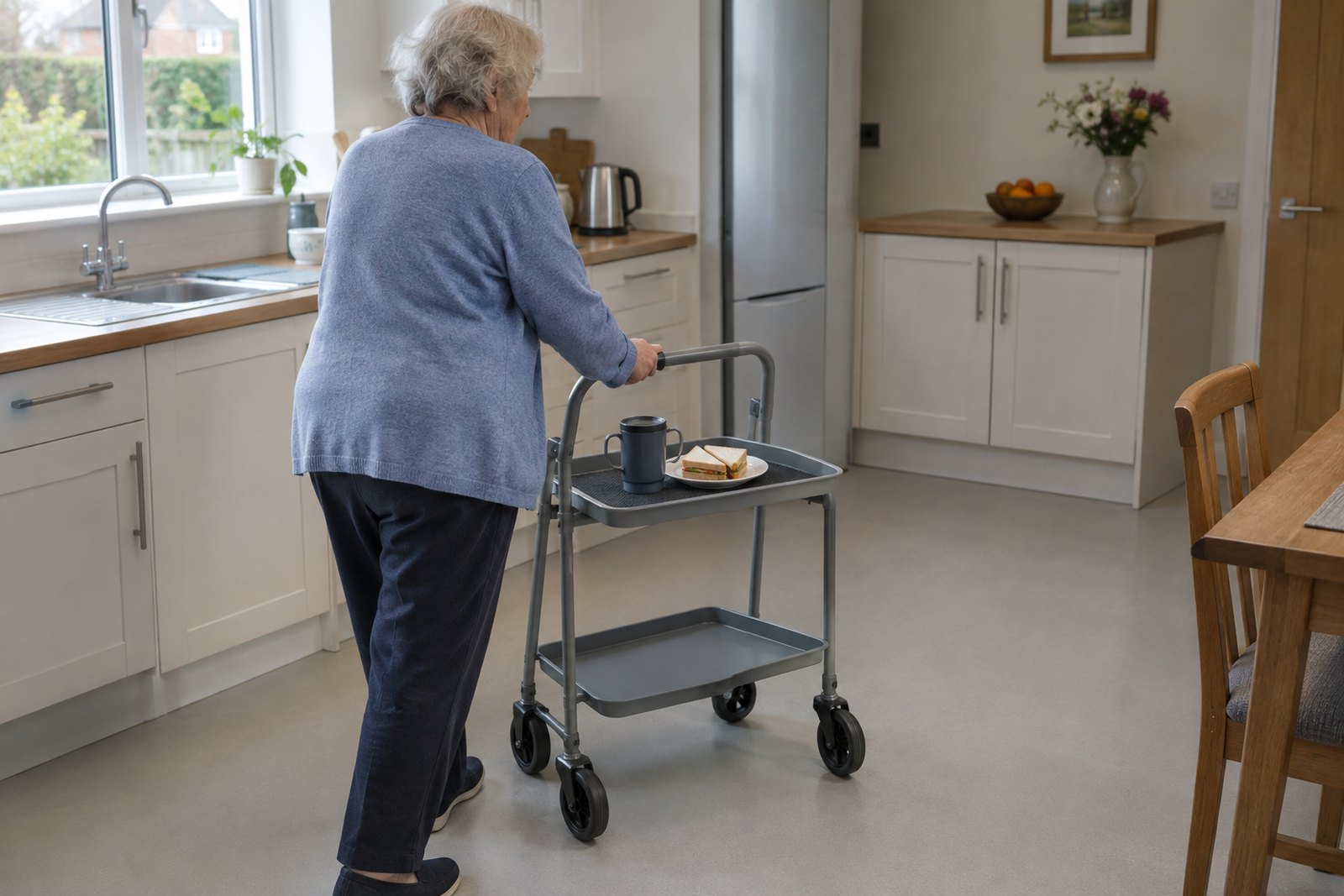
A trolley walker is a wheeled indoor walking aid with two shelves, built so you can push it like a frame and carry things on it at the same time: a cup of tea, a plate, your post, the TV remote. It suits people who walk reasonably well indoors but cannot safely carry anything while they do it, usually because they need one or both hands on a frame or a stick. It is not the same as an ordinary kitchen trolley, and it is not the same as a rollator.
The short version: if you or your mum or dad keep eating standing up in the kitchen, abandoning tea on the worktop, or walking across the room holding a hot mug with one hand and the furniture with the other, a trolley walker may well be the answer. But it is still a walking aid. The height, the brakes, the floors and how much weight the person puts through it all matter. Getting it assessed properly is worth the trouble.
What a trolley walker actually is
Most trolley walkers look much the same. A metal frame on four small wheels, two flat trays (one at about worktop height, one lower down), and handles at the top, either a single bar or two separate grips. The trays usually have a raised lip around the edge so things do not slide off. Some fold flat for storage; many do not. Some have brakes; some do not. The better ones have adjustable height.
They are designed for indoor use on flat floors. They are not built for gravel paths, steep slopes or bumping down a step into the garden.
How it differs from a rollator or a walking frame
People mix these up all the time, and it matters, because they do different jobs.
- Walking frame without wheels. You lift it, place it, step into it. Very stable, but both hands are busy and you cannot carry anything. Clip-on trays exist for some frames, but you are still lifting the frame with a full tray on it.
- Two-wheeled frame. Wheels at the front, rubber feet at the back. You push rather than lift. More stable than it looks, because the back feet drag, but again not much room for carrying.
- Rollator. Three or four larger wheels, hand brakes, often a seat and a bag or basket. Designed for walking further, often outdoors. The basket is for shopping and handbags, not for a plate of hot food or an open mug.
- Trolley walker. Four small wheels, two trays, usually no seat, made for short trips around the house with things on board. Less suited to longer walks or outdoors.
Our guide to walking frames, sticks and wheeled walkers goes into the wider range in more detail.
Who a trolley walker suits, and who it does not
A trolley walker tends to work well for someone who:
- Walks indoors with a frame or stick, or holds on to furniture, and so has no free hand for carrying
- Can get up, turn round and walk short distances without much help
- Wants to make their own drink or snack and take it to their chair, rather than wait for someone else
- Has a mostly flat ground floor with the kitchen and sitting room reasonably close
It is often less suitable, or needs more careful thought, for someone who:
- Puts a lot of weight through their walking aid, or needs it to catch them when they wobble
- Leans forward heavily or tends to rush, so wheels run away from them
- Has Parkinson's with freezing or a shuffling, hurrying walk, where wheels can make things worse rather than better
- Has much more weakness on one side, for example after a stroke, and cannot grip or steer evenly with both hands
- Has dementia and may forget it is not a chair, or try to pull themselves up on it
- Lives with thick carpet throughout, lots of rugs or raised door thresholds
None of these automatically rules it out. They are reasons to have it checked by someone who can watch the person walk, rather than buying one and hoping.
Kitchen trolley, tea trolley or trolley walker: why the difference matters
Search for "kitchen trolley for elderly" and you will find all sorts. Some are proper trolley walkers. Others are serving trolleys, storage trolleys on castors, or tea trolleys designed as furniture. They can look alike in a photo.
The difference is what happens when someone leans on it. A domestic serving trolley is built to carry plates, not people. It may tip, fold or shoot away across the floor if you put weight through the handle. A trolley walker sold as a walking aid is designed with that in mind, with a wider base, handles at a supportive height and, often, brakes or wheels that resist rolling.
So if the person needs anything to steady themselves while walking, a furniture trolley is not a substitute. If they genuinely walk well and only need a way of moving things from A to B, a serving trolley may be fine. Be honest about which group they are in. Most people who need help carrying also need a bit of help balancing.
Getting the details right
Height
The handles should sit roughly at the crease of the wrist when the person stands up straight with their arms hanging relaxed by their sides. That gives a slight bend at the elbow when they hold on. Too low and they stoop over it, which pushes their weight forward and makes the trolley roll away. Too high and their shoulders hunch and they lose control of steering. Always set it up with the shoes they actually wear indoors.
Brakes
Trolley walkers come with different arrangements. Some have no brakes at all. Some have wheels that lock when you press down on the handles. Some have brakes you set with a lever or foot pedal. A model with no brakes rolls freely, which is easy to push but not ideal for someone unsteady. A model that brakes when weight is applied can feel stiffer to push on carpet. Neither is right for everyone, which is one of the reasons an assessment helps.
Whatever type it is, the brakes should be on when the trolley is parked and when the person is loading or unloading it.
Shelves and trays
Look for trays with a raised lip and a surface that is easy to wipe. Two shelves give a useful split: the top for the things you are carrying, the lower one for heavier or less fragile items. Keep heavy things low, as it makes the trolley more stable. Check the maximum load the trays are designed for and stay well within it. A trolley walker is for a meal and a drink, not the weekly shop.
Wheels, floors and thresholds
This is where many trolleys come unstuck, quite literally. Small wheels catch on door strips, rug edges and the ridge where carpet meets vinyl. Thick carpet makes them hard to push, so people lean harder, so the trolley is less stable. Before you get one, walk the route it will take: kitchen to chair, chair to bedroom, and look at every surface and every join.
- Remove loose rugs, or at least take them off the route
- Look at raised door thresholds; small threshold ramps can help, and an occupational therapist can advise on whether they are suitable
- Check doorways are wide enough for the trolley and the person behind it to get through without twisting
- Make sure there is space to turn at each end, which trolleys need more of than people expect
Our guide to preventing falls at home covers floors, lighting and clutter more fully.
Never sit on it, and be careful how you lean
Most trolley walkers have no seat. The top tray is at roughly the height of a perch, and when someone is tired halfway across the room it can look tempting. It is not a seat. It can roll, tip or collapse, and a fall backwards onto a hard kitchen floor is a bad fall.
The same goes for using it to push up from a chair or pull up from the floor. Pushing down on a wheeled trolley to stand often sends it sliding away. Get up using the chair arms, stand still for a moment, then reach for the trolley with the brakes on.
Leaning is a grey area. A trolley walker designed as a walking aid will take some of your weight as you walk, the same way a frame does. But it is not designed to stop a heavy stumble, and a kitchen or serving trolley is not designed to take weight at all. If you find yourself leaning harder and harder on it, that is a sign to get walking reviewed, not to lean harder still.
Carrying hot drinks and food safely
The whole point of a trolley walker is often the cup of tea. So it is worth making that bit as safe as possible.
- Use a lidded cup. An insulated travel-style mug with a secure lid, or a lidded cup with handles, makes a spill much less likely if the trolley bumps at a door threshold, though it does not remove the risk of a scald completely.
- Do not fill to the brim. Two thirds full is plenty, lid or no lid.
- Put drinks in the middle of the tray, away from the edges, and plates in front of you rather than at the far end.
- Use a non-slip mat on the tray so cups and plates stay put.
- Let very hot food cool a little before setting off, especially soup.
- Load and unload with brakes on, standing close, rather than reaching across.
- Think about the kettle too. If lifting and pouring a full kettle is the real struggle, a kettle tipper or a one-cup hot water dispenser may help as much as the trolley.
For more on making drinks, preparing food and eating independently, see our guide to kitchen aids and mealtime independence.
Setting up the house around it
A trolley only works if it fits the way the home is laid out. A few small changes make a big difference:
- Keep the things you use daily (mugs, tea, a plate, a bowl) on the worktop or at waist height, so you are not bending to low cupboards with one hand on a trolley
- Give the trolley a parking spot near the kettle and another beside the chair, so it is always where you need it
- Make sure the side of the chair has room for the trolley to sit alongside, so you can reach the tray without twisting
- Keep the route lit, particularly in the evening
- If standing at the counter to make a drink is tiring, a perching stool may help, so you prepare the drink sitting and then use the trolley to carry it
Getting one: NHS, council or buying your own
You have broadly three options. Some local community equipment services lend trolley walkers after an assessment by an NHS or council occupational therapist or physiotherapist. Whether they do, and how quickly, varies from area to area. Our guide to community equipment services explains how borrowing works.
To ask for an assessment, you can contact your local council's adult social care team, or ask your GP or any health professional already involved. If the person has just come out of hospital, the hospital or community team may already be looking at walking aids.
You can also buy one yourself. If you do, buy a product described as a walking aid or indoor walker, with adjustable height, and check it fits your doorways before it arrives. If someone qualifies for VAT relief on disability equipment, that may apply too.
Where an occupational therapist fits
An occupational therapist looks at the whole task, not just the trolley. That means watching someone get up from their chair, walk to the kitchen, make a drink, load it, carry it back and sit down, in their own home, with their own floors and doorways. Often the trolley turns out to be one piece of a bigger answer that includes kettle aids, a stool, moving a few things in the kitchen or rearranging the furniture. A home assessment covers exactly this sort of thing.
Be clear about where other people lead, though. If the main problem is walking itself (balance, weakness, recent falls, recovering from a fracture or operation), a physiotherapist is often the right person to choose and set up the walking aid, and many NHS teams have both working together. If someone's walking has changed suddenly, they have new dizziness, unexplained falls, or one side has gone weak, that is a GP matter first. Sudden weakness, facial drooping or slurred speech means call 999. And if someone has had a fall, especially a head injury or one where they could not get up, contact their GP or NHS 111 for advice, or 999 if they are hurt.
Frequently asked questions
Is a trolley walker the same as a rollator?
No. A rollator usually has bigger wheels, hand brakes and a seat, and is designed for walking further, often outside. A trolley walker is for short trips indoors and has flat trays for carrying things. Some people use both: a rollator outside and a trolley walker in the house.
Can I use a trolley walker instead of my walking frame?
Sometimes, but not always. It depends on how much weight you put through your frame and how steady you are. Some people can swap completely indoors; others keep the frame and use the trolley only for short, careful trips. Do not swap without asking whoever gave you the frame, or getting an assessment.
Can I use a trolley walker on carpet?
Usually on short-pile carpet, yes, though it takes more effort than on hard floors. Thick or deep-pile carpet and rugs can make it hard to push and more likely to tip when you lean. Try it on your floors before relying on it.
Is it safe to carry a hot drink on a trolley walker?
It is much safer than carrying one in your hand while walking with a frame, as long as you use a lidded cup, do not overfill it and keep it in the centre of the tray. Take thresholds slowly and keep brakes on while loading and unloading.
Can my mum sit on her trolley walker if she gets tired?
No, unless it is specifically designed with a seat for that purpose, and most trolley walkers are not. The tray can roll, tip or give way. If she is getting tired halfway across the room, put a chair along the route, and mention it to her GP or an occupational therapist.
Can I get a trolley walker free on the NHS?
Some areas lend them through the community equipment service after an assessment, but it varies. Contact your council's adult social care team or ask your GP to find out what is available locally.
Next steps
If you are not sure whether a trolley walker is right, or how to set the kitchen up around one, see our equipment and aids page, or current guide prices, and choose your area below.
Talk to an occupational therapist near you
This guide is general information. For advice about your own situation - or someone you look after - a local occupational therapist can visit you at home and see it for themselves.
Choose your area: