

How to Improve Handwriting: Practice at Home That Actually Helps
By Mobile Occupational Therapist • 14 October 2026 • 14 min read
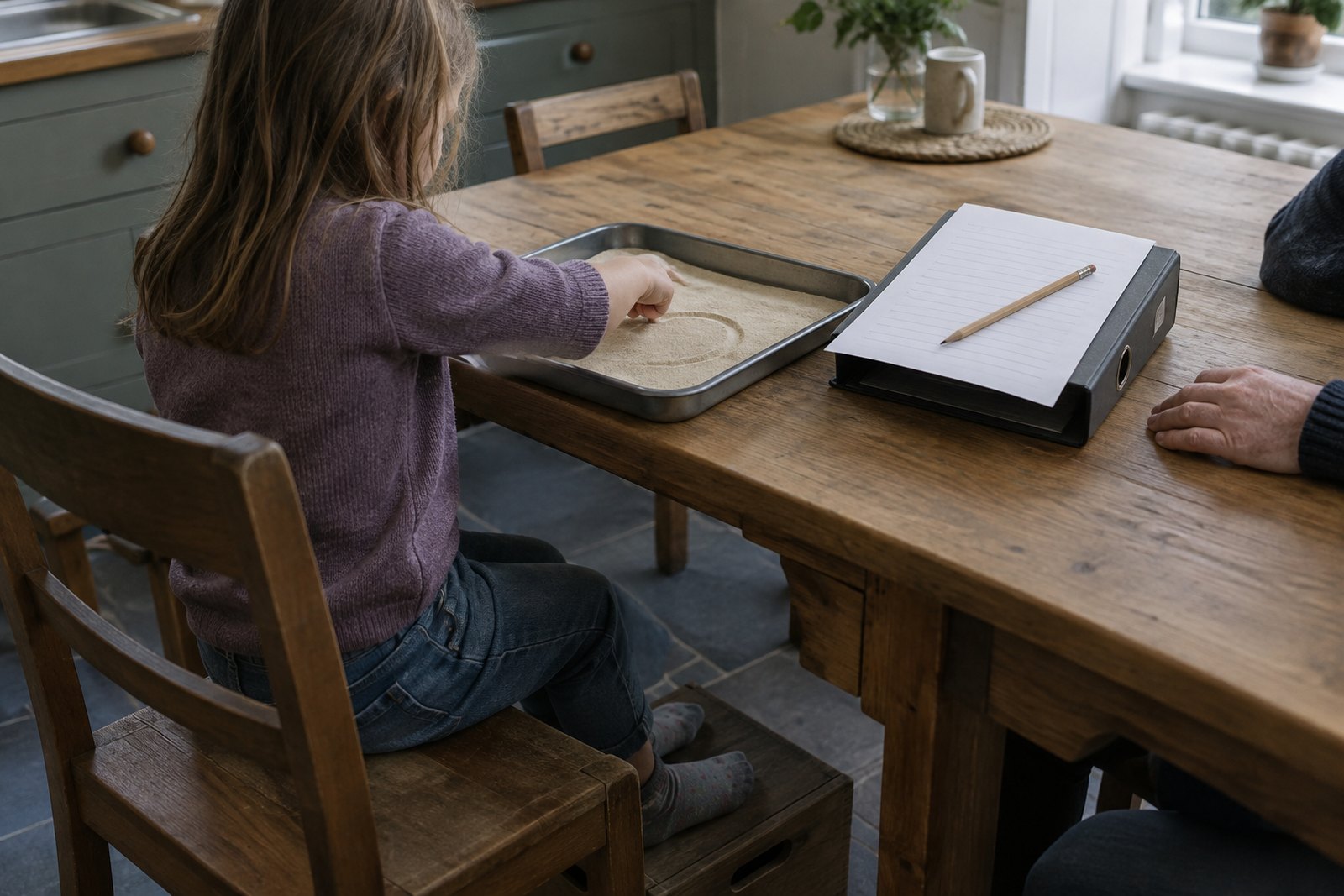
If you want to know how to improve handwriting, the honest answer is short, regular practice of the right things. Warm up the hands and shoulders, sit properly, learn letters in groups that share the same movement, and practise little and often. Five to ten minutes most days does more than an hour of worksheets on a Sunday. That holds whether you are helping a six-year-old or trying to tidy up your own scrawl at fifty.
Copying out lines and lines of writing while someone says 'neater' does not help much. Messy handwriting usually has a reason underneath it: weak shoulders, a tiring grip, letters started in the wrong place, no sense of where one word ends. Practice works best when it targets that reason. This guide covers the routines that do. It also covers the point where practice is not the answer. For some children and adults, pain, fatigue or very slow writing are signs that something else needs looking at.
If your question is about how a child holds the pencil, see our guide to pencil grip by age. If you suspect a specific writing difficulty, our article on dysgraphia goes into the signs. This one is about what to actually do at the kitchen table.
Start with the body, not the pencil
Handwriting is a fine motor skill sitting on top of a gross motor one. Fingers can only be precise if the wrist is steady. The wrist needs a steady elbow, and the elbow needs a stable shoulder and trunk. A child who slumps, leans on one arm or wraps their whole body round the page is often working hard just to stay upright.
Two-minute warm-ups
Do one or two of these before writing. They should feel like play, not PE.
- Wall push-ups: hands flat on the wall at shoulder height, ten slow pushes.
- Chair push-ups: sitting, hands flat on the seat either side, push down to lift the bottom slightly off the chair. Hold for a count of five.
- Animal walks: bear walks, crab walks or wheelbarrow walks across the room. Great for shoulders, and children rarely say no.
- Shoulder circles and 'hug and open': big slow circles forwards and back, then wrap your arms round yourself and open them wide.
- Hand wake-ups: squeeze and roll playdough or putty, spread the fingers wide then make a fist, do 'spider push-ups' with fingertips pressed together.
- Finger jobs: clipping pegs onto the edge of a box, tearing paper into small pieces, picking up pom-poms or dried pasta with tongs.
Adults can do the same, minus the crab walk if you prefer. Shoulder circles, a few finger stretches and shaking the hands out loose make a real difference to how relaxed the writing hand feels.
Write on a slope or a wall sometimes
Writing on an upright surface, such as paper taped to a wall, an easel or a chalkboard, puts the wrist into a slightly bent-back position that makes finger movements easier. It works the shoulder at the same time. A lever-arch file turned on its side makes a simple sloped writing surface on a normal table.
For more ideas to build hand strength and control at each age, see our guide to fine motor skills activities.
Get the set-up right
This is the dull bit and the one most worth doing. A good set-up can tidy writing up within days, because it stops the body fighting the task.
- Feet flat on the floor, or on a box or a stack of books. Dangling feet make children wriggle and slump.
- Hips and knees roughly at right angles, bottom at the back of the seat.
- Table height about elbow level when the arms hang relaxed. A firm cushion on the chair helps if the table is too high.
- Paper tilted, not straight. Line it up roughly with the writing forearm. For a right-hander the top of the page usually tilts a little to the left; for a left-hander, to the right.
- The other hand holds the paper. It sounds obvious. Many children forget, the page slides and the writing drifts.
- Good light, ideally coming from the side opposite the writing hand so the hand does not shade the page.
Left-handed writers usually do better sitting on the left at a shared table so elbows do not clash, and holding the pencil a little further from the tip so they can see what they have just written.
Teach letters in families
A lot of messy writing is really a formation problem. If a child starts an 'o' at the bottom and goes clockwise, it will never join neatly and it will always be slower. The fix is to learn letters by the movement they share, not in alphabetical order.
Schools use different schemes, so ask the school which handwriting style they teach (print, pre-cursive with lead-in strokes, or joined) and match it at home. Mixing styles confuses children. Broadly, the families are:
- Round letters that start like a 'c' and travel anticlockwise: c, a, d, g, o, q, with e, s and f closely related.
- Long straight-down letters: l, i, t and j, plus u and y, which go down and curve up.
- Down, back up and over letters: r, n, m, h, b and p.
- Diagonal or zigzag letters: v, w, x and z, with k often grouped here.
Practise one family until the starting point and direction are automatic, then move on. Say the movement out loud as you write, such as 'round, up, down' for 'a', because the words help the movement stick. Capital letters and numbers work the same way: group by movement and check the starting point every time.
Watch the writing happen, do not just look at the finished result. A letter that looks fine but was drawn bottom to top in three pieces is a habit worth catching early.
Make it multi-sensory and messy
For many children, a pencil and a worksheet is the hardest way to learn a letter. Big movements and interesting textures give the brain far more information about the shape. All of these count as handwriting practice:
- Sand or salt tray: a shallow baking tray with a thin layer. Write with a finger, shake to clear, go again.
- Shaving foam: squirted on a tray or a wipe-clean table. Keep it away from eyes, supervise younger children, and use something edible like whipped cream for any child who still puts things in their mouth.
- Chalk outside: giant letters on the patio or path, then walk along them in the right direction.
- Water painting: a bucket of water and a decorating brush on a fence or wall. The letters vanish, so there is no fear of getting it wrong.
- Sky writing: straight arm, pointing fingers, a letter as big as the body. Then smaller, then on paper.
- Rainbow writing: write a letter once, then trace over it in four or five different colours, starting in the right place each time.
- Back writing: take turns drawing a letter on each other's back with a finger and guessing it.
- Playdough letters: roll sausages and build the letter in the order you would write it.
Go from big to small: whole arm, then tray, then large paper, then normal lined paper. A child who can form a letter correctly in sand has a much better chance of doing it correctly in an exercise book.
Sizing and spacing tricks
Once the letter shapes are right, size and spacing are what make writing readable. Some simple tools help.
Size
- Highlighted lines: colour the middle band of lined paper with a highlighter so small letters (a, c, e, o) stay inside it, tall letters reach up and tails hang down.
- Sky, grass and ground: colour the lines blue at the top, green in the middle and brown at the bottom. 'b reaches the sky, a stays on the grass, g goes underground.'
- Raised-line paper: paper with lines you can feel, which helps children who keep drifting off the line.
- Squared paper: one small letter per square, for children whose letters vary wildly in size.
Spacing
- A spacer: a lolly stick, a finger or a small card shape placed after each word before the next one starts.
- A dot: a light pencil dot after each word, dropped once the habit forms.
- Every other line: for children who crowd lines or whose tails crash into the line below.
- Spot the space: afterwards, ask the child to find their best-spaced word and their most squashed one. Checking your own work is a skill in itself.
Little and often, and keep it real
The practice routine that works is short and predictable. Something like:
- Two minutes of warm-ups.
- Three to five minutes on one target: one letter family, or spacing, or sitting on the line.
- One short piece of real writing where the child uses it.
- Stop while it is still going well.
Real writing matters. Children practise more willingly when the writing has a point: a shopping list, labels for a toy shop game, a note to grandma, a menu, a score sheet, a secret message. Praise one specific thing ('all your d's started at the top') rather than just 'lovely', and do not correct everything at once. Pick one thing per session.
If practice ends in tears more than occasionally, cut it shorter. A reluctant child doing three happy minutes most days will get further than a child dragged through fifteen.
Adults who want neater handwriting
It is entirely possible to improve handwriting as an adult. Most adult scrawl comes from speed and habit rather than lack of ability. Try:
- Slowing down for a few weeks. Neatness first, speed later.
- Relaxing the grip. If your knuckles go white or you dent the page underneath, you are pressing too hard. Let the forearm move, not just the fingers.
- Choosing a pen that suits you. A thicker barrel, a soft grip or ink that glides with less pressure can make writing more comfortable. Try several types.
- Picking one style, print or joined, and practising the letters you form badly, in families as above.
- Daily, low-stakes writing: a to-do list, a diary entry, a few lines copied from a book. Ten minutes is plenty.
- Tilting the paper and sitting well. The same rules apply as for children.
Some adults have struggled with writing all their lives and never had an explanation. If that sounds familiar, the dysgraphia guide linked above covers adults too.
When an adult's handwriting changes
A change in handwriting is different from lifelong messy writing. See your GP if your writing has become noticeably smaller, shakier or more cramped over time, or if writing brings on pain, numbness or tingling in the hand. These can have medical causes that practice will not fix. If handwriting changes suddenly alongside weakness, a drooping face or difficulty speaking, call 999.
When practice is not enough
Practice helps most people. It does not help everyone, and pushing harder can make things worse. It is worth looking further if:
- Writing hurts in the hand, wrist, arm or shoulder, or the child keeps stopping to shake their hand out.
- They tire very quickly, slump further as they go, or come home exhausted after written work.
- Writing is very slow compared with classmates, and work is regularly left unfinished.
- Letter formation stays muddled despite months of regular, correct practice.
- They avoid writing, get very upset by it, or their ideas are far better spoken than written.
- There are other signs too, such as clumsiness, trouble with buttons and cutlery, or very bendy joints.
Some of these overlap with conditions such as dyspraxia or hypermobility, where the answer is a mix of support and adjustments rather than more worksheets.
Typing is not giving up
For some children and adults, the most useful step is to keep handwriting for short tasks and use a keyboard for longer ones. Touch typing, speech-to-text software and a laptop in lessons can free someone to show what they actually know. Schools can make these adjustments. For exams there are formal access arrangements that the school applies for, and schools generally need to show it is the student's normal way of working, so speak to the SENCo early. Typing well takes practice too, so starting before it becomes urgent helps.
Where an occupational therapist fits
An occupational therapist looks at why writing is hard, not just at the writing. That can include posture and core stability, shoulder and hand strength, grip, how well the eyes and hands work together, visual perception, motor planning, sensory processing and fatigue. They often use standardised assessments to compare with others of the same age, watch real writing tasks, and look at the desk, chair and classroom set-up.
The result should be a practical plan: specific activities, equipment by type where it helps (such as a sloped board, pencil grips or adapted paper), adjustments for school, and a clear view on whether typing should be introduced. A written report can support conversations with school and, where needs are more significant, a request for extra support such as an Education, Health and Care needs assessment in England (Wales, Scotland and Northern Ireland have their own systems).
An occupational therapist is not always the right first person. If your child squints, holds work very close or gets headaches, start with an optician. Concerns about reading, spelling or learning in general belong with the school, a specialist teacher or an educational psychologist. Joint pain or injury should go to the GP, who may refer to a physiotherapist. A child with speech or language difficulties may need a speech and language therapist.
NHS children's occupational therapy is available in most areas through a referral from your GP, health visitor or school, though criteria and waits vary. Some families choose a private occupational therapist visiting at home or school for a quicker assessment. Our children's occupational therapy page explains what that involves.
Frequently asked questions
How long should my child practise handwriting each day?
Five to ten minutes on most days is plenty for most children, including the warm-up. Short, regular sessions build movement habits better than long ones, and they are far easier to keep going.
Should my child learn joined-up writing or print first?
Follow whatever your child's school teaches. Schemes differ, and practising a different style at home can muddle things. If you are not sure, ask the class teacher for a copy of the letter formation sheet they use.
Is it too late to improve handwriting as an adult?
No. Many adults can noticeably tidy their writing with a few weeks of slower, deliberate practice, a relaxed grip and a better set-up. If writing is painful or has changed recently, see your GP first.
My child is left-handed. Does practice need to be different?
The letter shapes are the same, but the set-up matters more. Tilt the paper to the right, encourage a hold a little further up the pencil, and seat them on the left at shared tables. Some left-handers hook the wrist over the line to see their writing; tilting the paper further often makes this less necessary.
Will typing make my child's handwriting worse?
There is no need to choose one or the other. A child can type longer pieces of work and still practise handwriting for short tasks. For children who find writing slow or painful, typing often reduces frustration and lets them show what they know.
Do pencil grips and special pens help?
Sometimes. They can help someone who presses too hard or tires quickly, but they work best alongside the strength and posture work above, not instead of it. Our pencil grip guide covers what is normal at each age.
Next steps
If practice at home is not making a difference, or writing is painful, tiring or very slow, an assessment can find out why. See our children's occupational therapy page, or current guide prices, and choose your area below.

Talk to an occupational therapist near you
This guide is general information. For advice about your own situation - or someone you look after - a local occupational therapist can visit you at home and see it for themselves.
Choose your area: