

Reasonable Adjustments at Work: Examples and How to Ask
By Mobile Occupational Therapist • 26 September 2026 • 11 min read
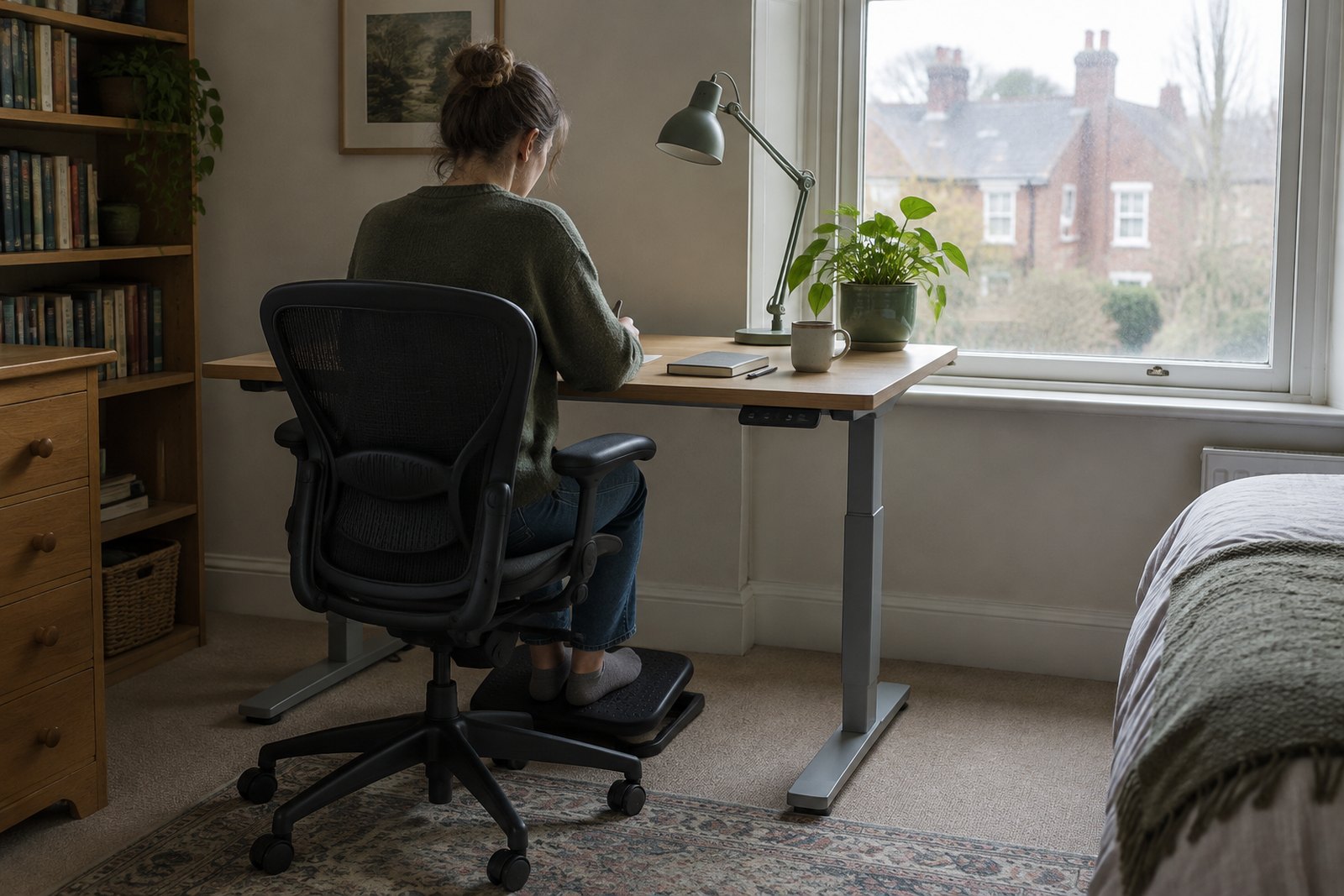
Reasonable adjustments at work are changes your employer makes so that a health condition or disability does not put you at a substantial disadvantage compared with colleagues. Under the Equality Act 2010, employers in England, Scotland and Wales have a legal duty to make them where it is reasonable to do so. They can be as small as a different chair or a later start time, or as big as a change of role. Your employer cannot charge you for them.
To ask for one, put it in writing to your manager or HR. Say what you find difficult at work because of your condition, what you think would help, and ask for a meeting. You do not need to know the legal wording or have a perfect solution. You do need to be specific, and the rest of this article is about how to do that.
What the law actually says, in plain terms
The Equality Act 2010 says that if a disabled worker is put at a substantial disadvantage by the way a job is set up, the employer must take reasonable steps to remove that disadvantage. The law breaks this into three areas:
- The way things are done. Policies, rules, hours, targets, sickness procedures, where and how you work.
- Physical features. Steps, heavy doors, lighting, layout, noise, the distance to the toilet or car park.
- Extra aids and services. Equipment, software, a support worker, information in a different format.
The duty applies to employees, and also to job applicants during recruitment. It kicks in when your employer knows, or could reasonably be expected to know, that you are disabled. That is one reason telling them clearly matters. An employer who genuinely had no idea is in a different position from one who was told and did nothing.
Northern Ireland has its own disability discrimination law with a similar duty. If you work there, check the detail with the Equality Commission for Northern Ireland or the Labour Relations Agency before relying on what follows.
Who is covered
The Act defines disability as a physical or mental impairment that has a substantial and long-term adverse effect on your ability to carry out normal day-to-day activities. In ordinary language:
- Substantial means more than minor or trivial. Not severe, just more than trivial.
- Long-term means it has lasted, or is likely to last, 12 months or more, or is likely to recur.
- Day-to-day activities include things like concentrating, getting dressed, travelling, using a keyboard, reading, talking to people and remembering things.
A lot of people assume they are not covered because they do not think of themselves as disabled. Many are. Arthritis, back conditions, diabetes, depression, anxiety, long COVID, epilepsy, ADHD, autism, dyslexia, hearing loss and many other conditions can all meet the definition. Conditions that come and go can count. The effect is judged as if you were not taking medication or using treatment that controls it, with some exceptions such as glasses. Cancer, HIV and multiple sclerosis are covered from the point of diagnosis.
You do not always need a formal diagnosis, though medical evidence helps. The GOV.UK guidance on the definition of disability is the place to check if you are unsure.
One honest point: a good employer will often make sensible changes whether or not you meet the legal definition. Asking does not require you to prove anything first.
What "reasonable" actually means
This is the word that causes the arguments. There is no fixed list. Whether an adjustment is reasonable depends on things like:
- How well it would actually remove the disadvantage
- How practical it is to do
- The cost and disruption
- The size and resources of the employer
- Whether outside funding is available to help pay for it
So a large organisation will usually be expected to do more than a small business. An adjustment that would cost little and help a lot is very hard to refuse. One that would change the core of the job, or put others at risk, may not be reasonable. An employer can refuse a specific request but should then look at alternatives, not just stop.
The outside funding point matters because of Access to Work, a government scheme that can help pay for equipment, support workers, travel to work and mental health support where your needs go beyond what an employer would normally be expected to provide. It is worth knowing about before you ask, and details are on GOV.UK.
Reasonable adjustments examples, grouped by need
These are ordinary, real-world examples. None will suit everyone. Use them to spark ideas about your own working day.
Physical conditions, pain and mobility
- A properly set-up workstation: a supportive chair with adjustable height and lumbar support, a footrest, a separate keyboard and mouse, a monitor at eye height
- A sit-stand desk so you can change position through the day
- A desk or parking space closer to the entrance, lift or toilet
- Moving your work to the ground floor
- Swapping heavy lifting, long standing or driving duties with a colleague
- Voice recognition software if typing is painful
- Lighter tools, trolleys or perching stools for jobs that involve standing
- Time off for physiotherapy, hospital appointments or treatment, recorded separately from ordinary sickness absence
Fatigue and fluctuating conditions
This covers conditions such as long COVID, ME/CFS, multiple sclerosis, lupus, and recovery from cancer treatment or major surgery.
- A phased return after time off, building hours up over weeks
- Shorter days, compressed hours or a later start to avoid rush-hour travel
- Working from home on some or all days
- Planned rest breaks, and somewhere quiet to take them
- Spreading demanding tasks across the week rather than stacking them
- Adjusting targets temporarily while you recover
- A higher trigger point before sickness absence leads to formal action
Mental health
- Regular, predictable check-ins with your manager instead of ad hoc ones
- Clear written priorities when workloads are high
- Flexibility to attend therapy appointments
- A quieter place to work, or permission to step away briefly when overwhelmed
- Changes to customer-facing or lone-working duties during a difficult period
- An agreed plan for what happens if you become unwell at work, written while you are well
If you need help with your mental health itself, rather than with your job, our guide to getting mental health support in the UK explains the routes.
Neurodivergence: ADHD, autism, dyslexia and dyspraxia
- Instructions given in writing as well as verbally, with meetings followed up by a short email of actions
- Agendas sent in advance so you can prepare
- Noise-reducing headphones, a fixed desk instead of hot-desking, or a seat away from busy walkways
- Text-to-speech, mind-mapping or spelling and grammar software
- Breaking large projects into smaller steps with interim deadlines
- Extra time for written tasks or tests
- Plain, direct feedback rather than hints
- Interview adjustments, such as seeing questions in advance
For more on day-to-day strategies, see occupational therapy and ADHD.
Sensory: sight, hearing and sensory processing
- Screen magnification or screen-reading software, larger monitors, better task lighting
- Documents in large print or accessible digital formats
- Captions on video calls and a quiet room for phone calls
- Seating in meetings where you can see faces clearly
- Visual or vibrating alerts for fire alarms
- Reduced fluorescent lighting, strong smells or background noise for people with sensory processing differences
Sensory sensitivity in adults is often overlooked. Our guide to sensory processing disorder in adults may help you put words to what you experience.
How to ask for reasonable adjustments in writing
A conversation is a good start, but follow it up in writing. It creates a record, it is harder to forget, and it makes you think through what you actually need.
- Write down your working day. Go through it hour by hour. Where does it go wrong? Travel, the commute, a particular task, a meeting, the afternoon slump, the open-plan noise. Be concrete.
- Link each difficulty to your condition. You do not have to share every medical detail. You do need to explain the effect: "My arthritis means I cannot grip for long, so a full day of typing leaves my hands swollen."
- Suggest what would help. Even a rough idea is useful. If you do not know, say so and ask for an occupational health referral or assessment.
- Ask for a meeting and say whether you want someone with you.
- Attach any evidence you have, such as a fit note with suggested changes, a letter from your GP or specialist, or an assessment report.
- Keep a copy and note the date you sent it.
A short version might read:
"I am writing to ask for reasonable adjustments under the Equality Act 2010. I have [condition], which affects [what it affects]. At work, this means I struggle with [specific tasks]. I think the following would help: [your suggestions]. I would be grateful for a meeting to discuss this, and I am happy to be referred to occupational health if that would be useful."
After the meeting, ask for what was agreed in writing, with a date to review it. Adjustments that worked in March may not work in November, especially with a changing condition.
If your employer says no, or nothing happens
Ask for the reasons in writing, and ask what alternatives they considered. Often a refusal is really "we had not thought about it" and a follow-up email sorts it out. If not, you can raise a formal grievance using your employer's procedure. Your trade union, if you have one, can support you.
Acas offers free, impartial advice and runs early conciliation, which you normally have to go through before taking a claim to an employment tribunal. Time limits for discrimination claims are short, usually around three months from the act complained of. If things are heading that way, contact Acas promptly and check the current rules with them.
Where an occupational therapist fits
Plenty of people know their job is harder than it should be but cannot pin down exactly what would fix it. Employers, meanwhile, are often willing but unsure what is reasonable. This gap is where an occupational therapist can be useful.
An occupational therapist looks at the match between you, the tasks you do and the place you do them. A private occupational therapist can assess how your condition affects specific work tasks, look at your workstation or home office, and write a report setting out practical, specific adjustments. Not "needs support with fatigue" but "a start time of 10am, a 20-minute rest break mid-afternoon, and the two weekly reports moved from Friday to Tuesday." Specific recommendations are easier for an employer to agree to, and easier to check have been done. See our page on work and ergonomics for more.
Occupational therapists also help with graded returns after illness or injury. Our guide to vocational rehabilitation covers that in detail.
Where an occupational therapist is not the right person:
- Your GP or treating clinician for diagnosis, treatment, medication and fit notes. A fit note can include suggested changes such as a phased return or amended duties.
- Your employer's occupational health service, if there is one. It is free to you and employers often wait for its advice. An independent report can sit alongside it.
- A physiotherapist for treating back, neck or joint problems.
- Acas, a union or an employment solicitor for legal disputes. An occupational therapist can describe what you need, not argue your legal case.
- Specialist assessors for formal diagnosis of conditions such as dyslexia, autism or ADHD.
Frequently asked questions
Do I have to tell my employer about my condition?
Generally no, but the duty to make reasonable adjustments depends on your employer knowing, or being reasonably expected to know. You can share only what is needed to explain the effects on your work.
Can my employer make me pay for an adjustment?
No. If an adjustment is reasonable, the employer must pay for it. Access to Work may help with costs that go beyond what is reasonable for the employer.
Is working from home a reasonable adjustment?
It can be, depending on the job and your needs. Separately, you can make a statutory flexible working request, which GOV.UK explains. A reasonable adjustment request is often the stronger route where your health is the reason.
What if my condition is not on any list?
There is no list for most conditions. What matters is the effect on your daily life and how long it lasts. Many people with conditions they would never call a disability are covered.
Can adjustments be temporary?
Yes. Phased returns and temporary changes to duties are common. Agree a review date so nothing is withdrawn without discussion.
Does an occupational therapy report guarantee my employer will agree?
No. It gives clear, specific recommendations based on an assessment, which often makes agreement easier, but the decision on what is reasonable still sits with your employer and, if disputed, a tribunal.
Next steps
If you want help working out exactly what would make your job manageable, see our work and ergonomics and functional assessments and reports pages, or current guide prices, and choose your area below.

Talk to an occupational therapist near you
This guide is general information. For advice about your own situation - or someone you look after - a local occupational therapist can visit you at home and see it for themselves.
Choose your area: