

Gross Motor Skills: What They Are, Milestones and Activities
By Mobile Occupational Therapist • 19 September 2026 • 12 min read
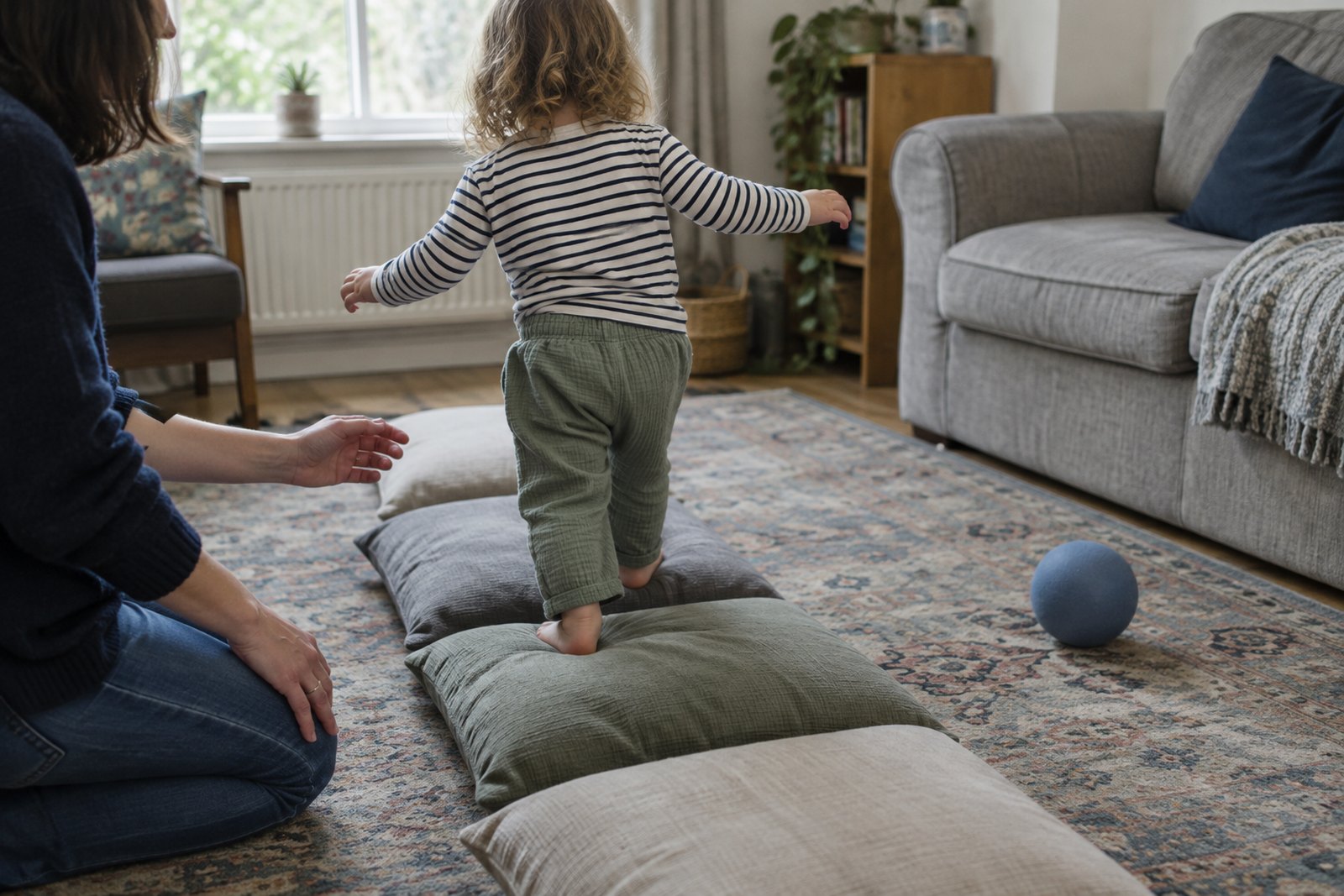
Gross motor skills are the big movements that use the large muscles of the body: the trunk, arms and legs. Rolling, sitting up, crawling, walking, running, jumping, climbing, kicking and throwing are all gross motor skills. So is the less obvious stuff, like sitting still on a chair without slumping, or standing on one leg long enough to pull trousers on.
Children develop these skills in a rough order but at very different speeds, and the normal range is wide. Most of what helps is ordinary play: floor time for babies, climbing and chasing for toddlers, balls, bikes and playgrounds for older children. If your child is losing skills they used to have, or is well behind other children of the same age, talk to your health visitor or GP. A physiotherapist usually leads on the movement itself. An occupational therapist looks at how movement difficulties affect everyday life, such as dressing, sitting at a table, PE and the playground.
Gross motor vs fine motor: what is the difference?
Gross motor skills are whole-body movements. Fine motor skills are the small, precise movements of the hands and fingers: holding a crayon, doing up buttons, using a knife and fork, picking up a raisin.
The two are more connected than they look. A child needs a steady trunk and shoulders before their hands can work well. If a child is using all their effort just to stay upright on a chair, there is not much left over for neat handwriting. This is why an occupational therapist assessing a child who struggles to write will often look at how they sit, how they hold themselves up and how stable their shoulders are, not just their pencil grip.
Gross motor skills examples
- Balance: standing on one leg, walking along a kerb, getting dressed standing up.
- Coordination: skipping, star jumps, pedalling, swimming strokes.
- Strength and stamina: climbing stairs, carrying a school bag, keeping up on a walk.
- Posture and core stability: sitting on the carpet at school, sitting at a table to eat.
- Ball skills: throwing, catching, kicking, bouncing.
- Body awareness: judging where your body is in space, so you do not bump into things or knock others over.
Gross motor milestones: broad age ranges
These are rough guides, not deadlines. Children vary a lot, and premature babies are usually judged from their due date rather than their birth date for the first couple of years. Your health visitor and your child's red book (the Personal Child Health Record) are the best places to check where your child is.
Birth to 6 months
- Gradually gaining head control, first when held, then lying on their tummy.
- Pushing up on forearms during tummy time.
- Starting to roll, often tummy to back first.
- Kicking and reaching for toys.
6 to 12 months
- Sitting without support, wobbly at first.
- Getting around: crawling, commando crawling or bottom shuffling. Some children skip crawling entirely and that is not in itself a problem.
- Pulling up to stand on furniture.
- Cruising: stepping sideways while holding on.
1 to 2 years
- Walking. Many children take first steps somewhere around their first birthday, but plenty walk later, and the range is wide.
- Squatting to pick something up and standing back up.
- Climbing onto low furniture (and off it, less gracefully).
- Starting to run, usually stiffly and with arms out.
2 to 3 years
- Running more confidently.
- Kicking a large ball.
- Walking up and down stairs holding a rail or hand, often both feet on each step.
- Jumping with two feet together.
3 to 5 years
- Pedalling a tricycle or riding a balance bike.
- Going upstairs one foot per step.
- Standing on one foot for a few seconds, then hopping.
- Climbing playground equipment.
- Catching a large ball with arms and body, then with hands.
5 to 7 years
- Skipping, galloping and more complex movements.
- Riding a bike, with or without stabilisers.
- Better ball skills: throwing at a target, kicking while moving.
- Getting dressed and undressed for PE, mostly independently.
- Joining in playground games without being left behind.
Everyday gross motor activities that actually help
You do not need special equipment or classes. Children build gross motor skills by moving a lot, in lots of different ways, with a bit of challenge. The best activities are the ones your child enjoys enough to repeat.
Babies
- Tummy time when awake and supervised, little and often. Lie on the floor facing them so there is something worth lifting their head for. Always put babies on their back to sleep.
- Floor time rather than long stretches in car seats, bouncers or baby seats. Babies learn to roll and sit by practising on a firm floor.
- Toys just out of reach to encourage reaching, rolling and wriggling.
- Sitting practice on your lap or between your legs on the floor, giving less support as they get steadier.
Toddlers
- Cushion obstacle courses: sofa cushions on the floor to climb over, crawl under and step across.
- Push-along toys or a sturdy box to push across the room.
- Stairs with you right there: crawling up, sliding down on their bottom, then holding the rail.
- Chasing games, dancing and action songs. Anything that involves stopping, starting and changing direction.
- The park: slopes, steps, grass, low climbing frames and swings.
Preschool and school-age children
- Ball games: start with a big, soft or slightly deflated ball, which is easier to catch. A balloon is slower still, but always supervise young children with balloons and clear away any burst pieces straight away, as they are a choking risk.
- Animal walks: bear walks, crab walks, frog jumps, wheelbarrow walks. Brilliant for shoulder and core strength, and they make children laugh.
- Balance games: walking along a line of tape on the floor, standing on one leg while you count, statues.
- Hopscotch, skipping and jumping games.
- Balance bikes and scooters, with a helmet.
- Swimming, climbing walls, soft play and outdoor play generally.
- Helping at home: carrying shopping bags, pushing a laundry basket, hanging washing on a low line, digging in the garden.
If your child avoids movement
Some children steer clear of physical play because they find it hard, and the less they do, the further behind they feel. Keep it private and low pressure at first. Practise catching in the garden before they try it with friends. Praise effort, not results. Short, frequent bits of practice beat one long, miserable session. If your child seems frightened of movement, hates their feet leaving the ground, or seeks out crashing and spinning far more than other children, it may be worth reading about the sensory systems, particularly balance and body awareness.
Signs worth raising with your health visitor or GP
Lots of children are a bit clumsy or a bit later than their friends and turn out fine. But it is always reasonable to ask. You know your child, and you do not need to be sure something is wrong before you mention it. Speak to your health visitor (for under-fives) or GP if you notice:
- Your child is not sitting without support, not getting around in any way, or not walking by about 18 months, especially if they are behind in other areas too.
- Their body feels very floppy or very stiff.
- They use one side of the body much more than the other, for example always reaching with one hand, or dragging one leg, in a child too young to have a clear hand preference.
- They walk on their toes most of the time and cannot easily put their heels down, or toe walk on one side only.
- They fall over far more than other children of the same age, or tire very quickly.
- They complain of pain in their legs, hips or back, or avoid walking.
- They are clearly struggling with everyday tasks compared with their classmates: dressing, PE, the playground, sitting at a table.
See your GP promptly if your child loses skills they used to have, such as no longer walking or sitting when they could before. That always needs checking.
Get urgent help if your child suddenly starts limping or will not put weight on a leg and has a high temperature or seems unwell, or after an injury. Call NHS 111 or your GP the same day, or 999 if they are seriously unwell.
Some children with ongoing coordination difficulties are eventually diagnosed with developmental coordination disorder (DCD), also known as dyspraxia. This is diagnosed by health professionals after assessment, usually not before about age five, and it is not something to work out from a checklist. You can read more on our developmental delay page.
Physiotherapy or occupational therapy: who does what?
Here is the honest answer. For many gross motor problems, a children's physiotherapist leads. Physios specialise in movement itself: muscle strength and tone, balance, walking pattern, posture, joint range and how the body moves. If your baby is late to sit or walk, your toddler toe walks, or your child has a condition affecting their muscles or joints, physiotherapy is usually the main route. Your GP or health visitor can refer you, and some NHS areas accept referrals from parents directly, so it is worth asking.
An occupational therapist comes at it from a different angle: what difference does this make to your child's day? An OT looks at the tasks your child needs and wants to do, and why movement difficulties are getting in the way. That might include:
- Dressing: a child who loses balance pulling on trousers may do better sitting on a low step or against a wall. An OT can break the task down and teach it in stages.
- Sitting at a table: a chair at the right height, feet flat on the floor or on a box or stack of books, and the table at roughly elbow height can make eating and writing much easier.
- PE and getting changed: practical strategies, extra time, and advice for school on how to include your child.
- The playground: building the confidence and skills to join in, rather than standing at the edge.
- Carpet time and classroom posture: ideas such as a supportive seat or a chance to move between tasks.
- Handwriting and fine motor skills, which often struggle when gross motor stability is weak.
- Sensory differences that affect how a child moves or tolerates movement.
Physios and OTs often work together, and some children need both. Neither replaces your GP or paediatrician where there is a medical question to answer. If speech, language or understanding is also a worry, a speech and language therapist is the right person for that part.
NHS children's occupational therapy is usually accessed through your GP, health visitor, paediatrician or your child's school (often via the SENCo). Waiting times vary by area. Some families choose a private occupational therapist, who can visit at home and see your child doing real tasks in their own space, and can write a report that may help school support or an education, health and care needs assessment. Our guide to paediatric occupational therapy explains what that looks like, and the children's occupational therapy page covers home visits.
Frequently asked questions
What are 5 examples of gross motor skills?
Walking, running, jumping, climbing stairs and throwing a ball are five common examples. Sitting upright, balancing on one leg and riding a bike are also gross motor skills.
My baby is not crawling. Should I worry?
Not necessarily. Some babies bottom shuffle, commando crawl or go straight from sitting to pulling up and walking. What matters more is that they are finding some way to get around, using both sides of the body, and generally moving forward with new skills. If you are unsure, ask your health visitor.
Is my child just clumsy, or is it something more?
Plenty of children are clumsy for a while, especially during growth spurts. It is worth asking for advice if the clumsiness is persistent, is clearly more than other children their age, or is getting in the way of everyday life such as dressing, PE or making friends at play.
Can gross motor skills improve with practice?
Yes, in most children. Regular, varied movement and repetition of specific skills usually help. Children with an underlying condition may need specialist therapy and may progress differently, but practice still matters.
Do I need a referral to see a children's occupational therapist?
For NHS occupational therapy, usually yes, through your GP, health visitor, paediatrician or school, though rules vary by area. You do not need a referral to see a private occupational therapist. Check they are registered with the Health and Care Professions Council and have experience with children.
Should I see a physio or an OT for my child's gross motor skills?
If the main concern is how your child moves, such as walking, balance, stiffness or toe walking, start with a physiotherapist via your GP or health visitor. If the main concern is how movement difficulties are affecting daily tasks like dressing, sitting to eat or write, PE or play, an occupational therapist may be more helpful. Many children benefit from both.
Next steps
If your child's movement is making everyday life harder, see our children's occupational therapy page, or current guide prices, and choose your area below.
Talk to an occupational therapist near you
This guide is general information. For advice about your own situation - or someone you look after - a local occupational therapist can visit you at home and see it for themselves.
Choose your area: