

Body Socks: What They Are and How Children Use Them
By Mobile Occupational Therapist • 28 October 2026 • 12 min read
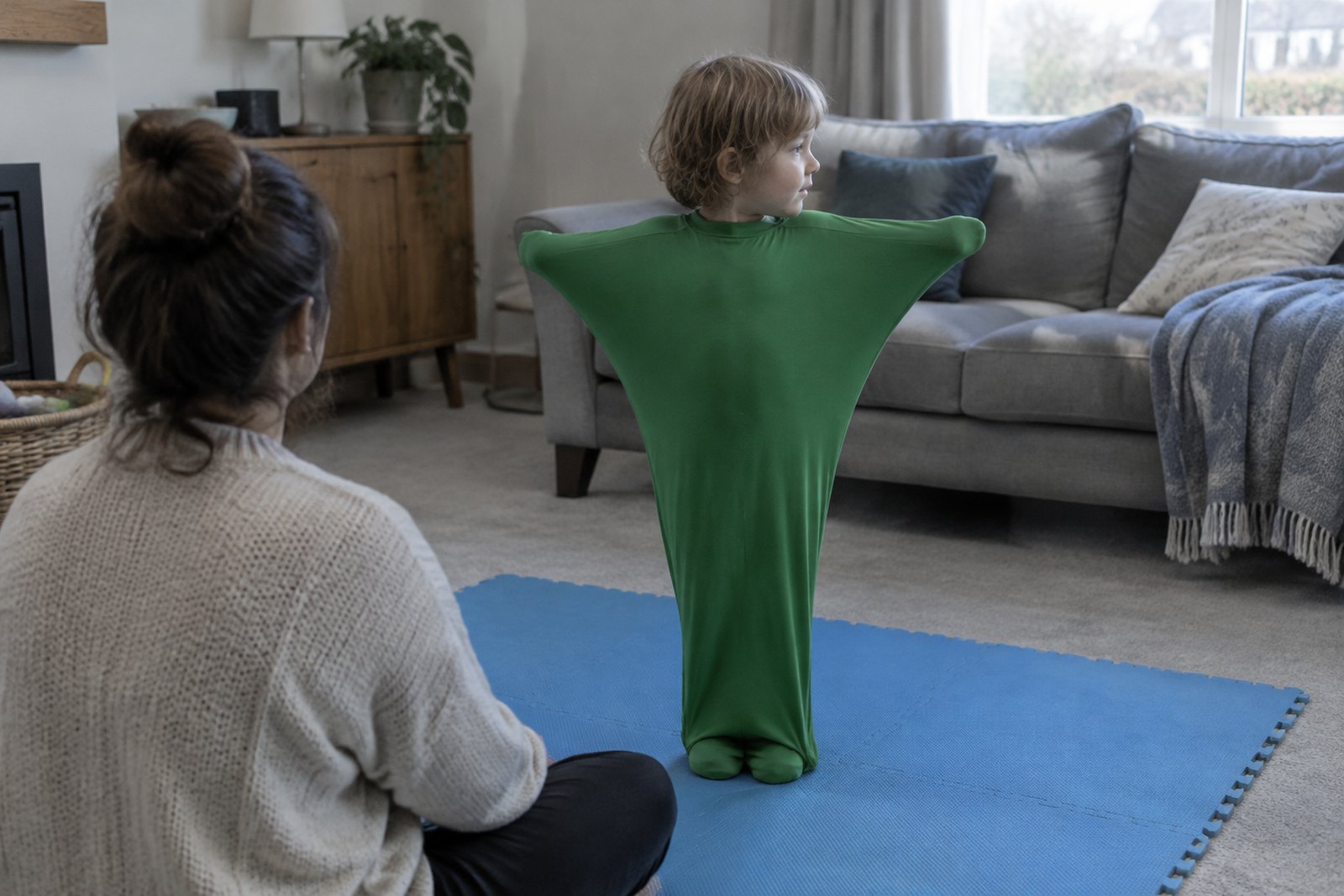
A body sock is a large, stretchy fabric sack that a child climbs into, usually with their head poking out of the top. Once inside, they push against the fabric with their arms, legs and back, and the fabric pushes back. That gentle, all-over resistance gives deep pressure and strong feedback to the muscles and joints. This helps some children feel where their body is, and helps some feel calmer and more settled.
Body socks are a common piece of sensory equipment in schools, nurseries and occupational therapy clinics, and plenty of families buy one for home. They are not a treatment for anything on their own. Used well, they are a fun, physical way to give a child the kind of input they are often already looking for, usually by crashing into the sofa or squeezing between cushions. Used carelessly, they carry real risks, mostly around breathing and getting stuck. This guide covers both.
What a body sock actually is
Most body socks are made from a lycra-type fabric with a lot of stretch in every direction. They come as a long rectangle or tube, closed at the bottom, with an opening at the top. Some have a hook-and-loop strip or a slit down one side so the child can get in and out more easily. The fabric is thin enough that a child can see light and shapes through it.
The child steps in, pulls it up over their body and then moves: stretching, pushing, making shapes, rolling. Because the fabric resists every movement, the brain gets a lot of information from the muscles and joints. This sense is called proprioception, and there is more on it in our guide to proprioception, body awareness and clumsiness.
Many body socks are sold to be pulled right over the head so the child is fully enclosed. We suggest families start, and usually stay, with the head and face outside the sock. The reasons are in the safety section below.
Who might enjoy a body sock
Children are different, and the same piece of kit can delight one child and upset another. Body socks tend to suit children who:
- Seek pressure and heavy movement. They crash, jump, squeeze into small spaces, hang off you, pile cushions on themselves or love tight hugs. Our guide to sensory seeking behaviour explains why this happens.
- Have poor body awareness. They bump into things, misjudge how hard to push or pull, seem floppy or clumsy, or find it hard to copy movements.
- Find snug, contained spaces calming. Some children love dens, tunnels and being wrapped in a blanket, and settle after time in an enclosed space.
- Need a reason to move. A body sock turns stretching and pushing into a game, which can appeal to children who avoid ordinary exercise.
This includes some autistic children, some children with ADHD, dyspraxia or hypermobility, and plenty of children with no diagnosis at all. A diagnosis does not decide it. What your child actually does and enjoys is a far better guide.
Children it may not suit
- Children who dislike tight clothing, labels in clothes or being touched, and children who become anxious in enclosed spaces.
- Children who cannot get out of it on their own, quickly, without help. That might be because of age, a physical disability, low muscle tone or difficulty following instructions. For them it needs a different plan, worked out with a professional.
- Children with breathing problems, a heart condition, epilepsy or another health condition where getting hot or stuck could be dangerous. Ask the GP or your child's specialist team before trying one.
If your child says no or looks unhappy, take it off. Forcing sensory input rarely helps, and it can make a child more wary of the next thing you try.
Body sock games and ways to use one
The point is active movement against resistance. Short, playful sessions work better than long ones. A few minutes is often plenty to start with.
Movement games
- Shapes and statues. Call out a shape (a star, a tall tree, a ball, the letter X) and your child makes it inside the sock. Freeze when the music stops.
- Caterpillar to butterfly. They start curled up as a cocoon, wriggle and push, then stretch out wide with arms pushing the fabric like wings.
- Push the walls. Standing or sitting, they push the fabric as far as it will go in every direction, hold for a count of five, then relax.
- Animal moves. Bear walks, frog crouches and crab shapes on a soft mat. Keep it slow. The sock limits how quickly they can put a hand out if they topple.
- Mirror me. You make a shape, they copy it in the sock. Good for body awareness and taking turns.
- Log rolls. Lying on a mat, they roll slowly from one end to the other. Only on a clear, soft floor.
Calmer uses
- Sitting in the sock on a beanbag or big floor cushion, head out, pressing gently outwards while you read a story.
- A slow stretching routine before homework or before the bedtime routine starts (never in bed).
- A short burst straight after school, when many children come home overloaded and need to move before they can sit.
As part of a daily routine
A body sock often works best as one activity within a planned set of movement and calming activities across the day, rather than something pulled out only when a child is already upset. That kind of plan is often called a sensory diet, and our guide to building a sensory diet at home explains how to put one together. If you are setting up a quiet corner for your child, the sock fits well with the ideas in sensory room ideas on a budget.
Watch how your child is afterwards. If they are calmer, more focused or more organised in their movements, it is earning its place. If they are more wound up, try a shorter session, a slower game or a different time of day.
Getting the size right
Body socks are usually sold in size bands linked to height or age. Height is the better guide, because children of the same age vary a lot.
- Measure your child standing up and check against the maker's size guide.
- Too small and it will be tight before they even move, hard to get in and out of, and may press uncomfortably on the neck or head.
- Too big and it gives little resistance, so they get little feedback, and the loose fabric becomes a trip hazard.
- Do not buy one to grow into. A sock that is much too long makes falls more likely.
- When your child stands inside and reaches up, the fabric should feel firm, but they should still move freely and be able to lift their arms out of the top.
Check the minimum age stated by the maker and the washing instructions. Look over the seams and any fastening regularly, and stop using it if it is torn or the stitching is coming apart.
Safety rules that matter
A body sock is soft and looks harmless, which is exactly why the rules are easy to forget. These are the ones that count.
- Head and face out. Keep your child's head and face outside the sock. Stretchy fabric over the nose and mouth can affect breathing, particularly if a child falls face down or gets tangled. Some body socks are designed to go over the head. If your child uses one that way on the advice of an occupational therapist, it should be for short periods, with an adult right beside them watching, and only if they can pull it off their head instantly by themselves.
- Never for sleeping. A body sock is not a sleeping bag or a bedtime wrap. Do not let a child fall asleep in one, and do not put one in a cot or bed.
- Always supervised. An adult should be in the room and paying attention, not in the kitchen. This applies at school as well as at home.
- Only if they can get out alone. Before any games, practise getting in and out together. If your child cannot get out quickly and calmly without help, do not use it until you have had professional advice.
- Plenty of clear space. Use it on a soft, open floor, away from stairs, furniture corners, radiators, fireplaces, windows and water. A child inside cannot always put their hands out to break a fall.
- No climbing. No standing on furniture, jumping off things or going up and down stairs in a body sock.
- Watch for overheating. Lycra holds heat. Keep sessions short, especially in warm weather, and stop if your child is flushed, sweaty or flagging.
- Stop if they are distressed. Panic, crying, going suddenly quiet and still, or any difficulty breathing means out, straight away.
- One child per sock. Two children sharing one is a fast route to a tangle.
If your child ever seems to be struggling to breathe, turns pale or blue, or becomes unresponsive, call 999.
What the evidence says, honestly
There is very little good-quality research on body socks themselves. Research on sensory-based approaches more generally, such as weighted items and sensory diets, is mixed, and many studies are small. You will see far stronger claims online than the evidence supports.
That does not make a body sock useless. Plenty of children clearly enjoy them, and active, resisted movement is a sensible thing to offer a child who keeps seeking it. It is best thought of as a play tool that may help your child feel settled and aware of their body, not as therapy that will change a diagnosis or fix behaviour. Judge it by what you see in your own child over a few weeks, and do not spend more than you are comfortable with. The same goes for other sensory equipment, such as weighted blankets, which come with their own important safety rules.
Where an occupational therapist fits
You do not need an occupational therapist to buy or use a body sock. Many families try one, notice what their child likes, and that is enough. It is worth getting advice if:
- Your child's need for pressure or movement is intense, constant or getting them hurt.
- Clumsiness, poor coordination or poor body awareness is affecting dressing, eating, handwriting, play or school.
- Your child becomes very distressed by sensory experiences and you are not sure what helps.
- Your child has a physical disability or health condition and you want to know whether a body sock is safe for them.
- You would like a written report to support your child at school, or as evidence for an education, health and care (EHC) needs assessment in England or the equivalent process elsewhere in the UK.
An occupational therapist can look at how your child takes in sensory information, how they move and what gets in the way of everyday life, then suggest specific activities and a routine that fits your family. They can show you how to use equipment safely, or suggest free alternatives using what you already have, like cushion sandwiches, pushing games or helping carry the shopping. A private occupational therapist visiting at home can see your child in their own surroundings, which often shows more than a clinic visit. Our sensory needs page explains more.
When someone else is the right person
- Your GP or health visitor if you are worried about your child's development, or if they have lost skills they used to have. Loss of skills needs prompt medical advice.
- A physiotherapist for difficulties mainly with strength, walking, balance or joints.
- A speech and language therapist for communication, or for difficulties with chewing and swallowing.
- A paediatrician or your local neurodevelopmental service if you are seeking an assessment for autism or ADHD. Ask your GP or your child's school about the referral route in your area.
Frequently asked questions
Can my child sleep in a body sock?
No. A body sock should never be used for sleeping, in a cot, a bed or anywhere else. Fabric near the face, heat build-up and getting tangled are all real risks when nobody is watching. If your child struggles to settle at night, talk to your GP or an occupational therapist about safer options.
Do body socks help autistic children?
Some autistic children love them and seem calmer afterwards. Others find them unpleasant. Being autistic does not mean a child will benefit. Try it calmly, keep sessions short and let your child's reaction guide you. There is no strong research showing body socks improve autism-related difficulties on their own.
What age can a child use a body sock?
Check the minimum age set by the maker. Whatever the label says, the real test is whether your child can get in and out alone, understands simple rules like keeping their head out, and can tell or show you when they want to stop.
How long should a session last?
There is no fixed rule. A few minutes of active play is often enough, and some children only want a minute or two. Stop before your child gets hot, tired or overexcited, and judge by how they are afterwards rather than by the clock.
Can schools use body socks?
Yes, many schools and nurseries do, often in a sensory room or as part of a short movement break. The same rules apply: an adult supervising, head out, clear space and never for rest or sleep. If a body sock helps at home, tell the school so they can use it in a similar way.
Should I see an occupational therapist before buying one?
Not usually, if your child is generally well, can get out alone and clearly enjoys pressure play. Get advice first if your child has a physical disability, a health condition affecting their breathing, or sensory needs that are causing real difficulty day to day.
Next steps
If you would like help working out your child's sensory needs and which activities really suit them, see our sensory needs and children's occupational therapy pages, or current guide prices, and choose your area below.

Talk to an occupational therapist near you
This guide is general information. For advice about your own situation - or someone you look after - a local occupational therapist can visit you at home and see it for themselves.
Choose your area: