

Sensory Seeking Behaviour in Children: Why It Happens and What Helps
By Mobile Occupational Therapist • 6 October 2026 • 14 min read
Sensory seeking behaviour is when a child goes looking for more sensation than most children their age seem to need. They crash into sofas. They spin until everyone else feels sick. They chew their sleeves, touch everything in the shop and talk at a volume that carries across the park. It is not naughtiness and it is not usually bad parenting. Most often the child's nervous system needs more input than average to feel settled, alert and organised, so they go and get it, using whatever is nearest.
The most useful thing you can do is not to stop the seeking but to feed it safely and on purpose. That means heavy work like pushing, pulling and carrying, regular movement, and safe things to chew and fiddle with, built into the day before the need boils over. This article explains what that looks like at home and at school, how to keep climbers and chewers safe, how sensory seeking relates to ADHD and autism, and when it is worth getting an occupational therapist to look properly.
What sensory seeking looks like
Every child seeks sensation. Toddlers spin, climb and put things in their mouths because that is how they learn. Sensory seeking becomes worth noticing when it is more intense, more frequent or goes on for longer than you would expect for their age, and when it starts getting in the way of daily life: meals, sleep, friendships, learning or safety.
Common signs include:
- Crashing and bumping: throwing themselves onto beds, sofas or other people, rough play that tips over into hurting, falling over on purpose.
- Constant movement: spinning, rocking, bouncing, jumping off furniture, unable to sit through a meal or a story.
- Climbing everything: worktops, bookcases, the very top of the climbing frame, often with little sense of danger.
- Chewing and mouthing: sleeves, collars, pencils, toys and hair, well past the age when most children stop.
- Touching everything: other people, shop displays, textured walls, rubbing hands on fabric.
- Noise: a loud voice, humming, banging, wanting the music or TV turned up high.
- Strong tastes: preferring very spicy, sour or crunchy food.
- Seeming not to notice pain: shrugging off bumps that would make another child cry.
Some children seek one kind of input and avoid another. A child who crashes into everything may still hate having their hair washed or scream at a hand dryer. That mix is common, and it is one reason sensory needs are best looked at as a whole picture rather than a checklist.
Why some children need more input
We take in information through more senses than the familiar five. Alongside sight, hearing, touch, taste and smell there is the vestibular sense (balance and movement, from the inner ear), proprioception (body position, from muscles and joints) and interoception (internal signals like hunger, needing the toilet or a racing heart). Our guide to the eight sensory systems explains each one plainly.
Brains differ in how strongly they register these signals. For some children, ordinary levels of input barely seem to land. Sitting still feels vague, wrong or sleepy, and the body hunts for something stronger to feel switched on. Crashing gives a big dose of proprioceptive input. Spinning gives vestibular input. Chewing gives strong input through the jaw. The child is not choosing to be difficult. They are doing what helps them feel organised, usually without knowing why.
Seeking can also rise when a child is tired, anxious, overwhelmed, hungry or bored. Some children use intense movement to calm down after a hard day, which can look like the opposite of calming. If the seeking spikes at particular times, such as straight after school, before bed or in busy places, that pattern is useful information. Jot it down for a week.
Meet the need instead of stopping it
Telling a sensory seeking child to sit still and stop chewing tends to work for about thirty seconds. The need has not gone. It just comes out somewhere else, usually somewhere less convenient. A better approach is to offer the same type of input in a safe form, regularly, and ideally before the child goes looking for it. When this is planned into the day it is often called a sensory diet.
Heavy work
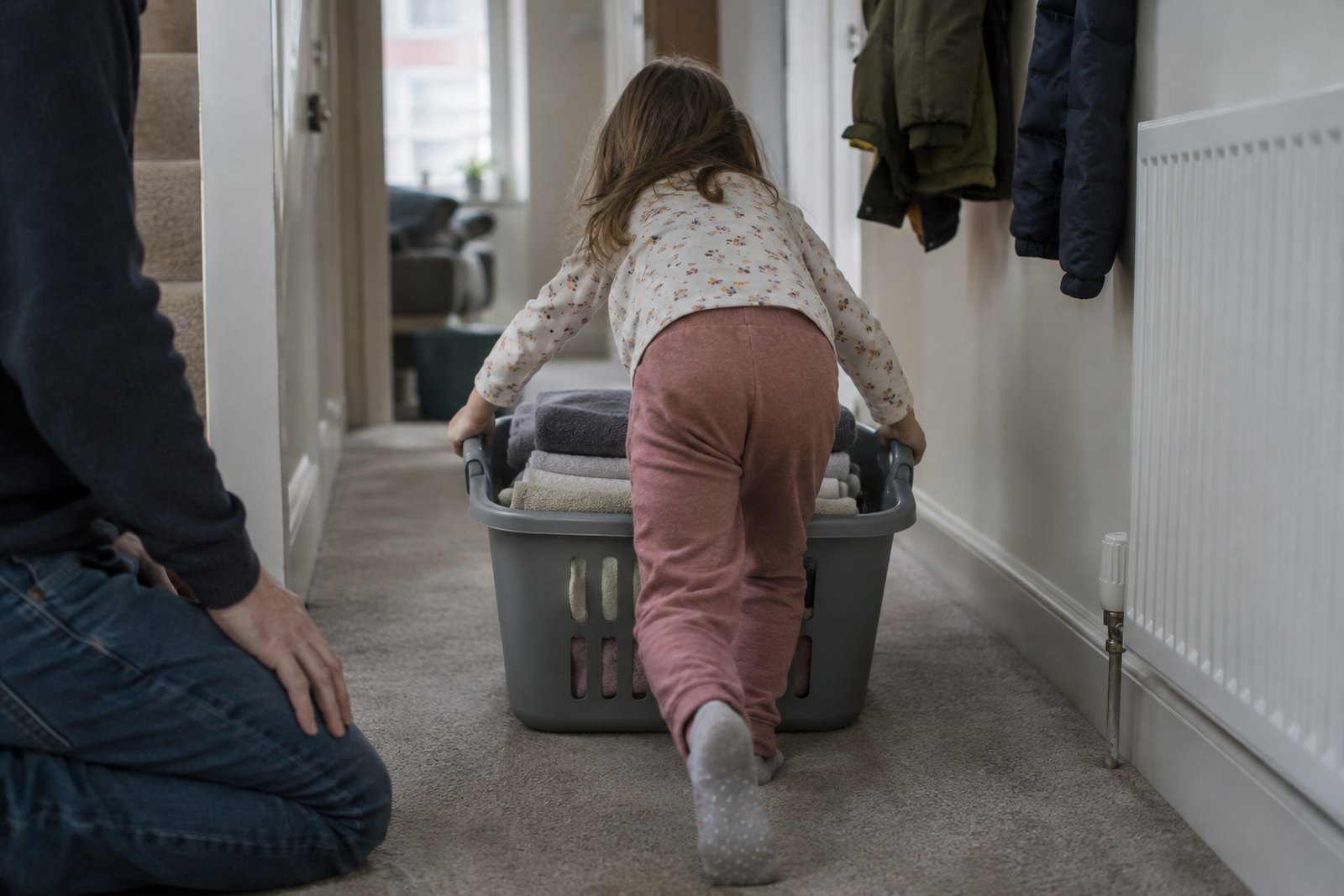
Heavy work means any activity where muscles push, pull, lift or carry against resistance. It gives strong proprioceptive input, and many children find it calming and organising at the same time. It is also the easiest to fit into family life, because a lot of it is genuinely useful.
- Carrying shopping bags in from the car, or the laundry basket upstairs.
- Pushing a loaded laundry basket or a box of books across the floor.
- Wall push-ups, or trying to push the wall over for a count of ten.
- Animal walks: bear crawls, crab walks, frog jumps.
- Tug of war with a rolled-up towel.
- Digging in the garden, raking leaves, pushing a wheelbarrow.
- Kneading bread dough, or pulling apart thick play dough or putty.
- Being squashed gently under sofa cushions, if the child likes it and can wriggle out easily. Always keep the head and face clear.
Short bursts several times a day usually help more than one long session. Before school, after school and before homework are good slots.
Movement
Children who spin and bounce often need vestibular input. Offer it in ways that have a clear start and finish: swings at the park, a garden trampoline with safety netting and one child on it at a time, scooters, bikes, rolling down a grassy slope, dancing, or a large exercise ball to bounce on. Steady back-and-forth or up-and-down movement tends to be calming. Fast spinning is far more stimulating and can tip a child over the edge.
Never spin a child who has not asked to be spun, and stop if they look pale, sweaty or sick, or go suddenly quiet. Some children do not notice dizziness the way others do, so you may need to be the one who calls time.
Mouth and chewing
Chewing, sucking and blowing are organising for many children. Crunchy and chewy snacks suited to their age, thick smoothies drunk through a straw, blowing bubbles and blow football all help. Purpose-made chew tools - chewable pendants, bangles or pencil toppers made from food-safe material - give a safe target instead of sleeves and pencils.
Choose ones designed for chewing and match the toughness to how hard your child bites. Check them every day for cracks, tears or loose pieces and throw them away at the first sign of damage. Supervise their use, especially with younger children and those who bite through things quickly. Necklace-style chews should have a breakaway clasp and should never be worn in bed.
Touch and fidgets
For children who touch everything, give their hands something better to do: a small fidget kept in a pocket, a textured strip stuck under the desk, a squeeze ball, a tub of dried rice or pasta to dig through at home (supervised for little ones), finger painting, or shaving foam on a tray. Firm touch is usually more settling than light touch, so a firm hug or a squeeze of the shoulders, offered rather than imposed, may help more than a gentle stroke.
A good fidget is quiet, does not need looking at, and lets the child carry on with what they are doing. If it becomes the main event, it is a toy, not a tool.
Noise
For loud children, offer sound with permission: music to dance to, drumming on pans in the garden, singing, and a time and place where loud is fine. Humming while they work may actually be helping them concentrate. It is also worth checking hearing. A child who is loud and seems not to listen should have their hearing tested through the GP or school nurse before anyone assumes it is sensory.
Keeping climbers and chewers safe
Climbers
- Fix bookcases, chests of drawers, wardrobes and TVs to the wall with anti-tip fittings.
- Fit window restrictors on upstairs windows and keep beds and furniture away from them.
- Move anything that acts as a step, such as chairs left next to worktops.
- Give a proper place to climb: a climbing frame, soft play, a climbing wall session or a supervised play park.
Children who seek a lot of movement may also have less awareness of danger, or of where their body is in space, so rules alone often will not hold. Change the environment rather than relying on them to remember.
Chewers, and when it is pica
Chewing is about the sensation. Pica is different. It means repeatedly eating things that are not food, such as soil, paint flakes, chalk, paper, hair, stones or soap. If your child regularly swallows non-food items rather than chewing and spitting them out, see your GP. Pica can sometimes be linked to a lack of iron, it is more common in autistic children and children with a learning disability, and some of the things swallowed can be harmful. It is a medical question first. An occupational therapist may help alongside, but not instead.
Take your child to A&E straight away or call 999 if you think they have swallowed a button battery, magnets or something poisonous, or if they are choking, struggling to breathe, drooling heavily or in pain after swallowing something. For other worries, call NHS 111. See your GP too if your child is hurting themselves, for example head banging that causes injury, or if there is a sudden change in behaviour or loss of skills they used to have.
Sensory seeking at school
School asks children to sit still, keep their hands to themselves and be quiet, which is exactly what a sensory seeking child finds hardest. Many of the home ideas transfer easily, and good schools already use them.
- Movement breaks between tasks, or jobs that involve moving: taking the register to the office, handing out books, stacking chairs.
- Heavy work at the start of the day or before long sitting tasks.
- Seating options: a wobble cushion, a stretchy band around the chair legs to push their feet against, or permission to stand at the desk.
- A quiet fidget agreed with the teacher.
- A chew tool, if the school agrees and it can be kept clean.
- Keeping playtime. Taking movement away as a punishment from a child who needs it often makes the afternoon worse for everyone.
Talk to the class teacher and the SENCO (special educational needs coordinator) and share what helps at home. In England, support at school should be based on a child's needs rather than on having a diagnosis. If needs are significant, a parent or the school can ask the council for an education, health and care needs assessment. The SEND section of GOV.UK explains the process. Systems differ in Scotland, Wales and Northern Ireland, so check with your local council or education authority.
ADHD, autism and sensory seeking
Sensory seeking is common in autistic children and in children with ADHD. It also shows up in children with dyspraxia, hypermobility, and in children with no diagnosis at all. Seeking on its own does not mean your child is autistic or has ADHD. You will see the term sensory processing disorder a lot online, but it is not listed as a separate condition in the main diagnostic manuals UK doctors use, so do not be surprised if your GP does not use it.
Movement seeking can look a lot like ADHD hyperactivity, and the two can overlap. If you are also seeing difficulties with attention, impulsivity, social communication, or very rigid routines and intense interests, speak to your GP, health visitor or the school SENCO about whether an autism or ADHD assessment is worth considering. An occupational therapist cannot diagnose either. What they can do is help with daily life, whatever the label turns out to be. Our guides to occupational therapy for autistic children and occupational therapy and ADHD go into more detail.
Where an occupational therapist fits
Plenty of families manage sensory seeking well with the ideas above and some trial and error. It is worth involving an occupational therapist when:
- the seeking is putting your child or others at risk
- it is getting in the way of sleep, eating, learning or playing with other children
- you have tried the obvious things and nothing settles them, or some things wind them up more
- school is struggling and wants a clearer plan
- there are other worries too, such as clumsiness, handwriting, dressing or coordination
An occupational therapist with children's and sensory experience will usually talk with you in detail, may ask you and school to fill in sensory questionnaires, and will watch your child play and move, ideally at home or in school. They look at which senses your child seeks and avoids, how their posture, coordination and motor skills are working, and what is happening at the times things fall apart. The result should be a practical plan: what to offer, when, how to tell whether it is working, and how to adapt the home and classroom.
On the NHS, children's occupational therapy is usually reached by referral from a GP, paediatrician, health visitor or school, and some areas accept referrals from parents. What is offered varies a lot between areas, and some teams do little sensory work. A private occupational therapist visiting at home can see your child in their own surroundings and can write a report that school or the council can use. Whoever you see, check they are registered with the HCPC.
An occupational therapist is not the right first stop for everything. Speech and language therapists lead on communication and on eating and swallowing difficulties. The GP leads on pica, hearing, sleep problems with a possible medical cause and anything that looks like illness. A paediatrician or the local children's mental health service leads on diagnosis and mental health.
Frequently asked questions
Is sensory seeking a sign of autism?
Not on its own. It is common in autistic children, but it is also common in children with ADHD, dyspraxia or hypermobility, and in children with no diagnosis. If you have other concerns about communication, social interaction or rigid routines, talk to your GP or the school SENCO about an assessment.
Will my child grow out of it?
Many children seek less as they get older, or find more socially acceptable ways to get the input they need, like sport, music or fiddling with a pen. Others carry strong sensory preferences into adulthood. Helping your child understand what their body needs is useful either way.
Should I let my child crash into the sofa?
Often yes, if it is safe. Pile up cushions or a beanbag in a clear space away from hard edges and give them a set place and time to crash. That is far better than crashing into furniture, walls or other children, and it teaches them where it is okay.
How do I tell sensory seeking from bad behaviour?
Sensory seeking tends to look driven rather than defiant, happens even when no one is watching, and often eases when the child gets the right input. Behaviour aimed at getting a reaction usually stops when there is no audience. In real life the two get tangled, especially when a child is tired or stressed, so start by meeting the sensory need and see what is left.
Are weighted blankets or weighted vests a good idea?
They help some children, but they carry real safety risks, particularly for younger children and around sleep. Never use them with babies or toddlers, and get advice from an occupational therapist about weight, fit and time limits before trying one.
Can my child have an occupational therapy assessment without a diagnosis?
Yes. An occupational therapist looks at what your child finds hard in everyday life, not at the label. Many families seek a sensory assessment before or while waiting for an autism or ADHD assessment.
Next steps
See our children's occupational therapy and sensory needs pages, or current guide prices, and choose your area below.

Talk to an occupational therapist near you
This guide is general information. For advice about your own situation - or someone you look after - a local occupational therapist can visit you at home and see it for themselves.
Choose your area: