

Proprioception Explained: Body Awareness, Clumsiness and Activities
By Mobile Occupational Therapist • 1 October 2026 • 12 min read
Proprioception is your body's sense of where it is and how hard your muscles are working. It is the reason you can touch your nose with your eyes shut, walk downstairs without staring at your feet, and pick up an egg without crushing it. Tiny sensors in your muscles, tendons and joints send a constant stream of information to your brain, and your brain uses it to plan and adjust every movement.
When that information is patchy or hard to read, people look clumsy. A child crashes into furniture, presses so hard with a pencil that the paper tears, or flops against walls. An adult after a stroke, or with numb feet from neuropathy, starts tripping or dropping things. The good news is that a lot can be done at home, from simple "heavy work" activities to small changes in how everyday tasks are set up. This guide explains what to look for, what to try, and when to bring in an occupational therapist, a physiotherapist or your GP.
What proprioception actually does
Proprioception has two main jobs. The first is position: knowing where each part of your body is in space, without looking. The second is force: knowing how much effort you are using, so you can grade it. That is why you lift a full kettle differently from an empty one, and why you know, before you even try, roughly how hard to push a door.
It works closely with two other senses. Your balance system in the inner ear (the vestibular sense) tells you about movement and gravity. Touch tells you what your skin is in contact with. Together they build your sense of body awareness. If you want the wider picture of how all the senses fit together, our guide to the 8 sensory systems covers the overview. This article goes deeper on proprioception alone.
A quick way to notice your own proprioception: close your eyes and bring the tips of your two index fingers together in front of you. Most people get close. That is your brain working out where your hands are purely from what your joints and muscles report.
Signs proprioception is not working well
None of these signs on their own means anything is wrong. Lots of children are bouncy and lots of adults are a bit clumsy. It is the pattern, and how much it gets in the way of daily life, that matters.
In children
- Bumping into furniture, doorframes and other people more than you would expect for their age.
- Being heavy-handed: breaking toys, slamming doors, hugging too hard, tearing paper with a rubber.
- Pressing very hard with a pencil, or so lightly the writing is faint and wobbly.
- Leaning on walls, tables or people, slumping in a chair, or propping their head on a hand.
- Seeking strong input: crashing onto sofas, jumping constantly, chewing sleeves, rough play.
- Needing to watch their hands or feet to do things other children do without looking, such as fastening buttons or going down steps.
- Finding it hard to copy movements in PE, dance or games.
- Tiring quickly when sitting, writing or standing, because holding a position takes more effort.
In adults
- Tripping, especially on uneven ground, in the dark or on stairs.
- Dropping cups or misjudging how hard to grip things.
- Feeling unsteady when you close your eyes, for example while washing your hair in the shower.
- Needing to look down at your feet when walking.
- Not being sure where an arm or leg is unless you can see it.
It is worth saying plainly: clumsiness has many causes, including eyesight, muscle weakness, coordination conditions such as dyspraxia (developmental coordination disorder), attention, tiredness and joint problems. Proprioceptive difficulty is part of the picture for some people, not a diagnosis on its own.
Why it matters for handwriting and dressing
Handwriting is a proprioception test that children sit several times a day. To write, a child has to hold a pencil with just enough grip, press with just enough force, and move their fingers in small controlled steps, all while keeping their trunk and shoulder steady. If they cannot feel how hard they are pressing, they either grip tight and press hard (sore hands, tired quickly, holes in the paper) or hold it so loosely the letters drift. Our guide to pencil grip and handwriting by age explains what is typical and what is worth a closer look.
Dressing is similar. Pushing an arm into a sleeve you cannot see, finding the back of your trousers, doing up a button under your chin, pulling up socks: all of these rely on knowing where your hands and limbs are without looking. A child who can do buttons on a doll but not on their own shirt is often showing exactly this. The same is true of adults after a stroke, who may be able to dress the arm they can see but lose track of the one they cannot.
Heavy work: activities that give the body strong information
"Heavy work" is the occupational therapy name for activities where muscles push, pull, carry or take weight. They send strong, clear signals from the joints and muscles to the brain. Many parents find heavy work helps children feel more settled and organised, and it is a sensible part of everyday play anyway. The research on sensory approaches is mixed, so treat this as low-risk, practical help to try and observe, not a cure.
Around the house
- Carrying shopping bags in from the car, or a laundry basket upstairs (a sensible weight for their size).
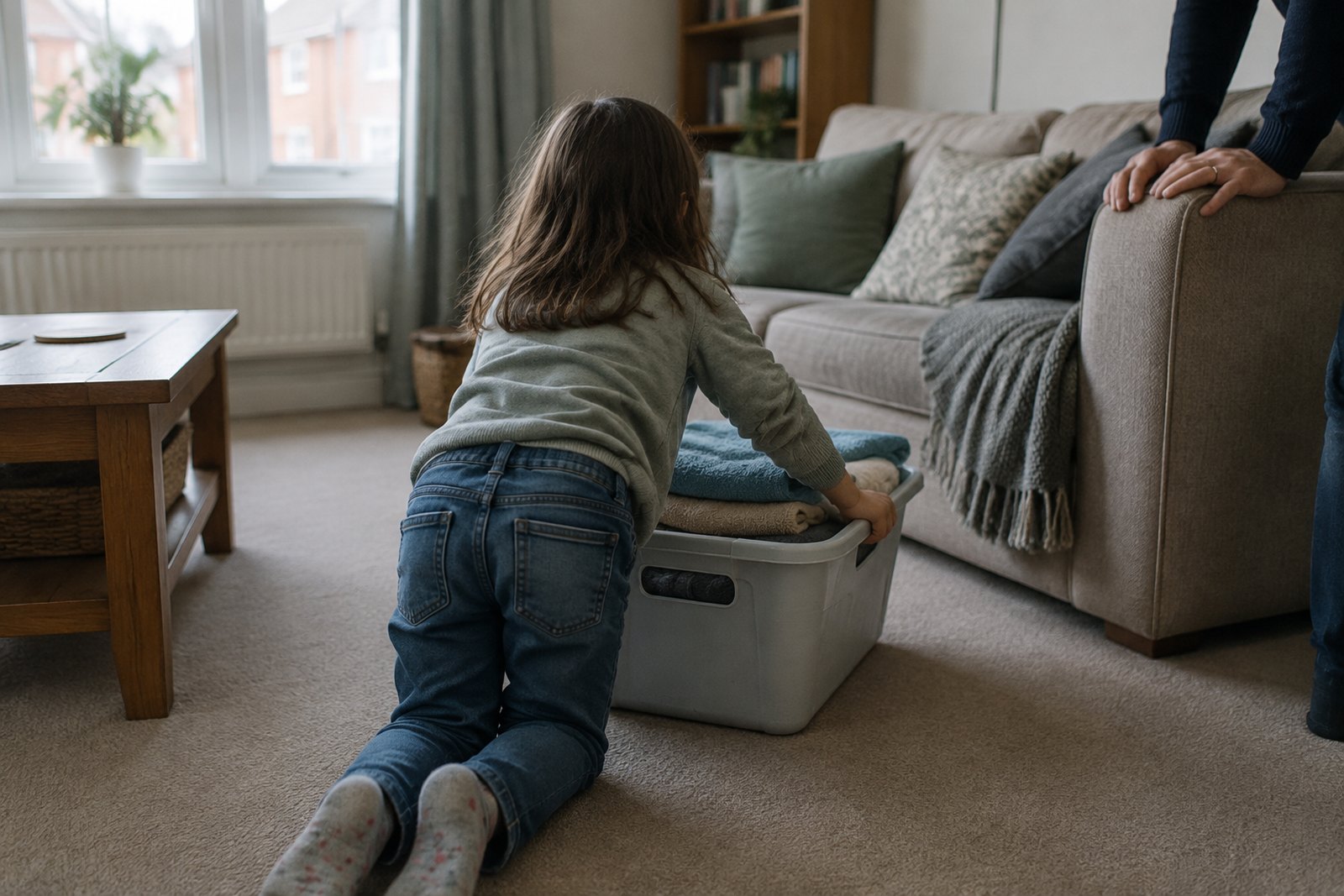
- Pushing a laundry basket full of towels across the floor, or pushing a box of books to another room.
- Helping move chairs, carry a watering can, or stack tins in a cupboard.
- Kneading dough, rolling pastry, squeezing a sponge when washing up.
- Wall push-ups: hands flat on the wall, bend and straighten the elbows ten times.
- Being rolled up tightly in a duvet like a sausage roll (head always out), or a firm squash with a cushion if they like it.
Outside
- Climbing frames, monkey bars, scrambling up slopes.
- Pulling a friend on a sledge or a cart, pushing a wheelbarrow, digging in the garden.
- Animal walks: bear walks, crab walks, frog jumps.
- Tug of war with a towel, swimming, and scooting.
At the table or at school
- Chair push-ups: hands on the seat, lift the bottom off for a count of five.
- Squeezing putty or a stress ball before writing.
- Jobs that involve carrying: taking the register back, handing out books, wiping tables.
- Drinking a thick smoothie through a straw, or crunchy and chewy snacks, which give strong input through the jaw.
Making it work
Short bursts work better than marathons. A few minutes of heavy work before a demanding task, such as homework, getting dressed or sitting down for a meal, is often more useful than an hour at the weekend. Watch how your child responds: some calm down, some get more wound up, and that tells you something. Keep it fun and part of ordinary life rather than a list of exercises. If you want to build activities into the day in a structured way, our guide to building a sensory diet at home walks through it.
Practical changes for everyday tasks
Alongside activities, small changes to how things are done can make a big difference.
- Dressing: sit down to dress, ideally on a low chair or the floor with back support, so balance is not competing with the task. Lay clothes out face down in the order they go on. Larger buttons, elasticated waists and looser sleeves help while skills develop.
- Use the eyes as backup: a mirror for doing up a coat, or getting dressed in a well-lit room, lets vision fill in what the body is not reporting.
- Handwriting: a stable chair where feet are flat on the floor or a box, and elbows rest on the table, takes away a lot of effort. A slightly thicker pencil or a grip can help those who squeeze too hard. Practise writing on paper laid over a mouse mat; it shows straight away who is pressing too hard.
- Eating: heavier cutlery and a non-slip mat can make it easier to feel what you are doing. Cups that are not too full reduce spills.
- Moving around: keep floors clear and furniture in the same place. Good lighting matters more than people expect, because vision does more work when proprioception is weaker.
Proprioception in adults: stroke, neuropathy and hypermobility
After a stroke
A stroke can affect the parts of the brain that process sensation as well as movement. Some people find that one arm or leg feels vague, "not mine", or that they lose track of it if they are not looking. That increases the risk of injury, such as a hand trapped by the wheel of a chair or a foot catching on a step. Practical habits help: check where the affected limb is before moving, position the arm on a cushion or table where you can see it, and use touch and weight-bearing during everyday tasks, such as leaning on the affected hand while wiping a table, as advised by your therapy team. Our guide to stroke recovery at home covers relearning daily tasks in more detail.
Peripheral neuropathy
Neuropathy is damage to the nerves in the hands and feet. Diabetes is one of the common causes, but there are many others. Numb feet do not report well where they are, so balance becomes harder, especially in the dark or with your eyes shut. Use night lights between bed and toilet, sit down to put on trousers and shoes, and wear well-fitting supportive shoes indoors rather than loose slippers. Because reduced feeling can also mean you do not notice injuries or heat, check your feet daily and test bath water with your elbow or a thermometer.
Hypermobility
People with very flexible joints often have less accurate position sense, which may partly explain why they can seem clumsy, sprain ankles easily or tire quickly. Strengthening around the joints, usually guided by a physiotherapist, is the core of management. Heavy work is still useful, but keep loads moderate and avoid forcing joints to the end of their range.
When to get medical help first
- Call 999 if someone suddenly loses feeling, strength or control on one side of the body, has a drooping face, or slurred speech. These can be signs of a stroke.
- See your GP about new numbness, tingling or burning in the hands or feet, new unsteadiness, or repeated falls. If numbness or weakness is spreading quickly over hours or days, or you have numbness around the groin or bottom with bladder or bowel changes, get urgent help the same day through NHS 111 or A&E.
- See your GP or health visitor if a child loses skills they had before, or if clumsiness comes with headaches, weakness or other changes.
- If you are unsure how urgent something is, call NHS 111.
Where occupational therapy and physiotherapy fit
The two professions overlap but lead on different things. A physiotherapist leads on balance, strength, walking and joint stability. If the main problem is falling, sprains, unsteadiness or hypermobile joints, physio is usually the right first step. After a stroke, neurological physiotherapy is often central.
An occupational therapist focuses on how body awareness affects the things you need and want to do: handwriting, dressing, eating, play, washing, cooking, work. For a child, an occupational therapist can assess motor skills and sensory processing, look at how they manage at home and school, and suggest activities and changes that fit your family's routines. They can write reports that support school planning. For an adult, they can look at daily tasks and your home, and suggest safer ways of doing things and equipment where it helps.
On the NHS, children are usually referred through the GP, health visitor or school, and adults through their GP or hospital team. Waiting lists vary by area. A private occupational therapist visiting at home can see how things actually go in your own kitchen, bathroom or bedroom. If speech, swallowing or feeding with the mouth is involved, a speech and language therapist is the right person.
Frequently asked questions
What is proprioception in simple terms?
It is your sense of where your body is and how hard your muscles are working, without needing to look. It comes from sensors in your muscles, tendons and joints.
Can proprioception be improved?
Often, yes, at least in how well a person manages. Children's skills develop with practice and activity. Adults after a stroke or injury can improve with therapy, and people with neuropathy can learn strategies that make up for reduced feeling, such as using vision and better lighting.
What are proprioceptive activities?
They are activities where muscles push, pull, carry or take weight, often called heavy work. Examples include carrying shopping, wall push-ups, climbing, digging and kneading dough.
Is poor proprioception the same as dyspraxia?
No. Dyspraxia, or developmental coordination disorder, is a diagnosed condition affecting the planning and coordination of movement. Some people with dyspraxia also have proprioceptive difficulties, but not all do, and many clumsy children do not have dyspraxia.
Why does my child press so hard with a pencil?
Sometimes because they cannot easily feel how much pressure they are using, so they press hard to get more feedback. It can also be tension, a weak grip compensated by squeezing, or poor sitting support. An occupational therapist can work out which.
Should I use a weighted blanket or vest?
Some families find them helpful, but they are not suitable for babies or young children and must never be used on anyone who cannot remove them easily. Get advice from an occupational therapist before using weighted items with a child.
Next steps
If body awareness is making everyday life harder for your child or for you, an occupational therapist can look at what is going on and what will help at home. See our children's occupational therapy or neurological pages, or current guide prices, and choose your area below.
Talk to an occupational therapist near you
This guide is general information. For advice about your own situation - or someone you look after - a local occupational therapist can visit you at home and see it for themselves.
Choose your area: