

AFOs: Living With an Ankle Foot Orthosis Day to Day
By Mobile Occupational Therapist • 29 October 2026 • 14 min read
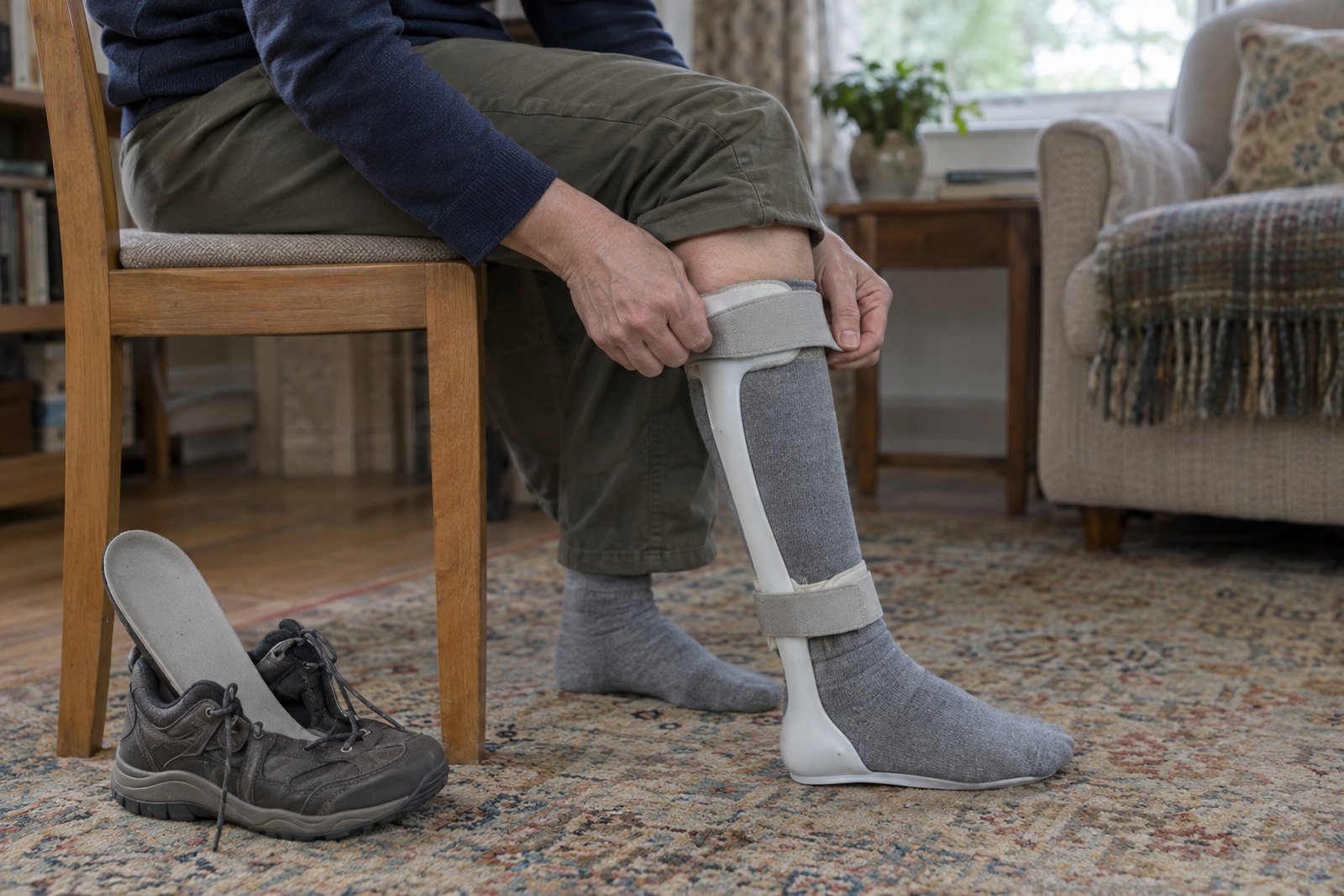
An AFO, or ankle foot orthosis, is a splint that runs down the back of your calf and under your foot. It is usually moulded plastic or carbon fibre, held on with straps, and worn inside a shoe. Its main job is to hold your foot up so your toes do not catch the floor as you walk. People call it a foot drop splint, a leg brace or just "the splint". It is assessed for and fitted by an orthotist, and your physiotherapist usually works on walking with it.
Living with one well comes down to a handful of practical things: putting it on with your heel right back, finding shoes that take it, checking your skin, and building up wear gradually rather than all at once. Most people find it awkward for the first week or two and then stop thinking about it. This guide covers the everyday side, and when to go back to the orthotics department rather than putting up with a problem.
Why you have been given an AFO
The most common reason is foot drop. That is weakness in the muscles that lift the front of your foot, so the toes drag or slap down with each step. To avoid tripping, people often hitch their hip, swing the leg out to the side or lift the knee unusually high. All of that is tiring and none of it is very safe.
Foot drop has a lot of possible causes. The ones that most often lead to an AFO are:
- Stroke, where weakness on one side affects the ankle as well as the arm and leg.
- Multiple sclerosis, where foot drop may come and go or worsen with tiredness and heat.
- Nerve injury, for example damage to the nerve that runs around the outside of the knee, or pressure on a nerve in the lower back.
- Cerebral palsy in children, where AFOs are often used to position the foot and ankle and help with standing and walking.
- Other neurological conditions, such as motor neurone disease or some inherited nerve conditions.
An AFO can also control an ankle that rolls inwards or outwards, help steady the knee, or gently hold a tight calf in a stretched position (some children and adults have a separate splint for night time for this reason).
The main types
- Solid or rigid AFOs hold the ankle at a fixed angle. Very supportive, but the ankle cannot bend.
- Hinged or articulated AFOs have a joint at the ankle, so some movement is allowed while the toes are still held up.
- Flexible AFOs (sometimes called posterior leaf spring) are thinner behind the ankle and spring back as you lift your foot.
- Carbon fibre AFOs are lighter and slimmer, often with a strut down the side or front.
- Off-the-shelf supports range from simple ankle straps that lift the shoe to standard-sized plastic splints, usually for milder foot drop.
Some people are offered functional electrical stimulation instead of, or alongside, an AFO. That is a decision for your physiotherapist or specialist service.
New foot drop needs checking first
If foot drop comes on suddenly with a drooping face, arm weakness or slurred speech, call 999. That could be a stroke. If you have back pain with numbness around your bottom or genitals, or new problems controlling your bladder or bowels, go to A&E or call 999. Any other new foot drop without a known cause should be seen by your GP promptly, not managed with a splint bought online.
Who does what
An orthotist assesses your foot and leg, decides which type of AFO suits you, measures or takes a cast, fits it and adjusts it. Orthotists are registered with the Health and Care Professions Council, and you can check the register on the HCPC website. On the NHS you are usually referred to orthotics by your GP, hospital consultant or physiotherapist.
Your physiotherapist leads on walking: how to step, balance, use the AFO on slopes and stairs, and exercises alongside it. A podiatrist is the person for corns, nails and foot health, especially if you have diabetes. Your GP is the route back in if you have been discharged and things change.
Putting it on properly
Most problems with AFOs, from rubbing to tripping, start with the heel not being fully back in the heel cup. If your heel sits even slightly forward or lifted, the splint presses in the wrong places and does not hold the foot as it should. Your orthotist will show you their preferred method, and it is worth following that. A common routine looks like this:
- Sit down on a firm chair or the edge of the bed with your feet flat. Do not try to do this standing.
- Put on a sock first. It should be longer than the top of the AFO and pulled smooth, with no wrinkles.
- Place the AFO behind your leg and slide your foot in, or put the AFO into the shoe first and slide your foot into both, whichever your orthotist recommends.
- Get the heel right back. Press down gently on your knee, or push your knee forward over your foot, so the heel settles into the back of the splint. Look or feel to check there is no gap.
- Fasten the ankle strap first if you have one, because that is the strap that holds your heel down. Snug, not tight.
- Then fasten the calf strap, firm enough that the splint does not slide around but not so tight it leaves deep marks.
- Put the shoe on and fasten it, then stand and check the heel has not lifted.
If one hand or one side does not work well
After a stroke, many people are doing this one-handed with a weak leg. Things that help include crossing the affected leg over the other knee if your balance allows, a long-handled shoehorn, a footstool to bring the foot closer, and straps with a loop or ring you can pull with one hand. Fastening order and a consistent seat matter more than strength. Our guides to dressing aids and living with one-sided weakness go into more detail.
Shoes that work with an AFO
This is the question people ask most, and the honest answer is that your usual shoes probably will not fit. The splint takes up room under and around your foot. What tends to work:
- Go up a size, often half a size to a full size, or a wider fitting. Try shoes on with the AFO in, not without.
- Removable insoles. Taking the insole out of the AFO-side shoe frees up a surprising amount of space.
- Wide openings. Laces that go a long way down towards the toes, or touch-fastening straps, let you open the shoe right up and get the AFO in without forcing it.
- A firm heel at the back that does not collapse, and a sole with reasonable grip.
- A low, broad heel. Avoid slip-ons, backless shoes and anything with a thin or tall heel.
Some people buy two pairs in different sizes to get a matched set, and some specialist footwear suppliers sell odd sizes. Ask your orthotist if they can suggest options locally. If you genuinely cannot find anything, tell them, as some people are referred for adapted or specialist footwear.
Heel height matters
Your AFO is set up for a particular heel height. Swapping from a flat trainer to a shoe with a bigger heel tips you forward or back and changes how the splint works. Stick with similar heel heights, and if you want to wear something different for an occasion, ask your orthotist first.
Socks, skin checks and keeping it clean
Always wear a sock between your skin and the AFO. Choose one that is longer than the splint, fairly thin, smooth, and ideally with flat or no seams. Change it daily, or more often if your feet get sweaty.
Check your skin every time you take the AFO off, especially in the early weeks. Look at the heel, ankle bones, top of the foot, the base of the toes and where the calf strap sits. A mirror on the floor helps, or ask someone to look.
What a red mark means
Some pinkness where the straps sit is normal and should fade quickly. A red mark that is still there after about 20 to 30 minutes with the splint off is a sign of too much pressure. Contact your orthotics department. Do not keep wearing it and hope it settles, and stop wearing it if you get a blister, broken skin or a sore that is getting worse.
If you have diabetes or reduced feeling
If you have diabetes, or reduced sensation in your feet for any reason, you may not feel a sore developing. Check your feet every day without fail. If you find broken skin, a blister or a wound, take the AFO off and contact your orthotist, GP or diabetes foot team the same day. If there are signs of infection such as spreading redness, heat, swelling or you feel unwell, call NHS 111 or your GP urgently.
Looking after the splint
Wipe it with a damp cloth and mild soap, then let it dry at room temperature. Keep it away from radiators, fires and hot cars, because heat can change the shape of plastic. Clear fluff from the fastening straps so they keep gripping. Never cut, sand or heat the splint to change it yourself.
Getting used to it gradually
Your orthotist will usually give you a wearing schedule. Follow that rather than the general advice here. If you were not given one, the usual approach is to start with short periods, check your skin each time, and build up over days rather than wearing it all day from the start.
Expect it to feel strange. Your walking pattern changes, other muscles take a different load, and it may feel heavy or hot. Mild tiredness in the leg is common early on. What is not normal is pain, marks that do not fade, numbness or tingling, or feeling less steady than before. Report those.
Stairs, driving, bathing and night time
A rigid AFO stops your ankle bending, so going down stairs can feel harder; use a rail, take one step at a time, and ask your physiotherapist to practise it with you (our guide to stair rails and half steps may help). On driving, the condition behind your foot drop may need to be reported to the DVLA and the splint can affect how you use the pedals, so check GOV.UK, tell your insurer and see our guide to driving after a stroke.
You take the AFO off to wash, so plan for that. Sit to dry and dress your feet, and do not walk on a wet floor without it. Night-time trips to the toilet are a classic moment for a trip when the foot is unsupported. Keep the splint and shoe where you can reach them from the bed, use a night light, and if putting it on at 3am is unrealistic, talk to an occupational therapist about the route, rails or a bedside alternative.
Do not walk about in the AFO without a shoe unless you have been told it is designed for that. Most splints are slippery underneath and are not made to take your weight directly on the floor.
Children and AFOs
Children grow, and AFOs do not. Your child should be reviewed regularly by their orthotics service, but you do not have to wait for the appointment if it no longer fits. Signs it is getting small include toes reaching or curling over the end, new red marks, the heel not settling back, straps that only just close, or your child suddenly refusing to wear it. Younger children often cannot explain discomfort, so refusal is information, not just behaviour.
Tell school and nursery how to put it on and what to look for, and send a note of which shoes go with it. PE, playtime and swimming all need a plan. If shoes are a constant battle, ask the orthotist about footwear advice, because growing feet in splints can get through shoes quickly.
When to go back to the orthotist
Contact your orthotics department if:
- red marks last longer than about 20 to 30 minutes, or you get blisters or broken skin
- the AFO cracks, a strap or rivet breaks, or the padding wears through
- your leg swells more or less than before, or your weight has changed noticeably
- you have new pain in the foot, knee, hip or back
- you are tripping or falling, or feel less steady
- your condition has changed, for better or worse
- a child has grown or the splint has stopped fitting
If you have been discharged, many departments let you contact them directly about an existing splint. If not, your GP or physiotherapist can refer you back.
Where an occupational therapist fits
To be clear: an occupational therapist does not prescribe, fit or adjust AFOs. That is the orthotist's job, and walking with one is the physiotherapist's territory. If the problem is the splint itself, go to them.
Where an occupational therapist can help is the rest of the day around it. That might mean working out how to get the AFO, sock and shoe on one-handed, choosing the right chair and setting for doing it, planning a morning routine that does not leave you exhausted before breakfast, making washing and night-time toilet trips safer, and showing a family carer how to help without rushing it. They can also look at falls risk around the home and suggest equipment such as long-handled shoehorns or easier fastenings. For people living with stroke, MS or another long-term condition, this sits alongside wider work on everyday tasks, covered in our guide to stroke recovery at home. A private occupational therapist visiting at home through our neurological occupational therapy service can see exactly where you get stuck.
Frequently asked questions
Can I wear my AFO without a shoe?
Usually not. Most AFOs are designed to be worn inside a shoe, and the underside is often slippery. Walking in the splint alone can make a fall more likely. Ask your orthotist if yours is an exception.
How many hours a day should I wear it?
That depends on why it was prescribed and what your orthotist has advised. Most people build up gradually from short periods to wearing it whenever they are up and walking. Follow the schedule you were given, and if you were not given one, ask.
Should I sleep in my AFO?
Only if you have been told to. Some people have a separate night splint to stretch a tight calf, which is different from a daytime walking AFO. Do not sleep in a walking splint unless your orthotist or physiotherapist has said so.
Will I need an AFO forever?
It depends on the cause. Some people with nerve injuries recover enough to stop using one. People with stroke, MS or cerebral palsy may need one long term, though the type can change over time. Your physiotherapist and orthotist will review this with you.
My knee or hip has started aching since I got it. Is that normal?
Some new muscle tiredness early on is common because you are walking differently. Pain that persists or is getting worse is not something to put up with. Tell your orthotist or physiotherapist, as the splint may need adjusting.
Can I buy an AFO online?
Simple off-the-shelf supports are sold widely, but foot drop needs a proper diagnosis first, and the wrong splint can cause sores or make walking worse. See your GP and get an orthotist's assessment. If you go private, check the orthotist is HCPC registered.
Next steps
If getting the AFO on, washing or moving safely around your home is the hard part, an occupational therapist can help with the daily routine around it. See our neurological and children's occupational therapy pages, or current guide prices, and choose your area below.

Talk to an occupational therapist near you
This guide is general information. For advice about your own situation - or someone you look after - a local occupational therapist can visit you at home and see it for themselves.
Choose your area: