

Stair Rails, Second Banisters and Half Steps: Making Stairs Safer
By Mobile Occupational Therapist • 19 October 2026 • 12 min read
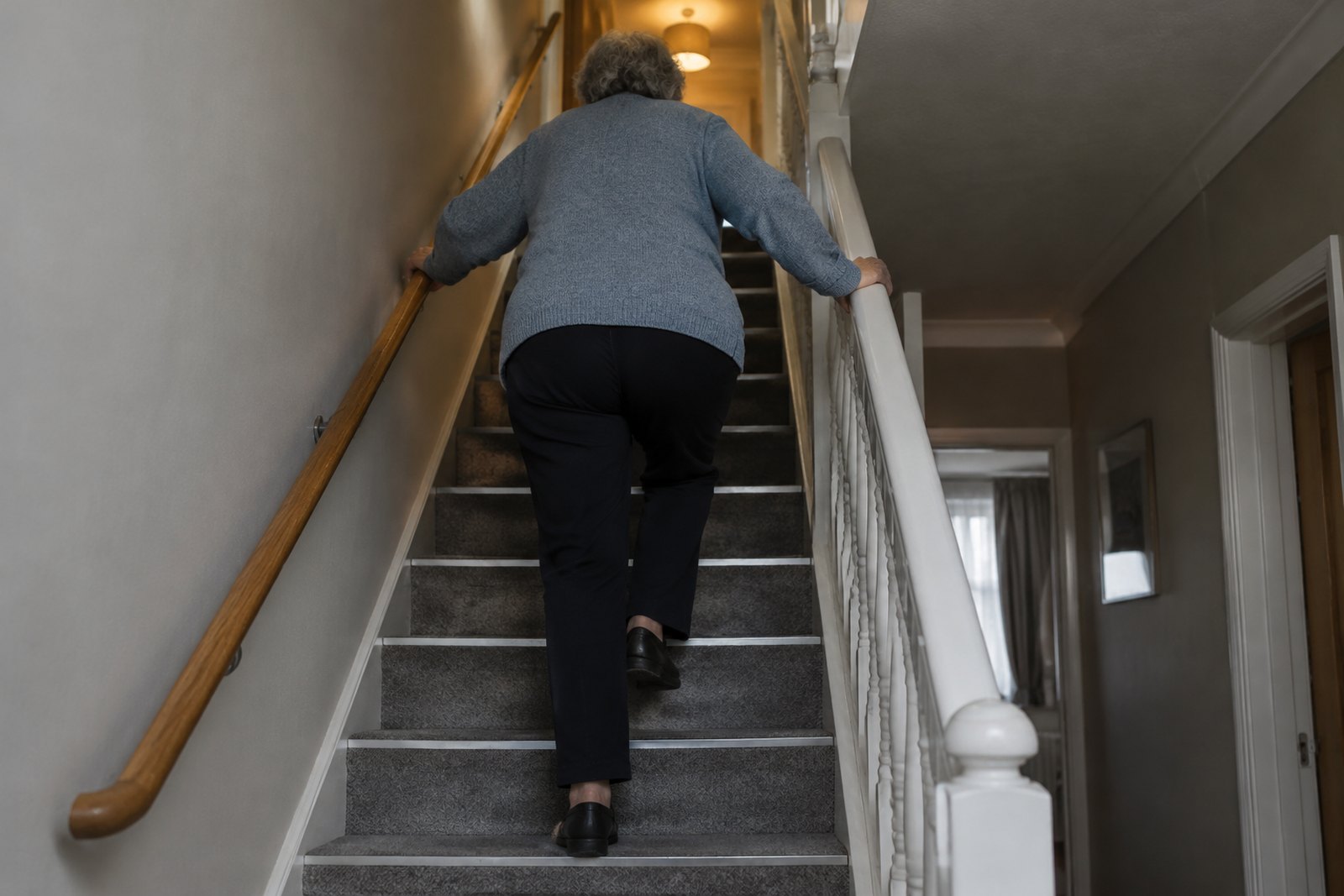
If stairs have started to feel like hard work, or you have watched your mum take them one at a time while gripping the banister with both hands, the single most useful change is usually a second stair rail on the other side. Two rails give support on both sides, in both directions, and let you hold on with your stronger arm whether you are going up or coming down. It is one of the cheapest, least disruptive changes you can make to a home, and it often helps more than people expect.
After that, the detail matters: the height of the rail, whether it runs all the way without breaks, whether it is fixed into something solid, and whether you can actually see where each step ends. For some people, half steps (small extra steps that split each rise in two) help as well. For others, the honest answer is that the stairs need a different solution. This guide covers all of it, plus how to get help from your council.
Why a second rail makes such a difference
Most homes have one banister. That is fine until one side of your body is weaker than the other, which happens to most people eventually. Going up, you hold the rail with, say, your right hand. Coming down, the same rail is on your left. If your left hand is the one with arthritis, or the arm that has not been the same since a stroke, you are relying on your weaker side for the harder direction. Coming down is when most people feel least steady, because you are lowering your weight rather than pushing it up, and a stumble pitches you forward.
A second rail fixes this. You can hold with your stronger hand both ways, or with both hands when you need to. It also means you stop using things that were never meant to take your weight: the wall, the spindles, a radiator, the door frame at the bottom. People do this quietly for years. It works until it does not.
It also fits the old physiotherapy rule for stairs: up with the good, down with the bad. Going up, step first with your stronger leg. Coming down, lead with the weaker leg and let the stronger one do the controlled bending. With rails on both sides, you can follow that pattern and keep your stronger hand on a rail. If a physiotherapist has taught you a specific technique after surgery, follow theirs.
People who gain most include anyone with one-sided weakness, arthritis, a new hip or knee, Parkinson's or MS, poor sight, or a fear of stairs after a fall or near miss.
Getting the rail itself right
Height
Building regulations guidance for new building work in England (Approved Document K, on GOV.UK) puts stair handrails between 900mm and 1,000mm high, measured vertically from the line of the step edges to the top of the rail. Existing homes do not have to meet this, and it is a sensible starting point rather than a rule. What matters more is the person using it: someone shorter or who stoops may want it lower. Try to have both rails at the same height so you stay level, and check the existing banister is not unusually low before copying it.
Continuous, and longer than the stairs
The best rail is one you never have to let go of. Breaks at a landing, a turn or a set of winders (the wedge-shaped steps on a turning stair) are exactly where people lose their footing, because for a moment there is nothing to hold. Where possible, the rail should run continuously round turns and across short landings.
It should also extend past the top and bottom step rather than stopping at the edge of the last one. Stepping on and off the stairs is when balance shifts most, and plenty of people fall at the top reaching for a rail that has already ended. The ends should be turned in towards the wall or finished off so sleeves and dressing gown cords cannot catch.
A rail you can actually grip
- Shape: a round or rounded oval rail you can wrap your fingers around is far easier than a wide, flat or chunky decorative one, especially with arthritis.
- Space behind: enough gap between rail and wall for your knuckles.
- Brackets underneath: so your hand can slide along without bumping into them.
- Contrast: a rail that stands out against the wall colour is easier to find for people with poor sight or dementia.
Fixed into something solid
This is the part that matters most. A stair rail has to take your full body weight in a sudden jolt when you stumble. It must never be fixed into plasterboard alone, whatever the wall plugs promise. On a brick or block wall, it needs proper masonry fixings into the solid wall, not just the plaster. On a stud wall (a timber or metal frame covered in plasterboard), the brackets need to go into the studs or into a solid backing board fitted behind. Whoever fits it should check for hidden pipes and cables first.
Give your existing banister an honest test too. If it wobbles, creaks or has loose spindles, get it repaired. A second rail is not a substitute for a safe first one.
Lighting and step edges
Many stair falls are not about strength. They are about not seeing the edge of the step.
- Switches at top and bottom, so nobody walks the stairs in the dark to reach a light. An electrician can add two-way switching.
- Bright, even light on the steps themselves, without glare in your eyes as you come down.
- Night lighting, such as plug-in night lights or motion-sensor lights on the landing, for night-time trips to the toilet.
- Contrasting step edges: a strip of contrasting colour along the front of each step shows exactly where it ends. Very helpful with plain carpet or sight loss.
- Sensible floor coverings: bold patterns make steps hard to judge, and worn or loose carpet is a trip hazard.
- Nothing left on the stairs: the pile of things waiting to go up is a classic hazard.
Think about carrying, too. If you need both hands for the rails, you cannot also carry a laundry basket. A small bag worn across the body, or keeping essentials upstairs and downstairs, saves trips. Varifocal and bifocal glasses can make step edges harder to judge when you look down, so mention it to your optician if stairs feel odd.
Half steps: what they are and who they suit
A half step is a small, sturdy step block that sits on each stair tread, usually on one side, splitting each normal step into two smaller rises. Instead of lifting your foot the full height of a stair, you lift it half as far, twice. They can be freestanding units secured in place or built in by a joiner.
Half steps can suit people who are steady on stairs but struggle to lift a leg or push up through a full step, for example people with arthritis in the hips or knees, some people after a joint replacement (check with your surgical team first), people with leg weakness who lack power rather than balance, and people of short stature or living with unusually steep stairs.
The downsides are real. They take up part of the stair width, narrowing the stairs for everyone else. Each tread needs to be deep enough to hold a foot on both the step and the half step without overhanging. They rarely work on winders. They add extra edges, which can confuse someone with dementia or poor sight. They must be firmly secured, with a rail on the side being used, because a half step that shifts is worse than none. And everyone in the house, including visitors and grandchildren, needs to know they are there, particularly at night. This is one to have assessed in person rather than bought on a hunch.
Outside steps
Steps up to the front door or down to the garden bring extra problems: rain, frost, leaves, moss and darkness. The same principles apply, plus a few more:
- Rails on both sides where possible, made for outdoor use and extending past the top and bottom step.
- A non-slip surface kept clear of moss and leaves, and gritted in icy weather.
- Contrasting paint or strips on step edges.
- A light by the door, ideally motion-sensor, so you are not hunting for keys in the dark.
- A flat area at the door so you can stand level while unlocking, rather than balancing on the top step.
For thresholds and getting in and out more generally, see our guide to ramps, rails and thresholds.
When the stairs are no longer the answer
Rails and half steps help people who can still manage stairs safely with a bit of support. They do not make stairs safe for someone who cannot. Signs it may be time to think differently include needing to stop and rest partway, needing someone to help every time, falls or near misses on the stairs, or avoiding upstairs altogether and sleeping in a chair.
Options include practical ways to manage stairs without a stairlift, such as living on one floor for a while; a stairlift, though it is worth reading about whether you need an OT assessment before buying one; or, for people who cannot transfer safely onto a stairlift or who use a wheelchair, a through-floor lift. For some, moving to a home without stairs is the right long-term answer.
If stairs have suddenly become much harder, do not just put it down to age. See your GP if you are getting breathless, dizzy or unusually tired on the stairs, or if you have had a fall. Call 999 for chest pain, sudden weakness on one side, a drooping face or slurred speech.
Getting help from your council
Stair rails are one of the most common things councils provide. In England, you can ask your council's adult social care team for a needs assessment, and if you are assessed as needing them, minor adaptations costing up to £1,000 should be provided free. Some areas fit rails through a home improvement agency or handyperson service. Waits vary a lot between areas. Arrangements differ in Wales, Scotland and Northern Ireland, so check with your own council or health and social care trust.
In England, Wales and Northern Ireland, bigger changes such as a stairlift or through-floor lift may be covered by a Disabled Facilities Grant, which is usually means-tested for adults (the rules differ between nations). In Scotland the system is different, so ask your council about help with adaptations. Our guide to the Care Act needs assessment explains how to ask and what to say.
Where an occupational therapist fits
An occupational therapist looks at how you actually use your stairs, not just the stairs themselves. On a home visit they will usually watch you go up and down, note which side is stronger, check the existing banister and recommend exactly where a second rail should go, how high and how far it should extend. They can say whether half steps are likely to help, look at outside steps, and tell you honestly whether the stairs are still a sensible option. They can also look at the rest of the home and write a report to support a council or grant application. A private occupational therapist visiting at home can often do this sooner than a council waiting list; see our home adaptations page.
What an occupational therapist does not do is fit the rail (a job for a joiner or handyperson) or investigate breathlessness or dizziness (your GP). Physiotherapists lead on strength and balance exercises and stair practice after surgery.
Frequently asked questions
Is it OK to hold the spindles or the wall instead?
It is common, but spindles are not designed to take a sideways pull of body weight and walls give you nothing to grip. If you or a parent are doing this, it is a strong sign a second rail is needed.
Will a second rail get in the way of a stairlift later?
Sometimes. A stairlift usually runs on one side, and a rail on that side may need to be shortened or moved. If a stairlift is likely in the next few years, plan the rail position with that in mind.
Will the council fit a stair rail for free?
In England, if you are assessed as needing it, a minor adaptation up to £1,000 should be free, and a stair rail is usually well within that. Contact adult social care. Elsewhere in the UK, check with your council or trust.
Can I fit a second rail myself?
Only if you are confident and know exactly what your wall is made of. The rail must hold someone's full weight in a fall, so fixings into solid masonry or studs are essential. If in doubt, use a competent joiner or handyperson.
Do I need permission if I rent?
Ask your landlord first, in writing. Council and housing association landlords often have their own adaptations process and may fit the rail themselves.
Next steps
If you would like someone to look at your stairs and the rest of the home in person, see our home assessment page, or current guide prices, and choose your area below.

Talk to an occupational therapist near you
This guide is general information. For advice about your own situation - or someone you look after - a local occupational therapist can visit you at home and see it for themselves.
Choose your area: