

Driving After a Stroke: DVLA Rules and Getting Back on the Road
By Mobile Occupational Therapist • 23 September 2026 • 13 min read
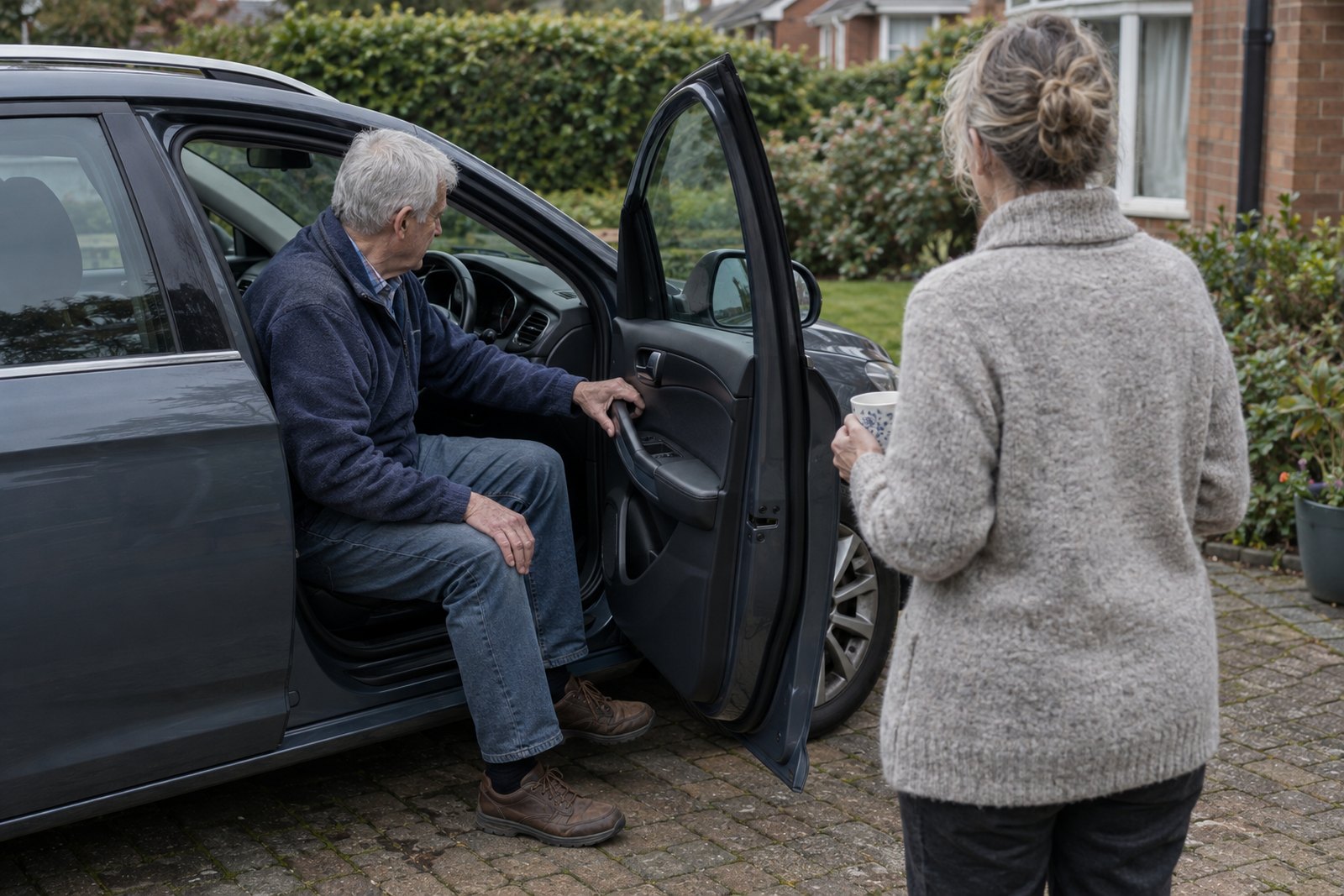
If you have had a stroke or a TIA (a mini-stroke) and you hold an ordinary car or motorbike licence, the general rule in the UK is that you must not drive for at least one month. After that month, you may be able to drive again if your doctor agrees you have recovered well enough. If you still have problems after the month is up, such as with your vision, movement, concentration or thinking, you need to tell DVLA. If you drive a lorry, bus or minibus on a Group 2 licence, the rules are much stricter and you must tell DVLA. There are extra conditions for some situations, such as several TIAs close together, and rules do change, so check the current GOV.UK guidance on stroke and driving before you decide anything.
That is the legal side. The harder part is the honest one: whether driving is right for you now, even when the law allows it. Many of the stroke effects that matter most behind the wheel are invisible. A gap in your vision you do not notice. Slower reactions. Tiredness that arrives twenty minutes into a journey. This guide covers the rules, what actually affects driving, how a specialist driving assessment works, adaptations, insurance, and where an occupational therapist fits. Nothing here can tell you that you are safe to drive. That decision belongs to your doctors, DVLA and, where needed, a specialist driving assessment.
What the DVLA rules say, and where to check them
Car and motorbike licences (Group 1)
The broad position for most people, as set out on GOV.UK, is:
- Do not drive for at least one month after a stroke or TIA. This applies even if you feel completely back to normal.
- After one month, you may be able to drive again if your doctor says your condition has improved enough.
- Tell DVLA if problems remain after the month. That includes weakness, vision changes, problems with memory, attention or judgement, and anything else that could affect driving.
- A single TIA with full recovery usually does not need to be reported, but repeated TIAs are treated differently and usually mean a longer period off the road.
Read the GOV.UK page yourself rather than relying on a summary, including this one. If you are unsure which rule applies to you, ask the stroke team or your GP directly and write down what they say.
Lorry, bus and minibus licences (Group 2)
If you hold a Group 2 licence, you must tell DVLA after a stroke or TIA, and you will usually be off the road for considerably longer than a car driver, with more medical checks before you can return. If your job depends on this licence, speak to your employer early. Our guide to getting back to work after illness or injury covers what reasonable adjustments and a phased return can look like.
How telling DVLA works
You can tell DVLA online or by post through GOV.UK, where there is a stroke questionnaire to complete. DVLA may then contact your doctors, ask you to have an eyesight or visual field test at an optician, or ask you to attend a driving assessment. They will write to tell you their decision, which might be that you can keep your licence, that you get a shorter licence that needs renewing, that you need particular car adaptations, or that you must stop driving for now.
In some situations the law allows you to keep driving while DVLA considers your case, but only if your doctor agrees and you meet specific conditions. Do not assume this applies to you. Check GOV.UK and ask your doctor first.
It matters. GOV.UK states you can be fined up to £1,000 if you do not tell DVLA about a medical condition that affects your driving, and you may be prosecuted if you have an accident. You can also choose to give up your licence voluntarily, which some people find less stressful, and reapply later if things improve.
The effects of a stroke that matter for driving
Driving is one of the most demanding things most of us do every day. It needs good vision, quick thinking, steady attention, decent reactions and enough physical control, all at once, for the whole journey. A stroke can chip at any of these.
Vision and visual field loss
A common effect of stroke is losing part of your field of vision, often the same half on both eyes. This is called hemianopia. Some people are not aware of it at all, because the brain fills in the gap. There is a legal minimum standard for visual field when driving, and many people with hemianopia do not meet it. Other visual problems, such as double vision or difficulty judging distance, can also matter. If the stroke team has not checked your visual field, ask. An orthoptist (an eye specialist who often works with stroke teams) or an optician can test it.
Attention, thinking and judgement
Thinking changes after a stroke are often the least obvious and the most important. Watch for:
- Difficulty doing two things at once, such as talking and following directions
- Missing things on one side, sometimes called neglect, such as eating only half a plate of food or bumping into door frames
- Slower processing, so busy junctions feel overwhelming
- Getting lost on familiar routes, or planning becoming harder
- Changes in judgement or confidence that is higher than ability
Language problems (aphasia) can also affect reading road signs quickly.
Reaction time
Even when strength comes back, reactions can stay slower. On the road, a fraction of a second matters, and you may not feel the difference yourself.
Fatigue
Post-stroke fatigue is real and can be heavy. It is not ordinary tiredness and it does not always lift with sleep. A short drive to the shops might feel fine while the drive home, once you are tired, is a different matter. Concentration tends to drop sharply when you are fatigued.
Weakness, sensation and coordination
Weakness or numbness in an arm or leg affects steering, braking, changing gear and using controls. Reduced feeling in your foot can make it hard to judge pedal pressure. Getting in and out of the car, and lifting a wheelchair or walking aid into the boot, also count.
Seizures, mood and medicines
Some people have a seizure after a stroke. Seizures have their own separate driving rules, so tell your doctor and check GOV.UK if this happens. Low mood and anxiety are also common after a stroke and can affect concentration. If you have started new medicines, ask your pharmacist or GP whether any of them could affect your driving.
Honest signs it may be too soon
These are not tests, and they cannot tell you that you are safe. But if any of these sound familiar, raise them with your doctor before getting behind the wheel:
- You tire out after short, everyday tasks
- You often knock into things on one side or miss things on one side of the table
- You lose track of conversations, especially in busy places
- You have got lost, or felt muddled, somewhere familiar
- People you trust feel uneasy about the idea of you driving
- You find yourself thinking "I will just stick to short trips"
That last one is worth a moment. Short local trips are not automatically safer. Most of the hard bits of driving, such as junctions, roundabouts, pedestrians and parked cars, are on local roads.
For families: when you are worried
If you are worried that your mum, dad or partner is driving when they should not be, you are not alone and you are not being disloyal. Start with a calm conversation, ideally not in the car and not when anyone is tired. Talk about the specific things you have noticed rather than their ability in general. Suggesting a specialist driving assessment can feel less like a verdict and more like getting an independent opinion.
If they will not listen, speak to their GP. You may not be told anything confidential, but the GP can take your concerns into account, and doctors have professional guidance on when they should inform DVLA themselves. Our guide on when a parent refuses help at home has more on handling these conversations without a standoff.
Specialist driving assessments
The UK has a network of accredited driving assessment centres, coordinated by the charity Driving Mobility. These centres assess people whose driving may be affected by a medical condition or disability. They are not a driving test and they are not trying to catch you out.
An assessment usually includes:
- A chat about your health, your driving history and what you need a car for
- Checks of vision, thinking skills, reaction time and physical movement
- Trying out controls and adaptations, sometimes in a static rig
- An on-road drive, usually in a dual-control car with an approved driving instructor
The team often includes an occupational therapist and a driving instructor working together. Afterwards you get a report with recommendations. That might be that you can return to driving, that you need certain adaptations, that some lessons would help, or that driving is not safe for now. DVLA sometimes asks people to attend one of these centres as part of their decision. You can also refer yourself in many cases. Costs and funding vary between centres and situations, so ask when you contact them.
Car adaptations after a stroke
If weakness is the main problem and your vision and thinking are good enough, adaptations can make a real difference. Common ones include:
- Automatic gearbox, so you do not need to change gear or use a clutch
- Left-foot accelerator, for people with right leg weakness
- Steering ball or knob, so you can steer smoothly with one hand
- Moved or extended controls, such as indicators, lights and wipers placed on the side of your stronger hand
- Swivel seats and transfer aids to make getting in and out easier
Get assessed before you buy or fit anything. The right adaptation depends on your exact pattern of weakness, and some adaptations need to be shown on your licence as a code. Fitting the wrong thing is expensive and can make driving less safe, not more. Extra mirrors, for example, do not fix a visual field problem in the eyes of the law.
Insurance
Tell your car insurer about your stroke, and about any car adaptations, even if DVLA says you can carry on driving. Most policies require you to disclose relevant medical conditions and changes to the car. If you do not, your cover may not be valid when you need it. Ask them to confirm in writing. If your premium changes or you are refused, shopping around with a specialist broker for disabled drivers is reasonable.
If you cannot drive, or not yet
Losing the car can feel like losing independence overnight, and it is fine to grieve that. Some things that help:
- A Blue Badge can be used when you are a passenger, which makes lifts from family much easier
- If you have been refused a licence on medical grounds, you may qualify for a disabled person's bus pass. Check with your council
- Community transport and dial-a-ride schemes run in many areas, again through the council or local charities
- Plan regular lifts with family or friends for fixed things, such as shopping or a weekly club, so you are not asking every time
Where an occupational therapist fits
Occupational therapists help people get back to the everyday things that matter to them, and for many people driving is near the top of the list. Here is where an OT can genuinely help:
- NHS stroke team OTs assess thinking, vision in everyday tasks and practical skills, and can flag concerns about driving early
- A private occupational therapist visiting at home can look at how you manage daily life, how fatigue builds through the day, how attention and memory are coping, and whether you can get in and out of a car safely. They can suggest when a specialist driving assessment makes sense and help you work towards it
- An OT can help you plan a life that works while you are not driving, from getting to appointments to staying in contact with people
- Where you need written evidence of how the stroke affects daily life, for example for benefits or work, a functional assessment report can help
Be clear about the limits. An occupational therapist visiting at home does not do an on-road driving assessment and cannot clear you to drive. That is for DVLA, your doctors and an accredited driving assessment centre. Your GP or stroke consultant leads on medical fitness. A physiotherapist leads on strength, balance and walking. An orthoptist or optician checks your vision and visual field. A speech and language therapist helps with communication and aphasia. Our guide to stroke recovery at home and our stroke page explain more about how these roles fit together.
And a reminder that matters more than any of this: if you or someone you are with has new signs of a stroke, such as a drooping face, arm weakness or slurred speech, call 999 straight away, even if the symptoms pass.
Frequently asked questions
Can I drive after a TIA?
Not for at least one month, according to the general GOV.UK rule for car and motorbike licences. After a single TIA with full recovery, you usually do not need to tell DVLA, but several TIAs close together are treated differently. Check the current GOV.UK guidance and ask your doctor.
Do I have to tell DVLA about my stroke?
If you drive a car or motorbike, you need to tell DVLA if you still have problems that could affect driving after the first month. If you hold a lorry, bus or minibus licence, you must tell DVLA. If in doubt, check GOV.UK and ask your doctor, because not telling DVLA when you should can lead to a fine.
Can my GP tell me if I am fit to drive?
Your GP or stroke consultant can advise whether your medical recovery is good enough, and the one-month rule depends partly on their view. For anything beyond that, DVLA makes the licensing decision, and a specialist driving assessment may be needed to look at how you actually drive.
Will I need to retake my driving test?
Not usually a formal test, but DVLA may ask you to attend a driving assessment, have an eyesight check or take lessons with adaptations. The details depend on your situation, so wait for DVLA's letter and follow it.
Do I need to tell my insurer if DVLA says I can drive?
Yes, in most cases. Insurers usually require you to disclose relevant medical conditions and car adaptations. Check your policy and get their answer in writing.
What happens if DVLA takes my licence away?
DVLA will explain why in their letter, and usually when or whether you can reapply. Recovery after a stroke can continue for a long time, so it is not always permanent. In the meantime, look at passenger Blue Badges, bus passes and community transport.
Next steps
If you want practical help with daily life after a stroke, and an honest view of when a driving assessment might be the right next step, see our neurological occupational therapy page or home assessment page, check our current guide prices, and choose your area below.

Talk to an occupational therapist near you
This guide is general information. For advice about your own situation - or someone you look after - a local occupational therapist can visit you at home and see it for themselves.
Choose your area: