

Wobble Cushions: Do They Help Children Sit Still and Focus?
By Mobile Occupational Therapist • 8 October 2026 • 14 min read
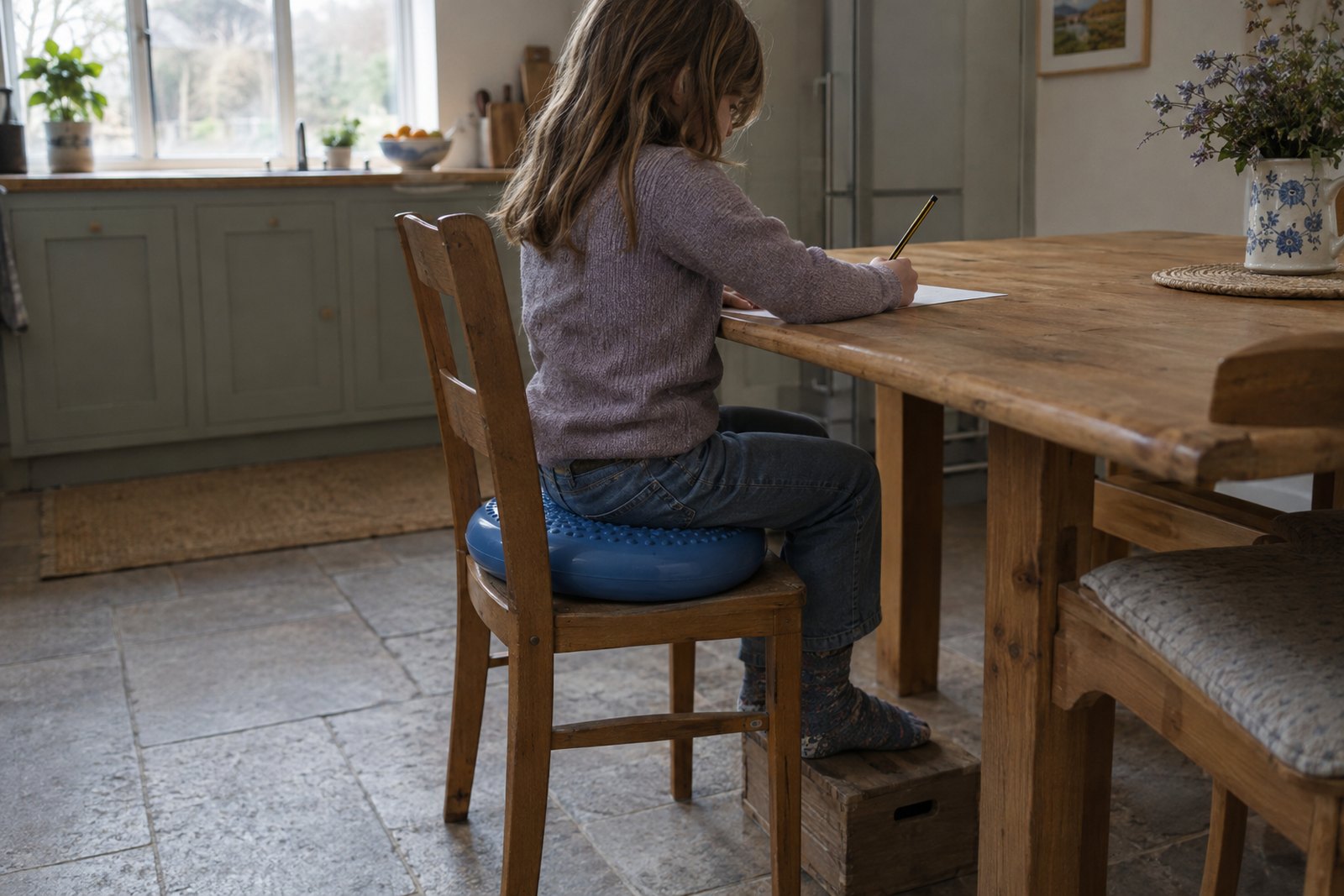
A wobble cushion is a round or wedge-shaped air-filled disc that sits on a chair seat. It lets a child rock, shift and wriggle slightly without getting up. For some fidgety or movement-seeking children it helps them stay in their seat longer and settle to a task. For others it makes no difference, and for a few it makes things worse. The research is limited and mixed, so the honest answer is: it might help your child, and the only way to find out is a careful, short trial.
What a wobble cushion does not do is make a child concentrate. At best, it gives a restless body some of the movement it is looking for in a way that does not involve tipping the chair, sliding onto the floor or wandering round the classroom. That can leave more attention free for the work. It is a small tool, not a fix, and it works best alongside other changes. This guide covers what to try, how to set it up so you get a fair answer, and when a fidgety child needs more than a cushion.
What a wobble cushion actually is
You will see the same thing sold as a wobble cushion, wiggle cushion, sensory cushion, balance disc, seat disc or air cushion. They are usually made of a rubbery plastic, filled with air through a small valve, and often have a smooth side and a bumpy side. Some are flat and round, roughly the size of a dinner plate or a bit bigger. Others are wedge-shaped, higher at the back than the front, which tips the child slightly forward.
Very similar discs are used in gyms and physiotherapy for balance exercises. For sitting at a table, the cushion usually needs to be softer and less inflated than it would be for standing on. That one detail makes a big difference, and we come back to it below.
The idea behind it
Sitting still is not a resting state for children. It takes muscle work and a fair bit of self-control, and some children find it much harder than others. You see it as constant fidgeting, rocking the chair back on two legs, kneeling up, sitting on their feet, sliding down until they are almost under the table, or getting up every few minutes.
The thinking behind a wobble cushion is sometimes called active sitting. Instead of fighting the urge to move, you give the child a seat that allows small, contained movements. The body gets feedback from the muscles and joints (the sense called proprioception) and from the balance system in the inner ear. For children who crave that kind of input, a bit of it on tap may help them feel more settled. The slight instability also asks the trunk muscles to keep working, which is why some people suggest it for children who slump.
That is the theory. Whether it works for a particular child is another matter.
What the evidence says
There has been some research on air cushions and therapy balls as classroom seating, mostly involving children with ADHD, autism or attention difficulties. Some studies found that some children spent more time in their seats and on task while using them. Others found little or no difference compared with an ordinary chair. Results vary from child to child even within the same study.
Most of the studies are small, short and use different ways of measuring success, so it is hard to draw firm conclusions. There is no good evidence that a wobble cushion improves learning, reading or handwriting in itself, or that the effect lasts once the novelty wears off. Anyone who tells you a cushion will transform your child's concentration is overselling it.
None of that means you should not try one. They are inexpensive, low risk for most children and easy to stop using. It just means you should treat it as an experiment and judge it on what you actually see, not on what the packaging promises.
Who a wobble cushion may suit
- Fidgety children with decent balance. Children who are on the move constantly but are steady on their feet and do not fall off things.
- Movement seekers. Children who rock, spin, bounce, crash into sofas and seem to need more movement than others. Our guide to sensory-seeking behaviour in children explains why this happens.
- Chair tippers. If your child rocks their chair back on two legs, a cushion can offer a safer outlet for the same urge.
- Some children with low muscle tone or hypermobility who slump and sprawl. The cushion may prompt them to sit up a little more. Be careful, though: these children often tire quickly, so very short periods are the rule. See hypermobility in children for more on managing tiredness.
- Children with attention difficulties who find it hard to stay seated for short focused tasks, such as reading with you or homework.
Who it may not suit
- Children with poor balance or coordination. If your child already falls off chairs, trips a lot or finds it hard to sit upright, an unstable seat adds to the problem. Many children with dyspraxia do better with more stability, not less.
- Children who need a firm base for writing or fine motor work. Handwriting, cutting and drawing rely on a steady trunk and shoulders. If writing gets messier or slower on the cushion, it is the wrong tool for that task.
- Children who dislike unpredictable movement. Some children, including some autistic children, find wobbly surfaces unsettling or frightening. A cushion can make them more anxious, not less.
- Children with physical disabilities who need specialist seating. A cushion is not a substitute for properly assessed seating. Ask your child's occupational therapist or physiotherapist.
- Children with back, hip or pelvic pain. Pain needs looking into by a GP first.
- Children whose restlessness is mainly worry. If fidgeting goes with anxiety, tummy aches or dread about school, a cushion treats the wrong thing.
How to try one properly
Most wobble cushion trials fail because the cushion is too hard, the chair is too high once it is on, or the child sits on it all day. Here is how to give it a fair go.
Get the inflation right
Under-inflate it. A rock-hard cushion is a balance challenge, which is tiring and makes falling off more likely. Press the flat of your hand into the middle: it should sink in noticeably and feel squashy, not like a ball. When your child sits on it, they should feel a gentle give and be able to rock slightly, not perch on top of a dome. Cushions lose air over time, so check every week or so.
Check the chair and table height
A cushion adds a few centimetres to the seat, which often leaves feet dangling. Feet should rest flat on the floor, with knees roughly level with or slightly below the hips. If they cannot reach, put a sturdy box or a stack of firm books under their feet. The table should be around elbow height when they sit up, so they are not hunching down or reaching up to write.
Start with short, specific sessions
Use it for one task, for about 10 to 20 minutes: reading together, a worksheet, carpet-time-style listening. Do not leave it on the chair all day. Children get used to it, tire of it, or start treating it as a toy. Let your child have a say in when they use it. A cushion they choose is more likely to work than one imposed on them.
Smooth side or bumpy side
Let them try both. Some children like the extra feel of the bumps; some find it irritating through thin school trousers. Neither is right or wrong.
Set simple rules
It is for sitting on. No standing, kneeling or bouncing on it, and no throwing it. If it becomes a game, put it away and try again another day.
Watch what actually happens
Give it about two weeks and keep rough notes. How long do they stay seated? How much work gets done? Is their writing the same, better or worse? Do they look more settled or more distracted? Compare a few days with the cushion and a few without. If you cannot see a difference, there probably is not one, and that is a useful answer too.
Using a wobble cushion at school
Many schools already have a few cushions in a cupboard, and plenty of teachers are happy to try one. Talk to the class teacher first, or the SENCO (special educational needs co-ordinator) if your child already has extra support. Share what you have tried at home and what you noticed.
A few things to agree on:
- When it is used. Perhaps for listening and reading tasks, but not handwriting if that suffers.
- Chair height. School chairs may not match the one at home, and feet still need to reach the floor.
- Who it is for. Other children often want a go. Some teachers handle this by offering cushions to anyone; others keep one for a specific child. Either can work.
- How you will know it is helping. Ask the teacher to tell you what they see after a couple of weeks.
If your child has, or is being assessed for, an Education, Health and Care plan, an occupational therapy report can set out specific seating and movement recommendations so they are written into the plan rather than left to goodwill. GOV.UK has information on special educational needs support in England.
Alternatives that may work better
A wobble cushion is one way of giving movement. Often other options work as well or better, and many cost nothing.
- Movement breaks. A short burst of movement before and during a sitting task: carrying a pile of books, wall push-ups, jumping on the spot, a quick errand. Planned regularly, this is the backbone of a sensory diet.
- Standing to work. Some children concentrate far better standing up. At home try the kitchen worktop or a raised surface at elbow height. At school, a standing spot at the back can work if the teacher agrees.
- A band around the chair legs. A stretchy exercise band tied across the front legs of a chair gives feet something to push and bounce against quietly.
- A footrest. Sometimes the fidgeting is simply because feet cannot reach the floor. A firm box under the feet can settle a child more than any cushion.
- Different positions at home. Lying on their tummy to read, or kneeling at a low table, is fine for many tasks.
- Something in the hands. A small squeezy object or a bit of putty can occupy restless hands during listening tasks, if it does not become the main event.
- Shorter chunks of work. Ten focused minutes and a break often beats thirty minutes of struggling.
- The basics. Tiredness, hunger and too little time running around outside all make sitting still harder. It is worth a look before buying anything.
When a fidgety child needs more than a cushion
Lots of children are wriggly and grow out of it. But speak to the school SENCO and your GP if your child's restlessness or poor attention is affecting their learning, friendships or family life, or if it shows up everywhere, not just in one setting. The GP or school can talk to you about whether an assessment for ADHD or autism might be appropriate. The NHS website explains how ADHD assessment works.
See your GP if your child seems unusually clumsy, falls a lot, is behind with physical milestones, complains of pain, or has staring spells where they seem to switch off and do not respond. If a child suddenly loses skills they had, or you are worried something is seriously wrong, contact your GP promptly or call NHS 111 for advice.
Where an occupational therapist fits
An occupational therapist looks at why a child is finding it hard to sit and get on with tasks, rather than just what they could sit on. That might be a sensory need for movement, low muscle tone, weak core strength, coordination difficulties, attention, anxiety, or simply a chair and table that do not fit.
A children's occupational therapist can:
- Watch your child at the table and assess posture, balance and fine motor skills.
- Advise whether a wobble cushion is likely to help, and set it up correctly if so.
- Suggest alternatives, including movement breaks and a practical sensory plan for home and school.
- Look at handwriting and other everyday skills if these are a struggle.
- Write a report with specific recommendations for school or an EHCP application.
NHS children's occupational therapy is usually reached through a referral from the GP, school or another health professional, and what is offered varies by area. A private occupational therapist visiting at home can often see your child in their own space, and some can also visit school. Find out more on our sensory needs page.
Be clear about what an occupational therapist does not do. They do not diagnose ADHD or autism; that is done by specialist NHS or private assessment teams, usually led by a paediatrician or psychiatrist. A physiotherapist leads on significant movement or muscle problems, and a speech and language therapist on communication. A good occupational therapist will tell you if someone else is the better first call.
Frequently asked questions
Can I use a gym balance disc as a wobble cushion?
Often, yes, as they are essentially the same thing. Check it fits the chair seat without hanging over the edge, and let plenty of air out. Discs sold for exercise are often pumped up firm for standing balance work, which is too unstable for sitting at a table.
How long should my child sit on a wobble cushion each day?
Start with 10 to 20 minutes at a time for a specific task, and build up only if it is clearly helping. There is no set daily amount. Many children do best using it for a couple of short sessions rather than all day.
Do wobble cushions help children with ADHD?
Some children with ADHD seem to stay seated and on task a little better with one, and some show no change. The research is small and mixed. A cushion is not a treatment for ADHD, but it can be one practical strategy among several, alongside movement breaks and support at school.
Are wobble cushions safe for young children?
For most children with reasonable balance, used on a stable chair with feet on the floor, they are low risk. Do not let children stand, kneel or bounce on them, and do not use one on a high stool or a chair that tips easily. Keep the inflation needle and any small parts away from young children.
Will a wobble cushion damage my child's posture?
Not if it is set up properly and used for short periods. Problems tend to come from a cushion that is too hard, a seat that is too high so feet dangle, or a child who is tired and slumps over it. If your child looks worse sitting on it, stop using it.
Will the school let my child use one?
Most schools are open to trying one, especially if you explain what you have seen at home. Speak to the class teacher or SENCO. If your child has an EHCP or is getting extra support, recommendations from an occupational therapist can help make sure it is used consistently.
Next steps
If you are not sure whether your child needs a cushion, a different seat or a wider plan for movement and focus, an occupational therapist can help you work it out. See our children's occupational therapy page, or current guide prices, and choose your area below.
Talk to an occupational therapist near you
This guide is general information. For advice about your own situation - or someone you look after - a local occupational therapist can visit you at home and see it for themselves.
Choose your area: