

W-Sitting in Children: Is It a Problem and What to Do
By Mobile Occupational Therapist • 1 October 2026 • 14 min read
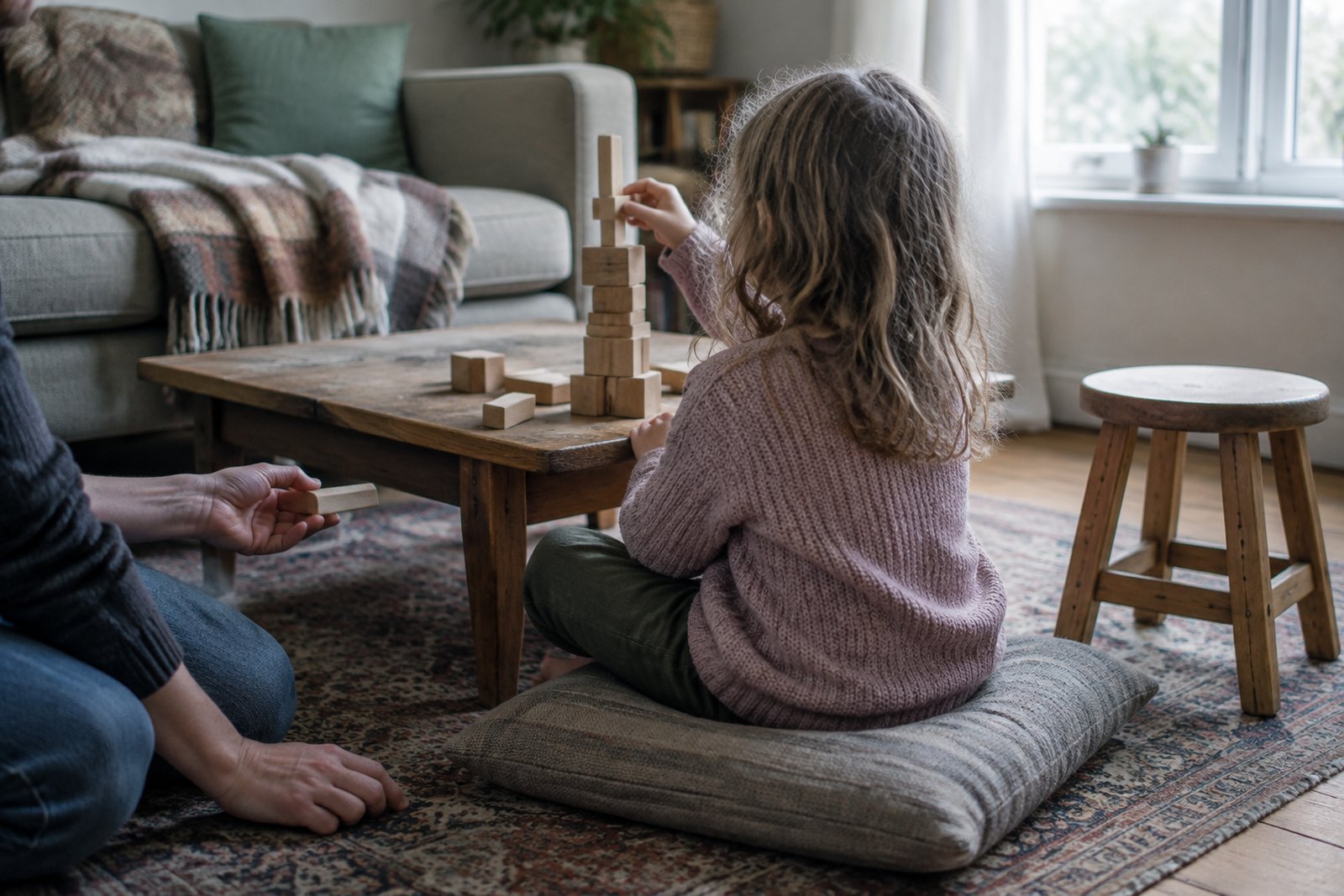
W-sitting is when a child sits on the floor with their bottom on the ground between their feet and their knees bent in front of them, so that from above their legs make a W shape. It is very common in toddlers and young children, and for most of them it is simply a comfortable, steady way to sit while they play. On its own, it is not usually a problem and it is not a reason to panic.
It is worth a closer look if your child sits this way almost all the time and cannot or will not sit any other way, if they have pain in their hips, knees or feet, if they seem very floppy or very bendy, if they trip a lot or their feet turn in noticeably, or if they are behind with things like walking, jumping or using their hands. In those cases the W-sitting is less a problem in itself and more a clue worth following up. This article explains why children do it, what you can try at home without turning it into a daily battle, and who to ask if you are worried.
What W-sitting looks like
Picture your child kneeling, then letting their bottom drop to the floor between their feet rather than onto their heels. Their thighs point forward, their lower legs splay out to the sides and their feet usually point outwards or backwards. Some children do it with both legs, some with one leg tucked back and the other in front.
Sitting back on the heels with the feet tucked underneath the bottom is different. That is ordinary kneel-sitting and is not what people mean by W-sitting.
Why children sit like this
Children are not being lazy or awkward when they W-sit. They are choosing the position that works best for their body at that moment. There are a few common reasons.
- It is very stable. The legs spread out to make a wide base, a bit like the legs of a tripod. The child does not have to work hard to stay upright, so all their attention can go into the toy in front of them.
- It frees up both hands. In some other positions a young child props themselves on one hand. In a W, both hands are free to build, draw or fiddle.
- The shape of young hips. Many young children have thigh bones that are naturally angled or twisted inwards a little at the hip. This makes turning the knees inwards easy and comfortable, and cross-legged sitting less so. For many children this lessens as they grow.
- Loose joints. Children who are naturally very flexible can drop into a W without any discomfort, and may find it the easiest way to sit still.
- Lower muscle tone or a weaker trunk. If the muscles around the tummy, back and hips tire quickly, the W takes the work away. The child gets a steady seat without having to hold themselves up.
- It is quick to get into and out of. From crawling or kneeling, a child can drop straight into a W and pop straight back up again. For a busy toddler that is very handy.
Is W-sitting actually harmful?
You will find plenty online claiming that W-sitting causes hip problems, damages knees, ruins posture or holds back development. Much of this is stated more confidently than the evidence behind it allows. In most cases, W-sitting is better thought of as a sign that something makes the position comfortable for that child, rather than the cause of a problem.
Babies in the UK have their hips checked as part of the newborn physical examination and again at the 6 to 8 week check, because some hip conditions are present from birth or develop very early. If you have ever been told your child has a hip problem, follow the advice of the team who looks after them rather than general advice online, including this article.
That said, there are sensible reasons to encourage variety. A child who only ever sits in a W gets less practice at things other positions demand: twisting the trunk, reaching across the body, shifting weight from side to side and holding themselves upright. Those are all skills that feed into running, climbing, sitting at a table and using a pencil. Some children with tight muscles may also find that always sitting one way keeps them tight. So the aim is not to ban the W. The aim is for it to be one position among several.
When it is worth getting it checked
Speak to your GP or health visitor (or the school nurse for older children) if any of these apply:
- Your child W-sits almost all the time and cannot sit any other way, or gets upset or uncomfortable when they try.
- They complain of pain in the hips, knees, ankles or feet, or rub their legs a lot, especially if it is regular rather than the odd evening.
- They seem very bendy, tire quickly, ask to be carried much more than other children their age, or seem clumsy. Our guide to hypermobility in children covers this in more detail.
- They feel floppy, slump a lot when sitting, or find it hard to hold their head and body up for long.
- They trip and fall much more than other children, or their feet turn in noticeably, especially if it is getting worse rather than better or affects one side more than the other.
- They are behind with movement milestones such as walking, running, jumping or climbing stairs, or with hand skills such as feeding themselves, building or drawing.
- One leg or one side of the body seems to move differently from the other, or feels stiff or tight.
When to get help quickly
Some things should never be put down to how a child sits. If your child suddenly starts limping, will not put weight on a leg, or has hip or knee pain, particularly if they also have a temperature or seem unwell, contact your GP the same day or call NHS 111. If they are very unwell, call 999 or go to A&E. Also see your GP promptly if your child seems to be losing skills they used to have.
Gentle alternatives, without nagging
If your child is generally well and you would simply like them to sit in a wider range of ways, the good news is that this rarely needs to be a fight. The bad news is that saying "fix your legs" forty times a day does not work. Children stop hearing it, you get cross, and they still sit in a W because it is still the comfiest option.
Things that tend to work better:
- Change the set-up, not the child. Put the toys on a low coffee table or the sofa seat so kneeling up is the natural position. Offer a small stool or child-size chair for floor play. A rolled towel or soft roll to straddle like a horse is often a hit.
- Make other positions comfortable. Cross-legged sitting is easier for many children with a firm cushion or folded blanket under the bottom, because it tips the hips forward slightly.
- Offer a choice. "Do you want to sit on the stool or lie on your tummy for this puzzle?" gets a better response than an instruction.
- Say it once, calmly, and help. A quiet "legs out" or a gentle tap on the knee, then helping them move, is enough. Agree a short phrase as a family so everyone says the same thing.
- Do not interrupt deep concentration. If they are absorbed in something, it is fine to let it be and suggest a change next time they move.
- Praise the play, not the legs. Making it into a big deal can make some children dig in.
- Expect progress, not perfection. Fewer W-sits across the day is a good result. Many children will always drop into one now and then.
Other floor positions to offer
- Cross-legged, with or without a cushion under the bottom.
- Side sitting, with both knees bent to one side. Encourage swapping sides so one side does not do all the work.
- Long sitting, legs straight out in front, perhaps leaning back against the sofa.
- Kneeling back on the heels, with feet tucked under the bottom.
- High kneeling, upright on the knees at a low table or the sofa. Good for short spells of building or drawing.
- Lying on the tummy, propped on the elbows. Brilliant for books, puzzles and drawing, and it works the shoulders and back too.
- Squatting, flat-footed if they can, for short bursts of play.
- Straddle sitting on a roll, a rolled towel, a ride-on toy or a small bench.
- A low stool or child-size chair with feet flat on the floor.
Play that builds the strength behind good sitting
If your child W-sits because their trunk tires quickly or their joints are loose, correcting their legs only goes so far. Building strength and control through play usually helps more, and it is a lot more fun for everyone. None of this needs special equipment.
- Animal walks. Bear walks on hands and feet, crab walks, frog jumps and bunny hops.
- Wheelbarrow walking, holding them at the thighs or knees rather than the ankles to begin with.
- Crawling through tunnels, under chairs or around a cushion obstacle course.
- Climbing at the playground, on frames and up steps and slopes.
- Tummy-time style play for older children: lying on the tummy to play, or lying over a big cushion or gym ball while you hold them steady.
- Balance games such as walking along a line on the floor, standing on one leg, or musical statues.
- Pushing and pulling, such as pushing a laundry basket of toys, tug of war with a towel, or helping carry the shopping.
- Rolling down a gentle grassy slope or across the bed.
A few minutes here and there throughout the day is more realistic than a set exercise session. If you would like ideas matched to your child's age, our guide to gross motor skills has more.
Sitting at the table: where W-sitting meets schoolwork
As children start nursery and school, the question shifts from floor play to sitting for tasks: carpet time, mealtimes, drawing and eventually writing. A child who relies on a very stable floor position may find it harder to sit still on a chair, slump over the table, wrap their legs around the chair legs or keep getting up.
A few simple checks help at home and are worth mentioning to nursery or school:
- Feet supported. Feet flat on the floor, or on a sturdy box or step if the chair is too high.
- Hips and knees roughly level, so they are not perched or sinking.
- Table at about elbow height when they sit upright, with the chair pushed in close.
- Short movement breaks. Some children sit better for ten minutes after a quick run around than they do for twenty minutes without one.
- Alternatives for carpet time, such as a cushion, a small stool or leaning against a wall, if the teacher is happy with that.
It is fair to say that a steadier trunk gives the hands a better base to work from. It is less fair to say that core exercises alone will fix handwriting. Hand skills need practice in their own right, and our guide to fine motor skills activities by age covers that side of things.
Who to talk to: GP, physio or occupational therapist
Your GP or health visitor is the right first stop if you are worried about pain, hips, walking, in-toeing or overall development. They can examine your child and refer on if needed.
A children's physiotherapist leads on hips, legs and walking. That includes in-toeing, muscle tone, tightness, joint looseness, balance, gross motor delay and strengthening programmes. If your main worry is your child's legs, the way they walk or whether W-sitting is linked to a hip or muscle issue, physio is the profession to ask. How you get an NHS children's physio referral varies by area, and some services accept referrals from parents, so ask your GP or health visitor what applies locally.
An occupational therapist looks at how your child manages everyday activities: sitting to play, eat and learn, getting dressed, using their hands, and coping at nursery or school. Where W-sitting is part of a bigger picture of clumsiness, tiring easily or struggling with hand skills, an OT can help. Sometimes this overlaps with coordination difficulties, which our guide to dyspraxia in children explains.
A private occupational therapist visiting at home can:
- watch your child play and move in their usual surroundings, rather than in a clinic;
- look at how they sit for tasks and suggest practical changes to chairs, tables and floor play;
- give you a play-based programme for trunk strength, balance and hand skills that fits into family life;
- look at related everyday tasks such as dressing, mealtimes and pencil skills;
- write a report for nursery or school with practical strategies, if that would help.
An occupational therapist will not diagnose hip conditions or replace a physiotherapist or doctor for leg, hip or walking concerns. Where both are involved, they work alongside each other. You can read more on our children's occupational therapy page.
Frequently asked questions
Does W-sitting cause hip dysplasia?
Hip dysplasia is a condition that is present from birth or develops very early, which is why babies' hips are checked at the newborn and 6 to 8 week checks. W-sitting is not generally considered to cause it. If your child has a diagnosed hip condition, ask their own medical team about sitting positions.
Should I stop my child W-sitting every time?
No. For most children it is fine as one of several positions. Constant correction tends to cause friction without changing much. Focus on offering other comfortable options, changing the set-up and building strength through play, and get advice if any of the warning signs above apply.
What age do children stop W-sitting?
There is no fixed age. Many children W-sit less as they grow, get stronger and their hips change shape, but some carry on into school age and beyond without any problems. What matters more than age is whether they can sit in other ways comfortably and whether there are other concerns.
Is W-sitting a sign of autism or ADHD?
Not on its own. Lots of children W-sit, and it is not a sign of any particular condition. If you have wider concerns about your child's development, communication, attention or behaviour, talk to your GP, health visitor or nursery so they can look at the whole picture.
My child's nursery says she always W-sits. Should I worry?
It is worth asking what else they notice. If she is happy, active, keeping up with other children and can sit in other ways when asked, it is usually not a concern. If they also mention tripping, tiring quickly, clumsiness or difficulty with hand skills, mention it to your GP or health visitor.
My older child still W-sits and it does not seem to bother them. Is that a problem?
Some older children and even adults W-sit comfortably, often because they are naturally flexible or their hips are shaped that way. If there is no pain, no tripping and they move well, it is usually fine. Pain, worsening in-toeing or stiffness are reasons to see your GP.
Next steps
If W-sitting is part of a wider picture of tiredness, clumsiness or struggling to sit for play and learning, a home visit can help you work out what will make the biggest difference. See our children's occupational therapy page, or current guide prices, and choose your area below.
Talk to an occupational therapist near you
This guide is general information. For advice about your own situation - or someone you look after - a local occupational therapist can visit you at home and see it for themselves.
Choose your area: