

Thumb Arthritis: Splints, Daily Changes and When to Get Help
By Mobile Occupational Therapist • 19 October 2026 • 13 min read
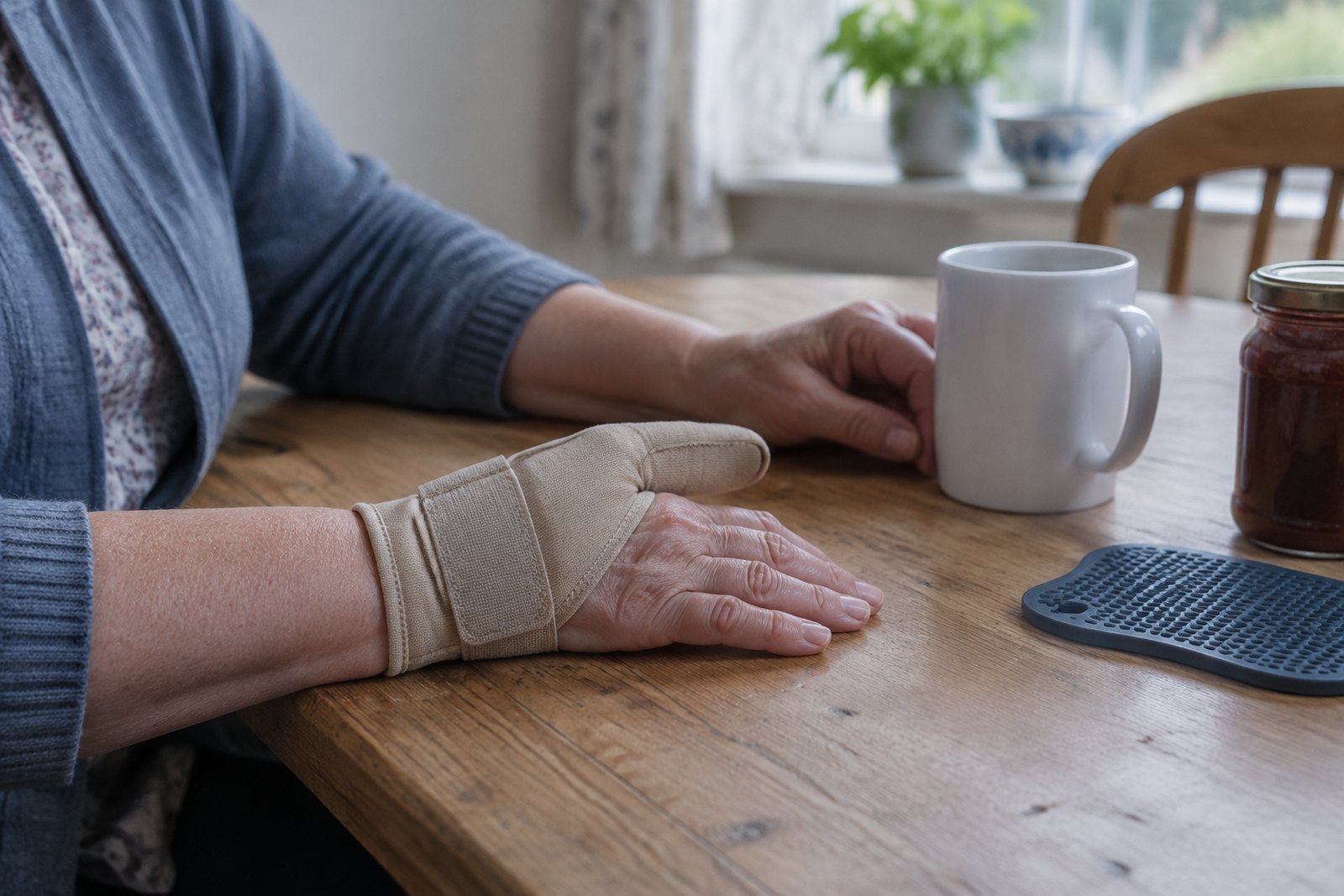
Thumb arthritis usually means osteoarthritis at the base of the thumb, in the joint where the thumb meets the wrist. It causes an aching pain in the fleshy part at the bottom of the thumb, a weaker pinch, and trouble with the small twisting and gripping jobs that fill a day: jars, keys, buttons, taps, plugs, the lid on the milk. It is common, especially from middle age onwards, and it is often more manageable than people expect.
What helps most is fairly simple. A well-fitted thumb splint can support the joint during the jobs that hurt, or rest it at night. Changing how you grip, and using a few hand-friendly tools, takes strain off the joint. Gentle exercises taught by a hand therapist can make the thumb more stable. If that is not enough, a GP can talk to you about other options. This guide covers each of those, and the signs that mean you should get checked sooner.
What base of thumb arthritis actually is
The joint at the base of your thumb is called the carpometacarpal joint, or CMC joint. It is shaped like a saddle, which lets your thumb swing across your palm and pinch against each finger. That freedom is brilliant for picking things up, but it also means the joint takes a lot of force every time you pinch hard. Over the years the cartilage can thin and the joint can become loose, sore and later stiff. Age, genes, old thumb or wrist injuries and years of heavy gripping can all play a part, and it often affects both hands, one usually worse than the other.
Common symptoms
- Aching or sharp pain at the base of the thumb, worse when you pinch, twist or grip
- A weak pinch, so you drop things or struggle to hold a mug by its handle
- Difficulty with jars, bottle tops, keys, buttons, zips, taps and pulling out plugs
- Stiffness, especially first thing or after a rest
- A bony lump or swelling at the base of the thumb
- A grinding or clicking feeling when it moves
- Later on, the thumb may sit closer to the palm, making it harder to open your hand around a large object
Symptoms often come and go. A busy spell of decorating, gardening or wrapping presents can bring a few bad weeks, followed by long stretches when you barely notice it.
When to see a GP
You do not need to wait until you cannot open a jar at all. See your GP if:
- the pain has lasted more than a few weeks and is not settling with the changes in this guide
- it is getting in the way of sleep, work, caring or everyday tasks
- you have numbness, pins and needles or weakness in your fingers, which can point to something else such as carpal tunnel syndrome
- several joints in your hands are swollen and stay stiff for a long time each morning, which can be a sign of an inflammatory arthritis such as rheumatoid arthritis
Get help the same day, through your GP or NHS 111, if a joint suddenly becomes hot, red and very swollen, especially if you feel feverish or unwell. If you have hurt your thumb or wrist in a fall and it is swollen, bruised, misshapen or you cannot use it, go to an urgent treatment centre or A&E, as it could be broken.
A GP will usually diagnose base of thumb arthritis by asking about your symptoms and examining your hand; an X-ray is sometimes arranged but not always needed. They can talk to you about pain relief and refer you to hand therapy or physiotherapy. Ask a pharmacist or GP about medicines rather than working it out alone, especially if you take other tablets.
Thumb arthritis splints
A splint is one of the most useful things for base of thumb arthritis, and one of the most often worn badly. The idea is to support the joint so it moves less and takes less strain while you do the jobs that hurt, or to rest it in a comfortable position overnight.
Types of thumb splint
- Short, hand-based thumb splint. Wraps around the palm and the base of the thumb, leaving the wrist and the tip of the thumb free. Usually the one for daytime, because you can still use your hand.
- Longer wrist and thumb splint. Extends onto the forearm. More supportive but bulkier, and sometimes used at night or when the wrist is sore too.
- Soft splints. Made from stretchy padded fabric. Warm, comfortable and gently supportive.
- Rigid, made-to-measure splints. Moulded from firm plastic, usually by a hand therapist, and shaped exactly to your hand for firmer support.
Daytime or night?
There is no single rule. Some people wear a splint only for the tasks that set it off: gardening, carrying shopping, cooking a big meal, a long drive. Others ache most at night or first thing, and a resting splint at night helps. A hand therapist will usually suggest a pattern for you rather than all day every day, because keeping a joint still for long periods can leave it stiffer and the muscles weaker.
Off the shelf or from a hand therapist
Hand therapists are occupational therapists or physiotherapists who specialise in hands and arms. In the NHS you usually reach them through a GP referral; some areas let you self-refer to musculoskeletal physiotherapy, which can pass you on. Ask at your surgery what is available locally.
You can also buy thumb splints from pharmacies, and some people do well with them. The catch is fit. Too loose does nothing; too tight or in the wrong place can make things worse. If you buy one, check that:
- it supports the base of the thumb, not just the knuckle near the tip
- you can still bend your fingers fully and touch your thumb to at least one fingertip
- it does not dig in at the edges or rub the web between thumb and finger
- any red marks fade soon after you take it off
- your thumb does not go numb, tingly, pale, blue or swollen
If any of those go wrong, take it off and get advice. Keep the skin underneath clean and dry, and check it often if you have thin skin, diabetes or reduced feeling in your hands.
Daily changes that take strain off the thumb
The biggest strain on the base of the thumb is a hard, narrow pinch: turning a key, pulling a tight lid, pinching a bag clip, gripping a thin pen for an hour. The principle is to make handles bigger, use your palm and larger joints rather than your fingertips, use two hands instead of one, and let a tool do the twisting. Our guide to joint protection for arthritic hands covers the full set of principles. Here are the thumb-specific changes that tend to make the most difference.
In the kitchen
- Jars and bottles. Break the seal by sliding a teaspoon under the edge of the lid, then use a fixed under-cupboard opener or a rubbery grip mat so your palm does the work, not your pinch. Our guide to jar openers and kettle tippers explains the types.
- Kettles and pans. Boil only what you need, or fill the kettle from a jug. Lift pans with two hands, one on the handle and one on a helper handle.
- Peeling and chopping. Thick, soft handles are kinder than thin ones, and you can build up a handle with foam tubing. Frozen chopped vegetables are a perfectly respectable choice on bad days.
- Packets. Use scissors instead of tearing. Tearing is pure pinch.
- Cloths. Do not wring them. Press the water out against the side of the sink with a flat hand.
Keys, buttons and taps
- A key turner gives you a bigger handle so you twist with your whole hand. See our guide to key turners and grip aids.
- Lever taps, or tap turners fitted over existing taps, are easier than small cross-head taps. Lever door handles beat round knobs.
- Plugs with a finger loop are easier to pull out. Where it is safe, switch off at the wall rather than unplugging.
- Larger buttons, a button hook, loops on zip pulls and slip-on shoes or elastic laces each save a daily pinch.
Writing, phones and carrying
- Use a thicker pen or a foam grip and hold it lightly. Gel pens need less pressure.
- Prop your phone or tablet on a stand rather than holding it in one hand and scrolling with your thumb. Try voice typing for longer messages.
- Carry bags over your forearm or shoulder, not hooked on your fingers. A shopping trolley or rucksack is better still.
- Hold mugs with both hands around the body of the mug rather than pinching the handle.
- Break long jobs up with short rests, and spread heavy ones across the week.
For equipment beyond the hands, from chairs to bathrooms, see our guide to arthritis aids around the home. Most small aids are inexpensive and you will not need all of them. Start with the one task that bothers you most.
Many people find morning stiffness eases with warmth, such as soaking hands in warm (not hot) water. Others prefer something cool on a sore joint after a busy day. Use whichever feels better, wrap anything hot or cold in a cloth, and take care if your hands have reduced feeling.
Exercises: helpful, but the right ones
Gentle movement stops the thumb getting stiffer, and strengthening the right muscles can help hold the joint in a steadier position so pinching hurts less. The detail matters. A hand therapist will often focus on the position your thumb works in, keeping the space between thumb and index finger open, and strengthening the muscles that support the joint, rather than lots of hard squeezing, which can aggravate it.
That is why it is worth having thumb exercises taught and checked by a hand therapist if you can. They watch how your thumb moves, show you how to keep the joint in a good position, and adjust things if your pain flares. Our guide to gentle hand exercises for arthritis describes general movements; if the thumb is your main problem, use it alongside advice from someone who has seen your hand. As a rough guide, mild discomfort that settles soon afterwards is usually fine, but pain that is worse the next day means ease back.
Injections and surgery
If splints, daily changes and exercise are not enough, a GP may discuss a steroid injection into the joint, which eases pain for some people for a time, or referral to a hand surgeon. Operations include removing a small wrist bone at the base of the thumb, joint fusion or joint replacement. Recovery takes months rather than weeks and usually involves a splint followed by hand therapy, often with an occupational therapist. These are decisions to talk through carefully with the specialist.
Where an occupational therapist fits
Occupational therapists look at how a condition affects the things you need and want to do, then change the task, the tools or the technique so you can keep doing them.
- Hand therapy. Many hand therapists are occupational therapists. They assess the thumb, make or fit splints, teach exercises and joint protection, and support recovery after surgery. In the NHS this usually follows a GP or consultant referral.
- Practical help at home. A private occupational therapist visiting at home can watch you in your own kitchen, at your own front door and with your own clothes, and suggest changes and equipment and aids that fit how you actually live. This is especially useful if arthritis affects several joints, or if you are caring for someone and your hands are struggling with the work.
- Work. If your thumb is making your job harder, an occupational therapist can look at your tasks and suggest adjustments.
Be clear about what you need. Not every occupational therapist makes rigid made-to-measure splints, as that is a specialist hand therapy skill, so ask before you book if that is what you want. Your GP is the right person for diagnosis, pain relief and referrals. In some NHS services a physiotherapist leads the exercise programme, and a hand surgeon is the person to discuss an operation with. Occupational therapy works alongside all of them.
Frequently asked questions
Will thumb arthritis go away?
The changes in the joint do not reverse, but the symptoms are not fixed either. Many people find the pain comes in flares and calm spells, and that with a splint, kinder ways of gripping and the right exercises they manage well for years. For some, the joint becomes stiffer but less painful over time.
Should I wear my thumb splint all the time?
Usually not, unless a hand therapist or surgeon has told you to, for example after an operation. Most people wear one for the tasks that hurt, at night, or both. Wearing it constantly can leave the thumb stiffer and weaker, so take it off regularly and move your hand gently.
Can I buy a thumb arthritis splint from a chemist?
Yes, and some people find a ready-made one helps. Choose one that supports the base of the thumb rather than just the tip, and stop using it if it causes numbness, tingling, rubbing or extra pain. If it is not helping after a fair try, a hand therapist can check whether a different style or a made-to-measure splint would suit you better.
How do I know it is arthritis and not something else?
Base of thumb arthritis tends to hurt deep in the fleshy part where the thumb meets the wrist, especially when you pinch. Pain along the thumb side of the wrist, worse when you move the wrist, can be a tendon problem called De Quervain's tenosynovitis. A thumb that catches or locks may be trigger thumb, and tingling in the fingers suggests a nerve problem. They are treated differently, so if you are unsure, see your GP.
Can I get splints and aids on the NHS?
Splints are often provided by NHS hand therapy services after a GP referral. Small daily living aids are usually bought privately, although your council's adult social care team may help if you have wider needs at home, and you can ask them for a needs assessment. What is available varies by area, so check locally.
Next steps
If your thumb is making everyday jobs harder, an occupational therapist can look at how you manage at home and what would genuinely help. See our equipment and aids page, or current guide prices, and choose your area below.
Talk to an occupational therapist near you
This guide is general information. For advice about your own situation - or someone you look after - a local occupational therapist can visit you at home and see it for themselves.
Choose your area: