

Key Turners and Grip Aids for Keys, Doors, Taps and Dials
By Mobile Occupational Therapist • 26 September 2026 • 12 min read
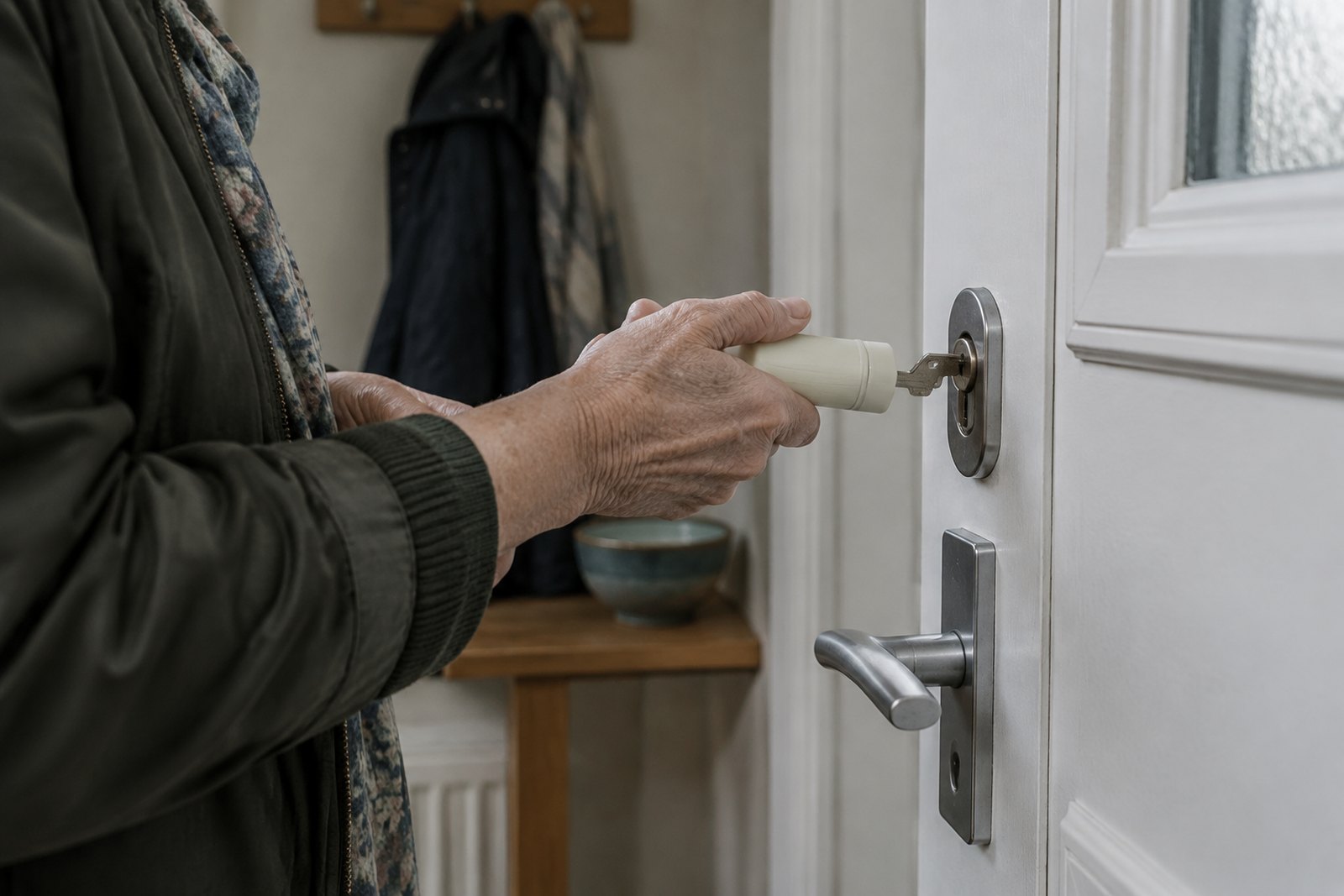
A key turner is a simple handle, usually plastic, that clamps onto an ordinary key. It gives you something big to hold and more leverage to turn it. If arthritis, a stroke, MS or a hand injury has made turning the key in your front door painful or impossible, a key turner is usually the cheapest and quickest fix, and it often works the same day you get it.
The same idea runs through a whole family of small aids: make the thing you grip bigger, longer or easier to lever. That covers lever handles and add-ons for doors, grips for round knobs, handles for pulling plugs, and turners for cooker dials and taps. Most cost little and need no tools, or only a screwdriver. This guide goes through each one, who it suits, how to fit it, and when it is worth asking an occupational therapist to look at the bigger picture.
Why keys, doors and dials get hard
Turning a key looks like nothing. It is actually a pinch (thumb pressed against the side of the index finger) combined with a twist of the wrist, often against a stiff lock. Round door knobs ask you to squeeze and twist at the same time. Old taps want the same. Plugs need a firm pinch and a pull. These are the movements that tend to go first when hands are affected by:
- Arthritis - osteoarthritis at the base of the thumb and in the finger joints, or rheumatoid arthritis, can make pinching and twisting weak and painful.
- Stroke - weakness on one side may leave you doing everything one-handed, often with your less skilled hand.
- MS and Parkinson's - weakness, stiffness, numbness, tremor or fatigue that makes fine control unreliable, sometimes varying through the day.
- Carpal tunnel syndrome, hand injuries and broken wrists - pain, numbness or a cast that leaves you short of grip for weeks or months.
One warning before the gadgets. If grip or hand control goes suddenly, over minutes or hours, especially with a drooping face, slurred speech or weakness in an arm or leg, call 999. That can be a stroke. If your hands have become steadily weaker, more painful, swollen or numb over weeks for no clear reason, see your GP. Aids help you manage. They do not tell you why something is happening.
Key turners
You push the head of your key into a slot at one end of the handle and tighten a screw, so the key becomes part of a much larger handle. Instead of pinching a small piece of metal, you hold the handle in your whole hand or push it round with your palm. The longer handle also works as a lever, so less twisting force is needed.
Types
- Single key turners - one key per handle. Light and simple, and you can have one for each lock.
- Multi-key turners - two or three keys fold out from one handle, a bit like a penknife. Handy for front, back and shed keys, though bulkier, and the folding action needs some finger control.
- Wide or wing-shaped turners - a broad, flat handle you can turn with an open hand or the heel of your hand, useful if your fingers will not close fully.
Fitting and using one
- Check your key will fit. Most take standard house keys. Very large key heads, some padlock keys and most modern car keys will not.
- Push the key in so its head sits fully inside the handle, then tighten the screw firmly. If the key wobbles, it twists inside the handle and you lose the leverage.
- Try it in the lock with the door open and closed before you rely on it. Make sure the handle does not hit the frame or a letterbox as it turns.
- If you have several, mark them with coloured tape so you can tell front door from back door at a glance.
Think about where it lives. A key turner does not sit in a pocket as neatly as a bare key, so a hook or bowl by the door, or a wrist strap when you go out, saves fumbling. At night, keep the inside key and its turner somewhere you can reach it straight away, so you can get out quickly in a fire.
And if the lock itself is stiff, no aid will fully fix it. A locksmith can often ease or replace a worn lock, and a door that has dropped so the bolt binds may just need its hinges adjusting.
Door handles: levers, add-ons and knob grips
Swapping round knobs for lever handles
For most doors, the biggest single improvement is replacing round knobs with lever handles. A lever can be pushed down with a flat hand, a wrist, an elbow or a forearm. No grip is needed at all, which matters if you are carrying something, using a walking aid or only have one working hand.
Whether it is a simple swap depends on the latch inside the door. Some take a lever handle as they are; others need the latch changing too. A competent DIYer, carpenter or handyperson can usually do it, and many councils and local charities run handyperson schemes for older and disabled people. If the door is a fire door, such as a flat front door, any new handle or latch must be suitable for fire doors, so check with your landlord or building manager first. If you rent, ask your landlord first. It is a reasonable request.
Lever add-ons
A lever add-on clamps or slides over an existing round knob and gives it a lever arm. These suit rented homes and short-term needs, such as the weeks after hand surgery. They work best on knobs that are not too stiff, and they must be clamped firmly. One that slips round on the knob is worse than none.
Round knob grips
A knob grip is a soft, ridged rubbery cover that stretches over a round door knob. It adds no leverage, but it makes the knob bigger and less slippery, so you need less squeezing force. A cheap first try if your grip is reduced rather than gone.
One thing not to touch: closers on fire doors in flats and shared buildings are there for fire safety. If a heavy door defeats you, speak to the landlord or building manager rather than removing or loosening the closer yourself.
Plug pull handles and switches
Pulling a plug from a tight socket takes a surprisingly strong pinch. People with weak hands often end up yanking the cable, which damages it. A plug pull handle solves this: either a plug with a built-in ring or loop, or an attachment that fits onto a standard plug so you can hook a finger or your whole hand through it.
- Sockets with large rocker switches let you switch off at the wall without unplugging at all.
- Remote-control sockets let you turn a lamp or appliance on and off with a hand-held button.
- Raised sockets stop you bending and pulling at the same time. Any change to fixed wiring needs a qualified electrician.
Dial and switch turners
Cooker knobs, oven dials, radiator valves and heater controls all need a pinch and a twist. A dial turner gives you a bigger handle:
- Multi-pin turners have a bed of sliding pins that mould around the shape of whatever knob you press them onto, then grip it as you turn. They work on many shapes.
- Bar or T-shaped turners have a wide handle with a slot that fits over a ridge-shaped knob.
- Radiator valve grips fit over the head of a thermostatic valve to make it easier to turn.
Cooker controls deserve a moment's thought. If you are struggling to turn the hob fully off, or cannot tell whether it is off, that is a safety problem as well as a grip one. A turner may help, but so might a cooker with larger controls, an induction hob with touch controls, or doing more cooking in a microwave or slow cooker. Never alter gas controls yourself.
Tap turners
Old crosshead and round taps are a common daily struggle. A tap turner is a lever that fits over the top of the tap so you can push it round with your palm or wrist. Some stay on the tap; others are a hand-held tool you carry from tap to tap. We cover them alongside long-handled sponges and other bathroom tools in our guide to washing aids and tap turners.
Longer term, lever taps are usually the better answer and a small plumbing job. A single-lever mixer lets you control flow and temperature with one hand. A tap that takes real force to turn off may just need a new washer or cartridge.
One free tip: ask everyone in the house to turn taps off gently, only until the water stops. Most stiff taps in a shared home are stiff because the strongest person shut them last.
Keyless options
Sometimes the best key aid is no key at all.
- Key safes are small coded boxes fitted outside, holding a spare key for carers, family or emergency services. They do not open your door for you, but they mean you are not rushing to let someone in. Our guide to key safes covers where to fit one.
- Keypad locks open with a code, which suits some people with weak grip but not those with memory problems or poor finger control.
- Smart locks open from a phone, fob or voice command and can be freeing for someone with very limited hand function, but check they suit your door, what happens if the battery or signal fails, and what your insurer and landlord say.
Small changes worth trying first
- Use bigger joints. Push levers with your forearm or palm and turn handles with an open hand. This is the same joint protection thinking explained in our guide to arthritis and your hands.
- Warm your hands. Stiffness is often worst first thing and in cold weather. Warm water before tackling the door can help.
- Fix the cause. Ease stiff locks, adjust dropped doors, replace worn tap washers.
Paying for grip aids
Most of these aids are inexpensive. If you have a disability or long-term condition and the item is designed for disabled people, you may be able to buy it without VAT - see our guide to VAT relief on disability equipment and check the current rules on GOV.UK. If your council's occupational therapy service assesses you as needing small aids, it may supply them, though what is offered varies by area.
Where an occupational therapist fits
You do not need an assessment to buy a key turner. If one task is hard and an aid fixes it, that is a good outcome. But if keys are the first of several things getting difficult - buttons, jars, cups, getting in and out of the bath - it is worth someone looking at the whole picture rather than collecting gadgets one at a time.
An occupational therapist can watch how you actually manage the tasks that matter to you, look at grip, pinch, wrist movement, sensation and stamina, and work out which aids will help, which changes to the home are worth making, and which ways of doing things protect painful joints. They also spot safety issues, such as not being able to get out quickly because the front door lock defeats you, or not reliably turning off the cooker. A private occupational therapist visiting at home sees your actual doors, taps and sockets, which is where these problems live, and can write recommendations for a landlord or for larger adaptations, although if you are applying for council funding, such as a Disabled Facilities Grant, the council will usually want its own assessment too.
Others lead in some areas:
- Your GP for new or worsening pain, swelling, numbness or weakness, and referral to specialists such as rheumatology.
- A hand therapist or physiotherapist for exercises, splints and rehabilitation after surgery or injury.
- A locksmith, plumber or electrician for the hardware changes themselves.
For an NHS or council assessment, contact your council's adult social care team, or ask your GP or hospital team about a referral. Waits vary by area.
Frequently asked questions
Will a key turner fit every key?
Most fit standard house keys. Keys with very large or unusually shaped heads, some padlock keys and most modern car keys will not. If in doubt, take the key with you or check the stated key size before buying.
Can I get grip aids free?
Sometimes. If your council assesses you and decides you need small aids, it may provide them. Many people simply buy their own because they are cheap and quick to get, and you may not have to pay VAT on items designed for disabled people.
Should I change door knobs or use a lever add-on?
Changing to proper lever handles is the better long-term fix because there is nothing to slip or come loose. Add-ons are useful when you rent, when the need is temporary, or while you wait for the job to be done.
Will using aids make my hands weaker?
Using an aid for a task that hurts is not giving in. It saves effort and pain for the things you want to do. If you have been given hand exercises by a therapist, keep doing them alongside the aids, and ask them if you are unsure about the balance.
What if the person also has memory problems?
Keypads and smart locks can confuse someone with dementia, and a new gadget may be forgotten or put down somewhere. A key turner on a familiar key, kept in the same place every day, often works better. An occupational therapist can help weigh this up.
Next steps
If keys, doors and taps are only part of what is getting harder, an assessment can sort out what will genuinely help. See our equipment and aids page, or current guide prices, and choose your area below.

Talk to an occupational therapist near you
This guide is general information. For advice about your own situation - or someone you look after - a local occupational therapist can visit you at home and see it for themselves.
Choose your area: