

Hand Exercises for Arthritis: Gentle Movements That Help
By Mobile Occupational Therapist • 25 October 2026 • 13 min read
Yes, gentle hand exercises can help arthritis. Done little and often, they ease stiffness, keep your fingers and thumb moving through as much of their range as possible, and help you hold on to the grip you need to open a jar, turn a key or do up a coat. They will not cure osteoarthritis or rheumatoid arthritis, and they do not replace treatment from your GP or rheumatology team. But for most people they are one of the most useful things you can do at home, for free, in about ten minutes.
The short version: warm your hands first, move slowly, aim for a mild stretch rather than pain, do the movement exercises most days and any strengthening a few times a week, and back right off during a flare. The rest of this page shows you how, and tells you when to stop and get someone to look at your hands properly.
Before you start: three things worth knowing
Osteoarthritis and rheumatoid arthritis are not the same. Osteoarthritis tends to affect the base of the thumb and the joints nearest the fingertips, often with bony lumps at the finger joints and an ache after use. Rheumatoid arthritis is an autoimmune condition, where the immune system attacks the lining of the joints. It more often affects the knuckles and wrists, usually on both sides, with warm, swollen joints and stiffness that is worst in the morning. The gentle movement exercises below suit both. Strengthening needs more care with rheumatoid arthritis, and that is covered further down.
If you have not been diagnosed, get your hands checked first. Stiff, sore fingers have several possible causes, and some, particularly inflammatory arthritis, do better the sooner treatment starts. Exercise is not a reason to put off seeing your GP.
Exercise is only half of it. How you use your hands through the day matters just as much. Our guide to arthritis and your hands: joint protection every day covers that side. This page sticks to exercise.
Warm up first: the warm water trick
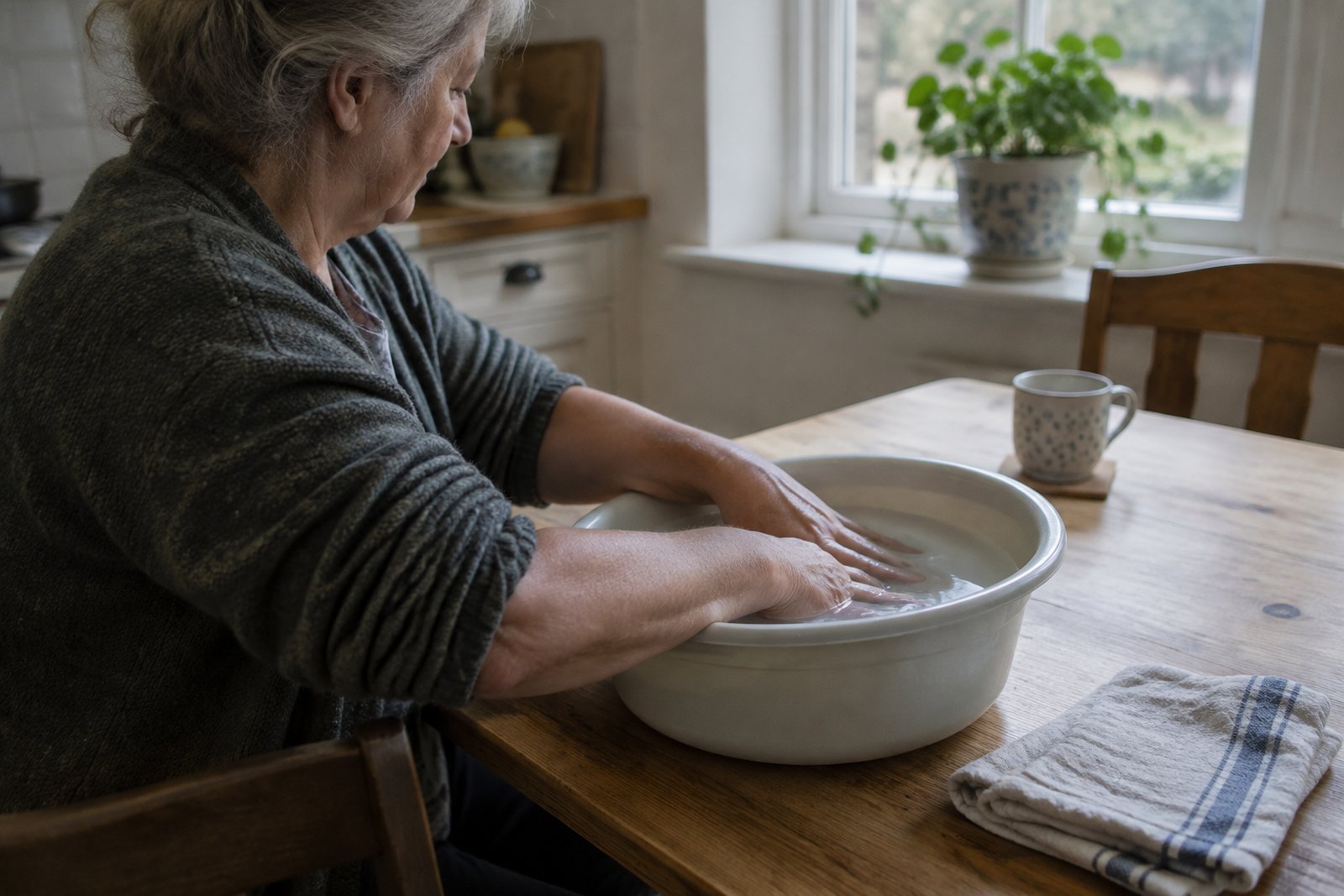
Stiff joints move more easily when they are warm. The simplest warm-up is a washing-up bowl of comfortably warm water at the kitchen table.
- Fill the bowl with warm, not hot, water. Test it with your elbow or the inside of your wrist first, not your fingertips, especially if your fingers feel numb or less sensitive than they used to.
- Rest your hands and wrists in the water for a few minutes.
- While they are in there, slowly open and close your hands, wiggle your fingers and circle your wrists. The water supports your hands and many people find movement easier this way.
- Dry your hands well and start your exercises while they are still warm.
No bowl handy? Doing your exercises straight after a bath or shower, or after washing up, works the same way. Some people prefer the morning, when stiffness is worst. Others find the evening easier. Either is fine.
One exception: if a joint is already hot, red and swollen, do not add heat. Skip to the section on flares.
Gentle movement exercises for stiff fingers
These are range-of-movement exercises. The aim is to take each joint gently as far as it comfortably goes, hold for a moment, and come back. Sit at a table with your forearm resting on it. Move slowly. No bouncing, no forcing, no helping one hand bend the other harder than it wants to go.
Wrist bends
Rest your forearm on the table with your hand over the edge, palm down. Slowly let your hand drop down, then lift it up as far as is comfortable. Then turn your forearm so your thumb is on top and move your hand gently up and down again, as if waving.
Wrist turns
Keep your elbow tucked into your side and bent at a right angle. Slowly turn your palm to face the ceiling, then turn it to face the floor. This is the movement you use for turning a door handle or a key, and it often stiffens without people noticing.
Making a fist and opening it
Start with your fingers straight. Slowly curl them into a loose fist with your thumb resting across the outside of your fingers, not tucked inside. Do not squeeze. Then open your hand and spread your fingers as wide as is comfortable. If you cannot make a full fist, that is fine. Go as far as you can.
Tendon glides
Tendon glides are a sequence of five hand positions that help the tendons slide smoothly and move each finger joint in turn. Hand therapists use them a lot. Go slowly from one to the next and hold each for a few seconds.
- Straight hand: fingers straight up, together, like a stop sign.
- Hook: bend only the top two joints of your fingers so they curl like a claw, knuckles still straight.
- Full fist: curl your fingers right down into your palm, gently, thumb on the outside.
- Tabletop: bend only at the big knuckles, keeping your fingers straight, so your hand makes an L shape.
- Straight fist: bend at the big knuckles and middle joints, keeping the fingertip joints straight, so your fingertips touch the base of your palm.
Then back to a straight hand. If one position is hard, do what you can. It usually gets easier with practice.
Thumb touches
Touch the tip of your thumb to the tip of your index finger to make a round O shape, not a flat pinch. Open your hand, then touch thumb to middle finger, then ring finger, then little finger. Next, slowly slide your thumb across your palm towards the base of your little finger, and back out. Finally, with your hand flat on the table, move your thumb out to the side, away from your fingers, and back.
Finger spreads and lifts
Lay your hand flat on the table, palm down. Slowly spread your fingers apart and bring them back together. Then, keeping your palm flat, lift one finger at a time a little way off the table and lower it.
Gentle strengthening, once movement is comfortable
When the movement exercises feel comfortable, some people benefit from light strengthening to support the joints and help with grip. Keep it gentle.
- Soft squeeze: gently squeeze a soft sponge or a piece of soft exercise putty, hold for a few seconds and let go. Soft means soft. A hard ball is not the right tool here.
- Pinch: pinch a small piece of soft putty or sponge between your thumb and each fingertip in turn, using that round O shape.
- Opening against resistance: put a wide, light elastic band around your fingers and thumb and slowly open your hand against it. Choose one that does not dig in.
If you have rheumatoid arthritis, check with your rheumatology team, physiotherapist or hand therapist before adding strengthening, particularly if any joints are swollen or your fingers have started to drift or change shape. Strong, repeated gripping can put extra strain on inflamed joints. Many people with rheumatoid arthritis are also advised to avoid movements that push the fingers sideways towards the little finger, so if you are not sure, ask.
How much and how often
A typical starting point for the movement exercises is five to ten slow repetitions of each, once or twice a day, on most days. Strengthening is usually done less often, perhaps a few times a week, with rest days in between. If a physiotherapist or hand therapist has given you different numbers, follow theirs, because they have seen your hands.
Start at the low end. It is much better to do a little every day than a lot once a week and then nurse sore hands for three days. Many people find it easiest to tie exercises to something they already do: the warm-water bowl before breakfast, the thumb touches during the adverts, the tendon glides while the kettle boils.
Be patient. You may notice your hands feel easier after a session straight away, but changes in stiffness and grip build up over weeks, not days.
The pain rules
Some discomfort is normal when you move stiff joints. The question is what kind, and how long it lasts. A rough guide:
- Fine: a mild stretch or ache during the exercise that settles within an hour or two afterwards.
- Too much: pain that is sharp, makes you wince, or is still worse than usual the next morning. Next time, do fewer repetitions or move through a smaller range.
- Stop and get advice: new swelling, a joint that becomes hot or red, pain that keeps building over several sessions, or a finger that locks or clicks painfully.
Pain is information, not a test of willpower. Pushing through it does not speed things up.
What not to do in a flare
A flare is when your arthritis suddenly gets worse for a while: more pain, more stiffness, and with rheumatoid arthritis often warm, puffy, tender joints. During a flare:
- Stop the strengthening. No putty, no bands, no squeezing.
- Keep moving gently. A few very gentle movement exercises, well within comfort, help stop joints stiffening up further. Smaller movements, fewer repetitions.
- Do not put heat on a hot joint. Many people find a cool pack wrapped in a tea towel more soothing on a hot, swollen joint. Never put ice straight on the skin.
- Rest your hands from heavy tasks. Let someone else open the jars this week.
- Contact your team if it does not settle. If you have rheumatoid arthritis and a flare is not settling, use your rheumatology advice line if you have one, or speak to your GP.
When to see your GP, NHS 111 or a hand therapist
See your GP if:
- you have stiff, painful or swollen finger joints and no diagnosis yet
- your hands are stiff for a long time in the morning, often given as more than about 30 minutes (check the NHS page on rheumatoid arthritis for the full list of symptoms)
- you have numbness or tingling in your fingers, which can point to a nerve problem such as carpal tunnel syndrome
- a finger catches, clicks or locks when you bend it, which may be trigger finger (see our guide to trigger finger)
- things are steadily getting worse despite exercise and sensible changes
Call NHS 111 or get an urgent same-day appointment if a single joint suddenly becomes very hot, red, swollen and painful, especially if you feel unwell or feverish, as this can be a sign of infection.
Call 999 if hand weakness or numbness comes on suddenly together with a drooping face, slurred speech or weakness in an arm or leg. That could be a stroke.
A hand therapist is an occupational therapist or physiotherapist with specialist training in hands. On the NHS you are usually referred by your GP, rheumatology team or surgeon. Hand therapists can tailor an exercise programme, check your technique, and assess for splints. Splints, such as a thumb splint for base-of-thumb arthritis or a resting splint for rheumatoid arthritis, help some people, but they need to be the right type and fit, so get one recommended or made by a hand therapist rather than guessing. You can read more in our guide to hand therapy at home.
Where an occupational therapist fits
Exercises keep your hands moving. An occupational therapist looks at what your hands actually need to do in your life, and how to make that easier. That might mean watching you make a cup of tea, do up buttons, turn on taps or open the post, then suggesting a different way of doing it, a simple piece of equipment, or a small change to your kitchen or bathroom. A private occupational therapist visiting at home sees the real taps, the real kettle and the real jar of marmalade, which is often where the useful answers are.
Some occupational therapists are specialist hand therapists and can give you a detailed exercise programme and splinting. Others focus more on daily living, equipment and adaptations. If you want hand therapy specifically, ask about this before booking.
To be clear about who leads on what: diagnosis, blood tests, medication and joint injections are for your GP or rheumatology team. A physiotherapist is often the right person for exercise across the whole body. Surgery for badly damaged joints is decided by a hand surgeon. An occupational therapist works alongside all of them. Our arthritis page explains more about how occupational therapy can help.
Frequently asked questions
Can exercise make arthritis in my hands worse?
Gentle exercise done within the pain rules above is very unlikely to harm your joints, and moving them generally helps more than keeping them still. What can cause problems is forcing stiff joints, heavy strengthening during a flare, or pushing through sharp pain. If you are unsure, ask your GP, physiotherapist or hand therapist to check your routine.
Should I squeeze a stress ball?
Firm balls are often too hard for arthritic hands and encourage a strong, sustained grip that can aggravate sore joints, especially with rheumatoid arthritis. A soft sponge or soft putty is gentler, and many people get more benefit from the movement exercises than from squeezing anything at all.
Are the exercises different for rheumatoid arthritis and osteoarthritis?
The gentle movement exercises are much the same. The difference is mainly in strengthening and flares. With rheumatoid arthritis, inflamed joints need more protection, so take advice before strengthening and ease right back when joints are swollen.
How long before I notice a difference?
Many people feel looser straight after a session, particularly after warm water. Lasting changes in stiffness and grip tend to build over several weeks of regular practice. If nothing is improving after a couple of months, or things are getting worse, see your GP.
My fingers have bony lumps or have changed shape. Can I still exercise?
Usually, yes. Work within the range your fingers have now rather than trying to straighten them. If your fingers have changed shape because of rheumatoid arthritis, get advice from your rheumatology team or a hand therapist first, as some movements may need to be avoided.
Is heat or cold better for stiff fingers?
Warmth usually helps stiffness, which is why the warm-water warm-up works well. Cold is often more comfortable on a joint that is hot and swollen. Always protect your skin, test the temperature first, and never use heat on a joint that is already hot.
Next steps
If everyday tasks are getting harder despite exercise, see our equipment and daily living aids page, or current guide prices, and choose your area below to find an occupational therapist who visits at home.
Talk to an occupational therapist near you
This guide is general information. For advice about your own situation - or someone you look after - a local occupational therapist can visit you at home and see it for themselves.
Choose your area: