

Through-Floor Lifts and Home Lifts: When They Are the Right Answer
By Mobile Occupational Therapist • 17 September 2026 • 7 min read
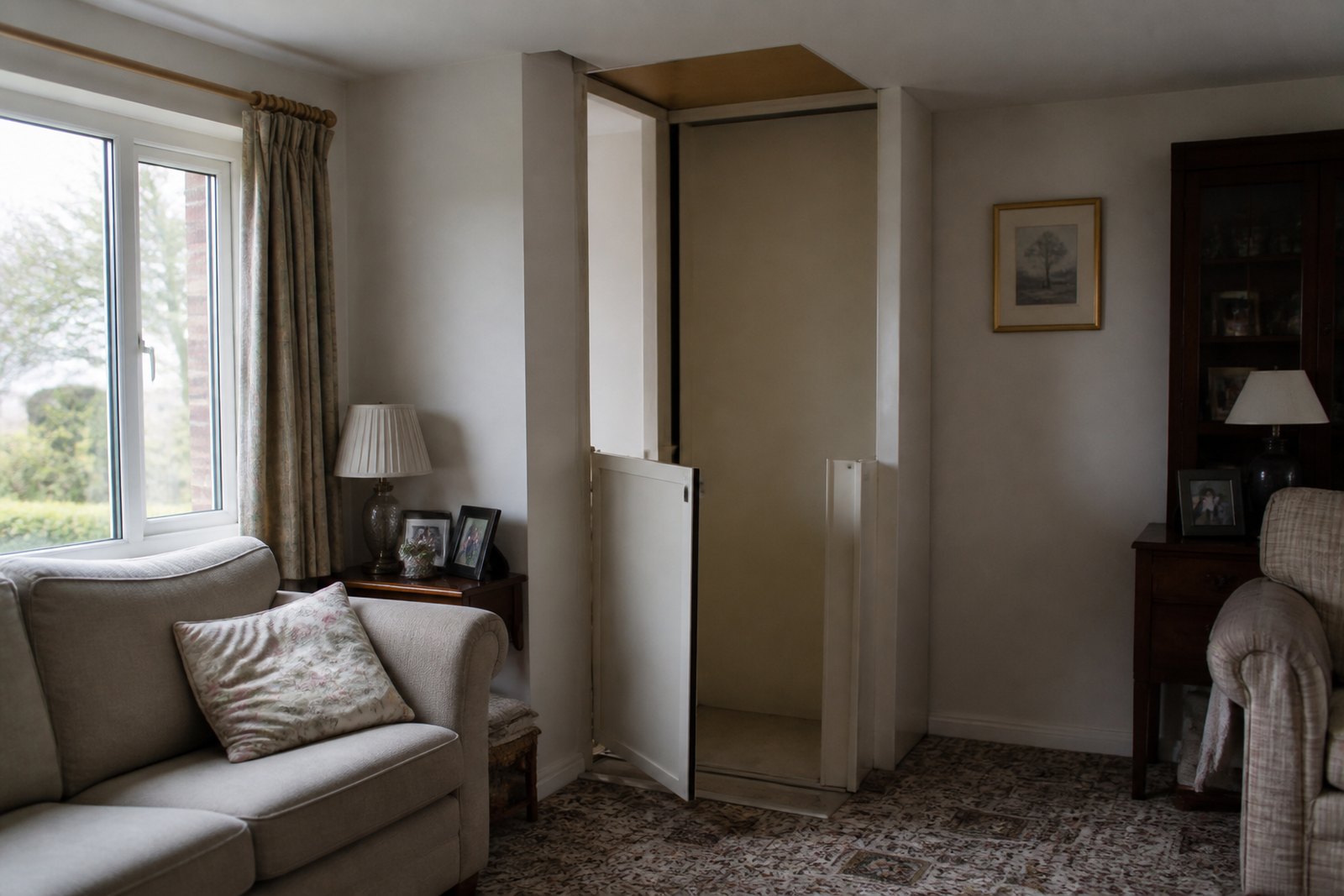
A through-floor lift is a serious piece of home engineering, and the honest headline is that most people who ask about one do not need one. For the minority who do, it is transformative - it keeps a wheelchair user living in their own home on both floors, and nothing else does that job. This guide explains what a through-floor lift actually is, when it is the right answer rather than a stairlift, what the installation genuinely involves in both rooms, and the alternatives that are frequently cheaper, quicker and better. We would rather you spent nothing than spent a great deal on the wrong thing.
What a through-floor lift is
A through-floor lift is a small domestic lift that travels between two floors through an opening cut in the ceiling. Most commonly it runs from a living room or dining room up into a bedroom directly above. Some models are enclosed in a shaft; others are open platforms with a guide rail, closing the ceiling aperture with a powered hatch as the car passes through. Sizes vary: some carry a seated person only, some carry a person in a wheelchair, and larger models carry a wheelchair user plus a carer standing alongside.
They are sometimes called home lifts or domestic lifts. Whatever the name, the defining feature is that they need a hole in your first floor and they occupy a footprint in both rooms permanently - the space downstairs and the space upstairs are both given up.
When a lift is the right answer rather than a stairlift
A stairlift is far less disruptive and far less expensive, and for most people with stairs difficulty it is the correct solution - we cover the decision in do you need an OT assessment before buying a stairlift. A through-floor lift starts to make sense when one of these applies:
- The person cannot transfer onto a stairlift seat. A stairlift only works if you can safely get on at the bottom, stay on, and get off at the top - and then have a second wheelchair waiting upstairs. If any part of that chain fails, the stairlift is not an option.
- The person needs to travel seated in their own wheelchair. A platform lift carries the chair and its occupant together, which removes two transfers a day from everyone's life, carers included.
- The condition is progressive. If a stairlift will be outgrown within a couple of years - as can happen with multiple sclerosis or advancing Parkinson's - installing the right thing once is often kinder than installing the wrong thing twice.
- The staircase will not take a stairlift. Some very narrow, tightly curved or open-sided staircases genuinely cannot be fitted safely.
What the installation actually involves
This is the part people are most often unprepared for, so we will be blunt about it.
- Structural work. Cutting an opening through a first floor means cutting joists and building a trimmed opening. That is structural, needs to be designed and signed off, and it is not a morning's work.
- Space in both rooms. Downstairs you lose a corner of the living room permanently. Upstairs you lose the same corner of the bedroom, plus clear space in front of the lift so someone can get out of it - a wheelchair needs room to turn. Furniture will have to move and some of it will not come back.
- A dedicated electrical supply. Most lifts need their own circuit from the consumer unit, with an isolator. That means an electrician, and some making-good afterwards.
- Making good. Flooring, skirting, plaster and decoration around the opening on both floors. Reputable installers say so upfront; ask specifically what is and is not included.
- Building regulations. The structural opening and the electrical work are notifiable. Do not let anyone tell you otherwise.
The alternatives that are often better
Before committing, it is worth genuinely testing three alternatives, because for many households one of them is the better life as well as the cheaper one.
A stairlift. Cheaper, faster, reversible, and adequate for the majority. Even a curved stairlift is usually a fraction of the disruption.
Living on one floor. Moving the bed downstairs and creating a downstairs toilet and level-access shower solves the stairs problem by removing the stairs from the daily routine altogether. It is often less money than a lift, it takes away a machine that can break down, and it is frequently what people end up doing anyway a few years later. If the bathroom is the sticking point, our guide to wet rooms and level-access showers covers what is involved.
Moving house. Nobody wants to hear it, and for some people it is genuinely unthinkable. But a bungalow or a ground-floor flat with level access can deliver more independence than any amount of engineering in a three-storey terrace. Local authorities can advise where the current home cannot reasonably be adapted, and we cover this in housing and rehousing.
Power cuts, servicing and the practical realities
Domestic lifts are fitted with a battery back-up so the car can complete its journey or be lowered in a power cut, and all have a manual lowering method for use by someone who has been shown how. Ask the installer to demonstrate it and make sure everyone in the household - including regular carers - knows where the instructions live. A lift that only one person knows how to lower is a trap.
Servicing is not optional. Lifts require regular scheduled maintenance by a competent engineer, and most owners hold a service contract that also covers breakdown call-outs. Budget for this as an ongoing cost, and ask about response times before you sign, because the answer to "how long could we be without it?" matters a great deal when the lift is the only way upstairs. It is also worth asking what happens to the contract if the installer ceases trading.
Paying for it
Where a lift is assessed as necessary and appropriate, a Disabled Facilities Grant may contribute towards the cost. The route runs through your council, and it starts with an occupational therapy assessment that establishes the need - our guide to the Disabled Facilities Grant and how OT assessments support your application explains the process, the means test and the common reasons applications stall. Grants are also more likely to fund the least disruptive solution that meets the need, which is another reason to have looked honestly at the alternatives first.
Frequently asked questions
How much space does a through-floor lift need?
Less than people fear in footprint terms - the smallest models take up little more than an armchair's worth of floor - but more than people expect once you add the clear approach and exit space at both ends. A wheelchair user needs turning room in front of the lift on both floors, and that is usually what decides whether a particular room works.
Is a home lift better than a stairlift for a disabled person?
Only when the person cannot use a stairlift safely, or needs to travel in their wheelchair. A stairlift is cheaper, quicker, less disruptive and easier to remove later. The right question is not which is better in general, but which meets this person's needs in this house - which is exactly what an OT assessment is for.
Can a through-floor lift be removed later?
Yes, though the floor opening has to be structurally reinstated and both rooms made good, so it is not a simple uninstall. Some households leave the aperture closed rather than reinstating it. Worth factoring in if the property will be sold.
Next steps
If you are weighing up a lift, a stairlift or moving life downstairs, get the assessment before you get the quotes. An occupational therapist will look at transfers, progression, the house itself and what the household can live with, and will often identify a simpler answer that installers have no reason to suggest. We can visit at home, set out the realistic options, and write the report a grant application needs - see home adaptations. To get started, look at the areas we cover and our prices.
Talk to an occupational therapist near you
This guide is general information. For advice about your own situation - or someone you look after - a local occupational therapist can visit you at home and see it for themselves.
Choose your area: